Grand Canal Dock: Dublin's Reinvented Waterfront
Once the largest dock in the world and later left derelict for decades, Grand Canal Dock is now one of Dublin's most architecturally impressive public spaces. The basin, quays, and surrounding plazas are free to explore and offer a quieter, more contemporary side of the city.
Quick Facts
- Location
- Grand Canal Dock, Dublin 2 — approx. 1.8 km southeast of city centre
- Getting There
- Grand Canal Dock DART and commuter rail station, a short walk from the basin
- Time Needed
- 45 minutes to 2 hours depending on how much you explore
- Cost
- Free to access; individual venues charge separately
- Best for
- Architecture, waterfront walks, photography, and combining with Docklands sightseeing
- Official website
- mygrandcanaldock.ie
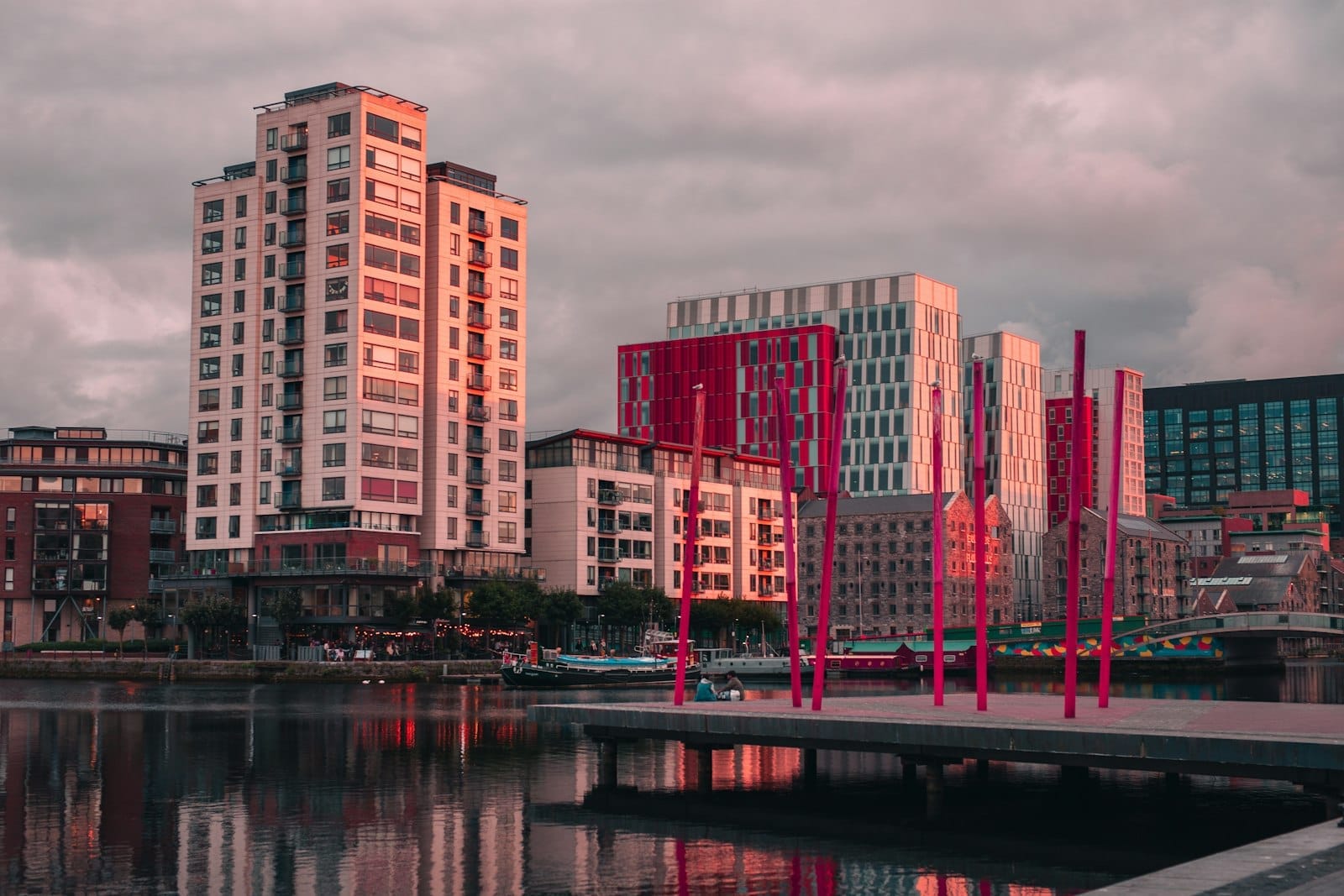
What Grand Canal Dock Actually Is
Grand Canal Dock (Irish: Duga na Canálach Móire) is a large enclosed harbour in Dublin's Docklands district, flanked by paved quays, modern apartment towers, and public plazas. It sits where the Grand Canal meets the River Liffey, roughly 1.8 km southeast of O'Connell Street. The dock itself is open water, permanently accessible from the surrounding quays, and there is no gate, ticket desk, or formal entrance. You simply arrive and walk around it.
What makes it worth a deliberate visit rather than a casual shortcut is the combination of scale and contrast: a 230-year-old industrial waterway completely surrounded by contemporary architecture, with the red steel-and-glass panels of the Bord Gáis Energy Theatre on one side and the reflective black water of the dock on the other. The spatial quality of Grand Canal Square, designed by landscape architect Martha Schwartz, is genuinely unusual for Dublin: a formal hard plaza of bright red resin-glass pavers sloping toward the water, broken up by angled light stanchions that glow red after dark.
💡 Local tip
The plaza reads very differently at night. If you visit only by day, you miss the full effect of the red light poles, which transform the square into something resembling a film set after dark. Even a 20-minute evening detour is worthwhile.
A Brief History: From World's Largest Dock to Derelict Wasteland to Tech Hub
Grand Canal Dock was designed by engineer William Jessop and opened in 1796. At that time it was considered one of the largest docks in the world, built to handle the cargo traffic flowing along the Grand Canal from the Irish midlands into Dublin Port. Coal, grain, whiskey, and timber moved through here at scale during the 18th and 19th centuries. The dock comprised inner and outer basins, and the whole canal system connected Dublin to the Shannon via roughly 131 km of canal.
By the mid-20th century, commercial canal traffic had collapsed completely, outcompeted by rail and road haulage. The area around the dock fell into prolonged decline and was largely derelict by the 1960s, with contaminated land, abandoned warehouses, and minimal investment. It sat in this condition for decades, a rare gap in the urban fabric close to the city centre.
Regeneration began in earnest around 2000 under the Dublin Docklands Development Authority, with major decontamination works carried out between 2002 and 2006. The transformation that followed was rapid and comprehensive. Within a decade, Grand Canal Dock became home to the European headquarters of Google and other large technology companies, the Bord Gáis Energy Theatre, a dense cluster of residential developments, hotels, and restaurants. The dock basin itself was preserved as the centrepiece.
Tickets & tours
Hand-picked options from our booking partner. Prices are indicative; availability and final rates are confirmed when you complete your booking.
Boyne Valley and Newgrange day trip from Dublin
From 85 €Instant confirmationFree cancellationGiant's Causeway, Dark Hedges, and Belfast Tour from Dublin
From 85 €Instant confirmationFree cancellationDublin self-guided audio tour
From 10 €Instant confirmationBird of Prey, Cliffs of Moher and Aillwee Cave from Dublin
From 201 €Instant confirmationFree cancellation
What You See Walking Around the Basin
The water in the dock is dark and still on calm days, reflecting the surrounding buildings with surprising clarity. The quays on the north and south sides offer different perspectives: the south quay looks toward the theatre and the towers of the wider Docklands; the north quay faces the water directly and is quieter, with less pedestrian traffic. Early mornings, when the office workers have not yet arrived, the dock has an almost empty quality. The scale of the basin becomes more apparent when it is not filled with the ambient noise of the working day.
At the west end of the basin, close to the lock gates, you can see the point where the Grand Canal proper enters the dock. The lock structure here is well-preserved and gives a clearer sense of how the original engineering worked. Occasional canal boats, though far fewer than in the dock's commercial era, still pass through, and watching a boat work through the lock is one of those unhurried moments that rewards visitors who are not in a rush.
Grand Canal Square is the formal focal point at the northwest corner of the dock. The Bord Gáis Energy Theatre anchors one edge of the square, its angular glass facade designed by Daniel Libeskind. If you are interested in Dublin's contemporary architecture, this forms part of a broader Docklands circuit worth exploring. See the Bord Gáis Energy Theatre guide for what's on and how to book tickets.
How the Dock Changes Through the Day
Between roughly 8am and 9:30am on weekdays, the area around the dock fills with commuters moving between Grand Canal Dock station and the surrounding offices. The cafe terraces along the quay open up, and there is real momentum in the streets. If you want the area to yourself, this is not the moment.
Midday on a dry day draws workers out from the nearby offices to eat along the quays. In summer, the south-facing steps by the theatre become an impromptu seating area. On grey or wet days, the same steps are deserted and the plaza can feel exposed and windswept. Dublin's coastal microclimate means the dock sits in a wind corridor, and even mild-seeming days can feel sharper here than in the sheltered streets closer to the city centre. A jacket is always a reasonable call.
Evenings around the dock change depending on the theatre programme. On nights when the Bord Gáis Energy Theatre has a show, the square fills with pre-theatre crowds, the bar terraces around the quay get busy, and the red plaza lighting becomes part of the atmosphere. On quiet nights, the dock is close to empty by 9pm, and the reflections on the water are at their most photogenic.
ℹ️ Good to know
Weather matters more here than at most Dublin attractions. The dock is fully exposed, with no shelter except the venues themselves. On a rainy day with strong wind, the architectural appeal diminishes quickly. Plan this as a clear-day visit if possible, ideally late afternoon in good weather for the best light on the water.
Photography at Grand Canal Dock
The dock rewards patient, considered photography more than quick phone snapshots. The most reliable shots are from the east end of the south quay in late afternoon, when the low Dublin sun catches the water and the facades of the apartment towers along the north quay. Long exposures at dusk, when the plaza lights have come on but there is still colour in the sky, produce the most distinctive images of the space.
The red pavers of Grand Canal Square are unusually photogenic as a foreground element when the plaza is not too crowded. The geometry works best from a low angle, emphasising the diagonal lines of the light poles receding toward the theatre facade. Midday overhead light flattens everything and is the least useful time for photography here.
Getting There and Getting Around
The most direct public transport option is the DART or Dublin commuter rail to Grand Canal Dock station, which sits very close to the basin on Barrow Street. The station is on the coastal rail line running south from the city centre toward Dún Laoghaire and beyond. From the station exit it is less than five minutes on foot to the water's edge.
On foot from the city centre, the walk takes around 25 minutes along the south quays of the Liffey, passing the Samuel Beckett Bridge and the wider Docklands area. This is one of the more rewarding urban walks Dublin offers, with the river on one side and the evolving Docklands streetscape on the other.
The dock sits within the broader Docklands neighborhood. If you are building a half-day itinerary, the EPIC Irish Emigration Museum is about a 15-minute walk north along the quays, and the Jeanie Johnston Tall Ship is nearby. Both require paid tickets and make for logical companions to a Grand Canal Dock visit.
The quays and plaza around Grand Canal Dock are paved and level, making them accessible for wheelchair users and pushchairs. The lock area near the canal entrance has some uneven surfaces. Individual venues in the area have their own accessibility provisions, which vary and are best checked directly before visiting.
Who Will Not Enjoy This
Grand Canal Dock is an urban architecture and waterfront space. It does not offer guided experiences, interactive exhibits, or shelter. Visitors expecting a heritage experience with interpretation panels, or families looking for activities for young children, will find little to hold their attention beyond a 15-minute circuit. In poor weather, the exposed quays and plaza offer nowhere to wait out the rain. The surrounding cafes and the theatre venue are the only indoor options.
If your priority is indoor attractions with clear narrative content, the EPIC Irish Emigration Museum nearby, or the Chester Beatty Library further into the city centre, will serve you better.
Insider Tips
- The Waterways Ireland Visitor Centre near the dock provides background on the Grand Canal system. It is easy to miss but adds useful context to what you are looking at; check current opening hours and any admission details before visiting.
- If you are visiting on a weekday, arrive before 8am or after 6:30pm to avoid the office commuter flow, which can make the quays feel like a transit corridor rather than a place worth pausing in.
- The lock gates at the west end of the basin are the most historically intact element of the original 1796 dock. Spend a few minutes here rather than just at the plaza end, where most casual visitors stop.
- Check the Bord Gáis Energy Theatre programme before you visit. If a show is on that evening, the pre-theatre energy around the square from about 6:30pm is worth experiencing, and the surrounding bars are worth a stop.
- The dock is popular with kayakers and small watercraft on weekend mornings in warmer months. Arriving early on a Saturday gives you a completely different, more active version of the space compared to the midweek office atmosphere.
Who Is Grand Canal Dock For?
- Architecture and design enthusiasts interested in contemporary urban regeneration
- Photographers looking for unusual Dublin compositions, especially at dusk
- Walkers building a Docklands circuit combining multiple quayside stops
- Visitors who want a quiet alternative to the crowded south city centre
- Travellers with a specific interest in industrial heritage and canal engineering history
Nearby Attractions
Other things to see while in Docklands & Grand Canal Dock:
- Bord Gáis Energy Theatre
Designed by Daniel Libeskind and opened in 2010, the Bord Gáis Energy Theatre is Ireland's largest theatre, anchoring the regenerated Grand Canal Square in the Docklands. From West End transfers to opera and live music, it draws major international productions to one of Dublin's most architecturally striking buildings.
- Custom House
The Custom House is Dublin's most accomplished neoclassical building, standing on the north bank of the River Liffey since the 1780s, with its construction completed in 1791. Designed by James Gandon, burned in 1921, and carefully restored, it holds two centuries of Irish administrative and political history behind a 100-metre Portland stone facade. Visitor Centre tickets start at €3 for child/student self-guided entry.
- EPIC The Irish Emigration Museum
EPIC The Irish Emigration Museum occupies the stone vaults of the 200-year-old CHQ Building on Custom House Quay. Across 20 immersive gallery rooms, it traces the journeys of Irish emigrants from medieval times to the present day, examining how a small island shaped science, politics, sport, and culture across every continent.
- Jeanie Johnston Tall Ship & Famine Museum
Moored on Custom House Quay in Dublin's Docklands, the Jeanie Johnston Tall Ship & Famine Museum is a full-scale replica of the original 1847 barque that carried more than 2,500 Irish emigrants to North America without a single loss of life. Guided tours take visitors below decks into the cramped quarters where those passengers lived, making the scale of the Great Famine feel immediate and personal.