Sacred Heart Cathedral: Guangzhou's Gothic Granite Church
Rising above the older streets of Yuexiu District, the Sacred Heart Cathedral is one of the most architecturally distinctive buildings in southern China. Built entirely from granite between 1861 and 1888, this twin-towered Gothic structure is an active Catholic cathedral and a serious piece of 19th-century ecclesiastical engineering. Entry is free.
Quick Facts
- Location
- 56 Jiubuqian, Yide Road, Yuexiu District, Guangzhou
- Getting There
- Haizhu Square Station, Line 2, Exit B2
- Time Needed
- 45–90 minutes
- Cost
- Free admission
- Best for
- Architecture lovers, history seekers, quiet contemplation
What Is the Sacred Heart Cathedral?
The Sacred Heart Cathedral, known in Chinese as 石室圣心大教堂 (Shí Shì Shèngxīn Dà Jiàotáng) or formally 广州耶稣圣心主教座堂, is the Catholic Diocese of Guangzhou's principal cathedral. It sits on Yide Road in Yuexiu District. The building is nicknamed 'Shí Shì' — Stone House — because the entire structure, unusually for China, is built from hand-cut grey granite blocks rather than brick or timber.
Construction began in 1863, and the cathedral was completed in 1888, making it a 25-year building project. The floor plan covers 2,754 square metres; the nave rises 27 metres to the vault; and the twin spires reach 58.5 metres. At that height, they remain among the tallest Gothic church towers in South China.
ℹ️ Good to know
This is an active place of worship, not a museum. Mass is held regularly, and visitors are expected not to wander through the nave or take photographs during services. Check the posted schedule at the entrance before exploring inside.
The Architecture: Why This Building Stands Apart
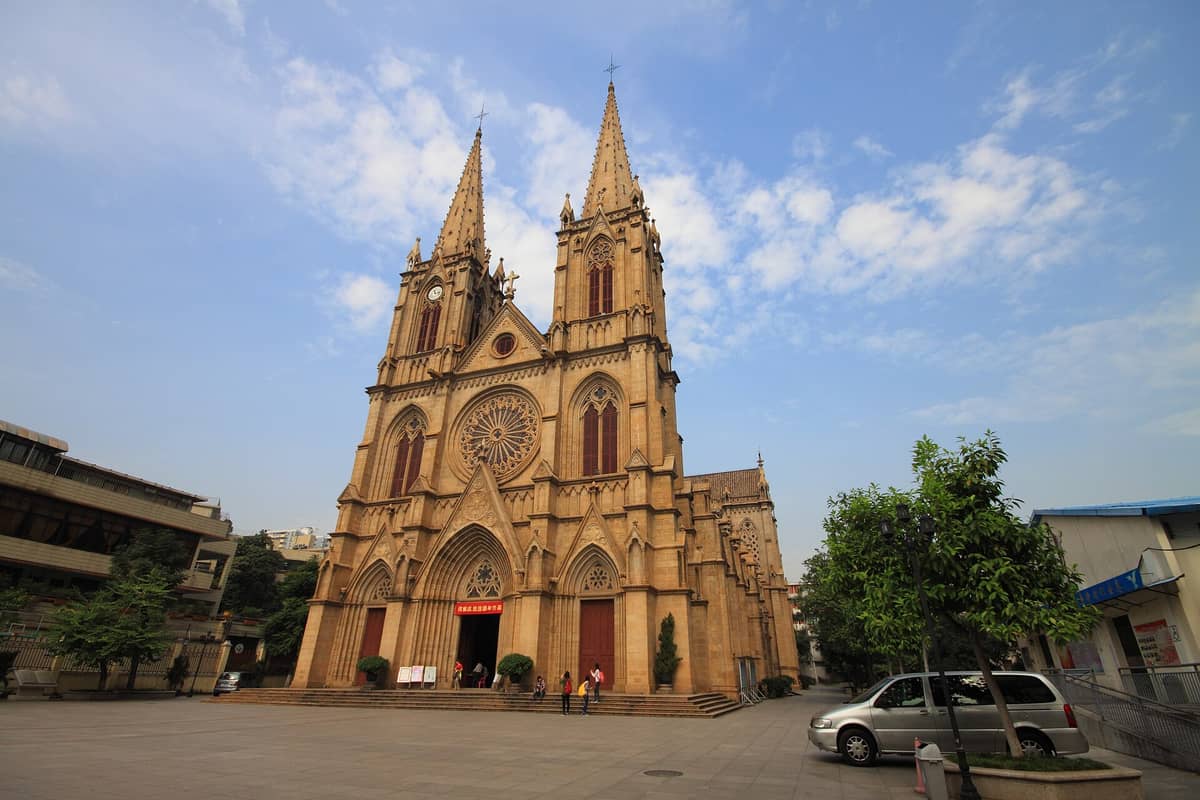
French Gothic Revival is the defining idiom here — pointed arches, ribbed vaulting, flying buttresses, and the characteristic verticality that pulls your eye upward. The facade is symmetrical, anchored by the two spires that can be seen from Yide Road before you reach the gate. What makes it specifically unusual in a Chinese context is the material: virtually every surface you see is granite, cut and fitted in the same tradition as European medieval masonry, rather than the plastered brick that characterises most 19th-century church construction in southern China.
Interior light enters through stained glass windows, which cast coloured patterns across the stone columns and floor during morning hours. The nave proportions feel genuinely European rather than locally adapted, which is disorienting in the best possible way when you arrive from the surrounding streetscape of Yuexiu.
The cathedral is often discussed alongside Guangzhou's broader 19th-century European architectural legacy. For context on how foreign architectural styles shaped the city's built environment, the Guangzhou architecture guide covers the key periods and sites in detail.
Visiting: What to Expect at Different Times of Day
The cathedral opens at 8:00 AM and closes at 5:30 PM daily. Early morning, especially on weekdays, is the calmest window. The low angle of morning sun catches the granite facade at a raking angle that sharpens every stone joint and carving. The courtyard in front of the cathedral is quiet at this hour, and you can study the exterior at your own pace without the foot traffic that builds later.
Midday on weekends brings tour groups and family visitors. The courtyard becomes crowded on Saturdays and Sundays. If you want interior photographs without other visitors in frame, arrive as close to opening time as possible. Sunday mornings are the most active for churchgoers attending Mass, which affects access to the nave.
Late afternoon light, particularly in the hour before closing, bathes the western facade warmly and is considered by many photographers to be the best exterior shooting window. The stone turns from grey to a softer amber tone, and the spires catch direct sunlight while the courtyard falls into shadow. Bring a wide-angle lens or use the widest setting on a phone camera: you cannot step back far enough in the courtyard to capture both towers without it.
💡 Local tip
For the most dramatic exterior photograph, stand at the far end of the courtyard and shoot upward toward the twin spires. A wide-angle lens or the ultrawide camera on a phone is necessary — the building is too tall and the space too confined for a standard focal length.
Historical Context: How This Cathedral Came to Exist in Guangzhou
The cathedral was built under the direction of the Paris Foreign Missions Society, the French Catholic missionary organisation that held significant influence in southern China throughout the 19th century. The project began during a period when foreign powers had extracted treaty concessions from the Qing government following the Second Opium War (1856–1860). The land on which the cathedral stands was part of a site acquired during this period, which makes the building's history inseparable from a complex and contested chapter in Sino-European relations.
Construction was extraordinarily ambitious for its time and place. Granite was quarried locally and transported to the site; the building techniques were imported from France. The result is a structure that is genuinely French Gothic in design and genuinely South Chinese in material — granite from Guangdong, cut and laid according to European methods that few local craftsmen had previously used.
The cathedral survived the upheavals of the 20th century, including periods of closure and damage during the Cultural Revolution, after which it was restored and returned to active use. Today it functions as the cathedral church of the Diocese of Guangzhou and holds regular Sunday services as well as daily Mass.
The cathedral sits in Yuexiu, Guangzhou's historic administrative and cultural core. Other significant historical sites nearby include the Nanyue King Mausoleum Museum and the Temple of the Six Banyan Trees, both within the same district.
Getting There and Getting In
The most straightforward transit option is Guangzhou Metro Line 2 to Haizhu Square Station, using Exit B2. From the exit, the cathedral is approximately a 5–8 minute walk northwest along Yide Road. The road is well-signed and the spires are visible from a distance once you are in the general area.
Entry is free. You walk through a gate into the forecourt and can approach the facade, photograph the exterior, and, when services are not in progress, enter the nave. There is no bag check, no ticket counter, and no formal queuing system. Dress modestly: covered shoulders and knees are appropriate, as this is an active church rather than a tourist site that happens to look like one.
Yide Road itself is worth noting: it is the street most associated with wholesale dried seafood and preserved goods trading in Guangzhou. If you approach from the east, you will pass through the Yide Road dried seafood market before reaching the cathedral, which creates a sensory contrast that is distinctly Guangzhou. The smell of salted fish and dried shrimp gradually gives way to incense and cool stone.
⚠️ What to skip
This is a working Catholic cathedral. During Mass — particularly on Sunday mornings — access to the interior may be restricted or limited to worshippers. Plan accordingly if your primary goal is photographing the interior.
Weather, Seasons, and When to Plan Your Visit
Guangzhou has a humid subtropical climate, and the cathedral is an outdoor-first experience: you will spend time in the forecourt regardless of what you want to see. October through December is the most comfortable window for exploring on foot, with lower humidity and temperatures that do not demand frequent shade stops. March through May is also reasonable, though spring brings intermittent rain.
Summer visits (June through August) are possible but genuinely hot and humid. The stone courtyard holds heat, there is limited shade, and midday temperatures regularly exceed 33°C. If you visit in summer, aim for early morning. Bring water. The interior of the cathedral, once you are inside, is noticeably cooler than the courtyard.
For broader seasonal advice on planning a Guangzhou trip, the best time to visit Guangzhou guide breaks down each month with practical detail.
Who This Attraction Suits and Who Should Reconsider
The Sacred Heart Cathedral rewards visitors who are interested in architectural history, religious heritage, or the physical evidence of how European and Chinese histories intersected in 19th-century Guangdong. The building is genuinely impressive in scale and execution, and it requires no prior knowledge of Catholic architecture to appreciate.
It is less compelling for visitors looking for interactive experiences, extensive exhibits, or family-friendly activities with children. There are no displays, no audio guides, no museum component, and no food or seating within the site. It is a cathedral: beautiful, quiet, and self-explanatory. Visitors who come expecting a managed tourist attraction rather than a place of worship sometimes feel the visit is over faster than anticipated — 45 minutes is a realistic average for a thorough look at interior and exterior.
Insider Tips
- Arrive on a weekday morning between 8:00 and 9:30 AM for the quietest conditions and the best low-angle light on the granite facade. The difference in atmosphere compared to a Saturday midday visit is significant.
- The interior acoustic is remarkable even when empty. If you are visiting outside of Mass times, pause for a moment in the centre of the nave and listen: the stone vaulting creates a reverberation that is unusual and worth noticing.
- The approach along Yide Road from Haizhu Square station takes you through the dried seafood wholesale street. Spend 10 minutes here before or after the cathedral — the contrast between the two is one of Guangzhou's more memorable small-scale urban experiences.
- Photography from directly below the twin spires, looking straight up, produces a compelling symmetrical image that is different from the standard wide-angle facade shot. The courtyard is just large enough to position yourself for this angle.
- If you are combining this visit with other Yuexiu sites, the Guangzhou Martyrs' Memorial Garden and the Nanyue King Mausoleum Museum are both within a manageable walking radius and add historical depth to the same half-day itinerary.
Who Is Sacred Heart Cathedral For?
- Architecture and history enthusiasts interested in 19th-century Gothic construction
- Photographers seeking a photogenic and structurally distinctive Guangzhou landmark
- Visitors building a half-day walk through Yuexiu's historical core
- Travellers curious about the intersections of European and Cantonese history
- Anyone wanting a quiet, cost-free pause between the commercial streets of the area
Nearby Attractions
Other things to see while in Yuexiu:
- Beijing Road Pedestrian Street
Beijing Road Pedestrian Street runs through the historic heart of Yuexiu District, layering modern retail over more than a thousand years of commercial history. Entry is free, the metro drops you right at the door, and the glass-covered archaeological ruins embedded in the pavement are an unexpected highlight worth stopping for.
- Canton Orchid Garden
Tucked inside Yuexiu District, the Canton Orchid Garden is a compact but carefully curated public garden dedicated entirely to orchid cultivation. At RMB 8 entry, it offers a rare pocket of calm in central Guangzhou, best appreciated in the cooler months when the flowers are at their peak.
- Ersha Island
Ersha Island sits in the Pearl River between Guangzhou Bridge and Haiyin Bridge, covering 1.26 square kilometers of parks, cultural venues, and tree-lined promenades. Free to enter and open around the clock, it offers a rare change of pace from the city's commercial core.
- Five Rams Statue
Carved from over 130 pieces of granite and completed in the late 1950s, the Five Rams Statue stands as one of Guangzhou's most recognizable landmarks. Located inside Yuexiu Park, it is free to visit and open daily, and is often best experienced in the early morning when the park is quiet and the light is soft.