Rue Mouffetard: The Ancient Heart of the Latin Quarter
One of Paris's oldest streets, Rue Mouffetard winds 650 metres through the 5th arrondissement, lined with fromageries, boulangeries, greengrocers, and centuries of history. The outdoor market runs Tuesday through Sunday and draws an equal mix of local shoppers and visitors, offering a slice of everyday Parisian life that most tourist itineraries overlook.
Quick Facts
- Location
- 5th arrondissement (Latin Quarter), Paris
- Getting There
- Censier-Daubenton or Place Monge (Métro Line 7, ~3-min walk)
- Time Needed
- 1–2 hours for a relaxed walk and market browse
- Cost
- Free (street and market access); budget €5–15 for food and produce
- Best for
- Food lovers, slow travellers, early-morning Paris seekers
What Rue Mouffetard Actually Is
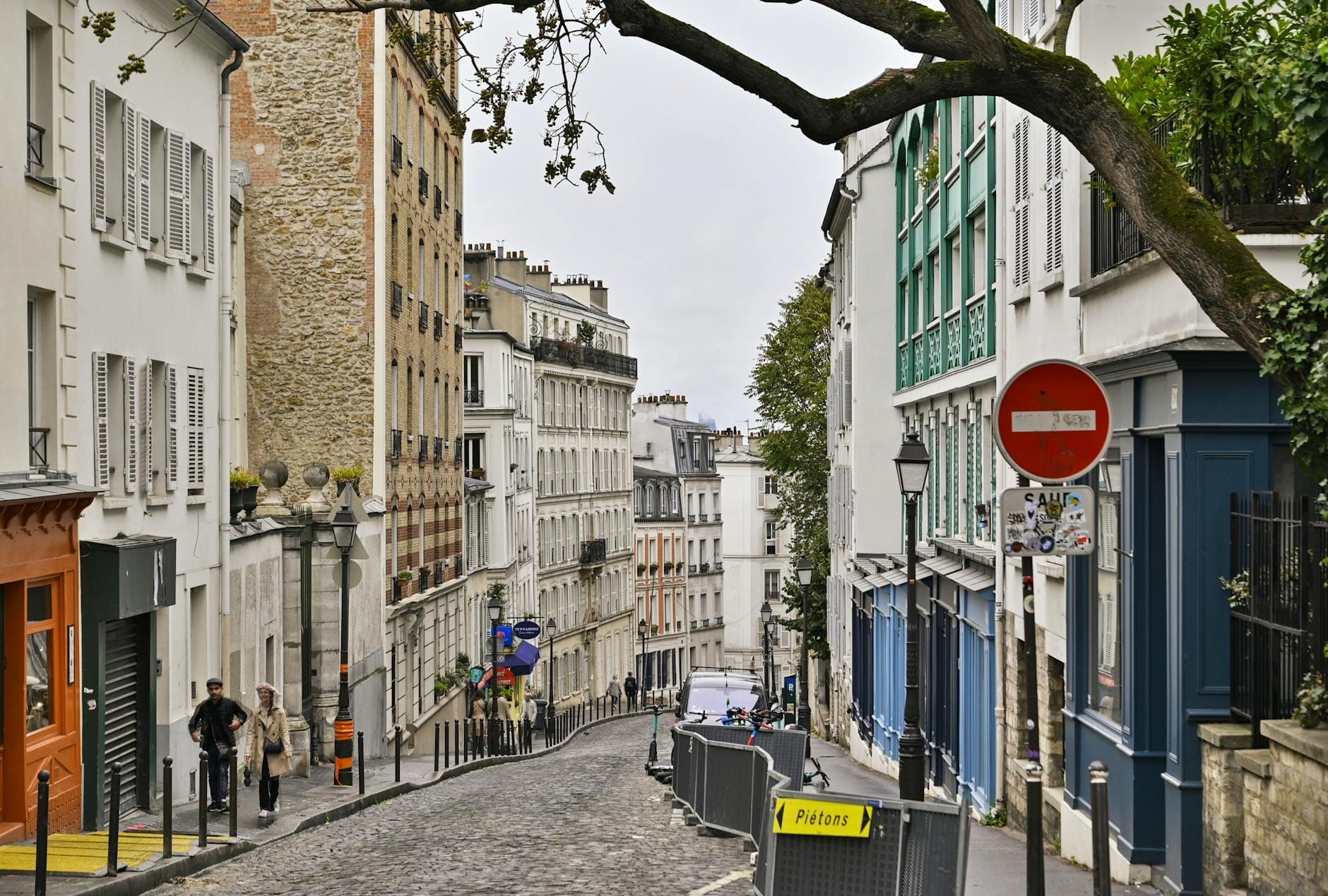
Rue Mouffetard is a narrow, cobbled market street that runs roughly 650 metres through the 5th arrondissement, descending from the lively Place de la Contrescarpe in the north to the churchyard of Église Saint-Médard in the south. It is not a monument you enter or a museum with a ticket desk. It is simply a street, one of the oldest in Paris, and the experience of walking it is the point.
The street sits in the Saint-Germain-des-Prés and Latin Quarter corridor, a part of Paris that has housed students, philosophers, and merchants for roughly 2,000 years. That continuity shows in the architecture, the street width, and the gentle slope that follows the original Roman road surface beneath.
💡 Local tip
The market is liveliest Tuesday through Saturday between 9:00 and 11:00 AM. Sunday mornings bring a slightly more relaxed crowd. Arrive by 9:30 AM for the best produce selection and the easiest navigation through the stalls.
A Street Two Thousand Years in the Making
Rue Mouffetard follows the path of an ancient Roman road that once connected the city of Lutetia (Roman Paris) to southern Gaul. The route is estimated to be around 2,000 years old, making it one of the earliest continuous urban pathways in the city. The street's name is thought to derive from 'mont Cetardus', the medieval Latin name for the hill on which it sits, though locals have long called this area simply 'la Mouffe'.
Look up as you walk and you will see facades bearing the marks of multiple centuries. A 1624 water well stands near the lower end of the street, a remnant of the neighbourhood's infrastructure before the Haussmann-era modernisation transformed most of Paris in the 19th century. Unlike the wide, planned boulevards that define much of central Paris, la Mouffe escaped comprehensive demolition, and so its scale and grain remain essentially medieval: tight, uneven, and human in proportion.
At the foot of the street sits the Latin Quarter's Église Saint-Médard, a church whose origins trace back to the 9th century. The square in front of it is one of the quieter spots on the street, a good place to pause before doubling back up toward the market's busier northern section.
Tickets & tours
Hand-picked options from our booking partner. Prices are indicative; availability and final rates are confirmed when you complete your booking.
Paris Essential dinner cruise at 6.15pm
From 99 €Instant confirmationFree cancellationEiffel Tower reserved elevator entrance to 2nd floor with walking tour and Seine cruise
From 94 €Instant confirmationFree cancellationBest of Paris city tour with Eiffel Tower lunch and Seine cruise
From 144 €Instant confirmationFree cancellationBike tour of Versailles Palace with skip-the-line tickets
From 109 €Instant confirmationFree cancellation
The Market: What You'll Find and When
The outdoor market on Rue Mouffetard operates Tuesday through Sunday, 8:00 AM to 1:30 PM, and is closed on Mondays. Unlike the covered Parisian market halls that feel curated for visitors, this one functions primarily as a neighbourhood food market. The vendors are real: cheesemongers who can talk you through a dozen different types of chèvre, greengrocer stalls stacked with seasonal produce, butchers with whole rabbits hung in the window, and boulangeries whose bread queues form before 9:00 AM.
The southern, lower section of the street is pedestrianised and holds most of the outdoor stalls. The northern section, closer to Place de la Contrescarpe, has more café terraces and wine bars. If you are shopping for food, focus on the lower half. If you want coffee with a view of the square, head to the top. Many shops along the street observe a traditional French lunch break, closing roughly between 1:30 and 3:00 PM, so plan accordingly if you want to browse the shops rather than the open-air stalls.
ℹ️ Good to know
This is a genuine neighbourhood market, not a tourist market. Prices reflect that: expect to pay local rates for bread, cheese, and fruit. Bringing a tote bag is practical and appreciated by the vendors.
Morning, Afternoon, and Evening: How the Street Changes
Early morning, before 9:00 AM, Rue Mouffetard belongs to the residents. Shop owners roll up metal shutters, boulangeries push the first trays of croissants into display cases, and delivery vans thread carefully down the slope. The smell at this hour is specific: warm bread, ground coffee, and the faint mineral damp of old cobblestones that haven't yet dried. Photography is best in this window. The golden light from the east strikes the upper facades cleanly, and the street is empty enough to frame shots without thirty people in the background.
By 10:00 AM on a Saturday, the street is full. Families with wheeled market trolleys, students from the nearby Sorbonne picking up fruit, and tourists photographing the painted shop signs create a dense, moving crowd. The noise level is genuinely high: vendors calling out daily specials, the clatter of crates, snatches of conversation in French, Arabic, and English. This is the peak market experience, but it is also the least comfortable time to walk the full length without stopping.
By early afternoon, once the market stalls pack down, the street shifts into café and restaurant mode. The terraces along the northern end fill with lunch crowds. The pace slows. By evening, the character changes again: the wine bars and restaurants along la Mouffe draw a younger crowd, and the street takes on a neighbourhood pub feel that has nothing to do with tourism.
Getting There, Getting Around
Two Métro stations on Line 7 serve the street almost equally well. Censier-Daubenton drops you closest to the middle of the market stretch, while Place Monge puts you near the northern end and Place de la Contrescarpe. Both are roughly a 3-minute walk from the street. Bus lines 47, 67, and 89 also pass nearby. There is no practical reason to take a taxi or rideshare unless you are travelling with heavy shopping or reduced mobility.
Rue Mouffetard connects naturally to the wider Paris Métro network, making it easy to combine with a visit to the Jardin des Plantes, which is a 10-minute walk east, or the Panthéon, about 8 minutes uphill to the northwest.
⚠️ What to skip
The cobblestones are uneven and the street descends on a real slope. Wheeled luggage is difficult; wheeled pushchairs are manageable but require effort. For wheelchair users, the street is challenging without assistance, and the narrower sections offer limited space to manoeuvre. Some adjacent shops have small ramps at their entrances.
What Makes This Worth Your Time (and What Does Not)
Rue Mouffetard is not a spectacular sight. There is no single building to photograph, no famous artwork to queue for, and no obvious centrepiece. What it offers instead is coherence: a street that looks and feels like Paris has always imagined itself, before the Haussmann grid and the luxury boutiques arrived. The painted wooden signs above the shop facades, some reproducing medieval-style lettering, give a visual continuity that most Parisian shopping streets have long since lost.
Travellers who are specifically seeking a refined, curated Paris experience may find la Mouffe underwhelming. The market is functional rather than pretty. The crowds on weekend mornings are genuine, not choreographed, and can feel claustrophobic. If immaculate presentation is the goal, the covered passages of Paris offer a more polished version of historical commercial architecture. But for anyone who wants to see how a working neighbourhood feeds itself, this street is hard to beat.
Similarly, if your Paris visit is limited to two days, there are higher-priority sights. Consult our 3-day Paris itinerary to see where Rue Mouffetard best fits. For travellers with a third or fourth day, it earns its place comfortably.
Photography, Food, and Practical Details
The best photography window is weekday mornings before 9:00 AM or the first 30 minutes after the market opens, when stalls are freshly arranged. The painted shop signs, the overhanging upper floors, and the convergence lines of the narrow street all reward a wide-angle lens. Avoid shooting directly into the sun on the south-facing descent; afternoon light on overcast days is actually more even and flattering for the stone facades.
For food, the fromageries are the standout draw. Several have been operating on the street for decades and carry farmhouse cheeses not found in supermarkets. The boulangeries compete fiercely, so quality is high. If you want a sit-down meal, Place de la Contrescarpe at the top of the street has a ring of café-restaurants with outdoor seating. For a broader sense of the neighbourhood's food scene, the guide to where to eat in Paris covers the Latin Quarter in context.
Street access is free and open at all hours. The market stalls operate Tuesday through Sunday, 8:00 AM to 1:30 PM. Individual shops set their own hours, and many close for lunch. The area is well-lit in the evening but the cobblestones can be slippery after rain. Wear shoes with grip, particularly if visiting in autumn or winter.
Insider Tips
- The very top of the street, Place de la Contrescarpe, was a favourite haunt of Ernest Hemingway, who described the cafés here in 'A Moveable Feast'. Arriving early enough to take a coffee at the square before the market crowds arrive gives you a moment that feels genuinely unhurried.
- Several shops have painted their facades in colours and scripts that replicate the look of 17th and 18th-century Parisian commercial signs. Look above eye level as you walk: the upper-storey detail is far more interesting than the shop windows at street level.
- On Sunday mornings, the lower section near Église Saint-Médard is appreciably quieter than on Saturdays. You get the full market without the weekend crowd peak. This is also the best time for relaxed conversation with vendors.
- The fromagerie at the lower end of the street keeps a small blackboard outside listing the cheeses that arrived that morning. This is not a tourist gimmick; it is for the regulars. Use it to ask specifically about whatever is listed rather than the pre-wrapped selection.
- Rue Mouffetard is entirely in the 5th arrondissement. Do not be confused if a shop listing gives a different postcode from what you expect.
Who Is Rue Mouffetard For?
- Food travellers who want to shop and taste like a Paris resident rather than a tourist
- Slow walkers and people-watchers with a few unscheduled morning hours
- History-focused visitors interested in Roman Paris and pre-Haussmann urban form
- Photographers looking for early-morning street scenes with real texture and depth
- Families with older children who can manage cobblestones and a working market environment
Nearby Attractions
Other things to see while in Saint-Germain-des-Prés & the Latin Quarter:
- Catacombs of Paris
Twenty metres underground, the Catacombs of Paris hold the remains of more than six million people in a network of former limestone quarries beneath the 14th arrondissement. It is one of the most unusual historical sites in Europe, and one of the most crowded. Here is what visiting actually looks like.
- Jardin des Plantes
Founded in 1626 as a royal medicinal herb garden, the Jardin des Plantes is France's principal botanical garden and one of Paris's most underrated green spaces. Free to enter and open every day of the year, it combines formal flowerbeds, towering greenhouse pavilions, a zoo, and four natural history museums inside a single 28-hectare site on the left bank of the Seine.
- Jardin du Luxembourg
Spread across 25.72 hectares in the heart of the 6th arrondissement, Jardin du Luxembourg is Paris's most refined public garden. Created in 1612 by Marie de Médicis, it blends French formal geometry with wilder English-style landscaping, 102 statues, a working orchard, and the grand Luxembourg Palace. Entry is free and the atmosphere shifts completely depending on the hour.
- Latin Quarter (Saint-Michel)
The Latin Quarter is Paris's most historically layered neighborhood, stretching across the 5th and 6th arrondissements on the Left Bank. From the monumental Saint-Michel Fountain to streets that follow paths worn by Roman Lutetia, this is a district where two thousand years of intellectual and political life are woven into the stone. Entry is free, and it rewards exploration at any hour.