Royal Gardens of Venice (Giardini Reali): A Free Escape from the San Marco Crowds
The Giardini Reali sit between Piazza San Marco and the Grand Canal waterfront, offering a rare pocket of greenery in the heart of Venice. Commissioned by Napoleon in 1806–1807, restored and reopened in December 2019, and free to enter, these compact gardens deliver lagoon views and genuine quiet just minutes from the city's most visited square.
Quick Facts
- Location
- Piazza San Marco, San Marco sestiere, Venice, Italy
- Getting There
- Vaporetto: San Marco or San Marco Giardinetti (lines 1, 2)
- Time Needed
- 30–60 minutes
- Cost
- Free (no ticket required; groups of 10+ must book in advance)
- Best for
- Lagoon views, a quiet break near St Mark's, history lovers, families with young children
- Official website
- www.venicegardensfoundation.org/en/royal-gardens-of-venice
What the Giardini Reali Actually Are
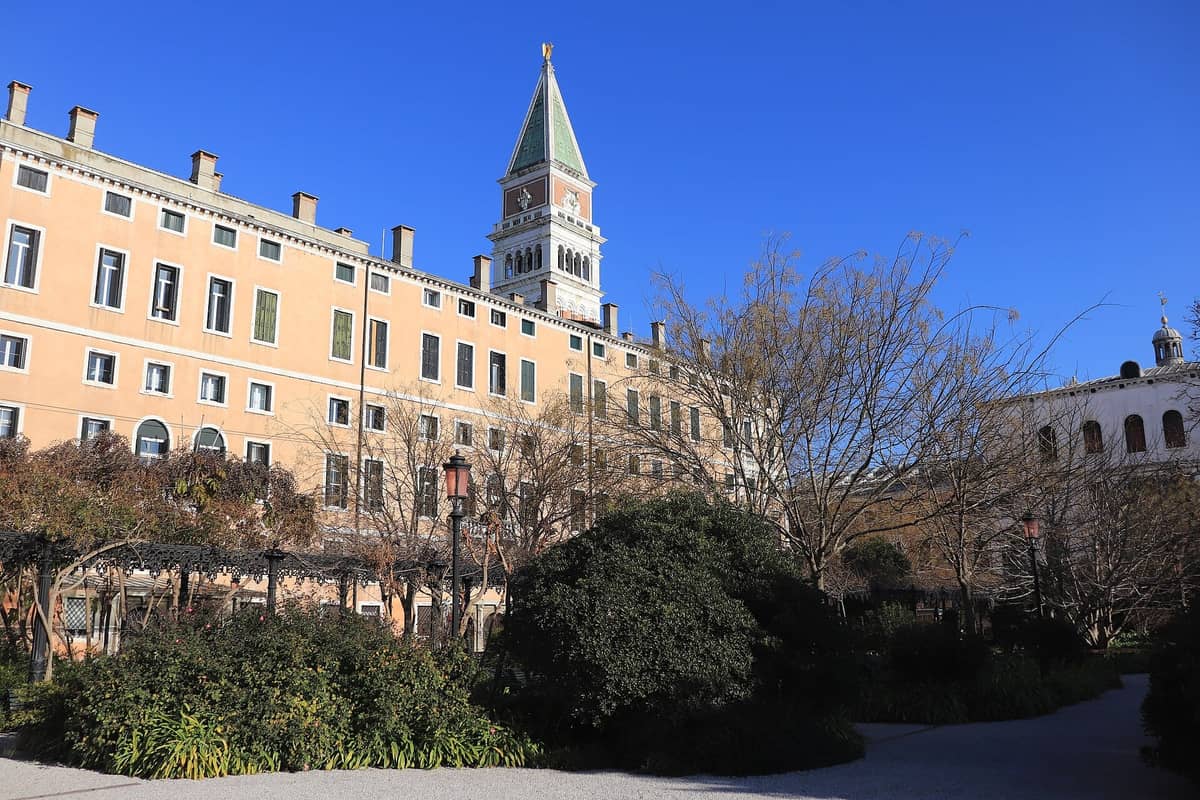
In a city built almost entirely of stone and water, the Royal Gardens of Venice (Giardini Reali) stand out as the only significant green space in the San Marco sestiere. The gardens occupy roughly 5,500 square metres of landscaped ground between the Procuratie Nuove and the San Marco waterfront, separated from the lagoon by a low iron railing and a wide stone promenade. They are compact by any park standard, but in Venice that scale is irrelevant: the simple presence of grass, mature trees, and birdsong so close to Piazza San Marco makes them feel disproportionately peaceful.
The gardens were fully restored by the Venice Gardens Foundation after years of deterioration and reopened to the public in December 2019. Entry remains free, which makes them one of the genuinely no-cost pleasures in one of Europe's most expensive tourist cities.
💡 Local tip
Hours shift by season: typically 08:30–19:00 (Wednesday–Friday) and 08:30–19:30 (Saturday–Sunday) from April 15 to October 15, and shorter winter hours from October 16 to April 14. The gardens are closed on Mondays and Tuesdays year-round, and on certain public holidays including Christmas Day, New Year's Day, the last Sunday of Carnival, Easter Sunday, and Holy Saturday (the day before Easter). Do not confuse Holy Saturday with the Festa del Redentore, which falls on the third weekend of July. Always confirm exact hours via the Venice Gardens Foundation website before visiting.
A Napoleonic Garden in the Shadow of St Mark's
The gardens were commissioned by Napoleon Bonaparte around 1806, part of his sweeping reorganization of the Marciana area following France's occupation of the Venetian Republic. To create them, he ordered the demolition of a granary (the Granai di Terranova) that had occupied the site for centuries. This was not a minor act of urban change: the granary had fed Venice during sieges and floods, and its removal was one of several controversial interventions Napoleon made to the fabric of the historic city.
The resulting gardens took the form of a modest pleasure ground for the use of the Italian royal court, which occupied the Procuratie Nuove as its Venetian palace. Under successive rulers, including the Habsburg Austrian administration, the gardens were maintained as a semi-private aristocratic space. The wrought-iron greenhouse pavilion visible near the lagoon-facing edge of the gardens dates from the 19th century and is one of the more architecturally specific features left from that era.
For context on how Napoleon's interventions reshaped the area around the gardens, the San Marco sestiere retains several of his imposed changes, including the modified wing of the Procuratie and the current alignment of the Ala Napoleonica at the western end of the square.
Tickets & tours
Hand-picked options from our booking partner. Prices are indicative; availability and final rates are confirmed when you complete your booking.
Spritz and cicchetti in Venice's Royal Gardens
From 18 €Instant confirmationFree cancellationLight lunch in St. Mark's Square Royal Gardens
From 28 €Instant confirmationFree cancellationVenice Legends, Anecdotes and Ghost Stories Tour
From 35 €Instant confirmationFree cancellationGhosts and legends tour of Venice
From 29 €Instant confirmationFree cancellation
The Experience on the Ground
Arriving from Piazza San Marco, the transition is immediate. You pass under the Procuratie colonnade, follow the Riva degli Schiavoni-facing street westward for about 90 seconds, and the garden gates appear on your right. The sounds change before you even enter: the audio backdrop shifts from the sharp echo of flagstones and crowd noise to something softer, with wind in the trees and, depending on the season, the distinct smell of damp earth and cut grass.
The layout is formal without being rigid. Gravel paths curve between planted beds and established trees including plane trees and palms, with several wooden benches positioned to face the water. The iron railing along the lagoon side is low enough that the view opens fully: the dome of San Giorgio Maggiore sits directly in the line of sight across the basin, and on clear days the Lido appears as a long thin line beyond the shipping channel. This view alone justifies the five-minute detour from the square.
The greenhouse pavilion, restored as part of the 2019 project, now functions as a space used periodically for events and educational activities organized by the Venice Gardens Foundation. It is not always open to internal visits, but the exterior ironwork is worth examining up close.
ℹ️ Good to know
The gardens are genuinely small. There is no route that takes more than 15 minutes to walk in full. Most visitors spend 30–45 minutes, mostly sitting. If you come expecting a large botanical garden or extensive trails, you will be disappointed. The value is in the location and the contrast with the surrounding city, not the scale.
Time of Day and Seasonal Differences
The gardens feel different depending on when you arrive. In the morning, particularly on weekdays, they attract a small number of local residents and early-arriving visitors who have just stepped off the vaporetto at the Giardinetti stop. The light on the lagoon at this hour is particularly clear, and the square itself is not yet at peak volume, so the sense of having found a calmer Venice is more convincing.
By mid-afternoon in summer, especially between June and August, the garden benches fill quickly with visitors who have walked out of Piazza San Marco looking for anywhere to sit down. The gardens absorb this reasonably well given their size, but the illusion of tranquility does thin. If you visit in July or August and want genuine quiet, aim for opening time on a Wednesday or Thursday morning.
In winter, the gardens take on a different character. The trees are largely bare, the light is low and grey for much of the day, and acqua alta events can occasionally affect the waterfront promenade just outside the gates, though the garden paths themselves sit slightly above the immediate flood risk zone. A winter visit is less photogenic but often more intimate, with far fewer people sharing the space.
If you are visiting during the colder months, it is worth reading about acqua alta in Venice before you go. Flooding events do not typically prevent access to the gardens themselves, but they can complicate the walk from the vaporetto stop.
Getting There and Getting In
The simplest approach is by vaporetto. Lines 1 and 2 both stop at San Marco Giardinetti, a landing stage located directly in front of the gardens on the Grand Canal waterfront. From the landing stage, the garden entrance is visible immediately to your left as you step off the boat, roughly 60 metres away. This is the most direct arrival point in Venice for any major attraction.
On foot from Piazza San Marco, the walk takes under three minutes. Head toward the waterfront from the square, turn right along the Riva, and the gates are on your left before you reach the landing stage. There are no ticket windows, no queues, and no entry fee. You simply walk in during opening hours.
For groups of ten or more visitors, advance booking through the Venice Gardens Foundation is required. This is a practical garden management measure rather than a ticketing system, and the gardens are not commercialized in the way that most major Venetian attractions are.
⚠️ What to skip
The gardens are closed on Mondays and Tuesdays year-round. This catches out a significant number of visitors who assume public green spaces operate seven days a week. Check before making it part of a tightly scheduled itinerary.
Photography and What to Capture
The strongest photographs from the Giardini Reali frame the lagoon view through the garden's iron railing or the greenhouse ironwork, using the park's greenery as foreground contrast against the water and the San Giorgio Maggiore dome. Early morning light from the east hits this view directly in summer, making the hour after opening the best window for photography.
Inside the garden, the interplay between the restored 19th-century greenhouse structure and the surrounding trees photographs well in both strong light and overcast conditions. The overcast winter light, which flattens harsh shadows, actually suits the architectural ironwork better than direct summer sun.
The waterfront promenade immediately adjacent to the gardens, the Riva degli Schiavoni, extends east toward the Bridge of Sighs and offers an unobstructed panorama of the San Marco basin that pairs naturally with a visit to the gardens.
Who Will Not Enjoy This
Visitors arriving with expectations built by Venice's larger set-pieces will find the Giardini Reali underwhelming. If you have limited time and are weighing it against the Peggy Guggenheim Collection, the Doge's Palace, or the view from the Campanile, the gardens should not be your priority. They do not contain significant art, do not offer panoramic elevated views, and do not provide a deep architectural experience beyond the restored greenhouse.
They are also genuinely small. Anyone who needs space for children to run freely, or who is looking for a full park experience with multiple hours of walking, will exhaust the grounds in 15 minutes. For that kind of visit, the Giardini della Biennale in Castello offer considerably more space, though they operate on a different schedule.
If you are planning more than a day in Venice, the gardens sit naturally within a broader San Marco itinerary that might include Piazza San Marco and a vaporetto ride across to San Giorgio Maggiore, whose campanile offers one of the least crowded elevated views in the city.
Insider Tips
- The San Marco Giardinetti vaporetto stop puts you at the garden entrance in under a minute. If you are arriving from Dorsoduro or the Accademia area, take line 1 eastbound and get off here rather than at San Marco Vallaresso, which deposits you slightly further away and into a busier stretch of waterfront.
- The restored wrought-iron greenhouse was built in the 19th century under Austrian administration and is one of the few surviving examples of that style of garden architecture in the San Marco area. It is worth pausing at rather than walking past.
- The lagoon-facing benches fill first on sunny afternoons. If you arrive after 14:00 in summer and want to sit facing the water, check the less obvious benches set back slightly from the railing under the trees on the western side.
- The gardens close on Monday and Tuesday year-round. This is a firm rule. If your itinerary lands on either of those days, do not include the Giardini Reali as a planned stop then.
- In autumn and early winter, acqua alta sirens may sound while you are in the gardens. The garden paths are generally not at immediate flood risk, but the surrounding streets can take on water quickly. Keep an eye on the waterfront and have waterproof footwear ready if you are visiting between October and January.
Who Is Royal Gardens of Venice (Giardini Reali) For?
- Travellers who need a genuine pause after the sensory overload of Piazza San Marco
- History-minded visitors interested in Napoleonic Venice and 19th-century urban change
- Families with young children who need a flat, safe space to slow down without paying for admission
- Photographers seeking an unusual foreground for lagoon and San Giorgio Maggiore compositions
- Budget travellers looking for free experiences in one of the city's most expensive neighbourhoods
Nearby Attractions
Other things to see while in San Marco:
- Bridge of Sighs (Ponte dei Sospiri)
The Ponte dei Sospiri is one of Venice's most photographed structures, an enclosed white limestone bridge linking the Doge's Palace to the New Prisons over the narrow Rio di Palazzo canal. You can see it for free from the Ponte della Paglia, or cross it from the inside as part of a Doge's Palace ticket. Here is everything you need to visit it well.
- Doge's Palace (Palazzo Ducale)
Doge's Palace is the Gothic heart of Venice's political history, rising at the edge of Piazza San Marco with a facade unlike anything else in Italy. This guide covers what you'll actually experience inside, when to visit for smaller crowds, and how to make the most of one of Europe's most significant civic buildings.
- Grand Canal (Canal Grande)
The Canal Grande is the main artery of Venice, a reverse-S shaped waterway stretching 3.8 km through the heart of the city and lined with more than 170 palaces spanning six centuries of Venetian architecture. Free to view at any hour, it rewards visitors who know when and how to travel it.
- Museo Correr
Occupying the grand Napoleonic Wing and part of the Procuratie Nuove above Piazza San Marco, the Museo Correr holds centuries of Venetian civic history, Renaissance painting, and lavishly decorated royal apartments. It rewards visitors who take their time, and it's consistently overlooked by crowds fixated on the Doge's Palace next door.