Royal Albert Hall: London's Greatest Concert Venue
The Royal Albert Hall is one of the world's most recognisable performance venues, a terracotta-clad Victorian amphitheatre that has hosted everyone from Jimi Hendrix to the BBC Proms for over 150 years. Whether you come for a concert, a guided tour, or simply to admire the building from the outside, it anchors one of the most culturally dense corners of London.
Quick Facts
- Location
- Kensington Gore, London SW7 2AP (Royal Borough of Kensington and Chelsea)
- Getting There
- South Kensington or High Street Kensington (both approx. 10–15 min walk); bus routes 9, 23, 52, 70, 360, 452 stop nearby
- Time Needed
- 30 min to admire the exterior; 1.5–2 hours for a guided tour; 2.5–4 hours for an evening performance
- Cost
- Exterior viewing free; event tickets and tour prices vary by performance and date — check royalalberthall.com for current listings
- Best for
- Classical music lovers, architecture enthusiasts, first-time visitors, families on rainy days, anyone after an iconic London evening out
- Official website
- www.royalalberthall.com
What Is the Royal Albert Hall?
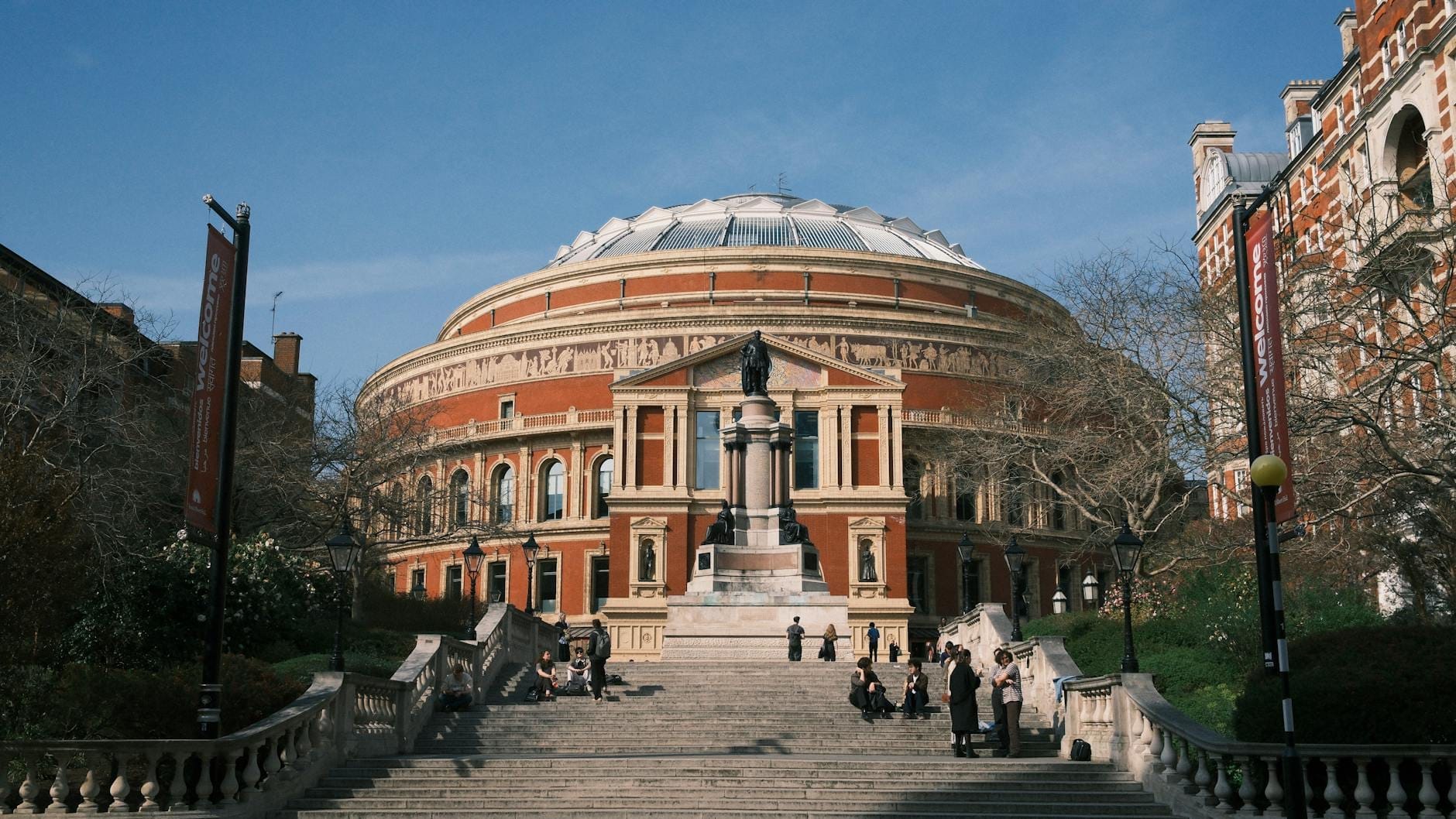
The Royal Albert Hall of Arts and Sciences — to use its full official name — is a Grade I listed concert hall in South Kensington that opened on 29 March 1871, when Queen Victoria herself presided over the inauguration ceremony. Built between 1867 and 1871 in an Italianate style inspired by Roman amphitheatres, the hall was conceived as a lasting memorial to Prince Albert, Victoria's husband, who had championed the idea of a great centre for the arts and sciences before his death in 1861. The result was one of the most architecturally ambitious buildings of the Victorian era: an elliptical drum of over six million red bricks wrapped in roughly 80,000 terracotta blocks, crowned by a vast wrought-iron and glass dome.
The Hall seats around 5,272 people in its main auditorium, rising to approximately 5,900 when standing areas are included. Those numbers matter less than the spatial experience: the interior is theatrical, a tiered arrangement of stalls, loggia boxes, grand tier boxes, second tier, gallery, and choir seating that wraps continuously around the central arena floor. Nothing quite prepares you for the scale the first time you walk in from the arena level.
💡 Local tip
The exterior frieze running around the building's upper circumference depicts 'The Triumph of Arts and Sciences' in terracotta mosaic. Take five minutes to walk the full perimeter before going inside — most visitors head straight to the doors and miss it entirely.
The Building Up Close: Architecture and Setting
Approaching from Prince Consort Road to the south, the Hall appears almost domestic in scale until you round the corner onto Kensington Gore and the full elliptical facade opens up. The terracotta is the dominant material and texture, a warm burnt-red that catches the afternoon light in a way that photographs rarely capture. The ornate inscription along the frieze — 'This Hall was erected for the Advancement of the Arts and Sciences and works of industry of all nations in fulfilment of the intention of Albert Prince Consort' — runs in letters large enough to read from the pavement across the road.
Directly opposite the main entrance is the Albert Memorial in Kensington Gardens, the gilded, canopied statue of the Prince that faces his hall across the wide expanse of Kensington Gore. The pairing is intentional and the view from the Hall's steps toward the memorial is one of the more quietly powerful civic compositions in London. Early morning, before tourist coaches arrive, the whole scene — low light, near-empty paths, the gold of the memorial against green park — is about as composed as London gets.
The Hall sits at the northern edge of a cultural cluster that defines this part of Kensington. The Natural History Museum, the Victoria and Albert Museum, and the Science Museum are all within a ten-minute walk, making this corner of Kensington and Chelsea one of the most concentrated areas of major institutions in any European city.
Tickets & tours
Hand-picked options from our booking partner. Prices are indicative; availability and final rates are confirmed when you complete your booking.
Thames Roundtrip Cruise and Old Royal Naval College with Painted Hall
From 43 €Instant confirmationFree cancellationThames One-Way Cruise and Old Royal Naval College with Painted Hall
From 31 €Instant confirmationFree cancellationPainted Hall London tickets
From 19 €Instant confirmationFree cancellationThe Cotswolds day trip from London
From 67 €Instant confirmationFree cancellation
Inside the Hall: What to Expect on a Tour
The Royal Albert Hall offers guided tours on most days (hours vary by event schedule, so check the official site before visiting). The tour takes you through parts of the building that concert-goers rarely access: the Victorian-era boxes with their original fittings, the backstage corridors, and the great auditorium itself when it is unoccupied. This is the best opportunity to understand how the space is constructed and why it has such an unusual acoustic character.
That acoustic history is interesting. When the Hall opened, the dome produced a pronounced echo — a several-second delay so troublesome that it was nicknamed 'the Albert Hall's second programme'. The problem was not properly solved until 1969, when a large array of fibreglass acoustic diffuser discs, known informally as 'mushrooms' or 'flying saucers', were suspended from the underside of the dome. They remain there today, an odd and endearing piece of engineering pragmatism in an otherwise immaculate Victorian interior.
The octagonal lantern at the top of the dome allows natural light to filter into the auditorium during the day, which gives the empty hall a quality quite different from its appearance under stage lighting at night. On a tour, you get to sit in different sections and appreciate how the sight lines change depending on where you are seated — useful information if you are planning to return for a performance.
ℹ️ Good to know
Tour availability changes significantly around major events and the BBC Proms season (typically July to September). Check royalalberthall.com for the current tour timetable before you plan your visit around one.
Attending a Performance: The Real Reason to Visit
Seeing the Royal Albert Hall on a tour is worthwhile. Attending a live performance here is something else. The Hall hosts around 390 events per year across an extraordinary range of genres: classical, opera, rock, comedy, tennis, boxing, film screenings with live orchestras, award ceremonies, and graduation ceremonies for several London universities. There is almost always something on.
The most famous annual event is the BBC Proms, a season of orchestral concerts running from July to mid-September that concludes with the Last Night of the Proms — one of the most exuberant and eccentric evenings in the British classical music calendar. Tickets for the Last Night are difficult to obtain and subject to a ballot system, but arena standing tickets for regular Proms concerts are sold for a low fixed price on the day, making this one of the better-value live classical music experiences in Europe.
For a first visit with no specific event in mind, the venue's own programming calendar rewards a look. The Hall often hosts one-off concerts and residencies that are less visible than the Proms but just as musically serious. Acoustics in the stalls and grand tier boxes are generally considered the strongest; the upper gallery offers a steep but complete view and is typically the most affordable option.
💡 Local tip
For Proms concerts, same-day arena standing tickets go on sale at the box office from around 10:00 on performance days. Arrive early — queues form before that, particularly for high-profile conductors or soloists. The standing experience in the arena is informal and social in a way that seated classical concerts rarely are.
Time of Day and Crowd Patterns
The Hall's surroundings shift noticeably across the day. Mornings are quiet. Kensington Gore carries light traffic, a few joggers cut through from Hyde Park, and the museum district behind the Hall has not yet reached full visitor capacity. This is the window for exterior photography without tour groups or coaches in the foreground.
By early afternoon the area fills with visitors spilling between the nearby museums. The Hall itself may be running tours, and the cafe and restaurant inside are open to ticketholders and tour participants. The contrast between mid-afternoon — when the Hall functions as a heritage attraction — and the hour before an evening performance is striking. From around 18:30 onwards, the pavement fills with concertgoers, the box office queues lengthen, and the building takes on an entirely different energy.
After a performance ends, particularly for large-scale evening concerts, the roads immediately outside become very congested. If you arrive by bus or Tube and are heading back toward central London, the walk to South Kensington station can be slow with crowds. High Street Kensington station, slightly further north, is often a less pressured option after major events.
Practical Information for Visitors
The Hall's address is Kensington Gore, London SW7 2AP. Neither South Kensington nor High Street Kensington Tube stations are especially close — both require a 10 to 15-minute walk. Bus routes 9, 23, 52, 70, 360, and 452 serve stops closer to the Hall and are often the most practical option if you are coming from central London. Note that neither South Kensington nor High Street Kensington currently has step-free access from street to platform; the nearest step-free Tube station is Green Park, from which bus 9 runs toward the Hall.
There is no general admission ticket to enter the building independently. If you want to see inside without attending a performance, a guided tour is the only option. Tour prices and schedules change; the official website is the only reliable source for current availability. Event ticket prices vary enormously depending on the performance and seating area. The Hall accepts card payments throughout.
If you are building an itinerary around this part of London, pairing the Hall with the Albert Memorial, a walk through Hyde Park, and one of the nearby museums makes for a full and rewarding day. For a broader overview of what this area offers, the best museums in London guide covers the full Kensington cluster in context.
⚠️ What to skip
During the BBC Proms season and other major events, parking in the surrounding streets is extremely limited and roads are subject to closure. Public transport or cycling are strongly recommended on performance evenings.
Insider Tips
- The Hall sometimes releases returned or unsold tickets close to performance time, which can be cheaper than advance prices for some events. Ask at the box office on the evening of a performance — it does not always work, but for lower-profile midweek concerts the savings can be substantial.
- The Grand Tier boxes are the most atmospheric seats in the house for classical music, with an intimate relationship to the stage that stalls seating does not replicate. If boxes are available when you book, they are worth considering even for solo travellers.
- Walk around the full exterior perimeter, not just the main south facade. The north side, facing Hyde Park, is less photographed and gives you a clearer view of the dome proportions without other buildings interrupting the frame.
- The Hall's cafe bar is open during tours and pre-concert periods. It is not especially well-signposted from the main entrance but is a legitimate place to sit with a drink even if you are not attending an event that day, provided you have a tour ticket.
- For the BBC Proms specifically, the first and last nights are the hardest tickets to get. The concerts in between — particularly chamber music events and late-night Proms — are often undersold and provide a more relaxed, less crowded experience of the Hall.
Who Is Royal Albert Hall For?
- Classical music fans and anyone wanting to experience the BBC Proms in person
- Architecture and Victorian history enthusiasts who want to understand the building's construction and acoustic engineering
- First-time London visitors building a Kensington cultural itinerary
- Families looking for a rainy-day indoor visit that combines history with hands-on tour elements
- Couples seeking a special evening out without the predictability of mainstream West End theatre
Nearby Attractions
Other things to see while in Kensington & Chelsea:
- Chelsea Physic Garden
Founded in 1673 by the Worshipful Society of Apothecaries, Chelsea Physic Garden is a four-acre walled enclosure in the heart of Chelsea containing over 4,500 medicinal, edible, and historically significant plants. It is the second-oldest botanic garden in Britain and one of the quietest places you will find in central London.
- The Design Museum
Housed in the dramatically restored former Commonwealth Institute building on Kensington High Street, the Design Museum is one of Europe's most respected institutions dedicated to design, architecture, fashion, and product innovation. Entry to the permanent collection is free, while rotating exhibitions draw on names from global creative culture.
- Harrods
Founded in 1849 and occupying over a million square feet in Knightsbridge, Harrods is as much a London spectacle as it is a shop. Whether you're browsing the Food Halls or shopping the designer floors, here's exactly what to expect.
- Hyde Park
Hyde Park is one of London's eight Royal Parks, covering 142 hectares in the heart of the city. Free to enter, open until midnight, and rich in history stretching back to a Tudor hunting ground, it rewards visitors who pace themselves and explore beyond the obvious.