Royal Academy of Arts: London's Grand Institution for Living Art
Founded in 1768 by King George III's approval of the Instrument of Foundation, the Royal Academy of Arts occupies one of London's most impressive Palladian buildings on Piccadilly. It stages world-class temporary exhibitions across fine art, architecture, and design, alongside its famous annual Summer Exhibition — all within walking distance of Green Park and Piccadilly Circus Tube stations.
Quick Facts
- Location
- Burlington House, Piccadilly, London W1J 0BD (also accessible via 6 Burlington Gardens, W1S 3ET)
- Getting There
- Green Park (Jubilee, Victoria, Piccadilly lines) or Piccadilly Circus (Bakerloo, Piccadilly lines) — both a short walk
- Time Needed
- 1.5–3 hours depending on exhibition size; longer on Friday evenings when the galleries stay open until 21:00
- Cost
- Burlington House courtyard and select displays are free; major exhibitions are individually ticketed — check royalacademy.org.uk for current prices
- Best for
- Art lovers, architecture enthusiasts, cultural day-trippers, and anyone seeking a serious exhibition in a spectacular West End setting
- Official website
- www.royalacademy.org.uk
What the Royal Academy Actually Is
The Royal Academy of Arts is not a state museum. That distinction matters. Founded on 10 December 1768 when King George III approved the Instrument of Foundation, the RA is an independent, privately funded institution led by practising artists and architects who are elected as Royal Academicians. It has no permanent government subsidy in the way that national museums do, which means the exhibitions it mounts are chosen by artists, for audiences interested in art as a living, argued-over discipline rather than a fixed heritage collection.
Britannica describes it as the principal society of artists in London — a characterisation that still holds. With around 80 elected Academicians at any one time, spanning painters, sculptors, printmakers, architects, and photographers, the RA functions simultaneously as a members' club, an exhibition venue, and an art school. The RA Schools, housed within Burlington House, is one of the oldest fine art schools in Britain, though it operates separately from the public galleries.
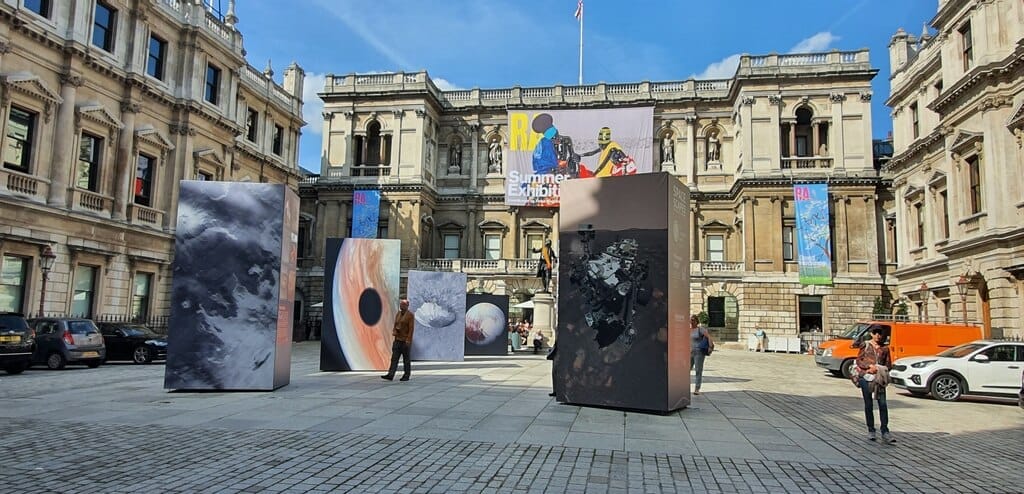
The RA sits at the heart of the West End, flanked by the commercial energy of Piccadilly and the quieter lanes around St James's. Walking from either Green Park or Piccadilly Circus takes roughly five minutes and deposits you through a gatehouse arch into the Burlington House forecourt — a sudden shift from pavement noise into a formal stone courtyard that functions as a kind of decompression chamber before the galleries themselves.
Burlington House: The Building as Attraction
Burlington House is the kind of building that rewards unhurried attention. The current Italianate palazzo facade along Piccadilly dates largely from the 1870s, when the government redeveloped the earlier mansion into a complex of learned societies — the Royal Astronomical Society, the Geological Society, the Royal Society of Chemistry, and others still occupy the surrounding wings. The RA anchors the north side of the courtyard with its grand entrance block.
Inside, the main staircase is a statement in itself: wide stone steps rising beneath a coffered ceiling, with casts of classical sculpture positioned at intervals. It is worth pausing here even before entering the first gallery. The John Madejski Fine Rooms on the first floor, used for displaying works from the RA's Collection, preserve much of the original Georgian interior: silk-hung walls, ornate plasterwork, and natural light through tall sash windows. These rooms are often quieter than the main exhibition spaces and give a sense of what the building looked like when it was the centre of London's official art world in the late 18th century.
The 2018 expansion — opening Burlington Gardens, a former government building to the north, as the RA's second campus — significantly expanded the institution's footprint. The two buildings are now connected at upper level, allowing visitors to move between them without returning to the street. Burlington Gardens houses a dedicated lecture theatre, additional gallery spaces, and a restaurant that is significantly calmer than the ground-floor café on the Piccadilly side.
💡 Local tip
The Burlington House courtyard is freely accessible from Piccadilly during opening hours and is worth a brief stop even if you are not entering the galleries — the architecture, the sculpture plinth at its centre, and the sudden quiet are all notable.
Tickets & tours
Hand-picked options from our booking partner. Prices are indicative; availability and final rates are confirmed when you complete your booking.
The Cotswolds day trip from London
From 67 €Instant confirmationFree cancellationThe British Royalty Tour with Changing of The Guard Ceremony
From 30 €Instant confirmationFree cancellationRoyal Windsor Afternoon Tour
From 87 €Instant confirmationFree cancellationChanging of the Guard and Royal Palaces Private Tour
From 146 €Instant confirmationFree cancellation
What to Expect Inside: Exhibitions and Permanent Collection
The RA does not have a large permanent display in the way the British Museum or the National Gallery does. Its strongest public-facing asset is its programme of large-scale temporary exhibitions, typically running for eight to twelve weeks each. These span the full range: major retrospectives of canonical figures, group shows exploring a period or theme, architecture exhibitions, and occasionally photography. The quality is consistently high, and the curatorial framing tends to be more ambitious than at purely commercial venues.
The Permanent Collection, shown in the Fine Rooms and rotated throughout the year, includes works donated or deposited by Academicians since the 18th century. Michelangelo's unfinished tondo known as the Taddei Tondo is a major highlight — a circular marble relief depicting the Madonna and Child, one of only four Michelangelo sculptures outside Italy. It is displayed in a dedicated space and worth seeking out specifically. The collection also includes portraits by Reynolds and Gainsborough, architectural drawings, and an extensive print collection.
The annual Summer Exhibition, held each year from June through August, is one of London's more unusual cultural events: an open submission show where any artist — professional or amateur — can enter work for consideration, and thousands of pieces are displayed and sold. It tends toward cheerful visual overload rather than curatorial restraint, and reactions divide sharply. For visitors interested in contemporary art in a broader London context, it pairs naturally with a visit to Tate Modern or the National Gallery to understand where the RA sits within London's wider art ecology.
How the Experience Changes by Time of Day
Tuesday through Thursday mornings, especially before noon, are the calmest periods. The galleries are lightly populated, the main staircase is mostly yours, and the Fine Rooms can feel private. This is the window for unhurried looking, for reading the wall texts without being jostled, and for spending time with the Taddei Tondo without a queue forming behind you.
Weekends change the character considerably. The forecourt fills from mid-morning, the ground-floor café has a persistent queue by 11:00, and blockbuster exhibitions become crowded by early afternoon. For popular shows, weekend visits benefit from advance timed tickets even when not strictly required — the difference between a 10:00 slot and walking in at 14:00 on a Saturday can be significant.
Friday evenings are a distinct proposition. The RA stays open until 21:00 on Fridays, and a post-work crowd arrives from roughly 18:00 onward — younger, less structured in its movement through the galleries, and often continuing to the Burlington Gardens restaurant or bar afterward. It is livelier than a typical museum evening but without the forced festivity of a ticketed late-night event. If you want to see a major exhibition in a more relaxed atmosphere than a weekend afternoon, Friday from 17:00 to 19:00 is often the most agreeable window.
ℹ️ Good to know
The RA is closed on Mondays. Hours are Tuesday–Sunday 10:00–18:00, with late opening until 21:00 on Fridays. Hours can vary for specific exhibitions or special events, so check royalacademy.org.uk before visiting.
Practical Walkthrough: Getting There and Getting Around
The main entrance is on Piccadilly, accessed through the archway from the street. The Burlington Gardens entrance (at 6 Burlington Gardens) is the alternative approach from the north and can be less congested during popular shows. Both entrances are step-free at ground level, and the RA provides accessible routes throughout the expanded building, including a lift connecting the two main floors. Accessible toilets and induction loops are available; the RA's dedicated access page at royalacademy.org.uk sets out current provisions in detail.
Green Park station (Jubilee, Victoria, and Piccadilly lines) exits directly onto Piccadilly and is a five-minute walk east to the RA forecourt arch. Piccadilly Circus (Bakerloo and Piccadilly lines) is a comparable walk west along Piccadilly. Several bus routes stop along Piccadilly itself. There is no dedicated car parking at Burlington House, and driving to this part of central London incurs the Congestion Charge on weekdays.
The RA sits within easy walking distance of several other West End institutions. The National Gallery and National Portrait Gallery are a 15-minute walk east via Piccadilly and St Martin's Lane. For visitors building a day around London's museum offerings, the RA works naturally as a morning stop before heading to those free national collections in the afternoon.
Photography, Food, and Practical Notes
Photography policies vary by exhibition. The RA's Permanent Collection displays in the Fine Rooms generally permit non-flash photography for personal use, but temporary exhibitions frequently prohibit photography entirely due to lender conditions. Check the signage at the entrance to each specific gallery before shooting — it is clearly posted and the gallery staff enforce it consistently.
There are food options within the building. The ground-floor café near the Piccadilly entrance is compact and busy on weekends, serving sandwiches, pastries, and hot drinks. The Burlington Gardens restaurant at the northern end of the complex is more spacious, runs a proper lunch and evening menu, and has a bar that stays open during Friday late openings. For visitors who want to eat as part of the visit rather than as an afterthought, arriving via Burlington Gardens and starting with the restaurant makes logistical sense.
The RA shop is well-stocked without being overwhelming — exhibition catalogues, art books, and a curated range of prints. If you are visiting London specifically for cultural reasons, the catalogues here are often the most thorough available for whatever major show is running. The RA sits within the broader context of London's best museums and is worth factoring into any multi-day cultural itinerary.
⚠️ What to skip
The RA does not offer free admission to major exhibitions (unlike several national museums nearby). Budget accordingly, and book tickets online in advance for popular shows to avoid the in-person queue and potential sellouts.
Worth Knowing: Is It Worth Your Time?
The RA is not a guaranteed recommendation regardless of when you visit. Its value depends almost entirely on the current exhibition programme. When the main show is a well-chosen retrospective or a rigorously curated thematic exhibition, Burlington House is one of the finest places in London to see serious art. When the programme is between major shows or relies on a subject that does not interest you, the Permanent Collection and Fine Rooms alone — though worth seeing — may not justify the journey from across the city.
For first-time visitors to London with limited days, the RA competes directly with the free national collections nearby. If you are working through a tight itinerary, review the current programme at royalacademy.org.uk before committing time and money. If you are on a longer trip and want to go deeper into London's cultural life, the RA is an essential stop. It pairs well with an afternoon at the Courtauld Gallery — another independent institution with a focused, high-quality collection — for a day centred on art that rewards attention rather than spectacle.
Those who will not enjoy the RA: visitors primarily interested in ancient or medieval history, anyone who prefers vast permanent collections they can return to repeatedly without additional cost, and children below about twelve who have limited patience for gallery formats. The building itself is impressive enough to hold most visitors' attention briefly, but the programming is pitched squarely at adults with a genuine interest in fine art and architecture.
Insider Tips
- Book exhibition tickets for a specific timed slot online, even if slots appear available — walk-up queues at the ticket desk during popular shows can add 20–30 minutes to your entry time, especially on weekends.
- The Taddei Tondo by Michelangelo is displayed in the Fine Rooms of the Permanent Collection, which are separate from the main ticketed exhibition spaces — you can see this remarkable sculpture without paying for the current show by asking staff for the Permanent Collection access route.
- Friday evenings offer a noticeably different atmosphere: the crowd is younger, the galleries are calmer than a Saturday afternoon, and the Burlington Gardens bar is open. It is one of the more enjoyable ways to spend a London evening if you have a cultural appetite.
- The Burlington Gardens entrance on the north side of the building is far less used than the Piccadilly arch and is worth knowing if the forecourt is crowded or you are approaching from Bond Street or St James's.
- The RA's exhibition catalogues are produced at a high standard and are often more comprehensive than equivalent publications from larger national museums. If you are visiting for a specific show, the catalogue is worth the cost as a reference that outlasts the visit.
Who Is Royal Academy of Arts For?
- Art enthusiasts wanting world-class temporary exhibitions in a historically significant London venue
- Architecture and design followers drawn to both the Burlington House building and the RA's regular architectural programming
- Cultural visitors on multi-day London itineraries who want to go beyond the free national collections
- Adults looking for a Friday evening activity that combines culture, food, and a relaxed bar setting
- Anyone specifically seeking out the Michelangelo Taddei Tondo — one of the most important sculptures in London
Nearby Attractions
Other things to see while in West End:
- British Library
The British Library holds over 170 million items spanning thousands of years of human thought, from the Magna Carta to Beatles lyrics. Entry to the building and permanent collection galleries is free, making it one of the most rewarding stops in central London for curious travellers.
- British Museum
The British Museum holds one of the world's great collections of human history and culture, spanning two million years across more than 60 free galleries. Entry to the permanent collection is free, but knowing how to navigate the scale of it makes the difference between a rewarding visit and an overwhelming one.
- Carnaby Street
Carnaby Street is the pedestrianised shopping district in Soho that defined the look of 1960s London and continues to draw fashion lovers, food hunters, and curious walkers today. Free to explore and five minutes from Oxford Circus, it rewards those who slow down and wander its connecting lanes.
- Coal Drops Yard
Coal Drops Yard is a redeveloped Victorian industrial estate in King's Cross, now home to independent retailers, restaurants, and bars set beneath strikingly restored brick vaults. The public outdoor spaces are free to enter and a short walk from King's Cross St Pancras station.