Rossio Square (Praça Dom Pedro IV): Lisbon's Living Room
Rossio Square, officially Praça Dom Pedro IV, has been Lisbon's central gathering place since the 13th century. Free to enter and open around the clock, it anchors the Baixa district with its wave-patterned pavement, bronze fountains, and the neoclassical D. Maria II National Theatre. Whether you're starting a morning walk or ending a night out, this square earns its place at the center of the city.
Quick Facts
- Location
- Praça Dom Pedro IV, Baixa, Lisbon (northern end of Rua Augusta)
- Getting There
- Rossio Metro Station (Green Line); Rossio Train Station is directly adjacent
- Time Needed
- 20-40 minutes to explore on foot; longer if you stop at a café
- Cost
- Free. No ticket required — open 24/7
- Best for
- Casual sightseeing, architecture, orientation walks, people-watching
What Is Rossio Square?
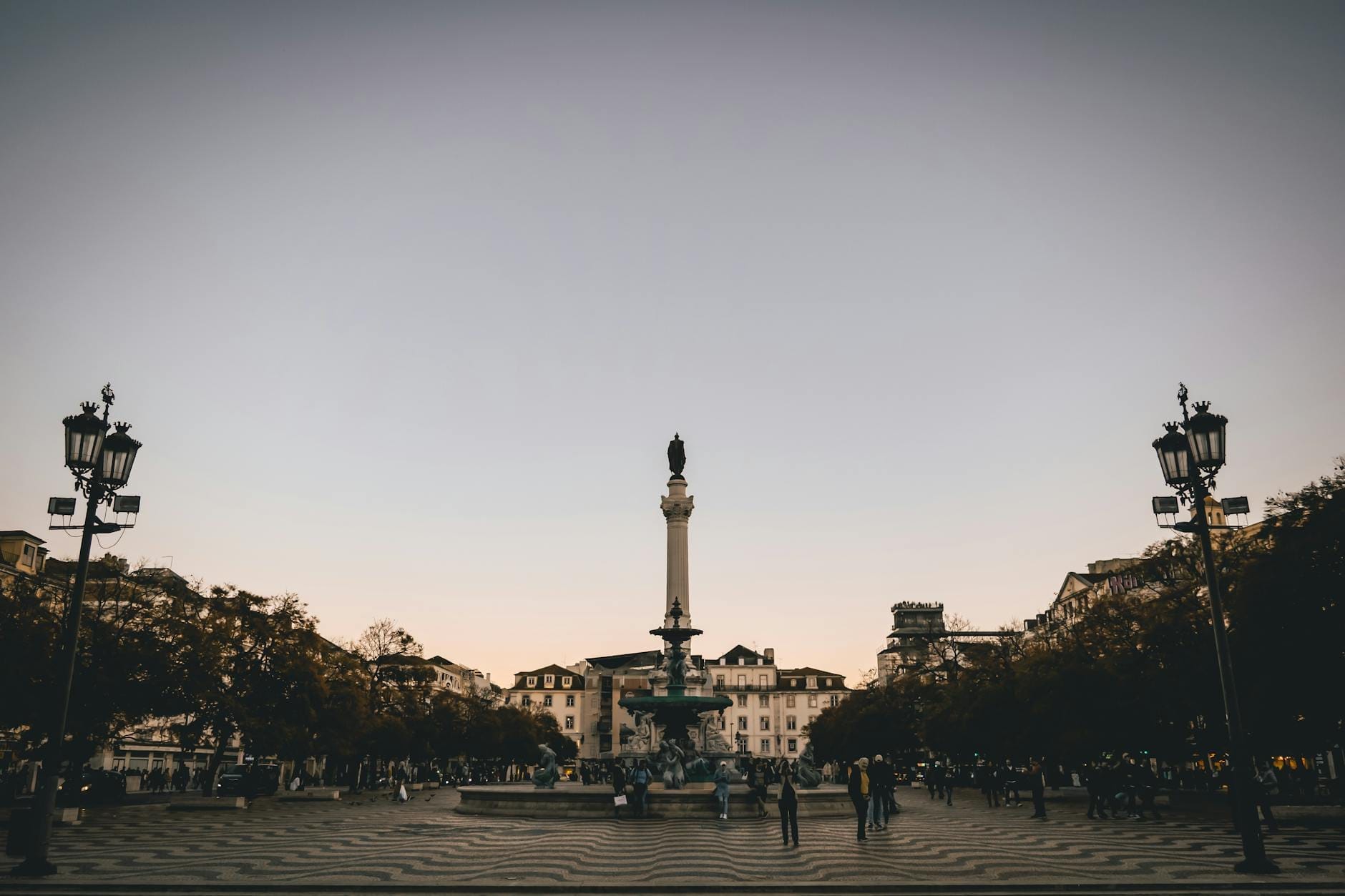
Praça Dom Pedro IV, almost universally known by its older name, Rossio Square, sits at the geographic and social center of Lisbon's lower city. It is a wide, open plaza roughly rectangular in shape, framed on its northern end by the grand D. Maria II National Theatre and flanked on all sides by 19th-century buildings whose ground floors house cafés, kiosks, and souvenir shops. Two large bronze fountains occupy the middle of the square, and at the center rises a 23-meter column topped by a bronze statue of King Pedro IV, installed in 1870 with its base completed in 1874.
The pavement is the square's most immediately striking feature: an undulating wave pattern in black basalt and white limestone, laid in 1848. On a bright morning, the contrast between dark stone and pale stone ripples underfoot like a frozen tide. It is visually arresting and genuinely beautiful, though you will notice quickly that the cobblestones are uneven and the wave pattern is more challenging to navigate than flat pavement.
⚠️ What to skip
Accessibility note: The traditional wave-patterned cobblestone pavement creates real difficulties for wheelchair users and anyone using a pram or rolling luggage. Smooth-soled shoes are also slippery when wet. Wear footwear with grip if rain is forecast.
A Square Built on History
Rossio's origins stretch back to the 13th century, when this open ground served as a commons for the growing city below São Jorge Castle. For centuries it functioned as the city's main public stage: markets, festivals, bullfights, and, more grimly, public executions took place here. The Inquisition held its autos-da-fé in the square from 1540, making it a place of genuine historical weight beneath its current pleasant surface.
The 1755 earthquake, which destroyed much of Lisbon, forced a wholesale rebuilding of the Baixa district under the direction of the Marquis of Pombal. The square was reconfigured as part of the rational Pombaline grid that now defines the lower city. The D. Maria II National Theatre, completed in 1842 by the Italian architect Fortunato Lodi, was built directly on the site of the former Palace of the Inquisition. Its neoclassical facade, with a portico of Ionic columns and statues of Portuguese dramatists in the niches, gives the northern end of the square a formal grandeur that anchors the whole space.
The square sits at the northern terminus of Rua Augusta, Lisbon's main pedestrian shopping street, which runs south toward the river and the Arco da Rua Augusta. Walking up from the water toward Rossio gives you a sense of how deliberately the Pombaline planners organized the city's public spine.
Tickets & tours
Live prices and dates from our booking partner. If you book, we may earn a commission at no extra cost to you.
Belem and Modern Lisbon bus hop-on hop-off combined tickets
From 28 €Instant confirmationFree cancellationSt. George Castle E-ticket and Audio Tour
From 28 €Instant confirmationLisbon Story Centre entrance tickets
From 7 €Instant confirmationFree cancellationYellow boat river tour
From 24 €Instant confirmationFree cancellation
How the Square Changes Through the Day
Early mornings at Rossio are quiet and photogenic. By 7 or 8 a.m., the outdoor kiosks are open, selling espresso and pastries to commuters crossing the square on their way to the metro or train station. The light at this hour hits the theatre facade directly, making it ideal for architectural photography without crowds in your frame. The fountains are usually running, and the sound of water carries clearly before traffic builds.
By mid-morning, tourist foot traffic increases steadily. Tour groups gather near the column, and the café terraces fill up. The square never feels cramped because of its size, but by noon in summer the exposed stone radiates heat and there is almost no shade. If you are visiting between June and August, arriving before 10 a.m. or after 6 p.m. makes a significant difference in comfort.
Evenings shift the atmosphere entirely. Locals reclaim the square after working hours: couples walk circuits around the fountains, older residents sit on the low ledges near the column, and the café terraces stay busy well past dark. The National Theatre is illuminated, the bronze of the fountains catches the lamplight, and the square takes on a warmer, less transactional character than it has during the tourist-heavy afternoon.
💡 Local tip
Best photography window: early morning (7-9 a.m.) for clean light on the theatre facade and near-empty pavement, or blue hour (just after sunset) when the illuminated theatre reflects in the fountain basins.
The Rossio Train Station: Worth Stopping Inside
Immediately adjacent to the square's western side stands the Rossio Train Station, built between 1886 and 1887 in a florid Neo-Manueline style. The two horseshoe-arched doorways on its facade are among the most ornate pieces of 19th-century architecture in the city and are frequently mistaken by visitors for a palace or a church. The interior is functional but includes decorative tilework and ironwork that rewards a few minutes of attention.
The station serves trains to Sintra, making it a practical starting point if you plan a day trip. Departures are frequent, the journey takes roughly 40 minutes, and you board here rather than at the main Santa Apolónia or Oriente stations.
For a full day out of the city, the trains from Rossio connect you directly to Sintra, one of the most rewarding day trips from Lisbon. If you are planning that excursion, book your return ticket in advance during peak season — the platform gets crowded in the late afternoon.
Practical Walkthrough: What to See at Ground Level
Start at the southern end of the square, near where Rua Augusta feeds in. Face north. The full geometry of the space opens in front of you: the twin fountains symmetrically placed, the column rising above them, and the theatre as the backdrop. This is the view that appears in most photographs of the square, and it is worth pausing here for a moment before walking in.
The bronze fountains, installed in the 1880s, are larger than they appear in photos. Each basin is several meters across, and the figures on the central columns are detailed and well-cast. Walk close to examine the metalwork rather than photographing them from across the square.
The column of Pedro IV is functional rather than spectacular up close: its base carries relief panels depicting scenes from Pedro's reign, worth a slow look. The figure at the top is difficult to make out without binoculars. The pedestals surrounding the base carry allegorical figures representing Justice, Strength, Prudence, and Moderation.
After the square itself, walk west a block to check the exterior of the Rossio Train Station, then head south down Rua Augusta to reach Arco da Rua Augusta and eventually Praça do Comércio at the riverfront. The three spaces work naturally as a single walking sequence and take about an hour at a relaxed pace.
Honest Assessment: Is It Worth Your Time?
Rossio Square is not an attraction you book in advance or dedicate a morning to. It is a transitional space that rewards a 20-to-40-minute visit, particularly if you combine it with the surrounding area. The square itself is handsome and historically significant, but it does not have the immersive quality of Lisbon's older quarters or the drama of its hilltop viewpoints.
Visitors who arrive expecting a quiet, atmospheric piazza may find the commercial surroundings and midday crowds less appealing. The kiosks sell tourist-grade merchandise, and the café terraces are priced for the tourist market rather than the local one. None of this diminishes the square's appeal as an orientation point and architectural set piece, but managing expectations matters.
Travelers looking for the more atmospheric side of Lisbon's public spaces will find it in the quieter miradouros of Alfama and Graça, or in the tiled plazas of Bairro Alto. Rossio is best understood as a starting point rather than a destination on its own.
ℹ️ Good to know
Who might skip Rossio: If your time in Lisbon is very limited and you are prioritizing experiential depth over historical orientation, the square can be seen in passing rather than as a dedicated stop. It sits between several better uses of your afternoon.
Insider Tips
- The kiosk at the southern end of the square, near the Rua Augusta junction, consistently has shorter queues than the ones near the theatre. If you want a quick coffee without the wait, aim for the southern kiosks rather than those at the center.
- The D. Maria II National Theatre has a schedule of performances worth checking if you are staying more than two nights. The building's interior matches its exterior in quality, and attending a performance gives you access to spaces tourists otherwise never see.
- The Rossio Train Station's horseshoe arch doorways photograph best in the late afternoon when the west-facing facade catches direct light. They are deeply shadowed in the morning and flat in harsh midday sun.
- If the square is crowded, walk one block north to Praça dos Restauradores. It is calmer, has a large obelisk commemorating Portuguese independence, and connects to the Avenida da Liberdade without retracing your steps through the tourist core.
- Pickpockets do operate in and around Rossio, particularly during busy summer afternoons and when the square hosts public events. Use a front pocket or closed bag when the crowd density is high — this is a general precaution, not cause for alarm.
Who Is Rossio Square For?
- First-time visitors needing a central orientation point in Baixa
- Architecture enthusiasts interested in Pombaline urban planning and Neo-Manueline design
- Travelers connecting to the Sintra train from the adjacent station
- Evening walkers who want to see the square at its most photogenic and least crowded
- Those building a walking itinerary that links the waterfront to the upper city
Nearby Attractions
Other things to see while in Baixa & Chiado:
- A Ginjinha
Open since 1840 and still run by the same family, A Ginjinha is the counter-sized bar that started Lisbon's love affair with ginjinha. There's no seating, no menu, and no fanfare — just a shot glass, a sour cherry, and nearly two centuries of tradition.
- Arco da Rua Augusta
The Arco da Rua Augusta anchors the northern edge of Praça do Comércio with neoclassical grandeur, commemorating Lisbon's post-earthquake rebirth. Climb to the rooftop terrace for an unbroken view across the Tagus River and the Baixa grid below. Small in scale, big in context.
- Carmo Convent
The Convento da Ordem do Carmo is Lisbon's most visually arresting survivor of the 1755 earthquake. Its roofless Gothic nave, open to the sky for nearly 270 years, now shelters an archaeological museum with Peruvian mummies and pre-historic artifacts. It is equal parts ruin, museum, and meditation on disaster.
- Elevador de Santa Justa
The Elevador de Santa Justa is a 45-metre Neo-Gothic iron structure that has been hauling passengers between the flat streets of Baixa and the hilltop Largo do Carmo since 1902. It's one of Lisbon's most recognisable landmarks, but knowing when to go and what you're actually paying for makes all the difference between a queue and a genuine experience.
Planning a trip? Discover personalized activities with the Nomado app.