Praça do Comércio: Lisbon's Grand Gateway to the River
Praça do Comércio is Lisbon's most monumental public square, stretching along the Tagus River in the heart of Baixa. Once the seat of royal power, this 30,600-square-metre space is free to enter and rewards visitors at any hour — from quiet morning walks to golden-hour crowds gathering at the waterfront.
Quick Facts
- Location
- Praça do Comércio, 1100-148 Lisboa — Baixa waterfront, Tagus River
- Getting There
- Terreiro do Paço ferry terminal (on-site); buses on Rua do Arsenal; walkable from Rossio Square via Rua Augusta
- Time Needed
- 30–60 minutes for the square itself; 2–3 hours with Arco da Rua Augusta and waterfront walk
- Cost
- Free (square); Arco da Rua Augusta viewpoint €3 adults; museums vary (approx. €7.50 adults)
- Best for
- Architecture lovers, history seekers, photography, waterfront strolls, first-time visitors
What Is Praça do Comércio?
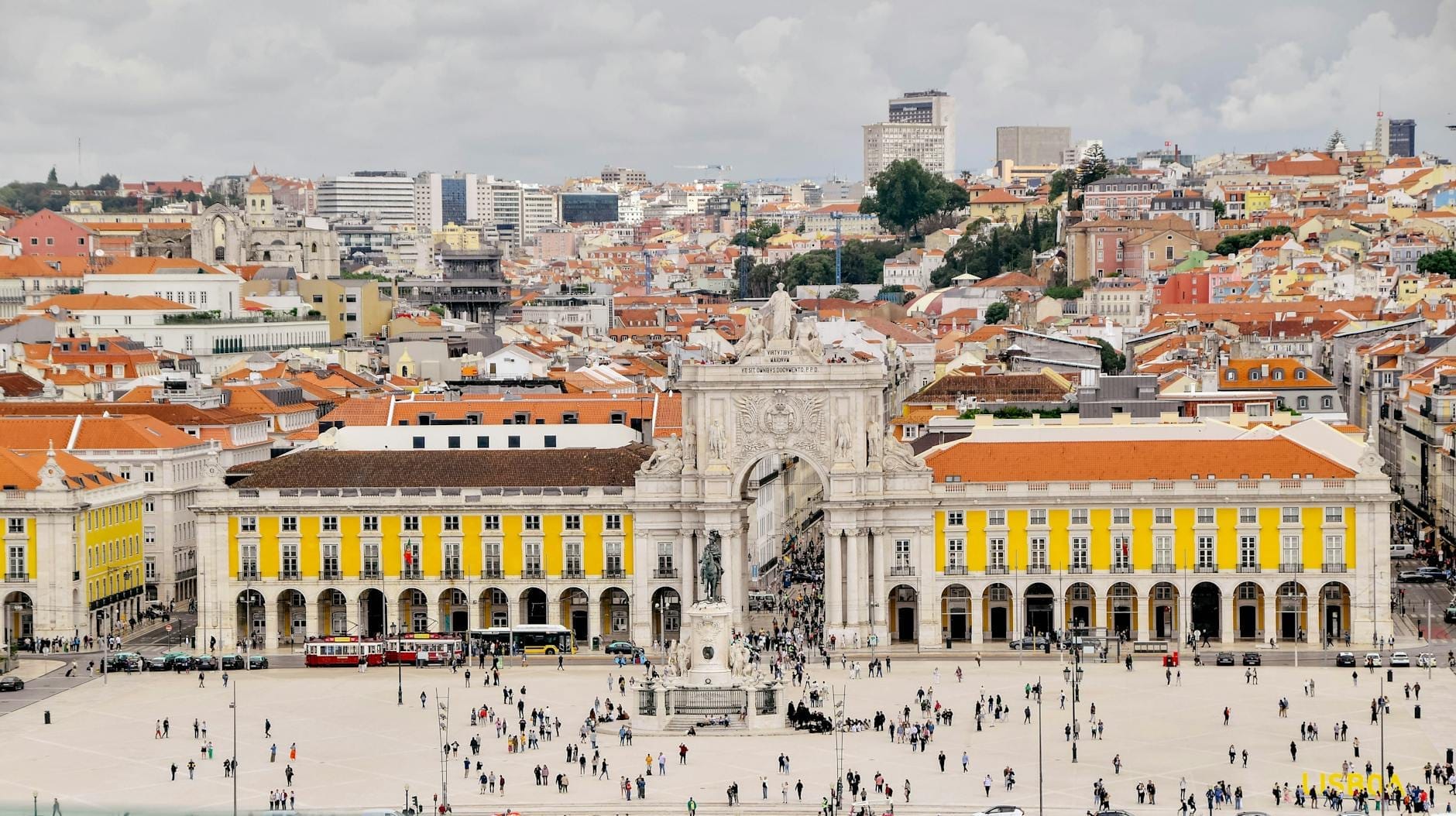
Praça do Comércio, also known historically as Terreiro do Paço, is Lisbon's largest and most ceremonially significant public square. Sitting directly on the northern bank of the Tagus River in the Baixa district, it covers roughly 30,600 square metres, making it one of the largest riverside squares in Europe. Three sides are enclosed by matching arcaded buildings painted in a distinctive ochre-yellow, while the fourth side opens completely onto the water, giving the space an almost theatrical relationship with the river.
The square is the natural endpoint of Rua Augusta, Lisbon's main pedestrian thoroughfare, and the two work as a pair: one funnels you through the commercial heart of Baixa-Chiado, and the other delivers you to the river with maximum drama. Entering through the triumphal arch from the north, the scale of the square hits you immediately. It does not sneak up on you.
💡 Local tip
Arrive from Rua Augusta and walk through the Arco da Rua Augusta rather than around it. The axis from arch to river is the intended approach, and it frames the square perfectly.
A Square Built on Catastrophe: The History
Before 1755, this site was not a public square at all. The Paço da Ribeira, the principal royal palace of Portugal, occupied the riverfront here for over two centuries. On the morning of 1 November 1755, a catastrophic earthquake followed by fires and a tsunami destroyed the palace and most of central Lisbon. The death toll ran into the tens of thousands.
What rose from the rubble was the vision of the Marquis of Pombal, the minister who directed Lisbon's reconstruction. Rather than rebuilding the palace, Pombal reimagined this space as a symbol of commercial and civic power. The arcaded buildings that frame three sides of the square were designed to house government ministries, and the open waterfront declared Lisbon's identity as a trading capital facing outward toward the Atlantic. The grid of streets running north from the square, the rational Pombaline baixa, was also his blueprint.
At the centre of the square stands an equestrian bronze statue of King José I, cast in 1775 by sculptor Joaquim Machado de Castro. It was the first major bronze equestrian statue produced in Portugal and remains one of the finest in Europe. The king faces the river, as though presiding over the maritime commerce that once made Lisbon one of the world's wealthiest cities.
Tickets & tours
Live prices and dates from our booking partner. If you book, we may earn a commission at no extra cost to you.
Belem and Modern Lisbon bus hop-on hop-off combined tickets
From 28 €Instant confirmationFree cancellationSt. George Castle E-ticket and Audio Tour
From 28 €Instant confirmationLisbon Story Centre entrance tickets
From 7 €Instant confirmationFree cancellationYellow boat river tour
From 24 €Instant confirmationFree cancellation
How the Square Changes Through the Day
Early mornings before 9am belong to commuters and joggers. The ferry terminal on the eastern edge brings workers across from the south bank, and they flow through the arcades without stopping. The square feels vast at this hour, the cobblestones still damp if there was overnight dew, the Tagus silver-grey in the low light. This is the best time for photography: no tour groups, clean lines, and the warm eastern light angling across the arcaded facades.
By mid-morning, the tourist rhythm picks up. Café tables under the arcades fill with people pausing before or after the Arco da Rua Augusta. The square never feels dangerously crowded the way some smaller Lisbon attractions do, because the sheer physical space absorbs volume well. Even in summer, you can find a quiet corner near the river railing.
Late afternoon is arguably the most rewarding time to visit. The sun drops toward the west, the light warms, and the Tagus picks up colour. Locals and tourists alike gravitate to the waterfront steps where the square meets the river, sitting on the wide stone ledges, facing the water. It becomes a naturally social space, unhurried and peaceful, in a way that few city squares manage.
ℹ️ Good to know
Praça do Comércio hosts outdoor concerts, festivals, and public events throughout the year, particularly around the Santo António festival in June. Check local listings before visiting if you want to avoid (or specifically catch) a large crowd event.
The Arco da Rua Augusta: Worth Climbing?
The triumphal arch at the northern end of the square, the Arco da Rua Augusta, is the square's most photographed feature. Its rooftop terrace, reached by lift and a short stair, offers a direct overhead view onto the square and a clear sightline to the river. The climb costs €3 for adults and is well worth it specifically for that aerial perspective, which makes the geometry of Pombaline Baixa suddenly legible: the grid of streets, the rectangle of the square, the blue line of the Tagus.
The arch was completed in 1873, more than a century after the earthquake reconstruction it crowned. The allegorical figures across its top represent Glory, Genius, and Valour, with statues of Vasco da Gama and the Marquis of Pombal flanking the central arch below. From street level these details are easy to miss. From the terrace, you look down on them and see the craftsmanship more clearly.
Practical Walkthrough: Getting There and Around
Praça do Comércio is straightforward to reach from most of central Lisbon. The most atmospheric approach is on foot down Rua Augusta from Rossio Square, a flat ten-minute walk through the pedestrian shopping street. From Alfama or São Jorge Castle, the square is about a twenty-minute downhill walk. There are also buses running along Rua do Arsenal on the western edge of the square.
If you are arriving by ferry from Almada or Cacilhas on the south bank, the Terreiro do Paço ferry terminal lands you directly at the square's eastern edge — a genuinely pleasant entry point. The ferry connection also makes the square a logical starting point for a trip to see Cristo Rei across the river.
The square's surface is flat, wide, and evenly paved, making it one of the most accessible spots in Lisbon for wheelchair users and families with pushchairs. There are no steps to navigate within the main square itself. Café seating under the arcades is available at several establishments, with prices typical of a prime tourist location, roughly €2.50–4.00 for a coffee.
⚠️ What to skip
The cafés and restaurants immediately under the arcades facing the square charge a premium for their location. For better value, walk one block inland toward Rua do Arsenal or Rua da Alfândega.
Photography Tips and What to Bring
The square's ochre facades photograph best in morning or late afternoon light, when the sun angles across rather than directly overhead. Midday in summer produces flat, harsh light and heavy shadows under the arcades. For the classic wide shot of the square with the arch in the background, position yourself near the riverfront railing and shoot north. For the equestrian statue against the river, shoot from behind the statue toward the Tagus.
Lisbon's most photogenic spots are often the obvious ones, and Praça do Comércio is no exception. What separates a strong shot here from a generic one is timing and angle. The view from the Arco da Rua Augusta terrace is unusual enough to stand out. The riverfront at sunset, with the arch behind you and the Tagus glowing, is among the better urban landscape shots available in the city without hiking to a miradouro.
Wear comfortable shoes. While the square itself is flat, any Lisbon day will involve cobblestones and hills once you leave it. Bring water, particularly in summer: the square is almost entirely exposed, with minimal shade except under the arcades.
Honest Assessment: Overhyped or Worth It?
Praça do Comércio is not a place to spend hours in passive contemplation. Its power is architectural and historical rather than experiential. It is a setting, a frame, more than a destination in itself. Visitors who expect it to feel atmospheric in the way Alfama's narrow streets do may find it surprisingly open and impersonal. That openness is actually the point: the square was designed as a ceremonial stage, not an intimate space.
For first-time visitors to Lisbon, it is an essential orientation point. Standing at the waterfront, looking south across the Tagus toward the hills of the south bank, with the Ponte 25 de Abril suspension bridge visible in the distance to the west, you understand Lisbon's relationship with its river in a way that no photograph or map quite prepares you for. That moment of spatial understanding is worth the visit even if you spend only fifteen minutes here.
Travelers who prefer historic interiors, museum depth, or the textured character of older neighborhoods will find the square most useful as a transit point rather than a destination. That is a legitimate way to use it.
Insider Tips
- The ferry from Terreiro do Paço to Cacilhas costs around €1.60 and takes twelve minutes. It is one of the most scenic short crossings in any European capital and gives you a view of the entire Lisbon waterfront from the water.
- The western arcade houses a branch of the Lisboa Story Centre, a multimedia museum on the city's history including the 1755 earthquake. It is a good rainy-day option and the earthquake simulation room is more affecting than you expect.
- For a free elevated view of the square, walk up to Miradouro de Santa Luzia in Alfama. You will not see the square itself, but you will see the riverfront and understand the geography better than from ground level.
- Pigeons and occasional street vendors cluster around the central statue. If you want unobstructed photos of the equestrian statue, the early morning window before 8:30am is the cleanest.
- The square is the traditional endpoint of large public demonstrations and celebrations in Lisbon. If you see crowds assembling or barriers going up, ask locals or check listings — you may have accidentally timed your visit to a major event.
Who Is Praça do Comércio For?
- First-time visitors to Lisbon wanting to understand the city's scale and waterfront geography
- Architecture and urban history enthusiasts interested in Pombaline reconstruction
- Photographers seeking wide, uncluttered city and river compositions
- Travelers combining a morning walk down Rua Augusta with a Tagus River ferry crossing
- Families and wheelchair users looking for a flat, accessible central landmark
Nearby Attractions
Other things to see while in Baixa & Chiado:
- A Ginjinha
Open since 1840 and still run by the same family, A Ginjinha is the counter-sized bar that started Lisbon's love affair with ginjinha. There's no seating, no menu, and no fanfare — just a shot glass, a sour cherry, and nearly two centuries of tradition.
- Arco da Rua Augusta
The Arco da Rua Augusta anchors the northern edge of Praça do Comércio with neoclassical grandeur, commemorating Lisbon's post-earthquake rebirth. Climb to the rooftop terrace for an unbroken view across the Tagus River and the Baixa grid below. Small in scale, big in context.
- Carmo Convent
The Convento da Ordem do Carmo is Lisbon's most visually arresting survivor of the 1755 earthquake. Its roofless Gothic nave, open to the sky for nearly 270 years, now shelters an archaeological museum with Peruvian mummies and pre-historic artifacts. It is equal parts ruin, museum, and meditation on disaster.
- Elevador de Santa Justa
The Elevador de Santa Justa is a 45-metre Neo-Gothic iron structure that has been hauling passengers between the flat streets of Baixa and the hilltop Largo do Carmo since 1902. It's one of Lisbon's most recognisable landmarks, but knowing when to go and what you're actually paying for makes all the difference between a queue and a genuine experience.
Planning a trip? Discover personalized activities with the Nomado app.