Arco da Rua Augusta: Lisbon's Triumphal Arch Above the City
The Arco da Rua Augusta anchors the northern edge of Praça do Comércio with neoclassical grandeur, commemorating Lisbon's post-earthquake rebirth. Climb to the rooftop terrace for an unbroken view across the Tagus River and the Baixa grid below. Small in scale, big in context.
Quick Facts
- Location
- Rua Augusta 2, Baixa, Lisboa — northern end of Praça do Comércio
- Getting There
- Metro: Terreiro do Paço (Blue Line)
- Time Needed
- 45–75 minutes
- Cost
- €3 adults; free under-5s; included with Lisboa Card
- Best for
- History lovers, photography, understanding Lisbon's urban layout
What Is the Arco da Rua Augusta?
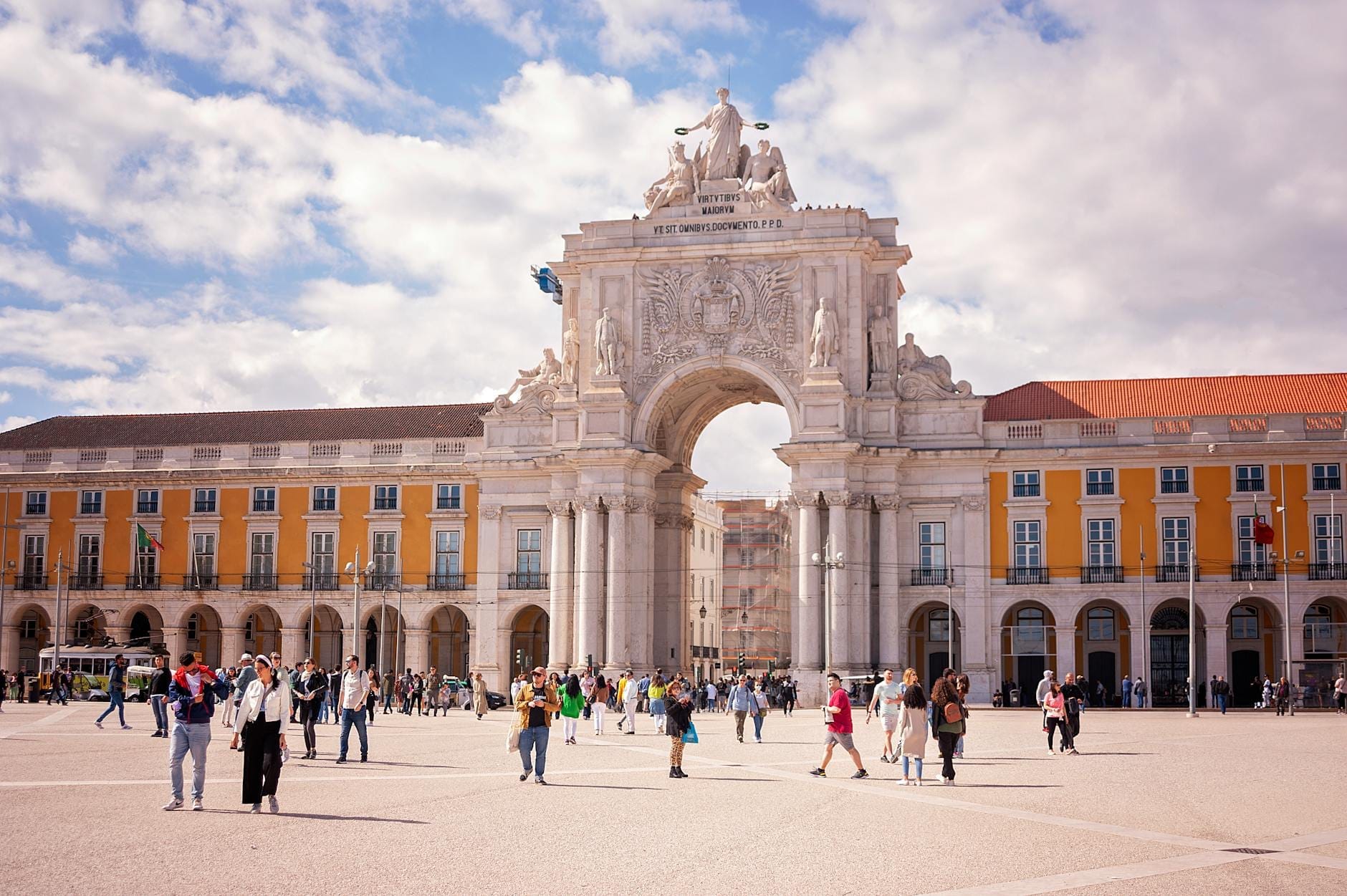
The Arco da Rua Augusta is a neoclassical triumphal arch standing at the northern boundary of Praça do Comércio, where the pedestrian street of Rua Augusta meets the grand riverside square. It is the formal gateway between Lisbon's commercial heart and its waterfront, and it reads as the city's most explicit architectural statement of civic pride and historical memory.
The arch was conceived as part of the post-earthquake reconstruction ordered by the Marquis of Pombal, who rebuilt Baixa from near-total rubble after the catastrophic 1755 earthquake, tsunami, and fire. The design was first planned around 1775, but construction only began in 1862 and was completed in 1873, meaning the arch took nearly a century from conception to completion. Until 2013, it was visible only from the outside. Since then, the interior has been opened to the public, with a small exhibition level and a rooftop terrace that gives a perspective of Lisbon most visitors never see.
💡 Local tip
The arch is free to view from the street. The €3 adult ticket covers the interior exhibition and rooftop terrace, children up to 5 enter free, and the Lisboa Card includes admission. It is a worthwhile add-on if you're already using the card for transport.
The Architecture and Its Symbolic Language
The arch is 30 meters tall, executed in stone with a single central barrel vault and two smaller lateral arches for pedestrian flow. At the top, a large sculptural group depicts Glory crowning Valor and Genius, flanked by allegorical figures on either side. Below them, four historical figures stand in niches: Viriatus, the Lusitanian warrior who resisted Roman conquest; Nuno Álvares Pereira, the medieval military leader; Vasco da Gama, who opened the sea route to India; and the Marquis of Pombal himself, the Enlightenment minister who rebuilt the city.
The Latin inscription carved across the arch reads "Virtutibus Maiorum Ut Sit Omnibus Documento" — meaning 'To the virtues of the greatest, so that it may serve as a lesson to all.' This framing is deliberate: the arch was always intended not merely as a gate, but as a monument to Portuguese resilience and historical greatness, positioned precisely where citizens entering from the Tagus would first encounter the rebuilt city.
The arch sits within the Pombaline architectural grid of Baixa, which is itself worth understanding as one of Europe's earliest examples of earthquake-resistant urban planning. The symmetry visible from the rooftop terrace — parallel streets converging toward the river — was entirely intentional, a 18th-century vision of rational city design.
Tickets & tours
Live prices and dates from our booking partner. If you book, we may earn a commission at no extra cost to you.
Rua Augusta Arch entrance tickets
From 5 €Instant confirmationFree cancellationBelem and Modern Lisbon bus hop-on hop-off combined tickets
From 28 €Instant confirmationFree cancellationSt. George Castle E-ticket and Audio Tour
From 28 €Instant confirmationLisbon Story Centre entrance tickets
From 7 €Instant confirmationFree cancellation
The Rooftop Experience: What You Actually See
Access to the top involves an elevator that takes you to the exhibition level inside the arch, followed by 74 steps of a narrow spiral staircase to reach the terrace. The staircase is tight and single-file, so be prepared to wait on the way up or down during busier periods. People with mobility limitations should note that the elevator reaches only part of the way, with the final 74 steps unavoidable.
From the terrace, the view opens in two directions. To the south, you look directly over Praça do Comércio, with its equestrian statue of King José I at the center, the salmon-pink colonnaded arcades wrapping three sides, and the Tagus River filling the horizon. On clear days, you can make out Cristo Rei on the far bank. To the north, Rua Augusta stretches below you as a pedestrian corridor lined with mosaic pavements and café terraces, leading the eye up toward Rossio Square.
The scale of the Pombaline grid becomes immediately legible from this height. If you want to understand why Lisbon's Baixa feels so different from the older hilltop neighborhoods like Alfama, standing on this terrace and looking north makes it obvious: regular blocks, consistent building heights, streets designed to funnel air and allow for drainage after disaster.
ℹ️ Good to know
The terrace is open-air and exposed. In summer it can be intensely hot by midday; in winter, the wind off the river makes it colder than street level. Bring a light layer in the cooler months.
Best Time to Visit and How Crowds Behave
The arch opens daily at 10:00, and the first hour tends to be the quietest. Midday, particularly between 12:00 and 15:00, is consistently the most crowded period, when cruise ship passengers and tour groups move through the Baixa in volume. The terrace is small, and with a dozen people on it, it begins to feel cramped. If you can arrive before 11:00 or after 16:00, you will typically have more space and a calmer experience.
Late afternoon offers the best light for photography if you are shooting south toward the river — the low sun catches the Tagus and casts long shadows across Praça do Comércio. Morning light works better if you are shooting north along Rua Augusta, with the city illuminated and the street still relatively empty.
The arch closes at 19:00, with last entry before that time. It is closed on December 25, and hours may be reduced on other holidays. Verify current hours before visiting, particularly if you are planning around a public holiday.
Getting There and Combining with Nearby Sights
The most straightforward approach is the Metro to Terreiro do Paço station on the Blue Line, which deposits you directly at the river side of Praça do Comércio. From there, walk north through the square and the arch is immediately in front of you. The walk from Rossio Metro station is also entirely flat and takes about eight minutes south along Rua Augusta.
A natural itinerary pairs the arch with a walk up Rua Augusta to Rossio Square, a detour to the Elevador de Santa Justa (which is a few blocks west), and lunch or coffee at one of the cafés along the pedestrian street. This is a walkable half-day circuit entirely within Baixa-Chiado.
The area around the arch is also the heart of Lisbon street performance, particularly in the warmer months. Fado singers, brass groups, and solo musicians rotate through the pedestrian stretch of Rua Augusta throughout the day. The quality varies considerably, but at its best it adds an atmospheric soundtrack to a slow walk toward the arch.
Photography Tips and Practical Notes
The most photographed angle is from ground level inside Praça do Comércio, looking north through the arch with Rua Augusta framed in the barrel vault behind. This shot works best in morning light, before the tour groups arrive, when the street behind is relatively quiet.
From the terrace, a wide-angle lens is useful for capturing both the square and the river in the same frame. A standard phone camera will capture the view but may struggle with the contrast between the bright river and the shadowed square on sunny afternoons. Early morning or overcast days reduce this contrast and tend to produce more evenly exposed shots.
Note that the terrace railing is solid stone to chest height, with a narrow open section above. The gap is sufficient for camera lenses but does require some positioning. Tripods are not practical in the limited space when other visitors are present.
⚠️ What to skip
The 74 steps from the elevator to the terrace are narrow and not suitable for pushchairs or visitors with limited mobility. The interior exhibition level, reached by elevator, is accessible — but the terrace view requires the stair climb.
Is It Worth the Ticket Price?
At €3, the arch offers honest value if you are interested in either the history of Lisbon's reconstruction or the rooftop view. The interior exhibition is modest in size but provides clear context about the post-earthquake rebuilding and the arch's long construction timeline. It is not a large museum, and visitors who are primarily drawn by the view will spend most of their time on the terrace.
For a free rooftop experience with a broader panorama, Miradouro das Portas do Sol and the other hillside viewpoints offer sweeping city views at no cost. The arch's value is specifically its position above the Pombaline grid and the Praça do Comércio, which no hilltop viewpoint can replicate. If that framing is meaningful to you, pay for it.
Visitors who find Lisbon's 18th-century history uninteresting, or who are simply looking for the best city panorama, may find other viewpoints more rewarding. The arch is specific in what it shows you, and it rewards curiosity about urban planning and Portuguese history more than a casual glance does.
Insider Tips
- Buy your ticket online in advance if visiting on a weekend in summer. Walk-up queues at the ticket window can add 20-30 minutes to your visit during peak season.
- The exhibition level inside the arch, reached by elevator, is often overlooked by visitors rushing to the terrace. Spend five minutes here — the scale models and explanatory panels on the Pombaline reconstruction put the entire district into context.
- If you are visiting Praça do Comércio anyway, looking back north through the arch from the center of the square costs nothing and gives the most iconic view. Many visitors get the visual payoff without ever going inside.
- The arch is included in the Lisboa Card, which also covers metro travel and many museum entries. If you are planning more than two or three paid attractions in a day, the card is likely worth calculating.
- Avoid the midday rush by combining the arch with a late morning start: arrive at 10:00 when it opens, spend 45 minutes inside, then walk to a café on Rua Augusta for lunch before the tour groups hit their peak.
Who Is Arco da Rua Augusta For?
- History and architecture enthusiasts interested in Enlightenment urban planning
- Photographers looking for the definitive Praça do Comércio aerial angle
- First-time visitors wanting a geographic overview of central Lisbon before exploring on foot
- Lisboa Card holders combining multiple attractions in a single day
- Travelers who want a compact, walkable experience in the Baixa neighborhood
Nearby Attractions
Other things to see while in Baixa & Chiado:
- A Ginjinha
Open since 1840 and still run by the same family, A Ginjinha is the counter-sized bar that started Lisbon's love affair with ginjinha. There's no seating, no menu, and no fanfare — just a shot glass, a sour cherry, and nearly two centuries of tradition.
- Carmo Convent
The Convento da Ordem do Carmo is Lisbon's most visually arresting survivor of the 1755 earthquake. Its roofless Gothic nave, open to the sky for nearly 270 years, now shelters an archaeological museum with Peruvian mummies and pre-historic artifacts. It is equal parts ruin, museum, and meditation on disaster.
- Elevador de Santa Justa
The Elevador de Santa Justa is a 45-metre Neo-Gothic iron structure that has been hauling passengers between the flat streets of Baixa and the hilltop Largo do Carmo since 1902. It's one of Lisbon's most recognisable landmarks, but knowing when to go and what you're actually paying for makes all the difference between a queue and a genuine experience.
- Igreja de São Roque
From the outside, Igreja de São Roque looks like any other Lisbon church. Step inside and you're face to face with one of the most opulent chapels ever built, assembled in Rome from gold, lapis lazuli, and ivory, then shipped across the Atlantic in three vessels. Admission to the church is free, and the attached museum costs less than a coffee.
Planning a trip? Discover personalized activities with the Nomado app.