Carmo Convent: Lisbon's Most Atmospheric Ruin
The Convento da Ordem do Carmo is Lisbon's most visually arresting survivor of the 1755 earthquake. Its roofless Gothic nave, open to the sky for nearly 270 years, now shelters an archaeological museum with Peruvian mummies and pre-historic artifacts. It is equal parts ruin, museum, and meditation on disaster.
Quick Facts
- Location
- Largo do Carmo, Chiado, Lisbon
- Getting There
- Baixa-Chiado Metro (Blue/Green Line), 5-min walk
- Time Needed
- 45–90 minutes
- Cost
- €10 adults; free under 14
- Best for
- History lovers, architecture fans, quiet mid-morning visits
- Official website
- www.museuarqueologicodocarmo.pt/info_en.html
What the Carmo Convent Actually Is
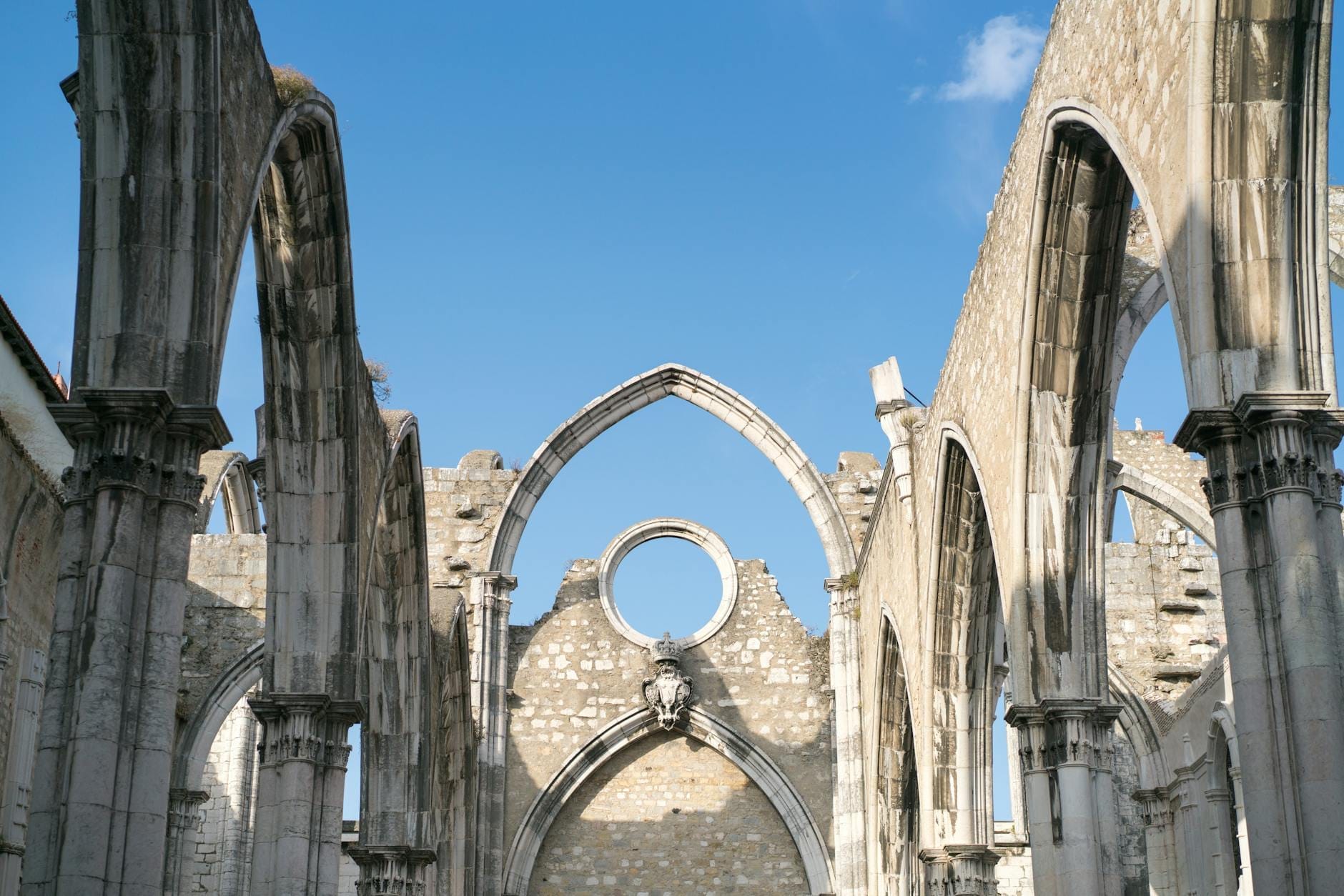
The Convento da Ordem do Carmo, known in English as Carmo Convent, is a 14th-century Gothic church whose roof was stripped away by the great earthquake of 1755 and never replaced. What remains is a soaring skeleton of pointed arches and stone columns open to the Lisbon sky, today housing the Museu Arqueológico do Carmo. Founded in 1389 by Portuguese military commander Nuno Álvares Pereira and completed in 1423, it was once among the largest churches in medieval Lisbon. The earthquake, and the fires that followed, gutted it completely.
Rather than rebuild, Lisbon chose to preserve the wreckage. In 1864, the Association of Portuguese Archaeologists converted the surviving apse into a museum. The roofless nave was left deliberately exposed, and that decision turned out to be one of the most striking pieces of architectural preservation in all of Portugal. Pigeons nest in the upper arches. On rainy days, water collects on the flagstone floor. On clear mornings, the sky frames each Gothic lancet arch like a painting.
ℹ️ Good to know
The Carmo Convent also became historically significant in 1974: during the Carnation Revolution, the army units that had just overthrown Portugal's Estado Novo dictatorship used the convent as a command post. The deposed prime minister, Marcelo Caetano, surrendered here.
The Nave: Walking Under Open Sky
Entering the nave from Largo do Carmo, the scale surprises most visitors. The arches rise roughly 30 meters and the length of the space pulls the eye forward toward the apse. Without a ceiling, the acoustics dissolve entirely. There is no echo, no enclosed hush. Instead you hear city sounds, wind, and occasionally rain on stone. The sensation is closer to standing in a garden than a church.
The floor is original flagstone, worn and uneven in places. Some stone fragments and carved capitals lie alongside the walls, remnants of decorative elements that fell in the earthquake. Visitors are free to walk through the nave without a prescribed route, which makes the space feel unhurried. Most people spend five to ten minutes here before moving into the museum in the apse, but the nave rewards slower attention.
💡 Local tip
Visit on a clear morning between 10:00 and 11:30. The light entering through the south-facing arches is at its best before midday, and crowds are thinnest right at opening. By early afternoon, groups from the Elevador de Santa Justa often spill in.
Tickets & tours
Live prices and dates from our booking partner. If you book, we may earn a commission at no extra cost to you.
Belem and Modern Lisbon bus hop-on hop-off combined tickets
From 28 €Instant confirmationFree cancellationSt. George Castle E-ticket and Audio Tour
From 28 €Instant confirmationLisbon Story Centre entrance tickets
From 7 €Instant confirmationFree cancellationYellow boat river tour
From 24 €Instant confirmationFree cancellation
The Archaeological Museum: Small but Specific
The museum occupies the surviving apse of the convent, a compact vaulted space that manages to hold a genuinely eclectic collection. It is not a comprehensive archaeological museum in the way a national institution would be. Think of it instead as a cabinet of curiosities with serious scholarly provenance, built up over 160 years of donation and acquisition.
The collection's most discussed objects are two Peruvian mummies in glass cases, displayed in their original crouched burial position. They date from the pre-Columbian period and were acquired during the 19th century. Nearby you will find Egyptian artifacts, an Aztec sacrificial stone, and carved prehistoric figures. The juxtaposition of cultures feels less like a coherent narrative and more like a Victorian-era portrait of global archaeology, which is exactly what it is.
Portuguese prehistoric and Roman-era objects take up a significant portion of the display cases: Iron Age pottery, Roman coins, Bronze Age tools, and Visigothic carved stonework. Labels are in Portuguese and English. Lighting inside the apse is relatively dim, which suits the medieval architecture but makes reading case labels in the back corners somewhat difficult. Bring reading glasses if needed.
⚠️ What to skip
The museum is closed on Sundays and major public holidays including Christmas, New Year's Day, and May 1st. Hours also change seasonally: 10:00–19:00 from May through October, and 10:00–18:00 from November through April. Last entry is approximately 20 minutes before closing.
Getting There and Getting In
The convent sits on Largo do Carmo, a small square in the Baixa-Chiado district. The most straightforward approach is from Baixa-Chiado Metro station (Blue and Green lines), a five-minute uphill walk through Chiado. Alternatively, the Elevador de Santa Justa exits directly onto a footbridge that connects to Largo do Carmo, so combining the two is natural and efficient. Tram 28E passes nearby, though its stops require a short climb.
Admission is €7 for adults and free for children under 14. Tickets are purchased at the entrance to the apse museum. There is no advance booking required or available online, and queues rarely form except during peak summer weeks. The square outside is public and free to enter, so you can see the exterior and part of the nave facade at no cost.
Accessibility is limited. The flagstone nave floor is uneven and the museum apse involves steps. Visitors with mobility concerns should be aware that there is no lift and the historical terrain makes wheelchair navigation difficult through significant portions of the site.
How It Changes Through the Day
At 10:00 when the doors open, Largo do Carmo is quiet. Street cleaners have usually finished their rounds and the café tables are just being set. Inside the nave, the morning light comes in at an angle that picks out the texture of the stone arches and casts long shadows across the flagstones. This is the best window for photography.
By midday, particularly in summer, the space fills with visitors who have come up from the Santa Justa lift footbridge. The nave does not feel crowded in the way indoor museums do, since the open-air structure disperses people, but the museum apse becomes noticeably fuller. Early afternoon is also when tour groups tend to arrive.
On overcast or rainy days, the nave takes on a different character entirely. The grey light flattens the stone and makes the roofless quality more stark. Rain falls directly onto the flagstones and collects in slight depressions worn by centuries of foot traffic. Visitors who come in rain almost universally find it more atmospheric than fair weather. A light jacket is sufficient shelter since the apse museum is covered, and the nave experience in drizzle is brief but memorable.
Context: Chiado and What Surrounds the Convent
The convent does not exist in isolation. Largo do Carmo is one of the more pleasant squares in central Lisbon, with a central fountain and café seating on most sides. It sits at the edge of Chiado, a neighborhood of bookshops, independent cafés, and 19th-century theatres. A short walk downhill brings you to Rossio Square, the social heart of Baixa, while walking ten minutes uphill takes you into Bairro Alto, Lisbon's late-night bar district by night and a quiet residential area by day.
The Carmo Convent works well as part of a broader Chiado and Baixa circuit. Many visitors combine it with a stop at the Elevador de Santa Justa for the city views, then continue downhill along Rua do Carmo toward the pedestrian shopping streets of Baixa. For those building a full day, the National Tile Museum and the Sé Cathedral are both within reasonable distance by tram or taxi.
Photography Notes
The nave is one of the more photogenic interior spaces in Lisbon, and for good reason. Shooting from the entrance toward the apse gives a compressed perspective of arches receding into the museum. Wide-angle lenses work well. Looking straight up from the center of the nave on a clear day gives a dramatic framing of sky within Gothic stone.
Inside the museum apse, the mummies are displayed behind glass and the lighting is low. A phone camera will struggle without adequate stabilization. The museum generally permits photography without flash. For the best exterior shot of the convent's Gothic facade, position yourself at the far end of Largo do Carmo and shoot toward the entrance portal in the morning before café umbrellas are fully open.
Insider Tips
- The footbridge from the top of the Elevador de Santa Justa connects directly to Largo do Carmo, making it easy to exit the lift and walk straight to the convent without retracing steps through Baixa.
- If you visit on a rainy morning, the nave experience is worth embracing rather than avoiding. The water on stone and grey light through the arches create a dramatically different atmosphere than sunny days.
- The square outside, Largo do Carmo, has one of the better café terraces for a coffee break before or after visiting. It is quieter than the Chiado main streets and gets morning shade, useful in summer.
- The museum's Peruvian mummies draw significant attention, but the Roman and prehistoric Portuguese sections are less crowded and often more relevant to understanding Lisbon's deeper history.
- The convent played a direct role in the 1974 Carnation Revolution: if you stand in the nave and look toward the apse, you are standing in the building where Portugal's authoritarian government formally ended. There is no large plaque marking this, which makes knowing it in advance more rewarding.
Who Is Carmo Convent For?
- Travelers with an interest in medieval architecture and earthquake history
- Photographers looking for dramatic interior light in the early morning
- Museum visitors who prefer curated, smaller collections over vast encyclopedic institutions
- Anyone building a Chiado walking circuit that connects Baixa with Bairro Alto
- History enthusiasts curious about Portugal's 20th-century political history and the Carnation Revolution
Nearby Attractions
Other things to see while in Baixa & Chiado:
- A Ginjinha
Open since 1840 and still run by the same family, A Ginjinha is the counter-sized bar that started Lisbon's love affair with ginjinha. There's no seating, no menu, and no fanfare — just a shot glass, a sour cherry, and nearly two centuries of tradition.
- Arco da Rua Augusta
The Arco da Rua Augusta anchors the northern edge of Praça do Comércio with neoclassical grandeur, commemorating Lisbon's post-earthquake rebirth. Climb to the rooftop terrace for an unbroken view across the Tagus River and the Baixa grid below. Small in scale, big in context.
- Elevador de Santa Justa
The Elevador de Santa Justa is a 45-metre Neo-Gothic iron structure that has been hauling passengers between the flat streets of Baixa and the hilltop Largo do Carmo since 1902. It's one of Lisbon's most recognisable landmarks, but knowing when to go and what you're actually paying for makes all the difference between a queue and a genuine experience.
- Igreja de São Roque
From the outside, Igreja de São Roque looks like any other Lisbon church. Step inside and you're face to face with one of the most opulent chapels ever built, assembled in Rome from gold, lapis lazuli, and ivory, then shipped across the Atlantic in three vessels. Admission to the church is free, and the attached museum costs less than a coffee.
Planning a trip? Discover personalized activities with the Nomado app.