Igreja de São Roque: Lisbon's Deceptively Plain Church with a Priceless Interior
From the outside, Igreja de São Roque looks like any other Lisbon church. Step inside and you're face to face with one of the most opulent chapels ever built, assembled in Rome from gold, lapis lazuli, and ivory, then shipped across the Atlantic in three vessels. Admission to the church is free, and the attached museum costs less than a coffee.
Quick Facts
- Location
- Largo Trindade Coelho, Bairro Alto, Lisbon
- Getting There
- Glória funicular from Restauradores, or Bus 737 from Cais do Sodré
- Time Needed
- 45–90 minutes (church + museum)
- Cost
- Church: Free. Museum: €5 (€2.50 concessions, 40% off with Lisboa Card)
- Best for
- Art and architecture lovers, history enthusiasts, budget travelers
- Official website
- museusaoroque.scml.pt/en/museum-church
First Impressions: A Deliberately Modest Facade
Igreja de São Roque sits at the top of Largo Trindade Coelho, a small square in Bairro Alto where the city shifts from the commercial energy of Chiado into quieter residential streets. The church's facade is flat, whitewashed, and almost aggressively plain. Compared to the gilded theatrics of many Portuguese churches, it barely registers as a building of consequence. That restraint is, in fact, entirely deliberate: the Jesuits who commissioned it in the 16th century believed external simplicity should direct attention inward, both spiritually and literally.
Igreja de São Roque was inaugurated in 1573, making it one of the three oldest Jesuit churches in Portugal. When the Society of Jesus was expelled from Portugal in 1759, the church was handed over to the Santa Casa da Misericórdia de Lisboa, the charitable institution that still manages it today. Unlike the lower districts of Lisbon, which were catastrophically damaged in the 1755 earthquake, Bairro Alto sits on more stable ground. The church survived intact, which is a significant part of why its interior remains so extraordinarily preserved.
💡 Local tip
Arrive between 10:00 and 11:00 on a weekday for the fewest visitors. The interior is cool and dim, so your eyes need a minute to adjust before the detail starts revealing itself.
Inside the Church: Eight Chapels, Zero Visual Repetition
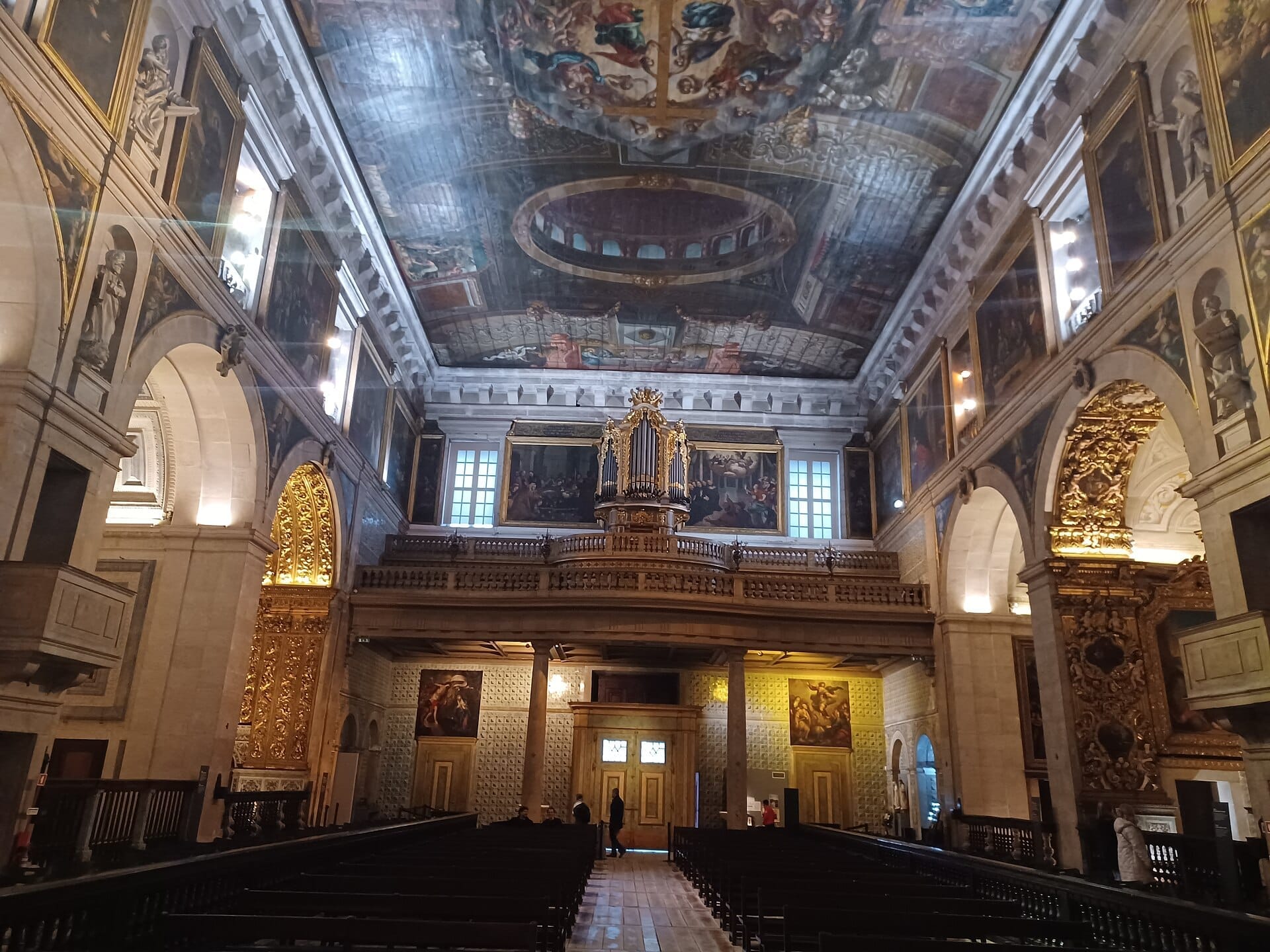
The interior layout is a single broad nave flanked by eight side chapels, each separated from the next by painted arches. At first glance, the ceiling appears to be elaborately carved wood, the kind of intricate coffering you see in major European basilicas. Look more carefully and you will realize it is flat, painted in trompe l'oeil to create the illusion of three-dimensional depth. It is one of the earliest known examples of this ceiling technique in Portugal, and it holds up under scrutiny far better than you expect.
Each chapel along the nave has its own distinct identity: different saints, different patron families, different artistic periods. Large canvases depicting scenes from the life of St. Ignatius of Loyola hang in prominent positions, painted with the saturated realism characteristic of 17th-century Mannerist and early Baroque work. The floors throughout are polished stone, and in the afternoon light that enters from the upper windows, the whole nave takes on a warm amber quality that makes photography difficult but the experience itself quietly affecting.
Tickets & tours
Live prices and dates from our booking partner. If you book, we may earn a commission at no extra cost to you.
Self-guided Discovery Walk in Alfama and Baixa with outdoor art
From 22 €Instant confirmationFree cancellationSelf-guided Discovery Walk in Lisbon's Bairro Alto and Bica: fun figures and fabulous views
From 28 €Instant confirmationFree cancellationSt. George Castle E-ticket and Audio Tour
From 28 €Instant confirmationTicket and Guided Tour of Castelo de Sao Jorge
From 40 €Instant confirmationFree cancellation
The Chapel of St. John the Baptist: Why This Church Is Famous
The fourth chapel on the left, dedicated to St. John the Baptist, is the reason most people seek this church out, and it earns the attention. Built in Rome between 1742 and 1747 under the commission of King João V of Portugal, it was constructed to function as both a private royal chapel and a demonstration of Portuguese prestige at the Vatican. It was blessed by Pope Benedict XIV before being carefully dismantled and shipped to Lisbon across three separate vessels, with the components packed by the craftsmen who had assembled it.
The materials are not decorative approximations: the columns are green verde antico marble and deep-toned lapis lazuli. The flooring is a mosaic of agate, amethyst, and other semi-precious stones. The altarpiece features gold, ivory, and intricately worked bronze. The mosaics on the walls were created in Rome to replicate oil paintings with such precision that visitors frequently mistake them for canvas. Standing in front of this chapel in a church you entered for free, on a side street in Bairro Alto, produces a genuinely disorienting experience. The contrast with the building's plain exterior is not accidental: it mirrors the Jesuit philosophy of spiritual surprise.
ℹ️ Good to know
The Chapel of St. John the Baptist is widely cited as one of the most expensive individual chapels ever built. It was extraordinarily expensive to build, a sum that would be extraordinary even by today's standards.
The Museu de São Roque: Small, Focused, Rewarding
Attached to the church is the Museu de São Roque, established on 11 January 1905 as one of Portugal's first purpose-built art museums. The collection is tightly focused on the church's history and the objects associated with the Chapel of St. John the Baptist: vestments, reliquaries, liturgical silverware, and the original papal documents authorizing the chapel's construction and blessing. It is not a large museum and you can move through it thoroughly in 30 to 40 minutes, but the quality of individual objects is high.
The most absorbing section covers the chapel's fabrication and transport. Scale models, architectural drawings, and correspondence between Lisbon and Rome give context to what would have been, by 18th-century standards, a logistical project of considerable complexity. If you have already stood in front of the chapel, these documents give the experience a second layer. Admission is €2.50, with a 40% reduction for Lisboa Card holders. The museum is closed on Mondays.
When to Visit and How to Get There
The church is open Tuesday through Saturday from 09:00 to 18:00, and on Monday from 14:00 to 18:00. The museum keeps slightly different hours, opening at 10:00 Tuesday through Sunday and remaining closed on Mondays. Verify current hours before visiting, as seasonal adjustments are possible.
Weekday mornings are quietest. Weekend afternoons bring organized tour groups, which can crowd the nave and make it harder to spend time in front of individual chapels. The church is genuinely popular with art-focused travelers, and the Chapel of St. John the Baptist in particular draws small clusters of people at most hours. Bairro Alto itself is best explored in combination with nearby Baixa-Chiado, which is a ten-minute walk downhill.
Getting here is straightforward. The Glória funicular from Restauradores Square drops you steps from the church entrance and is free with the Lisboa Card. Bus 758 from Cais do Sodré also serves the area. If you are already in Chiado or Bairro Alto, the church is within comfortable walking distance of both.
⚠️ What to skip
The church is an active place of worship. Dress modestly: covered shoulders and knees are expected. Photography is generally permitted in the nave, but be aware of any services or special ceremonies that may be in progress.
Honest Assessment: Is It Worth Your Time?
For the combination of free admission, genuine historical significance, and one of the most unexpected interiors in Lisbon, Igreja de São Roque offers strong value against other attractions in the city. It is not a cathedral with vast spatial drama, and it is not a site you should allocate half a day to. But as a focused 45-to-90-minute visit, particularly if combined with the museum, it rewards careful attention in a way that larger, more photographed landmarks sometimes do not. It pairs naturally with the Carmo Convent, which is a short walk away and offers a very different kind of architectural experience.
Travelers who are primarily interested in outdoor experiences, viewpoints, or Lisbon's food scene may find the church feels like a detour. Those who enjoy comparing religious art across different periods, or who want to understand the wealth and ambitions of 18th-century Portugal, will find it among the most concentrated experiences the city offers. If you are building an itinerary around Lisbon's churches and convents, this is a natural companion to the Basílica da Estrela and the Sé Cathedral.
Visitors focused entirely on free experiences will appreciate that the church itself costs nothing and represents, arguably, the most expensive square meters of art per euro of admission in Lisbon. If you are working with a tight budget, the full free things to do in Lisbon guide includes several other stops that pair well with this visit.
Insider Tips
- Stand at the back of the nave after entering and let your eyes adjust before approaching any chapel. The painted ceiling is far more legible from a distance than up close.
- The trompe l'oeil ceiling is easier to appreciate on overcast days, when flat light reduces the contrast that gives away its two-dimensionality.
- If you are carrying a Lisboa Card, use the Glória funicular to reach the church. It saves the uphill walk from Chiado and the card covers the fare.
- Pick up the free printed guide available near the entrance before starting your visit. It maps each chapel and names the works, which makes the side chapels significantly more coherent.
- The museum closes before the church on some days and maintains different weekly schedules. If the museum is your priority, check current times on the official site before planning your visit.
Who Is Igreja de São Roque For?
- Art and architecture travelers who appreciate detailed craftsmanship over monumental scale
- History enthusiasts interested in Portuguese imperial ambitions and Jesuit history
- Budget travelers seeking genuinely exceptional free cultural experiences
- Visitors combining a morning in Chiado or Bairro Alto with a short cultural detour
- Travelers building a focused itinerary around Lisbon's religious heritage
Nearby Attractions
Other things to see while in Baixa & Chiado:
- A Ginjinha
Open since 1840 and still run by the same family, A Ginjinha is the counter-sized bar that started Lisbon's love affair with ginjinha. There's no seating, no menu, and no fanfare — just a shot glass, a sour cherry, and nearly two centuries of tradition.
- Arco da Rua Augusta
The Arco da Rua Augusta anchors the northern edge of Praça do Comércio with neoclassical grandeur, commemorating Lisbon's post-earthquake rebirth. Climb to the rooftop terrace for an unbroken view across the Tagus River and the Baixa grid below. Small in scale, big in context.
- Carmo Convent
The Convento da Ordem do Carmo is Lisbon's most visually arresting survivor of the 1755 earthquake. Its roofless Gothic nave, open to the sky for nearly 270 years, now shelters an archaeological museum with Peruvian mummies and pre-historic artifacts. It is equal parts ruin, museum, and meditation on disaster.
- Elevador de Santa Justa
The Elevador de Santa Justa is a 45-metre Neo-Gothic iron structure that has been hauling passengers between the flat streets of Baixa and the hilltop Largo do Carmo since 1902. It's one of Lisbon's most recognisable landmarks, but knowing when to go and what you're actually paying for makes all the difference between a queue and a genuine experience.
Planning a trip? Discover personalized activities with the Nomado app.