A Ginjinha: Lisbon's Original Sour Cherry Shot Bar
Open since 1840 and still run by the same family, A Ginjinha is the counter-sized bar that started Lisbon's love affair with ginjinha. There's no seating, no menu, and no fanfare — just a shot glass, a sour cherry, and nearly two centuries of tradition.
Quick Facts
- Location
- Largo de São Domingos 8, 1100-201 Lisboa
- Getting There
- Rossio Station (train station) or Rossio metro stop (Green Line)
- Time Needed
- 10–20 minutes
- Cost
- €1.50 per shot; bottles from €11.00
- Best for
- First-time Lisbon visitors, food and drink enthusiasts, anyone curious about Portuguese drinking culture
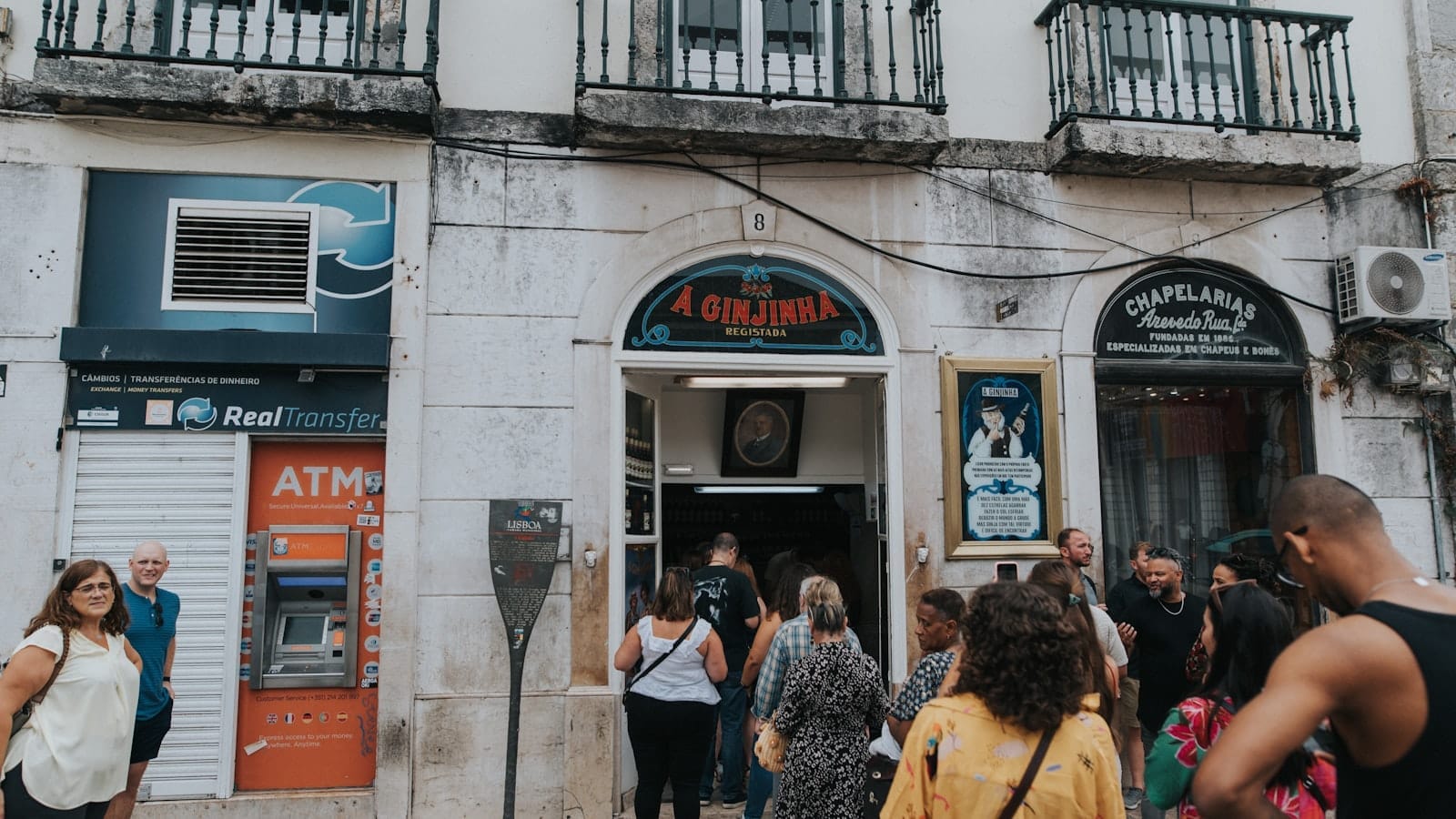
What A Ginjinha Actually Is
A Ginjinha — also known as Ginjinha Espinheira — is not a bar in any conventional sense. It is a single counter, roughly one meter long, cut into the facade of a building on Largo de São Domingos, a small square just steps from Rossio. There are no bar stools, no cocktail list, no food menu. You walk up, order a shot of ginjinha for €1.50, decide whether you want it with or without a sour cherry at the bottom ("com" or "sem"), and drink it standing on the pavement outside.
Ginjinha itself is a Portuguese liqueur made by steeping ginja berries — a variety of sour morello cherry — in aguardente (a grape spirit), then sweetening the result with sugar. It is dark, syrupy, and lands somewhere between port wine and cherry brandy. The flavor is intense: very sweet at first, then tart, with a warm alcohol finish. Most people find it immediately likeable. A few find it too sweet. Either way, at €1.50 it is one of the least expensive authentic experiences in Lisbon.
💡 Local tip
Order it "com ela" (with the cherry) for the full experience. The preserved cherry at the bottom of the glass is intensely flavored — some visitors eat it, some leave it. It is a matter of personal taste, not etiquette.
Nearly Two Centuries at the Same Address
A Ginjinha opened in 1840, making it the first establishment in Lisbon to commercialize ginjinha as a product. The bar has been operated by the same family across five generations, and it carries the official designation of Loja Com História — a formal recognition given by the City of Lisbon to historic shops that have played a significant role in the city's commercial and cultural identity.
The surrounding square, Largo de São Domingos, has its own layered history. The Igreja de São Domingos — the large church immediately behind the square — dates to the 13th century and survived the 1755 earthquake, though it was severely damaged by a fire in 1959. Its scarred interior walls were deliberately left unrestored, giving the church one of the most atmospheric interiors in the city. The square itself was historically associated with Lisbon's Jewish community and the Inquisition-era autos-da-fé that took place there. Arriving at A Ginjinha, you are standing in one of the most historically dense corners of the city.
The bar's location places it within easy walking distance of several major landmarks. Rossio Square is about 100 meters south. The Sé Cathedral is a 15-minute walk east through the Baixa grid. If you are building a day around the historic center, A Ginjinha fits naturally into the flow of the morning or late afternoon.
Tickets & tours
Live prices and dates from our booking partner. If you book, we may earn a commission at no extra cost to you.
Belem and Modern Lisbon bus hop-on hop-off combined tickets
From 28 €Instant confirmationFree cancellationSt. George Castle E-ticket and Audio Tour
From 28 €Instant confirmationLisbon Story Centre entrance tickets
From 7 €Instant confirmationFree cancellationYellow boat river tour
From 24 €Instant confirmationFree cancellation
What the Experience Feels Like at Different Hours
A Ginjinha opens at 10:00 a.m. and closes at 10:00 p.m., seven days a week. The atmosphere shifts considerably across those hours.
In the morning, between 10:00 and noon, the square is relatively quiet. A handful of locals stop by out of habit, and the light from the east falls directly on the church facade behind you. This is a good time to take in the physical setup of the bar without being jostled — you can clearly see the narrow counter, the bottles lined up behind it, and the small hand-lettered signage that has barely changed in decades. It is also the most peaceful moment to have a conversation with the person behind the counter.
By mid-afternoon, especially in summer, the line can stretch five to ten people deep. Groups on walking tours arrive in clusters, and the square fills with the sound of multiple languages. The wait is never long — service is fast and transactional by design — but the atmosphere during peak hours is more celebratory chaos than quiet ritual. Evenings bring a different mix: Portuguese office workers stopping on the way home, travelers doing a final sweep of the old town, and the occasional local using the square as a meeting point.
ℹ️ Good to know
A Ginjinha is open daily 10:00 a.m. to 10:00 p.m. No reservations, no table service, no indoor seating. Cash is standard; confirm card acceptance at the counter.
Practical Walkthrough: How a Visit Actually Works
Getting there is straightforward. From Rossio Station or the Rossio metro stop on the Green Line, walk north along the square, turn left onto Rua das Portas de Santo Antão, and take the first right. The bar is immediately visible on the corner of Largo de São Domingos — the dark wooden counter and the cluster of people holding small glasses give it away.
The counter is small enough that approaching it requires a degree of gentle assertiveness, particularly in the afternoon. Step up when there is space, order by saying "uma ginjinha, por favor" (one ginjinha, please) and specify "com ela" (with the cherry) or "sem ela" (without). You pay immediately. There is no tab, no table, no seat. You take your glass, step back from the counter, and drink it on the square. Most people linger for 5 to 10 minutes. Some return to the counter for a second.
If you want to bring some home, bottles are available for approximately €11.00. The bottle makes a practical and genuinely local souvenir — far more interesting than anything sold in the tourist shops on Rua Augusta. It travels well and keeps indefinitely.
Note that A Ginjinha is not the only ginjinha bar in Lisbon. Competitors have opened in recent years, including spots in the Chiado area and around Baixa-Chiado. Some of these are more comfortable and offer seating. But this bar, at this address, is the original — and that distinction matters if authenticity is what you are after.
Sensory Details Worth Knowing
The shot glass is small — a standard European liqueur measure. The liqueur is served at room temperature, never chilled. It is thick in texture, closer to a light syrup than a spirit, and the color is a deep garnet red that photographs well in afternoon light. The smell that hits you when you approach the counter is of cherry and alcohol, sweet and slightly medicinal in a way that is immediately distinctive.
Largo de São Domingos itself has a rough, unpolished quality. The church is imposing but worn, the paving stones are uneven in places, and the square attracts a cross-section of Lisbon life that includes tourists, commuters, and people who simply use it as a shortcut. It is not a manicured tourist plaza. That roughness is part of what makes the experience feel authentic rather than staged.
⚠️ What to skip
There is no indoor space and no seating of any kind. Visitors with mobility concerns should note that the pavement around the counter can be uneven, and peak-hour crowds can make maneuvering difficult.
Who Should Skip This (And Who Should Not)
If you do not drink alcohol, there is nothing for you here — A Ginjinha serves one thing. If you are looking for a sit-down experience or a quiet moment away from tourists, this is not the right stop. The location draws significant foot traffic, and the format does not allow for lingering comfort.
It also occasionally draws groups who treat it as a tick-box exercise on a walking tour itinerary, which can deflate the experience slightly if you arrive in the middle of a large crowd. In those moments, the square itself can feel more like a staging area than a meaningful cultural stop.
But for anyone genuinely curious about Portuguese food and drink culture, the visit is worth the 15 minutes it takes. Pair it with a walk through the surrounding streets, a stop at the Rossio Square to the south, or a short detour to the nearby Carmo Convent — a ruined Gothic church that survived the 1755 earthquake and now houses an archaeological museum. Together, these stops make a coherent half-morning in the old city.
For more on what to eat and drink around the Baixa area, the Lisbon food guide covers the full picture, from pastéis de nata to the city's market scene.
Insider Tips
- Go on a weekday morning, between 10:00 and 11:30 a.m., to find the counter nearly empty. You will have time to look around, ask questions, and drink without being hurried by the crowd behind you.
- The preserved cherry at the bottom of the glass is edible and worth trying — it has absorbed months of liqueur and is far more intense than a fresh cherry. That said, it is an acquired taste, and nobody will judge you for leaving it.
- If you plan to buy a bottle to take home, check your luggage allowance. The 750ml bottle is heavier than it looks and will need to go in checked baggage if you are flying. Alternatively, most wine shops in the city stock the same product.
- The square in front of São Domingos Church is worth a few minutes on its own. Step inside the church if it is open — the fire-scarred walls and stripped interior are genuinely striking, and almost nobody goes in.
- Several other bars in the city brand themselves as ginjinha establishments. The one at this address — Largo de São Domingos 8 — is the original 1840 founding location. If authenticity matters to you, go here first.
Who Is A Ginjinha For?
- First-time visitors to Lisbon looking for an authentic and inexpensive introduction to Portuguese drinking culture
- Food and drink travelers building a tasting itinerary through the city
- Travelers on a budget who want a genuinely local experience for under €2
- Anyone walking the historic center who needs a natural stopping point between Rossio and the Alfama
- Souvenir hunters looking for something portable, local, and actually useful to bring home
Nearby Attractions
Other things to see while in Baixa & Chiado:
- Arco da Rua Augusta
The Arco da Rua Augusta anchors the northern edge of Praça do Comércio with neoclassical grandeur, commemorating Lisbon's post-earthquake rebirth. Climb to the rooftop terrace for an unbroken view across the Tagus River and the Baixa grid below. Small in scale, big in context.
- Carmo Convent
The Convento da Ordem do Carmo is Lisbon's most visually arresting survivor of the 1755 earthquake. Its roofless Gothic nave, open to the sky for nearly 270 years, now shelters an archaeological museum with Peruvian mummies and pre-historic artifacts. It is equal parts ruin, museum, and meditation on disaster.
- Elevador de Santa Justa
The Elevador de Santa Justa is a 45-metre Neo-Gothic iron structure that has been hauling passengers between the flat streets of Baixa and the hilltop Largo do Carmo since 1902. It's one of Lisbon's most recognisable landmarks, but knowing when to go and what you're actually paying for makes all the difference between a queue and a genuine experience.
- Igreja de São Roque
From the outside, Igreja de São Roque looks like any other Lisbon church. Step inside and you're face to face with one of the most opulent chapels ever built, assembled in Rome from gold, lapis lazuli, and ivory, then shipped across the Atlantic in three vessels. Admission to the church is free, and the attached museum costs less than a coffee.
Planning a trip? Discover personalized activities with the Nomado app.