Cristo Rei: Lisbon's Giant Statue and One of Its Best Panoramic Views
Standing 110 meters tall on the south bank of the Tagus, Cristo Rei offers some of the most dramatic views of Lisbon available anywhere in the region. The journey there, by ferry and bus, is half the experience. Here is everything you need to plan a visit that goes beyond the postcard.
Quick Facts
- Location
- Alto do Pragal, Almada (south bank of the Tagus, across from Lisbon)
- Getting There
- Ferry from Cais do Sodré to Cacilhas (8 min), then bus 101 to the entrance. Total under 1 hour each way, under €5 return.
- Time Needed
- 2 to 3 hours including the ferry crossing
- Cost
- Ground level, chapel, and esplanade free; viewing platform €8 adults (13+), €3 children 8-12, free under 8 (verify current price on-site or at cristorei.pt)
- Best for
- Panoramic city views, architectural interest, religious tourism, photographers
- Official website
- cristorei.pt
What Is Cristo Rei and Why Does It Matter
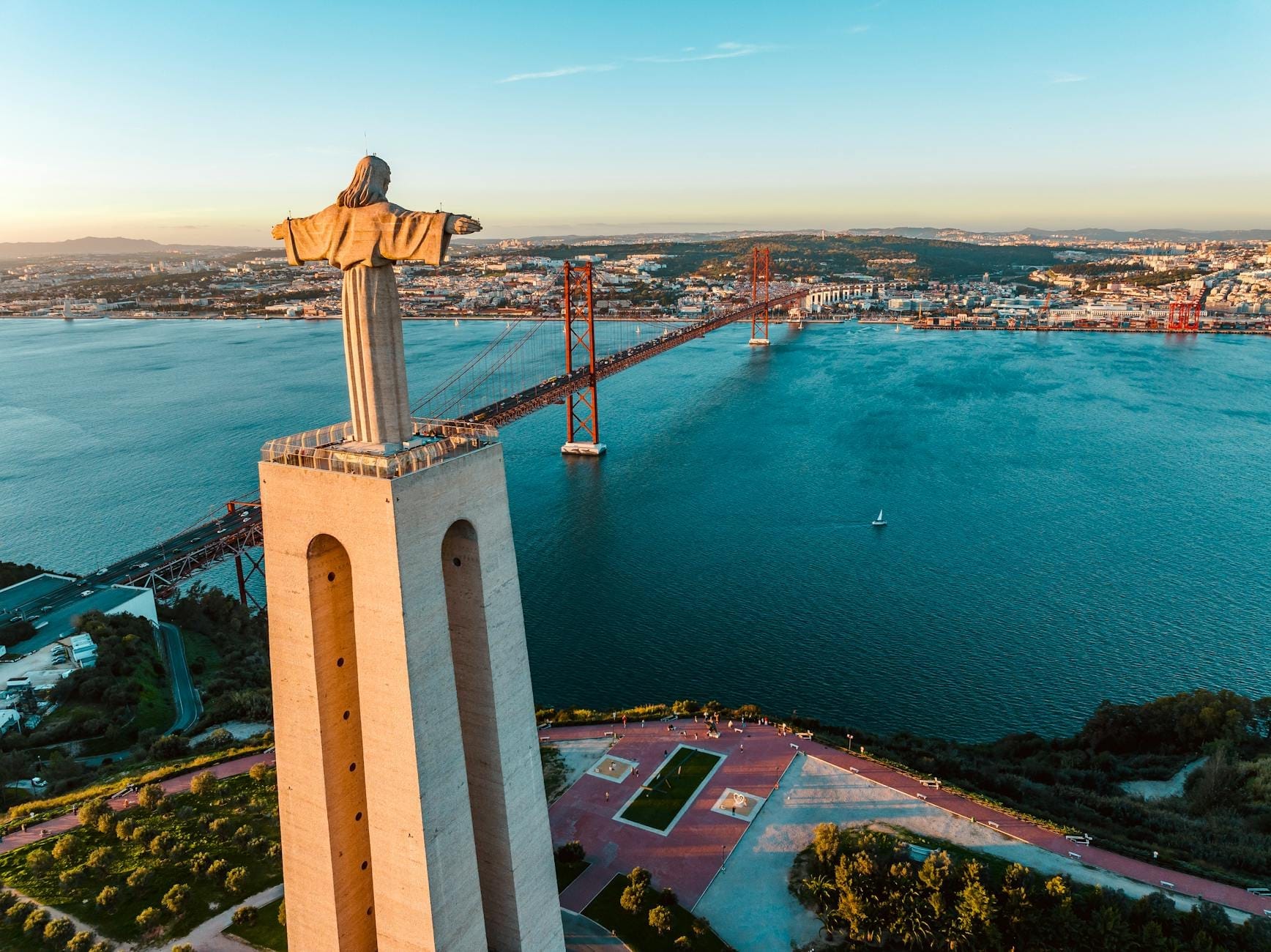
The Santuário Nacional de Cristo Rei, to use its full official name, is a monumental statue of Christ standing with outstretched arms on a tall concrete pedestal above the municipality of Almada, directly across the Tagus River from Lisbon. At a combined height of 110 meters, including a 28-meter statue atop an 82-meter pedestal, it is visible from much of the city and from the bridge approaches on both sides of the river.
The statue was not built for tourism. Its origins lie in a vow made by Portuguese Catholic bishops in 1940, during the Second World War, to erect a monument to Christ if Portugal was spared the destruction sweeping through Europe. Construction began in 1950 and the monument was inaugurated on 17 May 1959. The design was directly inspired by the Cristo Redentor in Rio de Janeiro, though the Almada statue is notably taller overall due to its much higher pedestal. The structure required roughly 40,000 tons of concrete.
For visitors to Lisbon, the appeal is twofold: the statue carries genuine historical and religious weight, and the viewing platform at the top of the pedestal delivers a 360-degree panorama that few spots in the region can match. If you want a single elevated perspective that takes in the Ponte 25 de Abril, the Tagus estuary, Belém, the Alfama hillside, and the city stretching north, this is the place.
💡 Local tip
Go on a clear weekday morning. The ferry crossing is quicker than most visitors expect, and the platform is significantly less crowded before midday. Haze tends to build over Lisbon in the afternoon during summer, softening the views.
The Journey There: Ferry and Bus Across the Tagus
Getting to Cristo Rei is part of the experience, and it is simpler than most guidebooks suggest. You take a commuter ferry from Cais do Sodré terminal in central Lisbon across to Cacilhas, a small riverside town on the south bank. The crossing takes about eight minutes. Ferries run frequently throughout the day and the fare is low, making this one of the more enjoyable short river crossings in southern Europe.
From Cacilhas, bus 3001 runs directly to the entrance of the Cristo Rei sanctuary. The full journey from Cais do Sodré to the statue entrance typically takes under an hour, and the return trip costs less than €5 per person. Taxis and ride-hailing services are also available in Cacilhas if you prefer flexibility.
One note for those combining this with a visit to Belém: the two areas are on opposite banks and are not easily combined into a single loop. Plan them as separate half-days rather than trying to rush both into one afternoon.
Tickets & tours
Live prices and dates from our booking partner. If you book, we may earn a commission at no extra cost to you.
Lisbon Sidecar Retro Tour Cristo Rei
From 249 €Instant confirmationFree cancellationBelem and Modern Lisbon bus hop-on hop-off combined tickets
From 28 €Instant confirmationFree cancellationSt. George Castle E-ticket and Audio Tour
From 28 €Instant confirmationLisbon Story Centre entrance tickets
From 7 €Instant confirmationFree cancellation
The Statue Up Close: What You Actually See
Approaching the sanctuary on foot from the bus stop, the scale of the pedestal becomes apparent in a way it never does from across the river. The structure is brutalist in spirit, a smooth concrete tower that rises steeply above a formal esplanade lined with low hedges and stone balustrades. There is a chapel at ground level, open to visitors, with a quiet interior that feels disconnected from the tourist activity outside.
An elevator carries visitors up the pedestal to the viewing platform at 82 meters. From here, the figure of Christ rises directly above you, arms extending over the city. The view north across the Tagus is remarkable on almost any clear day: the red suspension bridge in the middle distance, the long waterfront of Lisbon curving to the right, the dome of the Estrela Basilica visible above the rooftops, and the hills of Sintra faintly on the horizon when conditions allow.
The platform itself is relatively narrow and can feel crowded when tour groups arrive simultaneously. The ironwork railing is solid and the drop below is substantial, so visitors with a strong fear of heights may find it uncomfortable, though the experience is not extreme by most standards.
ℹ️ Good to know
Opening hours vary by season. The sanctuary is open daily from 10am to 7pm (April to September) or 10am to 6pm (October to March). On 24 December it closes at 5pm; on 25 December it opens at 2:30pm; on 1 January it opens at 10am. Confirm current hours at cristorei.pt before visiting.
How the Experience Changes by Time of Day
Early morning, between opening time and around 11am, the sanctuary grounds are calm. The air carries a faint brine smell from the estuary below, and you can hear the wind against the pedestal without the noise of crowds. The light from the east catches the Lisbon waterfront directly, which makes this the best window for photography looking north.
Midday brings tour coaches, particularly in summer. The esplanade fills with visitors, the elevator queue lengthens, and the platform becomes shoulder-to-shoulder. This is the period to avoid if you want a quiet, contemplative experience at the top. The views remain excellent, but the atmosphere shifts significantly.
Late afternoon, roughly from 4pm onward, is another strong window. The light shifts to a warm golden tone over the city and the suspension bridge picks up a richer color. Crowds thin out noticeably after 5pm on most days outside peak summer weeks. On evenings in July and August, the extended closing time allows visitors to stay past 7pm, when the light over Lisbon is genuinely extraordinary.
Photography at Cristo Rei
Most visitors photograph the statue from the ferry or from Lisbon's waterfront, where the figure appears small but dramatic against the sky above the bridge. From the platform itself, the statue is too close and too large to photograph effectively as a whole object. The real photographic value of the platform is the cityscape.
The northern view from the platform, with the Ponte 25 de Abril spanning the Tagus and Lisbon laid out behind it, is one of the most complete panoramic photographs you can take in the Lisbon region. A wide-angle lens captures more of the bridge and city together. For comparison with other elevated perspectives across the city, see our guide to the best viewpoints in Lisbon, which covers how Cristo Rei stacks up against the miradouros on the Lisbon side of the river.
⚠️ What to skip
On overcast or hazy days, the view from the platform is significantly reduced. Lisbon's summers bring afternoon haze that softens detail across the water. Check the forecast before making the trip specifically for the view.
Practical Details and Accessibility
The sanctuary address is Alto do Pragal, Av. Cristo Rei, 2800-058 Almada. Ground level access, including the esplanade and the chapel, is free. The elevator to the viewing platform carries an admission fee; the exact current price should be confirmed at the official website or on arrival, as it has varied over time.
The elevator makes the viewing platform accessible to visitors who cannot manage stairs, though the esplanade itself requires some walking on uneven stone surfaces. The chapel at the base is step-free. The site is open every day of the year, including public holidays, with adjusted hours on Christmas Eve, Christmas Day, and New Year's Day as noted above.
There are no large restaurants on-site, though a small café may operate near the entrance depending on the season. Most visitors eat before or after in Cacilhas, where the riverside has a row of seafood restaurants popular with locals. Cacilhas also connects to the broader Lisbon transport network and is a pleasant stop on its own.
Is Cristo Rei Worth the Trip?
The honest answer is: yes, but with conditions. If you have already seen Lisbon from the major miradouros on the city side of the river, Cristo Rei gives you a genuinely different perspective, one that includes those hills themselves as part of the view. The ferry crossing adds a layer of pleasure that no hilltop tram ride can replicate. And the monument itself has a real presence up close that photographs do not fully convey.
If you have only one or two days in Lisbon and your priority is covering the historic core, the time investment here may not be the best use of your schedule. The journey, platform visit, and return takes a minimum of two hours, and likely three when you factor in the ferry wait and any time at the top.
Visitors with limited time who still want a sweeping panoramic view might consider the closer-in options: Miradouro da Senhora do Monte or Miradouro da Graça both deliver strong city views without the cross-river transit. That said, neither offers the reverse perspective that makes Cristo Rei genuinely distinctive.
Visitors who actively dislike heights should note that the platform exposure, while manageable for most, is real. The railing is secure, but you are standing at significant elevation on an open terrace. This is not a concern for the majority of visitors, but it is worth knowing in advance.
Insider Tips
- The bus 101 from Cacilhas does not always run at peak frequency. Check the Transportes Sul do Tejo schedule before you cross on the ferry so you are not waiting 30 minutes at the Cacilhas stop.
- The esplanade around the base of the pedestal faces south and gets full sun most of the day. In summer, carry water and sunscreen, as there is minimal shade between the bus stop and the entrance.
- If you arrive when a tour group is loading into the elevator, wait 10 to 15 minutes at the chapel or esplanade rather than joining the back of the queue. Groups tend to move through quickly and the queue shortens fast.
- The Cacilhas waterfront has a cluster of traditional seafood tascas that have been serving locals for decades. Combining the Cristo Rei visit with lunch in Cacilhas turns a half-day trip into one of the more complete experiences on the south bank.
- For the clearest views across to Lisbon, visit between October and May when Atlantic air keeps the horizon sharp. Summer haze, particularly in July and August, can reduce visibility across the estuary by midday.
Who Is Cristo Rei For?
- Photographers wanting a full panoramic view of Lisbon from the south bank
- Visitors with an interest in 20th-century religious architecture and post-war European history
- Families with older children who enjoy the ferry crossing as part of the adventure
- Travelers on longer itineraries of four days or more who have already covered the main Lisbon miradouros
- Anyone curious about the view from the other side of the Ponte 25 de Abril
Nearby Attractions
Combine your visit with:
- Aqueduto das Águas Livres
Standing 65 metres above the Alcântara Valley on 35 soaring Gothic arches, the Aqueduto das Águas Livres is one of the most extraordinary feats of 18th-century engineering in Europe. Free to admire from street level and easy to combine with other west-Lisbon sights, it rewards visitors who look up from the city's quieter edges.
- Cabo da Roca
Cabo da Roca is the westernmost point of mainland Europe, a wind-scoured cape rising 165 metres above the Atlantic Ocean in the Sintra-Cascais Natural Park. It combines raw coastal scenery, genuine historical weight, and easy access from both Lisbon and Sintra into one of Portugal's most geographically significant stops.
- Cascais
Forty minutes west of Lisbon by train, Cascais trades the capital's urban intensity for whitewashed streets, Atlantic beaches, and a marina ringed by seafood restaurants. Once the summer retreat of Portuguese kings, it remains one of the most complete day trips available from Lisbon.
- Costa da Caparica Beaches
Costa da Caparica stretches 30 kilometres down the Atlantic coast, just 30 minutes from central Lisbon. Free to access year-round, it ranges from family-friendly Blue Flag beaches near the town centre to quieter surf breaks and nudist sections further south, backed by fossil-rich cliffs protected as a nature reserve.
Planning a trip? Discover personalized activities with the Nomado app.