Costa da Caparica: Lisbon's Great Atlantic Escape
Costa da Caparica stretches 30 kilometres down the Atlantic coast, just 30 minutes from central Lisbon. Free to access year-round, it ranges from family-friendly Blue Flag beaches near the town centre to quieter surf breaks and nudist sections further south, backed by fossil-rich cliffs protected as a nature reserve.
Quick Facts
- Location
- Municipality of Almada, Setúbal district — across the Tagus from Lisbon
- Getting There
- Bus 161 from Cais do Sodré metro station to Costa da Caparica terminal (30-40 min), then Transpraia coastal train (stops 1-20)
- Time Needed
- Half day minimum; full day recommended for southern beaches
- Cost
- Free entry; Transpraia train ticket extra (verify current price at stop)
- Best for
- Swimmers, surfers, sunbathers, families, nature walkers
What Costa da Caparica Actually Is
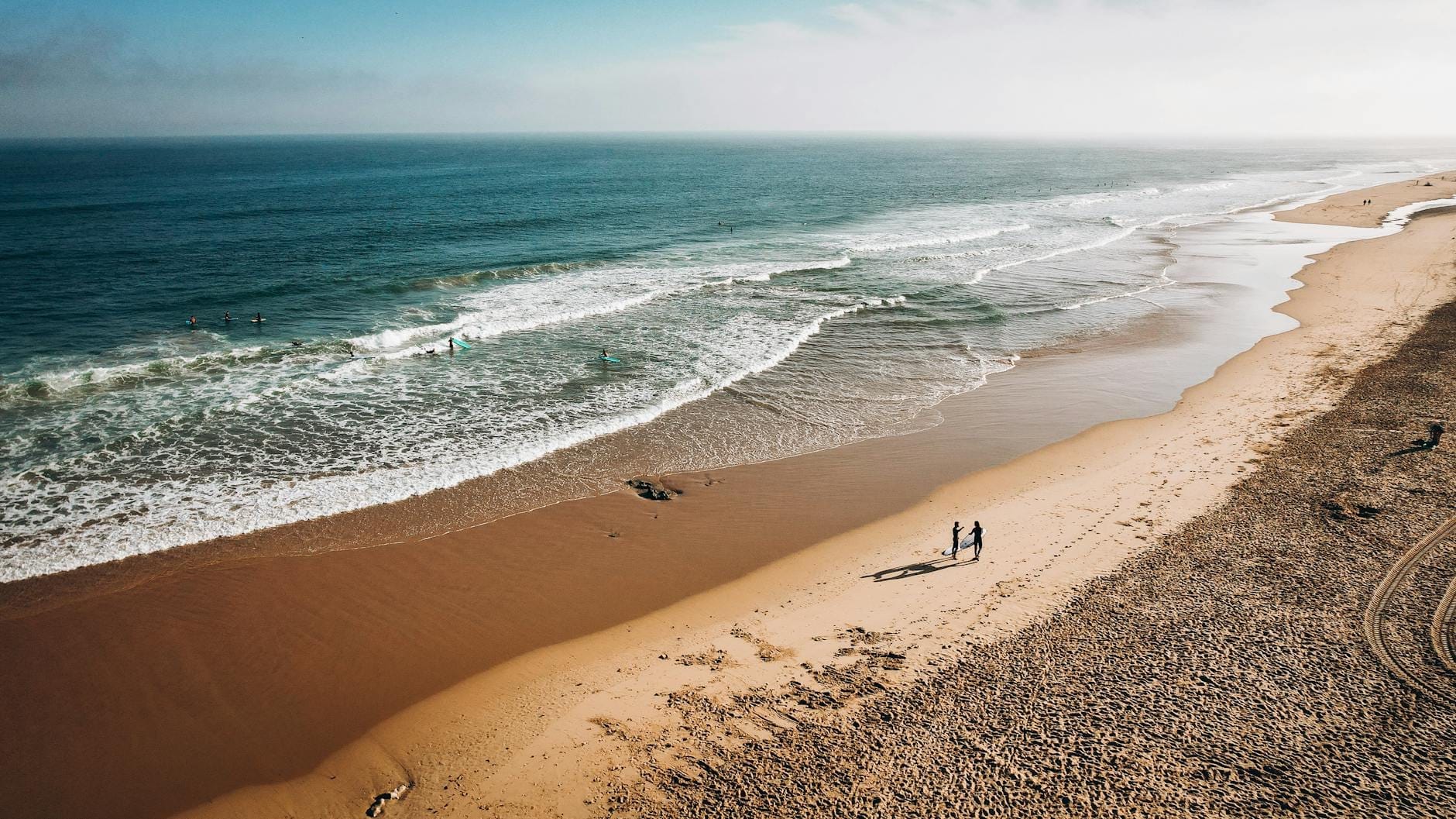
Costa da Caparica is not one beach. It is a continuous 30-kilometre strip of Atlantic-facing sand that runs south from the town of Costa da Caparica into the Arrábida Natural Region, progressively shedding crowds and cafés as you go. The northern stretch near the town is the most developed: there are wooden walkways over the dunes, beach bars serving beer and grilled fish, lifeguard towers, and rental umbrellas stacked in rows. Walk or ride the Transpraia train south past stop 5 or 6 and things open up considerably. By stop 15, the nearest human being is probably 50 metres away.
The beach faces directly west into the Atlantic, which matters for two reasons. First, the surf is real: consistent swells make several sections popular with surfers at an intermediate to advanced level, and multiple surf schools operate near the town. Second, the water is noticeably cooler than Mediterranean beaches, rarely exceeding 20°C even in August. Swimmers accustomed to the Adriatic or the Algarve should be prepared for a brisk entry.
ℹ️ Good to know
All beaches at Costa da Caparica are free and open year-round. The Transpraia tourist train runs seasonally along the coast with numbered stops (1-20), making it easy to target different beach sections without a car.
How the Beach Changes Through the Day
Early morning before 9am is the clearest window to understand what this coastline actually looks like. The light comes in low from the east, casting long shadows off the dunes, and the sand is smooth and untracked. A few joggers, some older locals walking dogs, the odd surfer checking the break. The beach bars are shuttered. If you come for photography, this is the time to shoot.
By late morning on a summer weekend, the northern beaches are filling fast. Families claim territory near the walkways; groups of teenagers cluster around the beach bars. The Transpraia train runs frequently and is worth taking to move south if you find the first few stops crowded. Stops 10 through 14 tend to offer a workable balance between some facilities and manageable crowd levels.
Late afternoon, roughly 4pm to 7pm, is when Costa da Caparica earns its reputation among Lisboetas. The heat softens, the light turns amber, and the surf picks up with the afternoon wind shift. The beach bars get louder in a pleasant way. Watching the sun drop toward the Atlantic horizon from a wooden deck chair with something cold is a genuinely good way to spend an evening, and the sunset here is unobstructed for the full 180-degree view.
Tickets & tours
Live prices and dates from our booking partner. If you book, we may earn a commission at no extra cost to you.
Belem and Modern Lisbon bus hop-on hop-off combined tickets
From 28 €Instant confirmationFree cancellationSt. George Castle E-ticket and Audio Tour
From 28 €Instant confirmationLisbon Story Centre entrance tickets
From 7 €Instant confirmationFree cancellationYellow boat river tour
From 24 €Instant confirmationFree cancellation
The Arriba Fóssil: More Than a Backdrop
Running behind the southern sections of the beach, the Arriba Fóssil da Costa da Caparica is a protected nature reserve of considerable geological interest. These fossil cliffs date to the Miocene epoch, meaning the sedimentary layers visible in the cliff face are millions of years old and contain marine fossils that have been studied extensively by Portuguese geologists. The reserve protects both the cliffs themselves and the adjacent dune ecosystem.
For most visitors, the cliffs function as dramatic scenery rather than a geology lesson. They rise behind the quieter southern beaches and provide a sense of enclosure that the flat northern section lacks. If you walk the beach at low tide in the southern reaches, you will notice how the cliff colour shifts from ochre to deep rust depending on mineral content. The reserve designation also means development stops here: no hotels, no beach bars, no construction.
Navigating the 20 Stops
The Transpraia train is the practical spine of a day at Costa da Caparica. It runs along the coast from the town centre southward, with numbered stops. The system is simple and the train is cheap, but it only operates during the warmer months, so if you visit in winter you will need a car or be prepared to walk.
- Stops 1-4: Most facilities, highest crowds, closest to town. Good for families who want lifeguards, beach bars, and easy access to restaurants.
- Stops 5-9: Still well-served, moderately busy. Multiple Blue Flag beaches in this section, including Praia da Mata and Praia da Rainha. Praia da Rainha is noted for accessibility features.
- Stops 10-14: Less crowded, still some bars. A reliable choice for visitors who want space without total isolation.
- Stops 15-17: Quieter, dunes more prominent. Surf conditions often better here.
- Stops 18-20 and beyond toward Fonte da Telha: Nude bathing areas, near-empty stretches, Arriba Fóssil reserve. Praia da Bela Vista (a pioneering official nudist beach) and Praia da Adiça (an official nudist beach) are in this southern zone.
💡 Local tip
If you drive, parking is available at the northern beaches near Praia de São João. In summer, arrive before 10am or after 4pm to find a space without a long wait.
Getting There from Lisbon
The most straightforward route is Bus 161, which departs from Cais do Sodré station in central Lisbon and arrives at the Costa da Caparica town terminal in roughly 30 to 40 minutes depending on traffic. Cais do Sodré is well connected to the rest of the city by metro and suburban rail. From the terminal, the Transpraia train picks up from stop 1. The combined journey is affordable and avoids any parking stress. For context on the broader Lisbon transport network, the guide to getting around Lisbon covers bus and metro options in detail.
Driving via the Ponte 25 de Abril bridge is faster if you are coming from Belém or the western side of the city, though tolls apply and summer traffic on the bridge approach can add significant time. From the Almada side, the coast road down to the beach is well-signed. Avoid driving on peak summer Saturdays if you have the option.
An increasingly popular option is the Tagus river crossing by ferry from Cais do Sodré to Cacilhas, followed by a local bus. This adds time but trades traffic stress for a pleasant water crossing with good views of the city skyline.
Surf, Swimming, and Practical Water Notes
The Atlantic swell at Costa da Caparica is consistent enough to support year-round surfing. Several surf schools near the town centre offer lessons for beginners, and the breaks in the northern sections are forgiving enough for learners. Further south, the swell becomes heavier and less predictable, suited to experienced surfers. Bodyboarding is popular throughout.
Swimming conditions vary with season and swell. In summer, the sea is manageable for competent swimmers, but rip currents are a genuine hazard on any open Atlantic beach. Always swim between the red and yellow flags where lifeguards are present, and do not underestimate the surf even on calmer-looking days. The Blue Flag beaches in the central section (Praia da Mata, Praia da Rainha, Praia da Sereia) are monitored for water quality and are consistently among the cleaner options.
⚠️ What to skip
Rip currents are present on Atlantic beaches. Swim only between the red and yellow lifeguard flags. Outside summer months, lifeguard cover is reduced or absent on most sections.
Weather, Season, and Honest Expectations
Costa da Caparica is at its most photogenic and most crowded from June through September. July and August bring Lisboetas in large numbers on weekends: the northern stops fill to capacity by 11am. If you are visiting in high summer, a weekday visit is noticeably more relaxed. The summer in Lisbon guide covers the broader seasonal picture for the city, which applies here too.
May, June, and September offer the best combination of warm air, calmer conditions, and lighter crowds. The water is still cold in May, typically 16 to 17°C, but the beach experience itself is genuinely pleasant. October through April, the beach is largely empty and the surf is at its most powerful. Walkers, photographers, and surfers visit in winter; casual sunbathers do not.
One realistic note: the wind. Costa da Caparica faces the Atlantic, and the afternoon nortada, a north wind common in summer, picks up reliably after midday and can throw sand with real force. Beach tents and windbreaks are rented at the northern stops for good reason. This is not a complaint about the place; it is something to factor into timing and packing.
For a broader view of when to visit the region, the best time to visit Lisbon page breaks down each month with practical detail.
Day Structure: How to Use the Time Well
A half-day is enough to experience the northern section and understand what Costa da Caparica is. A full day allows you to take the Transpraia south to stop 12 or 14, swim, have lunch at one of the beach bars (fresh fish, grilled calamari, cold beer are standard options), and return in time for sunset from the town promenade.
Combining Costa da Caparica with a Lisbon itinerary works best when you dedicate a full day to it rather than trying to fit it around city sightseeing. The logistics of the bus connection and the Transpraia train mean you will lose an hour to transit each way, which is fine if the beach is the plan. It does not combine efficiently with, say, a morning at the Jerónimos Monastery in Belém.
If you are exploring the wider area, the day trips from Lisbon guide includes Costa da Caparica alongside other coastal and inland options within easy reach of the city.
Insider Tips
- The Transpraia train can get crowded at the terminal stop on summer weekends. Walk five minutes south along the beach road to pick it up at stop 2 instead, where you are more likely to find a seat.
- Stop 9 sits in front of one of the less-photographed Blue Flag beaches with good facilities but noticeably fewer people than stops 1 through 4. It is a reliable middle-ground choice without pre-research.
- The afternoon nortada wind typically kicks in around 1 to 2pm in summer. If wind bothers you, arrive by 9am and plan to leave or find a windbreak rental by early afternoon.
- Low tide exposes a wide flat section of hard-packed sand that is excellent for walking long distances along the shore. Tide times for the day are posted at beach information boards near the larger stops.
- If you want the nudist beaches at the southern end without a car, take the bus to the terminal, then the Transpraia to its final stop, and walk further south from there. The journey is longer but doable.
Who Is Costa da Caparica Beaches For?
- Lisbon visitors who want a genuine Atlantic beach day rather than a tourist attraction
- Surfers and bodyboarders looking for reliable swell within range of a European capital
- Families wanting Blue Flag water quality, accessible infrastructure, and beach bar convenience
- Geology and nature walkers interested in the Arriba Fóssil fossil cliff reserve
- Travellers on a budget: the beach is free and the transit connection is cheap
Nearby Attractions
Combine your visit with:
- Aqueduto das Águas Livres
Standing 65 metres above the Alcântara Valley on 35 soaring Gothic arches, the Aqueduto das Águas Livres is one of the most extraordinary feats of 18th-century engineering in Europe. Free to admire from street level and easy to combine with other west-Lisbon sights, it rewards visitors who look up from the city's quieter edges.
- Cabo da Roca
Cabo da Roca is the westernmost point of mainland Europe, a wind-scoured cape rising 165 metres above the Atlantic Ocean in the Sintra-Cascais Natural Park. It combines raw coastal scenery, genuine historical weight, and easy access from both Lisbon and Sintra into one of Portugal's most geographically significant stops.
- Cascais
Forty minutes west of Lisbon by train, Cascais trades the capital's urban intensity for whitewashed streets, Atlantic beaches, and a marina ringed by seafood restaurants. Once the summer retreat of Portuguese kings, it remains one of the most complete day trips available from Lisbon.
- Cristo Rei
Standing 110 meters tall on the south bank of the Tagus, Cristo Rei offers some of the most dramatic views of Lisbon available anywhere in the region. The journey there, by ferry and bus, is half the experience. Here is everything you need to plan a visit that goes beyond the postcard.
Planning a trip? Discover personalized activities with the Nomado app.