Aqueduto das Águas Livres: Lisbon's Monumental Aqueduct Above the Rooftops
Standing 65 metres above the Alcântara Valley on 35 soaring Gothic arches, the Aqueduto das Águas Livres is one of the most extraordinary feats of 18th-century engineering in Europe. Free to admire from street level and easy to combine with other west-Lisbon sights, it rewards visitors who look up from the city's quieter edges.
Quick Facts
- Location
- Travessia do Vale de Alcântara, Campolide, Lisbon
- Getting There
- Bus 711, 746 or 776 (Campolide); Campolide train station (Sintra line)
- Time Needed
- 30–60 min to view from ground level; longer with Museu da Água visit
- Cost
- Free to view externally; Museu da Água admission applies for interior access
- Best for
- Architecture lovers, history enthusiasts, photographers, off-the-beaten-path explorers
What You're Actually Looking At
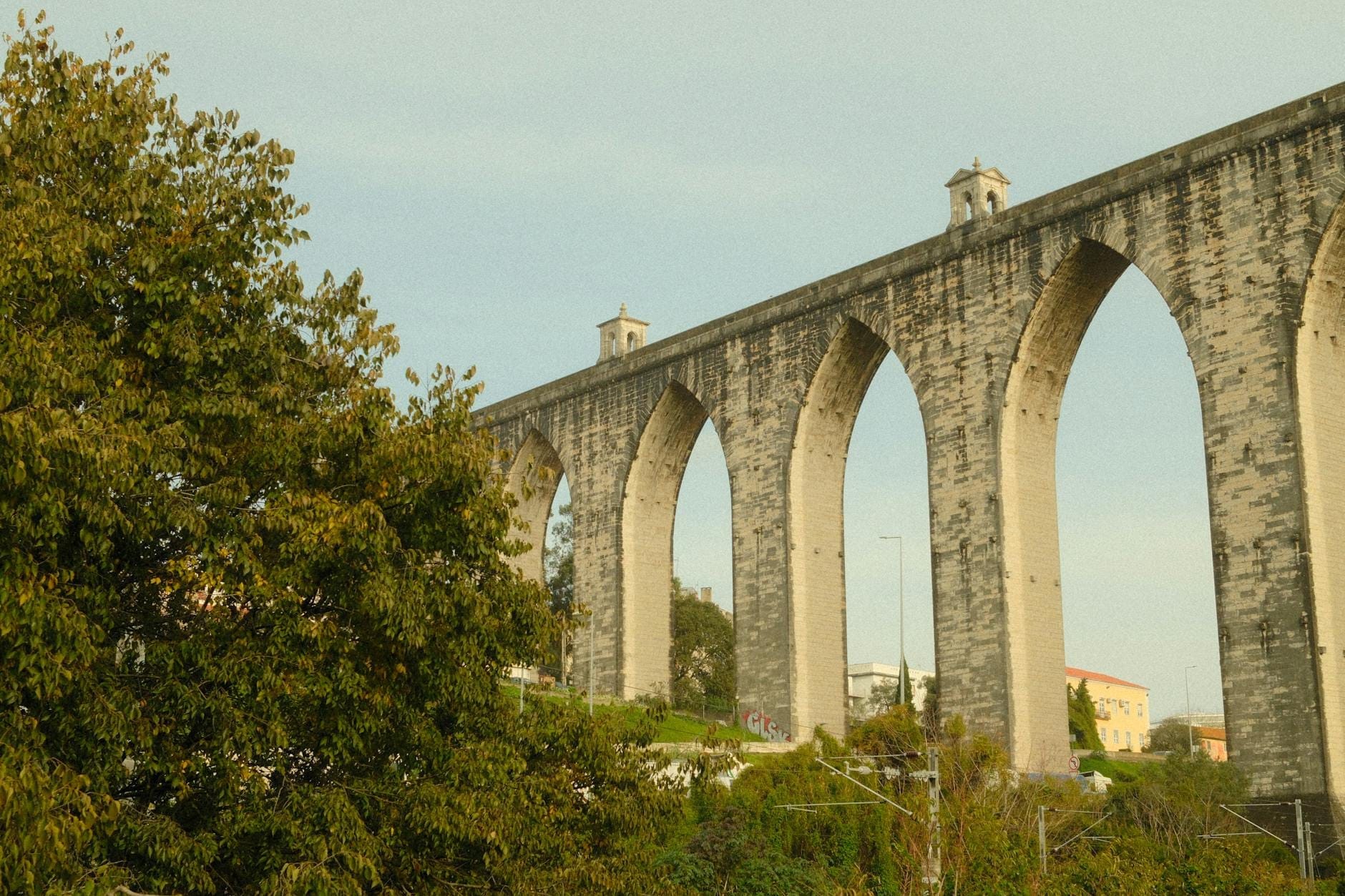
The Aqueduto das Águas Livres is not a ruin you admire behind a fence. It is a working piece of infrastructure that still stands in full, unbroken use of its original stone, threading through Lisbon's western neighbourhoods with a quiet, almost arrogant confidence. The structure's most dramatic section crosses the Alcântara Valley at Campolide: 35 arches in total, stretching 941 metres, with the central arch rising 65 metres high and spanning 32 metres across. That central arch remains, to this day, the largest stone arch built in the 18th century.
What strikes most visitors seeing it for the first time is the scale relative to the surrounding urban fabric. You approach through ordinary Lisbon streets, turn a corner near Campolide, and there it is: a Gothic-arched stone wall cutting across the skyline at a height that belongs more to cathedral naves than city infrastructure. The stone is a warm, pale limestone that picks up gold in afternoon light and turns silvery grey on overcast mornings.
💡 Local tip
The best unobstructed view of the full Alcântara Valley crossing is from Calçada da Quintinha, a short street running beneath the arches in Campolide. Come in the late afternoon when the sun angles from the west and the limestone glows warmest.
History: Why Lisbon Needed an Aqueduct in 1731
By the early 18th century, Lisbon was a city of roughly 200,000 people drawing water primarily from wells and rivers that were increasingly contaminated and unreliable. King João V, flush with gold and diamonds arriving from Brazil, commissioned a solution proportionate to his ambitions: a gravity-fed aqueduct that would bring clean water from springs near Belas, in the Sintra hills, more than 14 kilometres into the city centre.
Construction began in 1731 and continued for decades, with the main pipeline reaching Lisbon in 1748. The full system, incorporating 58 water sources across a network totalling approximately 58 kilometres, was not completed until 1799. The engineering challenge at Alcântara was considered nearly insurmountable: crossing a deep valley without losing gravitational pressure required arches of unprecedented height. The result was declared a National Monument in 1910 and has been on Portugal's UNESCO World Heritage tentative list.
The aqueduct's most remarkable historical footnote came on 1 November 1755. The earthquake that reduced much of Lisbon to rubble, killing tens of thousands and toppling churches, palaces, and entire neighbourhoods, left the aqueduct intact. The engineering of its foundations and the flexibility built into its arch design meant it absorbed the seismic shock that destroyed almost everything around it. Standing beneath the arches and knowing this is a quietly unsettling experience.
If you want to understand how the aqueduct fits into the broader story of 18th-century Lisbon's reconstruction and ambition, pair this visit with the National Tile Museum, which holds a famous azulejo panel depicting Lisbon before the 1755 earthquake, giving a remarkable before-and-after picture of the city the aqueduct served.
Tickets & tours
Live prices and dates from our booking partner. If you book, we may earn a commission at no extra cost to you.
Belem and Modern Lisbon bus hop-on hop-off combined tickets
From 28 €Instant confirmationFree cancellationSt. George Castle E-ticket and Audio Tour
From 28 €Instant confirmationLisbon Story Centre entrance tickets
From 7 €Instant confirmationFree cancellationYellow boat river tour
From 24 €Instant confirmationFree cancellation
How the Visit Actually Feels: Morning vs. Afternoon
In the early morning, the area beneath the arches in Campolide is almost completely quiet. Lisbon's commuter energy has not yet reached this corner, and the only sounds are distant trains on the Sintra line and pigeons roosting in the upper stonework. The shadow of the arches falls long and cool across the street, and the scale of the structure is somehow more legible without crowds to distract from it. This is the best time for photography: clean light, no people, and a stillness that lets you actually process what you're looking at.
By midday, a handful of tourists usually appear, mostly those who have sought the spot out deliberately rather than stumbled across it. Unlike Lisbon's most famous landmarks, this is not a site that draws crowds simply by proximity to other attractions. That relative solitude is one of its genuine advantages. You can stand directly under the central arch, look straight up 65 metres, and feel the weight of the stone above you without being jostled.
Late afternoon brings the best quality of light and occasionally draws local residents who walk or run the stretch of road alongside the aqueduct. There is something ordinary and Portuguese about seeing joggers pass beneath arches built for a Baroque king, and it gives the visit a texture that purely monumental sites in more touristic areas lack.
Getting There and Getting Around
The Alcântara Valley section of the aqueduct, which is the part worth visiting, is in the Campolide neighbourhood. Bus 758 stops nearby, and Campolide station on the Sintra suburban rail line is a short walk away. If you are coming from central Lisbon, a taxi or rideshare to Calçada da Quintinha takes roughly 10 minutes from Baixa-Chiado and costs a few euros.
The aqueduct is most naturally combined with a visit to the Jardim da Estrela or the Basílica da Estrela, both about 15 minutes on foot to the east, which makes for a satisfying half-day loop through western Lisbon's quieter architecture.
ℹ️ Good to know
The aqueduct's arches span a public road and are visible at all hours at no charge. If you want to see the interior channel or learn more about the engineering and history, the Museu da Água manages access and has associated exhibits. Verify opening hours and any ticketing requirements directly with EPAL before visiting.
The Mãe d'Água Reservoir: The Aqueduct's Urban Terminus
The aqueduct terminates at the Mãe d'Água das Amoreiras, a large 18th-century cistern in the Amoreiras neighbourhood, a short distance from the Alcântara Valley crossing. This receiving reservoir is architecturally impressive in its own right: a cavernous stone-vaulted hall with a central pool that reflects the overhead arches. The effect is cool, dim, and unexpectedly beautiful. The smell is damp stone and old water, and the acoustic quality of the space, which amplifies the quietest sounds, makes it feel more like a chapel than a utilitarian tank.
The Mãe d'Água is managed by the Museu da Água, which is part of EPAL, the Lisbon water utility. Check with them directly for current access and any admission fees, as these can change. For visitors with a particular interest in urban infrastructure, engineering history, or photography, it is easily one of the more unusual and under-visited spaces in Lisbon.
The Amoreiras area itself is worth a few minutes. The nearby LX Factory is a 20-minute walk south and offers a good option for lunch or a coffee before or after the aqueduct visit.
Photography, Practicalities, and Who Should Skip This
For photography, the Alcântara crossing shoots best with a wide-angle lens that can capture the full height of the central arch in a single frame. A 16–24mm equivalent on a full-frame camera or the ultra-wide mode on a phone camera works well. Shoot from the road looking up and along the line of arches for perspective compression, or step back toward the valley slope for a three-quarter view of the full arcade.
Wear comfortable shoes. The streets around the aqueduct involve the usual Lisbon inclines: nothing extreme, but enough to make sandals or flat-soled shoes inadvisable. There is no shade directly beneath the arches at midday in summer, so bring water if you are visiting between June and September. The site has no visitor facilities of its own, no toilets, no café, no shelter.
Who should skip it: travellers with a very compressed itinerary who have not yet seen Lisbon's headline sights. The aqueduct rewards those who already have some architectural or historical context for 18th-century Lisbon, or who genuinely enjoy infrastructure and engineering as subjects. If you are still working through the Jerónimos Monastery, São Jorge Castle, and the Belém waterfront, save this for a second day or a return visit.
For those building an itinerary, the full range of Lisbon's architecture and history is easier to navigate with a structured plan. The 4-day Lisbon itinerary includes the aqueduct alongside other western neighbourhoods, making the most of the geographic logic of the city.
⚠️ What to skip
The aqueduct has a dark historical footnote: in the 19th century, the serial killer Diogo Alves used the height of the arches to commit murders. This is occasionally mentioned on tours and in local history accounts. It does not affect the visit, but some travellers find it adds an unexpected layer to the site's atmosphere.
Insider Tips
- Walk the length of the Alcântara crossing from north to south on foot via Calçada da Quintinha for a ground-level perspective of all 35 arches in sequence. Most visitors only stop at one point beneath the structure rather than moving along its full span.
- The Mãe d'Água cistern at Amoreiras is acoustically remarkable. If you are visiting during a quiet period, bring a companion and speak in a whisper at one end of the hall; the stone vault carries the sound across the full space with unsettling clarity.
- Locals use the road beneath the arches as a regular walking route. Following their path rather than approaching from the obvious tourist angle gives a more immediate, lived-in experience of the structure's scale.
- If you are visiting Lisbon in summer, this is one of the coolest outdoor sites in the city at midday. The stone arches provide real shade, and the Alcântara Valley channels a consistent breeze. It is a good refuge between late morning and early afternoon.
- Check EPAL's Museu da Água programme ahead of your visit. The institution occasionally hosts evening events and cultural programming inside the Mãe d'Água cistern, which transforms the space completely under artificial light.
Who Is Aqueduto das Águas Livres For?
- Architecture and engineering enthusiasts who want to see 18th-century construction at an extraordinary scale
- Photographers seeking dramatic geometric compositions without the crowds of Lisbon's main viewpoints
- Travellers on a return visit to Lisbon who have already covered the headline attractions
- History-focused visitors interested in the logistical and political ambitions of João V's reign
- Anyone looking for a genuinely quiet outdoor site in the city during summer heat
Nearby Attractions
Combine your visit with:
- Cabo da Roca
Cabo da Roca is the westernmost point of mainland Europe, a wind-scoured cape rising 165 metres above the Atlantic Ocean in the Sintra-Cascais Natural Park. It combines raw coastal scenery, genuine historical weight, and easy access from both Lisbon and Sintra into one of Portugal's most geographically significant stops.
- Cascais
Forty minutes west of Lisbon by train, Cascais trades the capital's urban intensity for whitewashed streets, Atlantic beaches, and a marina ringed by seafood restaurants. Once the summer retreat of Portuguese kings, it remains one of the most complete day trips available from Lisbon.
- Costa da Caparica Beaches
Costa da Caparica stretches 30 kilometres down the Atlantic coast, just 30 minutes from central Lisbon. Free to access year-round, it ranges from family-friendly Blue Flag beaches near the town centre to quieter surf breaks and nudist sections further south, backed by fossil-rich cliffs protected as a nature reserve.
- Cristo Rei
Standing 110 meters tall on the south bank of the Tagus, Cristo Rei offers some of the most dramatic views of Lisbon available anywhere in the region. The journey there, by ferry and bus, is half the experience. Here is everything you need to plan a visit that goes beyond the postcard.
Planning a trip? Discover personalized activities with the Nomado app.