Rua Augusta: Lisbon's Grand Pedestrian Promenade
Rua Augusta is Lisbon's main pedestrian street, a 700-metre cobblestone corridor connecting Rossio Square to the riverfront Praça do Comércio. Free to walk, open around the clock, and anchored by a triumphal arch, it is the commercial and ceremonial backbone of the Baixa district.
Quick Facts
- Location
- Baixa, Lisbon (from Rossio to Praça do Comércio)
- Getting There
- Rossio Station (Green Line) or Terreiro do Paço metro station (Blue Line)
- Time Needed
- 30–90 minutes for the street itself; longer if exploring side streets
- Cost
- Free (public street); Arco da Rua Augusta rooftop has a separate admission
- Best for
- First-time visitors, morning walkers, architecture fans, shoppers
What Rua Augusta Actually Is
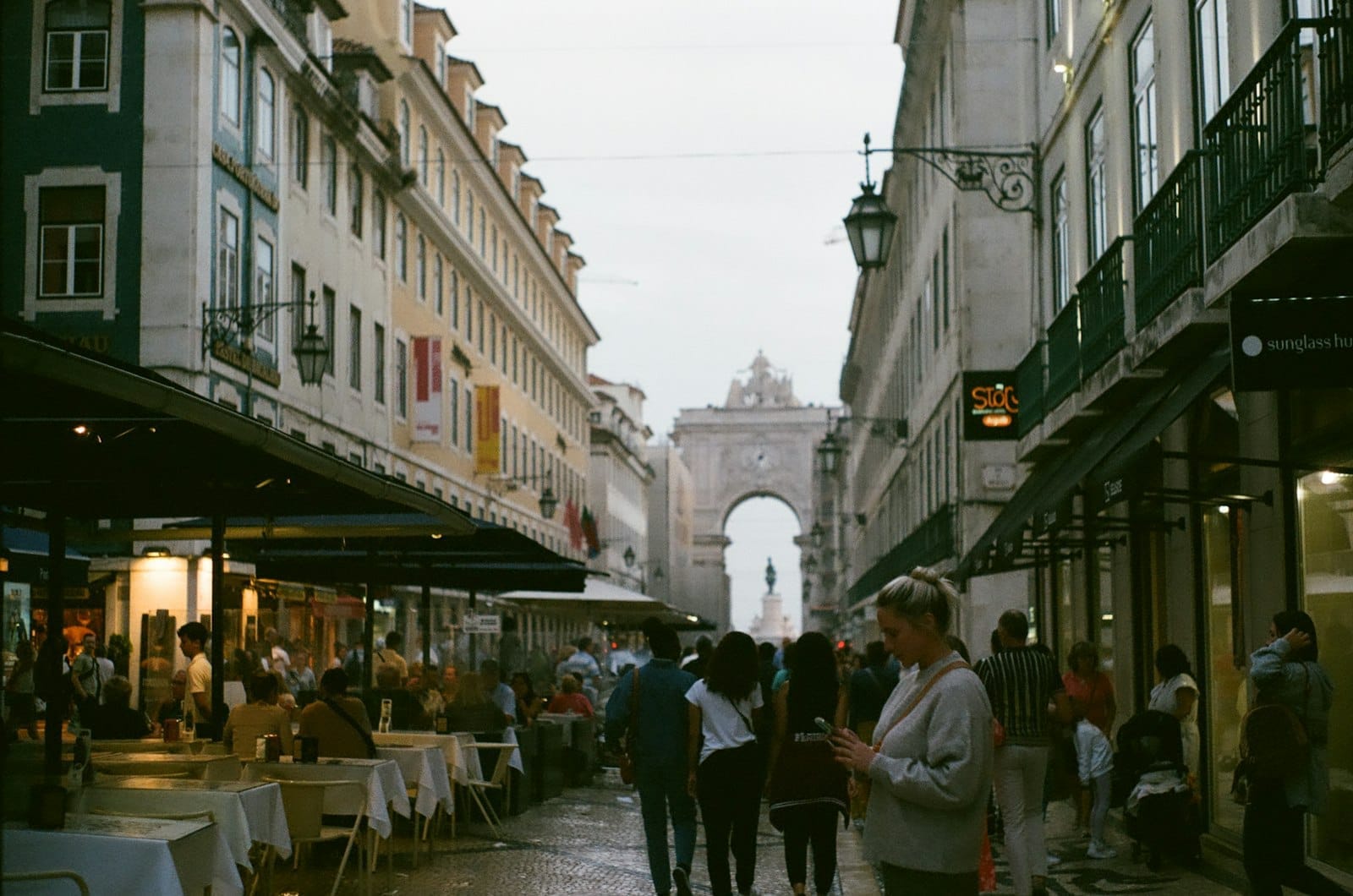
Rua Augusta is Lisbon's primary pedestrian artery, a straight, flat, 700-metre stretch of black-and-white mosaic cobblestones running from the southern edge of Rossio Square down to the Tagus riverfront at Praça do Comércio. It is the ceremonial spine of the Baixa district, the lower city that was rebuilt from near-total ruin after the catastrophic 1755 earthquake levelled much of Lisbon. The street was inaugurated in November 1760 as part of the Marquis of Pombal's rational grid reconstruction, and it was named in honour of King Dom José I.
It is not a secret. It is not undiscovered. Rua Augusta is, deliberately, the most visible street in the city, designed from its inception to be a place of commerce, pageantry, and public life. Understanding that purpose helps set expectations: this is a street meant to be experienced at a steady walking pace, with noise, crowds, and constant visual stimulation on all sides.
ℹ️ Good to know
The street is flat from end to end — a genuine rarity in hilly Lisbon. If you are arriving from Alfama or another elevated neighbourhood, descending into Baixa via Rua Augusta is a genuine relief for tired legs.
The Architecture: Pombaline Baixa at Ground Level
The buildings lining Rua Augusta are largely uniform in height and style, a signature of the Pombaline reconstruction that prioritised structural regularity and earthquake resistance. Facades are typically four to five storeys, with ground-floor arcades in some sections, decorative tilework on upper levels, and wrought-iron balconies that cast long shadows on the cobblestones during the afternoon. The scale is human rather than monumental: wide enough to feel open, narrow enough to feel intimate compared to a boulevard.
The undisputed architectural anchor is the Arco da Rua Augusta, the triumphal arch that frames the southern end of the street and the entrance to Praça do Comércio. Construction on the arch began in 1862 and was completed between 1873 and 1875. Its rooftop terrace, accessible to the public since August 2013, offers one of the more unusual elevated perspectives in the city: looking north along the length of Rua Augusta, with the street's geometry snapping into perfect alignment below you.
The arch features sculptural figures representing Glory, Valour, and Genius, along with statues of Portuguese historical figures including Vasco da Gama and the ancient Iberian leader Viriato. For more on the arch itself, the dedicated page on the Arco da Rua Augusta covers admission details and what the rooftop view looks like at different times of day.
Tickets & tours
Live prices and dates from our booking partner. If you book, we may earn a commission at no extra cost to you.
Rua Augusta Arch entrance tickets
From 5 €Instant confirmationFree cancellationBelem and Modern Lisbon bus hop-on hop-off combined tickets
From 28 €Instant confirmationFree cancellationSt. George Castle E-ticket and Audio Tour
From 28 €Instant confirmationLisbon Story Centre entrance tickets
From 7 €Instant confirmationFree cancellation
How the Street Changes Through the Day
Early morning, before 9am, Rua Augusta belongs to locals and delivery workers. The cobblestones are damp from overnight cleaning, shop shutters are still down, and the only sounds are espresso machines from the cafes that open early near Rossio. This is genuinely the best window to photograph the street: the arch at the far end frames a clear shot without a single human obstruction, and the morning light from the east catches the mosaic pavement at an angle that makes the wave pattern in the stone pop.
By mid-morning, street vendors set up their stalls selling scarves, tile magnets, and ginjinha. Café terraces fill quickly. By noon the street is at capacity with a thick pedestrian flow that requires patience rather than speed. Buskers take positions at regular intervals, and the mix of languages you hear — Portuguese, English, Spanish, French, German — reflects just how central Rua Augusta is to Lisbon's tourism circuit.
Evenings bring a different atmosphere. Families with strollers, couples choosing restaurants for dinner, the occasional fado performer trying to attract an audience. The arch is lit from below after dark, and the cobblestones reflect the light in a way that makes the whole corridor feel more theatrical than it does at noon. Late evening, after 10pm, the crowd thins noticeably — most nightlife migrates west to Bairro Alto or south to the waterfront.
💡 Local tip
Visit before 9am for photography. Visit midday if you want the full energy of the street. Avoid midday in July and August if you are heat-sensitive — there is almost no shade, temperatures regularly exceed 32°C, and the pavement radiates heat.
What You Will Find on the Street
The retail mix on Rua Augusta leans toward mid-range international chains, souvenir shops, and a handful of Portuguese brands. There are pharmacies, banks, a few jewellers, and multiple cafes. It is not where you shop for genuinely Portuguese goods at local prices — for that, the side streets of Baixa and the shops around Chiado are more rewarding.
Food options on the street itself are tourist-facing and priced accordingly. The best eating nearby is in the parallel streets and in the arcaded Praça do Comércio at the southern end. If you want to understand what Lisbon's food culture actually looks like, the Lisbon food guide will redirect you more productively than the menus posted in the windows on Rua Augusta.
The mosaic cobblestones themselves deserve attention. The black-and-white wave patterns are a form of Portuguese traditional paving called calçada portuguesa, laid by hand by skilled pavers. The pattern on Rua Augusta is relatively simple compared to more elaborate versions found in Rossio Square and along the Tagus waterfront, but the sheer length of the unbroken pavement is impressive. Wear shoes with some grip: the stones are smooth and become slippery when wet.
Practical Walkthrough: Getting There and Moving Through
The most logical approach is from the north, starting at Rossio Square, reachable on the Green or Yellow metro line (Rossio station). From there, the street slopes very gently downward toward the river — almost imperceptibly — for the full 700 metres until you emerge through the arch into Praça do Comércio and the Tagus waterfront.
Approaching from the south, Terreiro do Paço station on the Blue Line puts you directly at Praça do Comércio, from where you walk north through the arch. This direction works well if you are combining a visit with a Tagus river cruise or a ferry crossing from the south bank.
The street is fully pedestrian and flat, making it one of the most accessible routes in a city that is otherwise challenging for wheelchair users and people with limited mobility. Pavement surfaces are even and maintained. There are no steps between Rossio and the arch.
⚠️ What to skip
Pickpocketing is a real risk on Rua Augusta, particularly in the dense midday and afternoon crowd. Keep bags in front of your body, do not display expensive cameras on straps, and be especially alert near the arch, where crowds compress as people stop to photograph it.
Is It Worth Your Time?
Rua Augusta is not an attraction in the traditional sense. You do not visit it the way you visit a museum or a viewpoint. It is a street — one that happens to be central to how the lower city functions and how tourists move through Lisbon. If you are staying in Baixa or passing between Rossio and the waterfront, you will walk it anyway. The question is whether to linger.
The honest answer depends on when you go. In high summer at midday, with thousands of other visitors compressed onto the same 700 metres, the street can feel less like a promenade and more like a crowded corridor. At that point its main value is navigational. In the early morning or on a quiet weekday in November, with the arch lit by low winter sun and the pavement to yourself, it is genuinely one of the more handsome urban spaces in the country.
Travellers who want to understand Lisbon's street life more broadly should not limit themselves to Rua Augusta. The walking tours of Lisbon cover routes through Alfama, Chiado, and Mouraria that show parts of the city with far more texture. Rua Augusta is a starting point, not a destination.
Those who are overhyped on this street expecting a picturesque medieval lane will be disappointed — this is a post-earthquake grid city, formal and rectangular. For the narrow, atmospheric streets that appear in most Lisbon photography, head east to Alfama.
Insider Tips
- Walk the full length before 8:30am on a weekend to experience the mosaic pavement without distraction. The visual perspective from Rossio toward the arch, with no crowd, is the image most people never actually see in person.
- The side streets running parallel to Rua Augusta — Rua da Prata, Rua do Ouro, Rua dos Correeiros — have less foot traffic and more interesting independent shops. The experience of Baixa is better in those streets than on Rua Augusta itself.
- Street performers cluster near the midpoint of the street and in front of the arch. If you stop to watch, keep your bag secure. The gathering crowds around performers are a known distraction technique for opportunistic thieves.
- The rooftop of the Arco da Rua Augusta offers a north-facing view straight up the length of the street. Time this for the late afternoon when the light is coming from the west and catches the buildings on the east side of the street.
- The Lisboa Card covers the Rossio metro stop and provides free access to some nearby attractions. If you are spending multiple days in the city, calculate whether the card's savings offset its cost before buying it at the tourist office on Praça do Comércio.
Who Is Rua Augusta For?
- First-time visitors orienting themselves in central Lisbon
- Architecture enthusiasts interested in Pombaline reconstruction after the 1755 earthquake
- Morning walkers who want a flat, scenic route to the riverfront
- Travellers combining a visit to the triumphal arch with a stop at Praça do Comércio
- Families with strollers or visitors with limited mobility needing a flat, accessible route through the city centre
Nearby Attractions
Other things to see while in Baixa & Chiado:
- A Ginjinha
Open since 1840 and still run by the same family, A Ginjinha is the counter-sized bar that started Lisbon's love affair with ginjinha. There's no seating, no menu, and no fanfare — just a shot glass, a sour cherry, and nearly two centuries of tradition.
- Arco da Rua Augusta
The Arco da Rua Augusta anchors the northern edge of Praça do Comércio with neoclassical grandeur, commemorating Lisbon's post-earthquake rebirth. Climb to the rooftop terrace for an unbroken view across the Tagus River and the Baixa grid below. Small in scale, big in context.
- Carmo Convent
The Convento da Ordem do Carmo is Lisbon's most visually arresting survivor of the 1755 earthquake. Its roofless Gothic nave, open to the sky for nearly 270 years, now shelters an archaeological museum with Peruvian mummies and pre-historic artifacts. It is equal parts ruin, museum, and meditation on disaster.
- Elevador de Santa Justa
The Elevador de Santa Justa is a 45-metre Neo-Gothic iron structure that has been hauling passengers between the flat streets of Baixa and the hilltop Largo do Carmo since 1902. It's one of Lisbon's most recognisable landmarks, but knowing when to go and what you're actually paying for makes all the difference between a queue and a genuine experience.
Planning a trip? Discover personalized activities with the Nomado app.