Roosevelt Island: New York's Most Overlooked Sliver of History and Skyline
Roosevelt Island sits in the East River between Manhattan and Queens, reachable by an iconic aerial tram or the F subway line. It combines sweeping midtown skyline views, a surprisingly intact set of 19th-century ruins, and a calm residential atmosphere that feels worlds apart from the city just across the water.
Quick Facts
- Location
- East River between Manhattan and Queens, part of Manhattan borough. Common visitor reference: 591 Main St., Roosevelt Island, NY 10044
- Getting There
- Roosevelt Island Tramway from 59th St & 2nd Ave (Manhattan); or F subway line to Roosevelt Island station. Standard MTA fare applies to both.
- Time Needed
- 2 to 3 hours for a full walk; 1 hour for a quick tram ride and promenade
- Cost
- Free to explore on foot. Tram and subway access require standard NYC transit fare (verify current fare with MTA before visiting)
- Best for
- Skyline photography, history walkers, families wanting a calm outdoor escape, repeat NYC visitors
- Official website
- www.rioc.ny.gov
What Roosevelt Island Actually Is
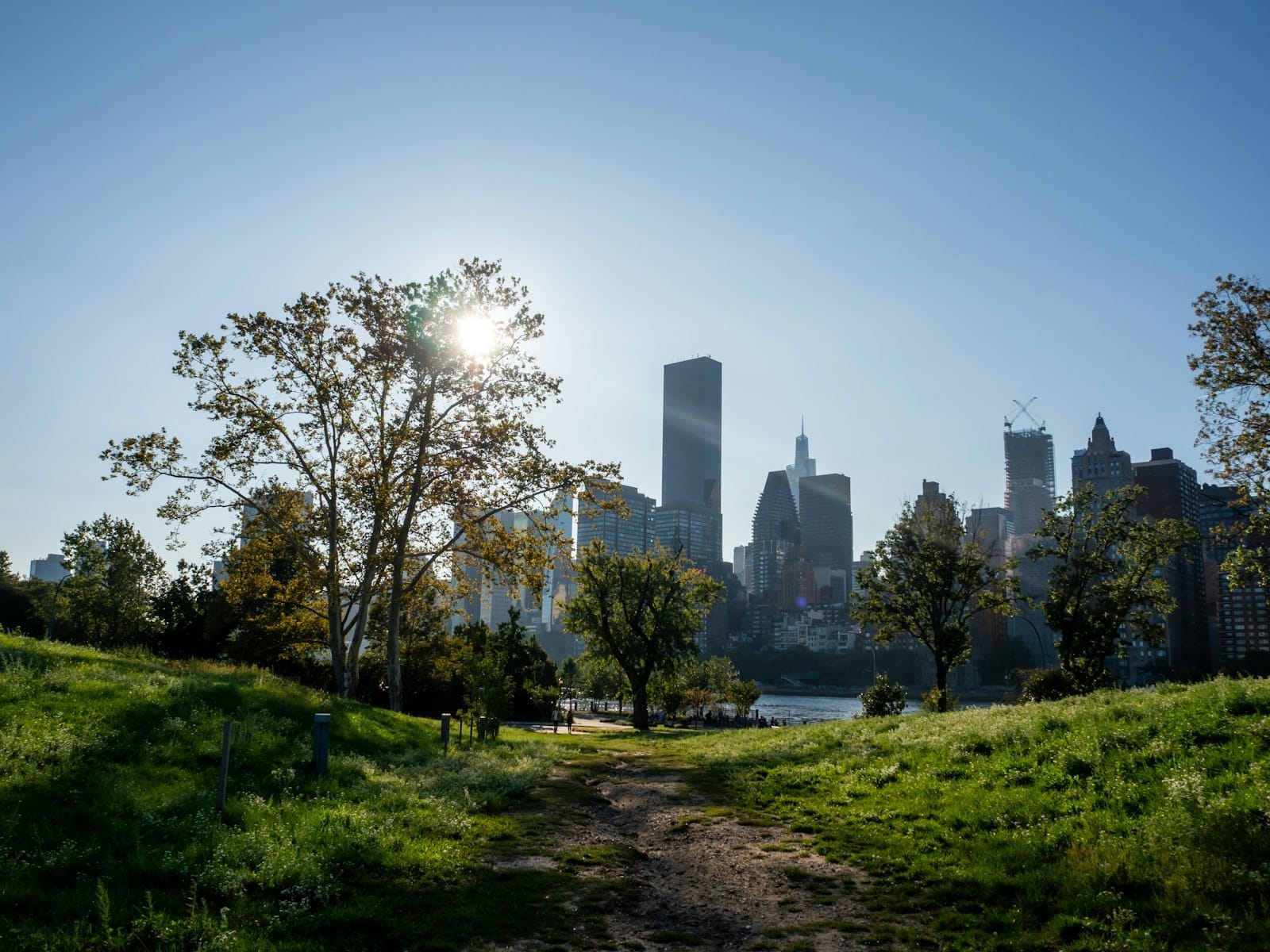
Roosevelt Island is a narrow strip of land in the East River, roughly 1.5 miles long and only an eighth of a mile wide at its widest point, covering about 139 acres in total (figures sometimes rounded; other official estimates put it closer to 2 miles long and 147 acres). Administratively it belongs to Manhattan, but it feels nothing like Manhattan. There are no yellow taxis crowding the street, no midtown noise, no wall of glass towers pressing in from either side. Instead, you get promenades, open grass, scattered historic structures, and an unusually calm atmosphere for a place so close to the geographic center of New York City.
Most of the island is residential today, home to a tight-knit community of around 11,700 people. But the southern and northern tips are open public spaces, and it is those areas, combined with the experience of getting here, that make Roosevelt Island worth a deliberate visit. This is not a major sight in the traditional sense. There is no single world-famous attraction anchoring the visit. What it offers instead is perspective: a rare chance to look at Manhattan from the water level, surrounded by the sounds of the East River, with far fewer people than you would find at any comparable vantage point.
💡 Local tip
Take the tramway to arrive and the F train to leave, or vice versa. Using both gives you two completely different experiences of the crossing and lets you exit at a different point on the island.
The Tram Ride: More Than Just Transportation
The Roosevelt Island Tramway is one of only a few aerial trams in North America used as regular commuter transit. It departs from a station near 60th Street and Second Avenue in Manhattan, swinging out over the East River at roughly 250 feet above the city streets below. The crossing takes about three minutes. At standard MTA fare, it is also one of the most affordable aerial views you will find in any major city.
From the tram cabin, the view west toward midtown Manhattan is wide and clear. You can see the Queensboro Bridge (formally the Ed Koch Queensboro Bridge) directly alongside the tram cable, which gives the ride a slightly industrial texture that sets it apart from the polished observatory experience. The view east toward Queens is more residential and less dramatic, but the contrast is part of the point. You are crossing a real border, not just a scenic one.
For photography, the tram's west-facing windows give the better angle. Late afternoon light hits the Manhattan skyline from the right direction, making it a good time to ride if you want usable images. Morning rides are quieter and faster to board. If you are planning an extended day of skyline views across NYC, the tram is worth building into your route.
Tickets & tours
Hand-picked options from our booking partner. Prices are indicative; availability and final rates are confirmed when you complete your booking.
Statue of Liberty, Ellis Island, and Brooklyn Bridge Happy Hour Cruise
From 49 €Instant confirmationFree cancellationSpirit of New York Dinner Cruise
From 161 €Instant confirmationFree cancellationNew York City Highlights bike tour
From 70 €Instant confirmationFree cancellationNew York Statue of Liberty and Ellis Island tour by ferry
From 55 €Instant confirmation
The Southern Tip: Four Freedoms Park and the FDR Memorial
At the southern end of the island sits Franklin D. Roosevelt Four Freedoms State Park, a formal landscape designed by architect Louis Kahn. Kahn conceived the park in the early 1970s, but it was not completed and opened to the public until 2012, nearly four decades after his death in 1974. The result is stark and deliberate: a long allée of linden trees leading to a granite-paved room open to the sky, anchored by a large bronze bust of Roosevelt. The park occupies the very tip of the island, with water on three sides and an unobstructed view of the United Nations Headquarters and the midtown Manhattan skyline.
The park's design is minimalist to the point of austerity. Some visitors find it moving; others find it too empty. It works best as a quiet stopping point rather than a destination in itself. Check the park's operating hours before visiting, as it does not follow the same open-24-hours policy that applies to the island's public paths. The park honors Roosevelt's 1941 State of the Union address, in which he articulated the four essential human freedoms: freedom of speech, freedom of worship, freedom from want, and freedom from fear. That context adds weight to what might otherwise read as a cold granite terrace. You can also see the United Nations Headquarters clearly from the park's southern edge.
Historic Ruins and 19th-Century Remnants
Roosevelt Island carries several names from its history. It was Blackwell's Island for most of its early existence, named after the farming family that owned it in the 17th and 18th centuries. In 1828, New York City purchased it and began using it for institutions it wanted removed from Manhattan, including a workhouse and penitentiary, a poorhouse, a lunatic asylum, and later a smallpox hospital. The name changed to Welfare Island in 1921, and then to Roosevelt Island in 1973, around the time the state began converting it into a planned residential community.
What remains from that institutional era is worth seeking out. The Renwick Ruin at the southern end is the shell of a smallpox hospital completed in 1856, designed by James Renwick Jr., the same architect responsible for St. Patrick's Cathedral. The Gothic Revival stone walls stand roofless and partially enclosed, preserved as a stabilized ruin. It is genuinely atmospheric, particularly in lower light or overcast conditions, and feels far more dramatic than photographs suggest.
Further north, the Octagon Tower is one of the oldest structures on the island, the sole surviving element of the New York City Lunatic Asylum from 1843. The tower has been incorporated into a modern residential complex, so you cannot enter it as a historic building, but the exterior is still visible. The Blackwell House, dating to the 1790s, is among the oldest remaining farmhouses in Manhattan. The Chapel of the Good Shepherd, built in 1888, and the lighthouse at the island's northern tip, dating to 1872, round out a surprisingly dense collection of 19th-century structures for a strip of land this small.
ℹ️ Good to know
The Renwick Ruin is enclosed behind a fence and visible but not freely walkable through the interior. Viewing it from the perimeter path still gives a strong sense of its scale and detail.
Walking the Island: Atmosphere at Different Hours
The main path running along the island's perimeter is flat, paved, and accessible. In the morning on weekdays, it is mostly local residents: people walking dogs, commuters heading to the tram station, and occasional joggers. The pace is slow and the crowd is thin. Weekend afternoons bring more visitors from Manhattan, particularly families, and the southern promenade around Four Freedoms Park sees more foot traffic.
The east-facing promenade looks toward Queens, which offers a quieter and less photogenic view but catches good morning light and tends to be less crowded than the west side at any time of day. The west-facing path gives you a low, unobstructed line on the midtown Manhattan skyline. The buildings are close enough that you can distinguish individual towers clearly. The sound environment is dominated by the river: wind, the occasional boat motor, and the low background hum of the city filtered through distance and water.
In summer the promenade fills out with residents, and the grass areas near the southern tip see picnics and informal gatherings. In winter the island is quieter and the skyline views are often crisper due to lower humidity, making it an underappreciated option for photography in the colder months. If you are trying to plan around NYC's seasonal weather patterns, autumn and spring offer the best combination of mild conditions and good visibility.
Practical Details: Getting There, Getting Around
There are three main ways to reach Roosevelt Island. The tramway from 59th Street and Second Avenue in Manhattan is the most popular visitor route. The F subway line stops at Roosevelt Island station, making it straightforward to incorporate into a subway-heavy day. A vehicular bridge connects the island to Queens, but this is primarily used by residents with cars and is not a typical visitor route.
Both the tram and the F train accept standard MTA fare payment, including the OMNY contactless system and MetroCard. Verify current fares with the MTA before your visit, as these are updated periodically. Once on the island, a free public bus called the Red Bus operates along Main Street and connects the length of the island, which is useful if you want to reach the northern lighthouse without walking the full distance. For orientation on navigating NYC's transit system more broadly, planning ahead saves time.
The island's paths are largely flat and suitable for strollers and wheelchairs. The tramway is part of the public MTA system; confirm current accessibility arrangements with the MTA or RIOC if you have specific mobility requirements, as features and operational details can change.
⚠️ What to skip
There are very few food options on Roosevelt Island. Bring water and snacks, especially if you plan to spend more than an hour exploring. A handful of small cafes exist along Main Street but do not count on finding them open at all hours.
Who Will Enjoy This, and Who Might Not
Roosevelt Island works best for visitors who want something genuinely different from the standard Manhattan circuit. If you have already done the Empire State Building and the High Line and want a quieter alternative that still rewards with skyline views and historic interest, this fits that gap well.
It is also a solid choice for first-time visitors who want a low-cost, low-crowd experience. The tram ride alone is something that most tourists never take, and the combination of the crossing, the Four Freedoms Park, and the Renwick Ruin covers a range of experiences in a compact two-to-three-hour loop.
Travelers looking for dense urban stimulation, world-class museum collections, or major nightlife will find Roosevelt Island disappointing. It is quiet by design and residential by nature. The lack of restaurants and shops means it does not work as a half-day destination for people who like to eat their way through a neighborhood. First-time visitors with only one or two days in New York should likely prioritize elsewhere and save the island for a return trip.
Insider Tips
- The tramway experiences occasional service interruptions for maintenance. Before building your day around it, check the MTA's service status or the RIOC website for any scheduled downtime.
- The northern lighthouse at the tip of the island is a short walk beyond where most visitors stop. It is rarely crowded and offers wide water views in multiple directions that is difficult to find anywhere else in the five boroughs.
- The Renwick Ruin photographs most dramatically in overcast or low-contrast light. Bright midday sun creates harsh shadows on the Gothic stonework and washes out the texture that makes it interesting.
- The free Red Bus on Main Street runs on a loop and is the fastest way to travel the length of the island without walking. Locals use it routinely but most tourists walk past the stop without realizing it exists.
- Roosevelt Island's residential character means it is genuinely quieter than surrounding Manhattan, but it is not entirely cut off from city noise. The Queensboro Bridge runs directly overhead, and traffic noise carries down intermittently, particularly on the northern promenade beneath the bridge span.
Who Is Roosevelt Island For?
- Repeat NYC visitors looking for something off the standard tourist circuit
- Architecture and history enthusiasts interested in 19th-century New York
- Photographers seeking low-angle midtown skyline views without the crowds
- Families wanting a calm, walkable outdoor experience near midtown
- Budget travelers who want a scenic and historically rich half-day for little more than a subway fare
Nearby Attractions
Other things to see while in Midtown Manhattan:
- Broadway Theater District
The Broadway Theater District in Midtown Manhattan is the center of American live theater, home to 41 official Broadway houses spanning nearly a century of performance history. Whether you're booking months in advance or hunting same-day discount tickets, this guide covers everything from curtain times to architectural details.
- Bryant Park
Tucked behind the New York Public Library on Sixth Avenue, Bryant Park is an 8-acre public park that holds its own against the surrounding skyscrapers. Free to enter year-round, it shifts character dramatically by season, from a winter ice rink to a summer outdoor cinema — and remains one of the most functional and well-managed public spaces in New York City.
- Carnegie Hall
Carnegie Hall has anchored Midtown Manhattan's cultural life since 1891. With three auditoriums ranging from 268 to 2,790 seats, it hosts everything from orchestral premieres to intimate recitals. This guide covers the halls, the history, and exactly how to make the most of a visit.
- Chrysler Building
Completed in 1930 and briefly the tallest building on earth, the Chrysler Building remains the finest example of Art Deco architecture in New York City. Visitors generally can't go inside beyond the main lobby, but the experience of standing beneath its gleaming stainless steel crown is genuinely unforgettable.