United Nations Headquarters: What to Expect Before You Visit
The United Nations Headquarters sits on an 18-acre East River campus in Midtown Manhattan, one of the few places in New York with a distinct international legal status under a special agreement with the United States. Guided tours take you through the General Assembly Hall and Security Council Chamber, but the experience rewards visitors who arrive with context and curiosity rather than expecting a typical tourist attraction.
Quick Facts
- Location
- 760 United Nations Plaza (visitor entrance near 46th St & 1st Ave), Turtle Bay, Midtown Manhattan, NY 10017
- Getting There
- Subway: 4/5/6/7/S to Grand Central–42nd St, then a 10-minute walk east to 1st Ave. Several MTA bus routes also stop along 1st Ave.
- Time Needed
- 1.5 to 2.5 hours for a guided tour; allow extra time for security screening on arrival
- Cost
- Guided tour tickets required; prices vary by tour type and age group. Book and verify current prices at un.org/en/visit before you go.
- Best for
- History and politics enthusiasts, architecture lovers, international travelers, students of global affairs
- Official website
- www.un.org/en/visit
What the UN Headquarters Actually Is
The United Nations Headquarters is not a museum, not a park, and not a conventional landmark you can simply wander into. It is a functioning intergovernmental complex: the permanent seat of the UN Secretariat, the General Assembly, and several major councils. The campus, officially known as United Nations Headquarters (Siège de l'Organisation des Nations Unies in French), sits on an 18-acre site bounded by First Avenue to the west, the East River to the east, East 42nd Street to the south, and East 48th Street to the north. Its grounds have a distinct international status under a 1947 Headquarters Agreement with the United States, which, among other things, restricts U.S. federal, state, and local officials from entering without the Secretary-General’s consent, while U.S. law continues to apply in important respects.
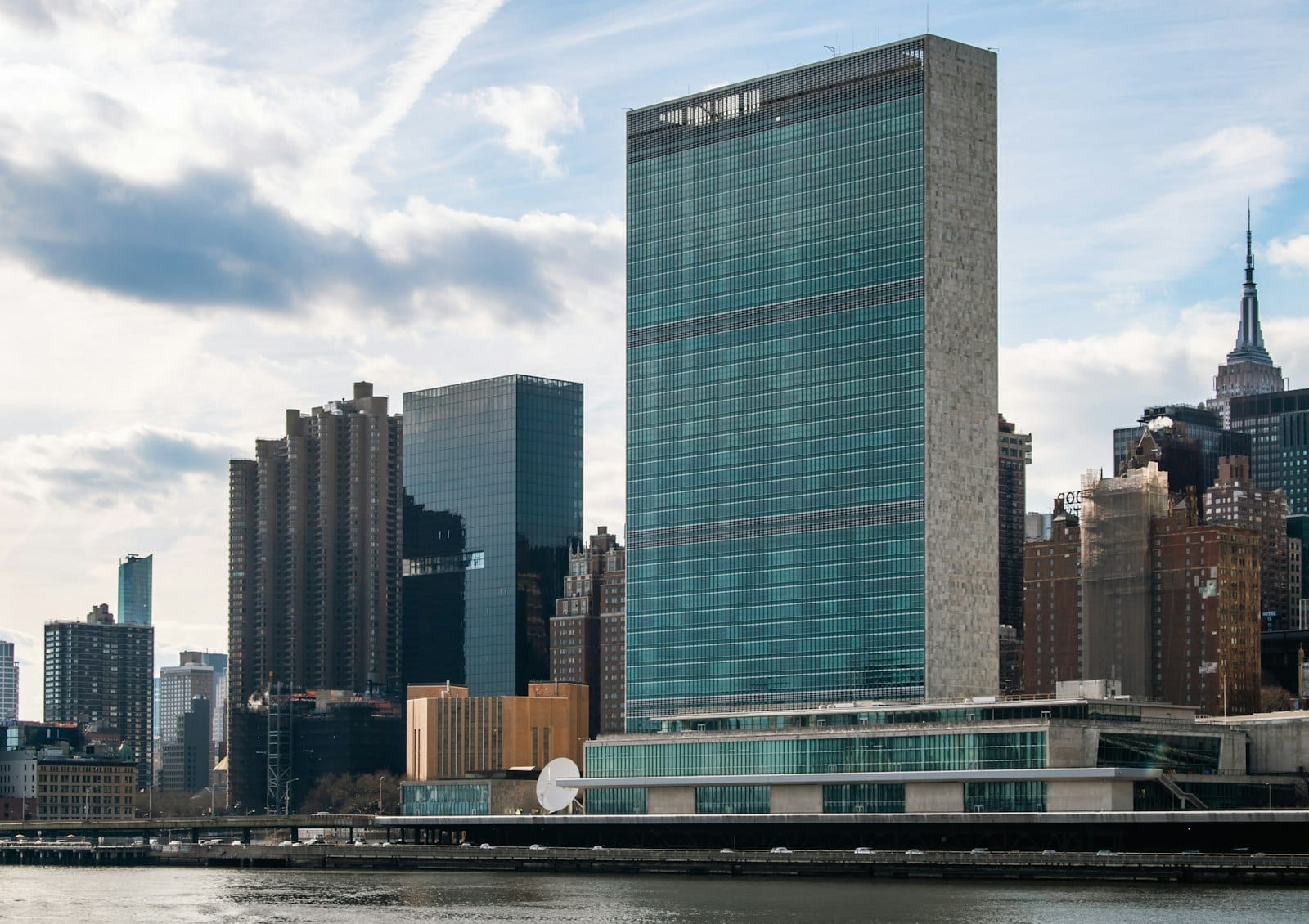
The complex’s main buildings were substantially completed by 1952, with an official opening ceremony for UN Headquarters held on January 9, 1951. Four main structures define it: the 39-floor Secretariat Building, a sleek curtain-wall slab that became one of the defining images of postwar Modernism; the low, curved-roof General Assembly Building; the Conference Building extending toward the river; and the Dag Hammarskjöld Library. Seen from the FDR Drive or a waterfront vantage, the Secretariat tower still reads as architecturally bold, a glass-and-aluminum rectangle that influenced commercial skyscraper design across American cities for decades.
ℹ️ Good to know
Most visitors are asked to pre-register on the UN security website before arriving, and adults 18 and older need a valid government-issued photo ID at the entrance checkpoint. Do this before the day of your visit to avoid delays.
The Architecture: Postwar Idealism in Glass and Marble
The Secretariat Building was designed by an international committee of architects that included Le Corbusier, Oscar Niemeyer, and Wallace Harrison, among others, working under significant diplomatic and creative tension between 1947 and 1950. The result was a 39-story glass curtain wall on the narrow east-west axis, flanked by marble on the north and south ends. In the 1950s, this kind of all-glass commercial tower was still a novelty, and the Secretariat helped popularize the form that would saturate Midtown Manhattan over the following three decades.
From street level on First Avenue, the scale is impressive but not overwhelming. The General Assembly Building's low, spreading roofline contrasts cleanly with the tower, and the open plaza between them gives the complex a sense of civic breathing room that is increasingly rare in this part of Midtown Manhattan. The grounds also hold several notable public artworks: a large bronze sculpture of a revolver with its barrel tied in a knot, titled Non-Violence, is often photographed near the main entrance. Stained glass panels by Marc Chagall are inside the building, visible on guided tours.
Tickets & tours
Hand-picked options from our booking partner. Prices are indicative; availability and final rates are confirmed when you complete your booking.
Statue of Liberty, Ellis Island, and Brooklyn Bridge Happy Hour Cruise
From 49 €Instant confirmationFree cancellationSpirit of New York Dinner Cruise
From 161 €Instant confirmationFree cancellationNew York City Highlights bike tour
From 70 €Instant confirmationFree cancellationNew York Statue of Liberty and Ellis Island tour by ferry
From 55 €Instant confirmation
Getting There and Through Security
The visitor entrance is near 46th Street and First Avenue. From Grand Central Terminal, the walk takes about ten minutes heading east along 42nd or 45th Street. The subway lines serving Grand Central (4, 5, 6, 7, and S trains) are the most practical approach. First Avenue buses are an alternative if you are coming from the Upper East Side or Lower Midtown.
Security screening at the entrance is real and thorough. Expect airport-style bag checks and ID verification. The process moves at a reasonable pace on most weekday mornings, but if you arrive close to a tour start time without buffer, you may miss it. Build in at least 20 to 30 minutes before your scheduled tour for screening and check-in. The main visitor entrance is on the west side of the complex, off First Avenue, not along the East River perimeter.
⚠️ What to skip
Guided tours generally operate Monday through Friday during daytime hours, and there are normally no public tours on weekends or UN holidays. If your trip to New York falls on a long weekend, check the UN calendar before booking. Tours sell out on busy weekdays, so book in advance at un.org/en/visit.
The Guided Tour: What You See Inside
Access beyond the public lobby areas requires a guided tour ticket, booked through the UN's own booking system. Prices vary by age group and tour type; the UN does not publish a single fixed fee on its general information page, so verify current pricing directly when booking. There are no free entry options for the main tour experience.
The tour typically moves through the General Assembly Hall, the largest chamber in the complex. The hall seats delegates from all 193 member states, arranged in curved rows facing the green marble podium. The acoustics are deliberately controlled; you notice the near-silence when the group pauses. Earphones hang at each delegate seat for simultaneous interpretation in the six official UN languages: Arabic, Chinese, English, French, Russian, and Spanish. When the General Assembly is not in session, visitors stand on the floor itself, which changes the room considerably. It feels institutional and solemn rather than dramatic.
The Security Council Chamber, donated by Norway in 1952, is smaller and more overtly theatrical in its design. The Norwegian artist Per Krohg painted the large mural behind the dais: gold and blue figures representing humanity moving from the darkness of war toward the light of peace. The five permanent member seats face the room from the horseshoe table. Tour guides typically explain the veto power structure here, which tends to spark the most visitor questions and the liveliest discussion. The Trusteeship Council Chamber, designed by Denmark and featuring a ceiling of blond Danish wood, rounds out the main chambers and has a quieter, almost domestic quality compared to the other rooms.
The experience is more engaging if you follow current events before visiting. When a conflict or major resolution is in the news, standing in the Security Council Chamber carries weight that it otherwise lacks for casual visitors. Combine your visit with a broader Grand Central Terminal stop nearby for a contrasting view of Midtown's architectural history, or plan it as part of a New York City architecture tour.
Time of Day and Crowd Patterns
Morning tours, particularly those starting between 9:30 and 11:00 a.m., tend to run with smaller groups than afternoon slots and have a calmer energy. By early afternoon, school and student groups increase noticeably in the lobby and common areas, and the pace quickens. The complex is busiest during the General Assembly's high-level General Debate, held each September, when heads of state and foreign ministers arrive in large numbers and visitor access is heavily restricted or closed entirely. If you plan to visit in September, check the UN session calendar well in advance.
The outdoor plaza along First Avenue catches the morning light well from around 9:00 to 11:00 a.m., which is the best time for exterior photographs of the Secretariat tower. The east-facing orientation means the glass curtain wall gets strong direct sun in the afternoon when shooting from outside, creating glare. The Non-Violence sculpture photographs cleanly from the plaza side in diffuse light on overcast days.
Who Should Visit and Who Should Skip It
This attraction rewards visitors with a genuine interest in international relations, postwar architectural history, or diplomacy. If those subjects engage you, the UN Headquarters delivers an experience that no other site in New York replicates. For travelers who want primarily visual spectacle or kinetic energy, the visit can feel slow and procedural. The interior spaces are institutional by design; they are not decorated to impress tourists in the way that Grand Central Terminal or the Chrysler Building lobby are.
Children who are engaged with world history or geography can find the tour genuinely interesting, particularly the Security Council Chamber discussion. Younger children who are not yet curious about these topics are likely to find the experience long and the interior spaces austere. The UN does offer educational programming for school groups; if visiting with students, check the UN's dedicated education visit options.
Visitors with accessibility needs should contact UN Visitor Services in advance, as the general information page does not list step-free route specifics or assistive technology availability. For travelers building a full Midtown day, the UN pairs well with a walk down to the New York Public Library or a stop at Bryant Park, both within 15 minutes on foot.
Practical Details at a Glance
- Tours: Generally Monday to Friday during daytime hours; no public tours on weekends or UN holidays (check current schedule).
- Tickets: Required for access beyond public areas. Book at un.org/en/visit. Prices vary by age and tour type — confirm at time of booking.
- ID: Government-issued photo ID required for all visitors 18 and older. Pre-register on the UN security site before arriving.
- Transit: Subway 4/5/6/7/S to Grand Central–42nd St, then walk east. Multiple MTA bus routes on 1st Ave also serve the area.
- Photography: Permitted in most public and tour areas; individual guides may specify restrictions in certain chambers.
- Weather: The outdoor plaza is exposed. In winter, the walk from Grand Central along 42nd or 45nd Street is cold and windy. Dress accordingly.
Insider Tips
- Book your tour slot at least several days ahead, not the morning of. Popular weekday slots sell out, especially in spring and late September during General Assembly season.
- Arrive 25 to 30 minutes before your tour start for security screening. The line moves steadily but a late arrival risks missing your slot with no refund pathway.
- The UN gift shop, located in the public area accessible without a full tour ticket, sells stamps from member nations that are valid for postage on mail sent from the UN post office on-site. Sending a postcard with a UN stamp is a small but genuinely distinctive keepsake.
- If you want exterior architecture photographs, position yourself on the First Avenue sidewalk looking east in morning light for the cleanest shots of the Secretariat's glass curtain wall. Afternoon sun creates strong glare on that facade.
- Avoid visiting in the last two weeks of September if you want open access. The General Assembly's high-level General Debate draws heads of state, and visitor tour availability is sharply curtailed during this period.
Who Is United Nations Headquarters For?
- Travelers with a serious interest in international politics, diplomacy, or global history
- Architecture enthusiasts interested in mid-century Modernism and postwar institutional design
- Students and educators looking for a directly relevant civics or history experience in New York
- International visitors for whom the UN has personal or national significance
- First-time visitors to New York building a comprehensive Midtown itinerary over several days
Nearby Attractions
Other things to see while in Midtown Manhattan:
- Broadway Theater District
The Broadway Theater District in Midtown Manhattan is the center of American live theater, home to 41 official Broadway houses spanning nearly a century of performance history. Whether you're booking months in advance or hunting same-day discount tickets, this guide covers everything from curtain times to architectural details.
- Bryant Park
Tucked behind the New York Public Library on Sixth Avenue, Bryant Park is an 8-acre public park that holds its own against the surrounding skyscrapers. Free to enter year-round, it shifts character dramatically by season, from a winter ice rink to a summer outdoor cinema — and remains one of the most functional and well-managed public spaces in New York City.
- Carnegie Hall
Carnegie Hall has anchored Midtown Manhattan's cultural life since 1891. With three auditoriums ranging from 268 to 2,790 seats, it hosts everything from orchestral premieres to intimate recitals. This guide covers the halls, the history, and exactly how to make the most of a visit.
- Chrysler Building
Completed in 1930 and briefly the tallest building on earth, the Chrysler Building remains the finest example of Art Deco architecture in New York City. Visitors generally can't go inside beyond the main lobby, but the experience of standing beneath its gleaming stainless steel crown is genuinely unforgettable.