Grand Central Terminal: More Than a Train Station
Open since 1913, Grand Central Terminal is one of Midtown Manhattan's most architecturally significant landmarks. Free to enter and running daily from 5:15 AM to 2:00 AM, it draws commuters, architecture lovers, and curious travelers in equal measure. The experience shifts dramatically depending on what time you arrive.
Quick Facts
- Location
- 89 E 42nd St at Park Avenue, Midtown Manhattan, NY 10017
- Getting There
- Subway lines 4, 5, 6, 7, S — Grand Central–42nd St station. Also served by Metro-North, LIRR (Grand Central Madison), and MTA buses M1, M2, M3, M4, M42, M101–M103, Q32
- Time Needed
- 45 minutes to 2 hours depending on how deep you explore
- Cost
- Free public entry. Individual dining, food market, and tour costs vary.
- Best for
- Architecture, photography, food halls, people-watching, New York history
- Official website
- grandcentralterminal.com
What Grand Central Terminal Actually Is
Grand Central Terminal is not Penn Station. That distinction matters. Where Penn Station is largely functional and utilitarian, Grand Central Terminal is a civic monument that also happens to move trains. Opened on February 2, 1913, it was designed by the firms Reed & Stem and Warren & Wetmore in the Beaux-Arts style, a school of architecture that treated grandeur as a civic duty. The result is a building that makes you look up the moment you walk in, whether you intend to or not.
It sits at 89 E 42nd St at Park Avenue, right at the heart of Midtown Manhattan, and is served by subway lines 4, 5, 6, 7, and the S shuttle, along with Metro-North Railroad and Long Island Rail Road service to Grand Central Madison. For millions of New Yorkers, it is simply a transit node they pass through without a second glance. For visitors with time to slow down, it is something else entirely.
💡 Local tip
Public entry is completely free. You do not need a train ticket or any reservation to walk through the Main Concourse. Just enter from 42nd Street at Park Avenue and go.
The Main Concourse: What You See When You Walk In
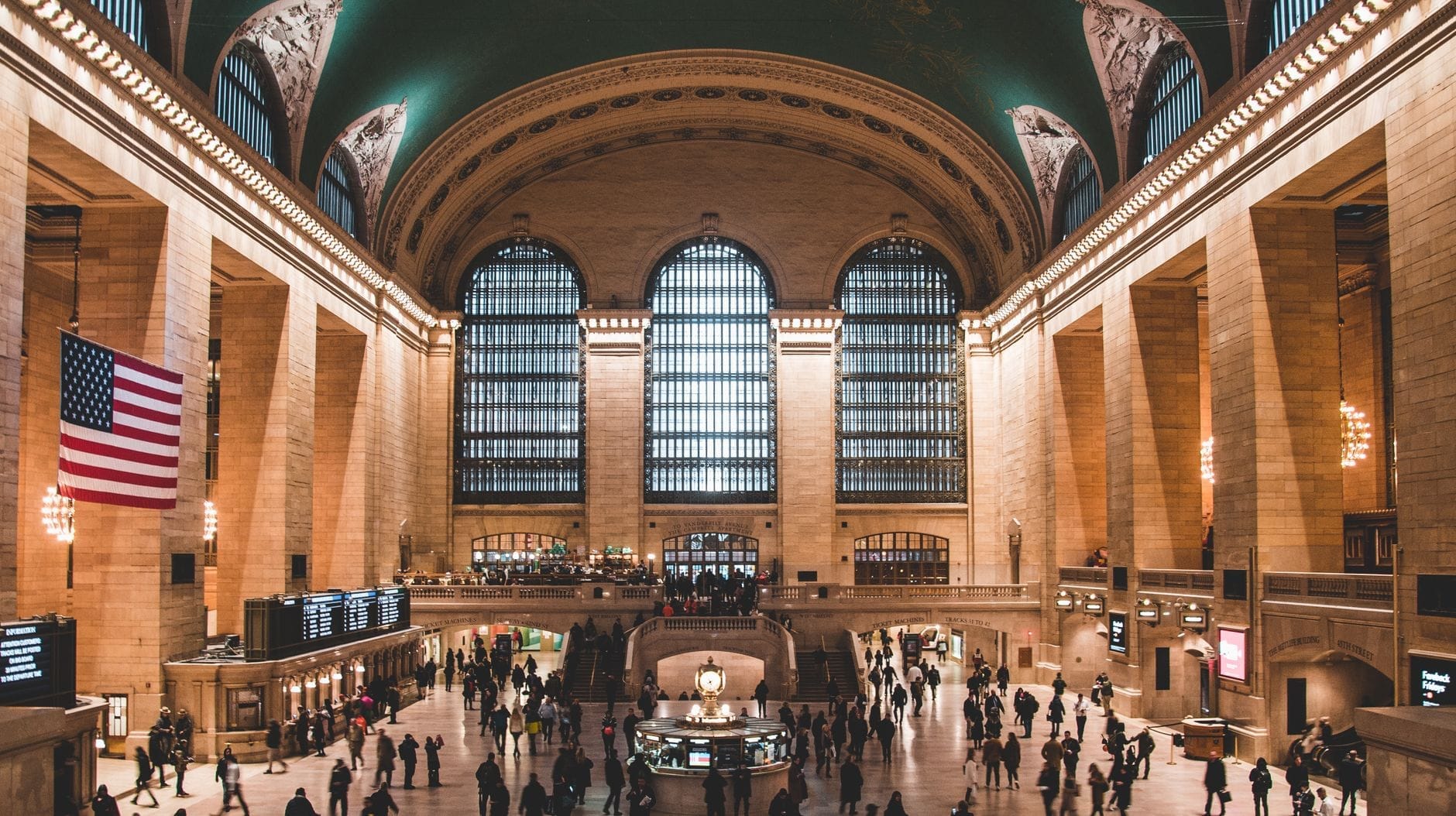
The Main Concourse is the central hall, and it delivers something that photographs do not fully prepare you for: scale combined with natural light. The room is approximately 275 feet long, 120 feet wide, and 125 feet high. Three arched windows on the south facade measure 75 feet tall each, and on clear mornings they send shafts of pale gold light across the Tennessee marble floors, illuminating the movement of crowds below in a way that feels almost staged.
The ceiling is the first thing most people notice. It depicts a Mediterranean winter sky with constellations picked out in gold leaf on a blue-green background. There are 2,500 stars represented, including Orion, Aquarius, and Pisces. The image is, famously, painted in reverse, a mirror image of the actual sky. Whether this was intentional or a historical error remains a matter of debate, though the terminal's own historical materials acknowledge the inversion. The ceiling was restored in the 1990s after decades of grime from tobacco smoke obscured it almost entirely.
At the center of the concourse sits the circular information booth with its famous opal glass clock, one of the most photographed objects in New York City. The clock sits on top of the booth and is visible from nearly every point in the hall. It has four faces, each made of opal glass rather than conventional clock faces, and the light passes through them in a way that makes them glow faintly from the inside.
Grand Central is one of the most compelling stops on any New York City architecture itinerary, but it works equally well as a spontaneous stop rather than a planned destination.
Tickets & tours
Hand-picked options from our booking partner. Prices are indicative; availability and final rates are confirmed when you complete your booking.
NYC: Official Grand Central Terminal Tour
From 30 €Instant confirmationFree cancellationGrand Central Terminal NY self-guided walking tour
From 13 €Instant confirmationFree cancellationGrand Central Terminal and Manhattan Sights Walking Tour
From 59 €Instant confirmationFree cancellationCentral Park Guided Bike Tour with Map
From 41 €Instant confirmationFree cancellation
How the Experience Changes by Time of Day
Arrive between 8:00 and 9:30 AM on a weekday and Grand Central is at full operational pitch. The concourse fills with commuters crossing in every direction with practiced efficiency, briefcases and coffee cups in hand, the rhythm relentless. The sound in the hall at this hour is a low, continuous roar of footsteps and ambient noise, filtered through the marble and stone into something almost melodic. It is genuinely impressive to watch, but not the best moment for photography or quiet observation.
Come between 10:30 AM and noon, or between 2:00 and 4:00 PM on a weekday, and the crowd thins considerably. This is when the light from the south windows does its best work and when you can actually stand still in the concourse without impeding foot traffic. You get a clearer sense of the room's proportions, and the acoustic quality of the space becomes more apparent: conversations carry strangely across the marble, and the general ambient hum drops to something more contemplative.
Weekend mornings, particularly Sunday between 9:00 and 11:00 AM, offer a genuinely different version of Grand Central. The commuter crowd is absent, the food hall vendors are setting up, and the Main Concourse is quiet enough that you can hear your own footsteps echo. This is the best window for photography without crowds competing for the frame.
⚠️ What to skip
Midday on weekdays and any time during the holiday season (November through early January) brings significant congestion. The terminal is also heavily used during major weather events, when it becomes a shelter of sorts. Plan accordingly.
Below the Concourse: The Dining Concourse and Oyster Bar
Descend from the Main Concourse via the ramps on either side (the building was designed around ramps rather than stairs, allowing a continuous flow of pedestrian traffic across multiple levels) and you reach the Dining Concourse, a food hall with dozens of vendors selling everything from soup dumplings to sushi, Thai food, sandwiches, and coffee. The quality is uneven, as it is in most food halls of this size, but the selection is broad enough that most travelers will find something workable for a quick meal.
The Grand Central Oyster Bar, which has operated in the terminal since its opening year of 1913, occupies the lower level and is worth a look even if you do not eat there. The room itself, with its Guastavino tile vaulting, is architecturally notable. The curved tile ceiling creates a whispering gallery effect at the arched entrances: stand in one corner and speak softly, and someone standing in the opposite corner can hear you clearly. The acoustic phenomenon is a reliable curiosity for visitors who know where to position themselves.
If you are building a broader itinerary around Midtown food, the New York City food guide covers both neighborhood staples and destination restaurants within walking distance of the terminal.
Historical and Cultural Context
The terminal was not always celebrated. By the 1960s, Penn Station had been demolished to build Madison Square Garden, a loss that caused significant public outcry and helped galvanize the historic preservation movement in New York City. Grand Central faced a similar threat: developers proposed building a tower above or in place of the terminal, and the resulting legal battle went all the way to the U.S. Supreme Court. In Penn Central Transportation Co. v. New York City (1978), the court upheld New York City's landmarks preservation law, protecting the terminal. Grand Central's survival as a building is, in part, a direct consequence of Penn Station's destruction.
The terminal underwent a major restoration that concluded in 1998. The project addressed structural issues, restored the ceiling, improved pedestrian circulation, and added new retail and dining. The current terminal is essentially the restored 1913 building, with updated infrastructure. The restoration is considered one of the most successful urban preservation projects in American history.
Grand Central sits in the middle of Midtown Manhattan, one of the densest commercial districts in the world. The surrounding blocks contain a concentration of significant 20th-century buildings that reward a slow walk even after you leave the terminal.
Practical Walkthrough: How to Navigate the Space
The terminal has multiple levels connected by ramps and stairways. The Main Concourse is the primary entry level from 42nd Street. From here, ramps lead down to the Dining Concourse (food vendors, the Oyster Bar) and further down to the lower level train platforms served by Metro-North. There is also a mid-level that contains additional retail. The subway platforms for the 4, 5, 6, 7, and S trains are accessible via staircases within the terminal.
Accessibility is well handled. The MTA has equipped Grand Central Terminal with elevators, ramps, tactile warning strips, and audiovisual passenger information systems throughout the facility. The ramp-based design of the building's original architecture actually makes it more navigable for those with mobility limitations than most comparable historic buildings.
Photography is permitted in all public areas. For the best angle on the Main Concourse, the balcony on the south end (accessible from Vanderbilt Avenue entrance on the west side) gives an elevated view across the full length of the hall. Arrive before 10:00 AM on a weekday or any time on a Sunday morning for the combination of good light and manageable crowds.
ℹ️ Good to know
Grand Central Terminal is open daily from 5:15 AM to 2:00 AM. Individual stores, restaurants, and the food market have their own hours that vary. Check the official site at grandcentralterminal.com before planning meals or shopping around specific vendors.
Who Should Probably Not Prioritize This
If your travel style is about destinations that require effort to reach or carry an element of discovery, Grand Central might feel too central and too well-known to merit dedicated time. It is by definition a major throughway, not a retreat. Travelers who are uncomfortable in crowds, particularly during weekday rush hours or the December holiday period, may find the experience more stressful than rewarding. The terminal is also not an attraction with a defined beginning and end: there is no admission process, no guided path through exhibits, and no climactic moment. What you get out of it depends almost entirely on how much attention you bring with you.
Insider Tips
- The whispering gallery at the Oyster Bar entrance on the lower level is one of the best acoustic curiosities in the city. Position yourself in one of the four corners of the arched entryway and speak at normal conversational volume facing the wall. Someone standing in the diagonally opposite corner can hear you clearly.
- The balcony on the south end of the Main Concourse, accessed from the Vanderbilt Hall side, gives you an unobstructed elevated view across the full length of the concourse. Most visitors on the floor level miss it entirely.
- Vanderbilt Hall, directly off the Main Concourse to the west, is a large secondary hall frequently used for temporary markets, events, and exhibitions. Check the terminal's events calendar before visiting, as it occasionally hosts food markets and pop-up vendors worth timing your visit around.
- If you are traveling on Metro-North, the lower-level platforms are largely calm even during peak hours. The concourse directly above the platforms has a practical local food counter that sees far less traffic than the main Dining Concourse one level up.
- Dozens of ticket machines for Metro-North are spread across the terminal but the quieter bank of machines is on the lower level near the train platforms, not in the main hall where lines can form during peak periods.
Who Is Grand Central Terminal For?
- Architecture and design travelers who want to understand New York's Beaux-Arts heritage
- First-time visitors to New York City who want a landmark that is free, central, and genuinely impressive
- Photographers looking for interior light, crowd dynamics, and urban scale
- Anyone with a layover or a gap between plans in Midtown who wants somewhere to sit, eat, and observe
- History-minded travelers interested in American urban preservation
Nearby Attractions
Other things to see while in Midtown Manhattan:
- Broadway Theater District
The Broadway Theater District in Midtown Manhattan is the center of American live theater, home to 41 official Broadway houses spanning nearly a century of performance history. Whether you're booking months in advance or hunting same-day discount tickets, this guide covers everything from curtain times to architectural details.
- Bryant Park
Tucked behind the New York Public Library on Sixth Avenue, Bryant Park is an 8-acre public park that holds its own against the surrounding skyscrapers. Free to enter year-round, it shifts character dramatically by season, from a winter ice rink to a summer outdoor cinema — and remains one of the most functional and well-managed public spaces in New York City.
- Carnegie Hall
Carnegie Hall has anchored Midtown Manhattan's cultural life since 1891. With three auditoriums ranging from 268 to 2,790 seats, it hosts everything from orchestral premieres to intimate recitals. This guide covers the halls, the history, and exactly how to make the most of a visit.
- Chrysler Building
Completed in 1930 and briefly the tallest building on earth, the Chrysler Building remains the finest example of Art Deco architecture in New York City. Visitors generally can't go inside beyond the main lobby, but the experience of standing beneath its gleaming stainless steel crown is genuinely unforgettable.