New York Public Library – Stephen A. Schwarzman Building: What to Expect Before You Visit
The Stephen A. Schwarzman Building is the flagship of the New York Public Library system, a Beaux-Arts masterpiece on Fifth Avenue that has anchored Midtown Manhattan since 1911. Admission is free, the architecture is extraordinary, and the Rose Main Reading Room alone justifies the detour. Here is everything you need to know to make the most of it.
Quick Facts
- Location
- 476 Fifth Avenue at East 42nd Street, Midtown Manhattan, New York, NY 10018
- Getting There
- 42 St–Bryant Park (B/D/F/M) and Grand Central–42 St (4/5/6/7/S)
- Time Needed
- 45 minutes to 2 hours depending on your interest
- Cost
- Free. Some special programs require advance registration.
- Best for
- Architecture lovers, history enthusiasts, first-time visitors, rainy-day explorers
- Official website
- www.nypl.org/locations/schwarzman
What the Schwarzman Building Actually Is
The New York Public Library – Stephen A. Schwarzman Building is not a typical library in the borrowing-books sense. It is a research library, which means you come here to read, study, and explore collections on-site rather than check items out. That distinction matters practically: you will not find a checkout desk near the entrance, but you will find some of the most spectacular interior spaces in any public building in the United States, all of them free to enter.
Opened on May 23, 1911, the building sits at Fifth Avenue and East 42nd Street, directly across from Bryant Park on its western flank. It was designed by the architecture firm Carrère and Hastings in the Beaux-Arts style and designated a National Historic Landmark in the 1960s. More than a century after it opened, it remains one of the finest examples of that grand civic tradition anywhere in the country.
ℹ️ Good to know
Opening hours: Monday and Thursday–Saturday 10:00–18:00; Tuesday and Wednesday 10:00–20:00; Sunday 13:00–17:00 (closed Sundays in July and August). Verify current hours at nypl.org before visiting.
The Exterior: Patience and Fortitude on Fifth Avenue
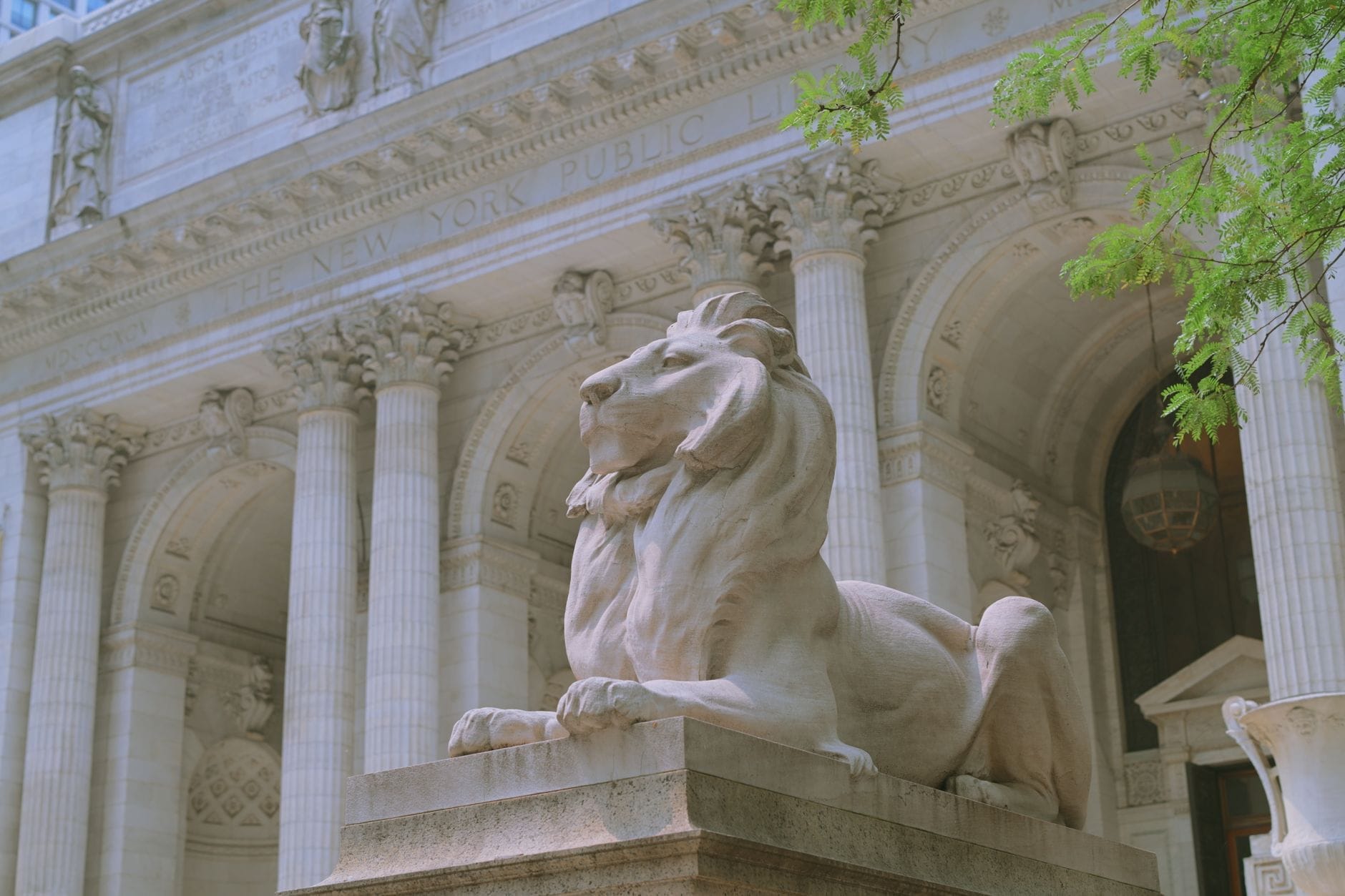
The approach along Fifth Avenue sets the tone immediately. The building's white Vermont marble facade rises in three broad tiers above street level, with a wide ceremonial staircase flanked by two recumbent marble lions. Those lions have been guarding the entrance since the building opened, and they were given their now-famous nicknames — Patience and Fortitude — by Mayor Fiorello La Guardia in the 1930s, reportedly to reflect the qualities New Yorkers needed to survive the Great Depression.
At street level on a weekday morning, the steps are quiet enough to pause and take in the full scale of the facade. By midday the same steps become an impromptu social space: students eat lunch, tourists photograph the lions, and office workers cut through on their way to the subway. The afternoon light hits the marble directly in late spring and summer, giving the facade a warm, almost cream-colored glow that photographs well from the sidewalk opposite. In winter, the contrast of white marble against a grey sky reads as severely formal, which is not less impressive, just different.
💡 Local tip
For the cleanest exterior photos, arrive before 10:00 when the steps are mostly empty and the light is still soft from the east. Fifth Avenue itself is already active by 8:00, but the library forecourt stays calm a little longer.
Tickets & tours
Hand-picked options from our booking partner. Prices are indicative; availability and final rates are confirmed when you complete your booking.
New York Public Library self-guided audio tour
From 9 €Instant confirmationSpirit of New York Dinner Cruise
From 161 €Instant confirmationFree cancellationNew York City Highlights bike tour
From 70 €Instant confirmationFree cancellationNew York Statue of Liberty and Ellis Island tour by ferry
From 55 €Instant confirmation
Inside: The Architecture of Civic Ambition
Through the main doors, the entrance hall opens into a sequence of marble corridors and ornate vestibules that feel more like a 19th-century European palace than a public building. The walls are pale Danby marble. The ceilings are vaulted and painted with allegorical murals in muted golds and greens. There is no admission desk, no rope line, no audioguide kiosk — you simply walk in, and the building unfolds around you.
The building's floor plan is not intuitive on a first visit. Signs direct you upward toward the main reading rooms, but it is easy to miss corridors branching off toward exhibition galleries, smaller reading alcoves, and the DeWitt Wallace Periodical Room, which has its own painted ceiling and rows of long wooden reading tables. Allow yourself to follow your instincts rather than a fixed route. Getting briefly lost here is not a problem.
If you are interested in the library's architectural context in relation to Midtown's broader landscape of civic and commercial landmarks, it pairs naturally with a walk to Grand Central Terminal four blocks east, which was completed just two years after the library and reflects a similar Beaux-Arts sensibility at urban scale.
The Rose Main Reading Room: The Reason to Come
The Rose Main Reading Room on the third floor is the heart of the visit, and nothing quite prepares you for the scale of it. The room stretches approximately 297 feet in length, roughly the distance of an American football field, and rises 52 feet to an ornately painted ceiling depicting a blue sky with clouds. Rows of long oak reading tables run the full length of the room under warm brass reading lamps. On a weekday afternoon, maybe a third of the seats are occupied by actual researchers, students working on laptops, and a handful of visitors who have simply sat down to absorb the room.
The ceiling paintings were restored in 1998 after a partial collapse in 1992 that closed the room for years. Up close, you can see the intricate detail of the restoration: the clouds have depth, the decorative borders along the cornice are crisp. Standing at the south end of the room and looking north across the full length of those tables and lamps, under that ceiling, you get a sense of what it meant to build a library as a statement of public aspiration. The room is not merely beautiful; it is argumentative. It insists that access to knowledge should feel like this.
💡 Local tip
If you want to sit and actually read or work in the Rose Main Reading Room, you are welcome to do so — it is a functioning research space, not a museum exhibit. Keep noise levels low and treat it as you would any serious library.
Exhibitions, Tours, and What Else Is On
Beyond the permanent architecture, the Schwarzman Building runs a regular program of free exhibitions drawn from its research collections. These cover photography, rare manuscripts, maps, prints, and historical documents. The quality and depth vary, but several exhibitions each year draw on holdings that are genuinely world-class: the library's map collection numbers in the hundreds of thousands of items, and its photography archive spans more than a century. Check the NYPL website for current exhibitions before you visit, because a strong show can meaningfully extend the time you spend here.
Free guided tours of the building depart daily, typically starting in the entrance hall. These are led by trained volunteer docents who know the history of the building in detail and can explain architectural features, the original construction process, and the significance of specific artworks. If you have any interest at all in the building's history, the tour is worth joining. It runs approximately one hour and does not require advance booking, though it is worth confirming the current schedule on the NYPL website, as it occasionally changes.
For visitors combining the library with a broader exploration of Midtown's cultural institutions, the best museums in New York City guide covers the full range of options nearby, including the Morgan Library and Museum a few blocks southeast, which holds comparable Beaux-Arts interiors and exceptional manuscript collections.
Practical Details: Getting There, Accessibility, and What to Bring
The building is straightforward to reach by subway. The B, D, F, and M trains stop at 42 St–Bryant Park, which brings you to the library near 42nd Street. The 4, 5, 6, 7, and S trains stop at Grand Central–42 St, a four-block walk west. If you are already walking along Fifth Avenue from Rockefeller Center or St. Patrick's Cathedral to the north, the building is an easy 10-minute walk south.
Accessibility is well managed. The main Fifth Avenue entrance involves stairs, but there is an accessible entrance on 42nd Street with elevator access to public floors. NYPL's Accessibility Services can arrange ASL interpretation and assistive listening devices for programs and tours with advance notice. Strollers are manageable on the upper floors via elevator, though the main reading rooms are large enough that they rarely feel crowded.
There is no coat check, and you can bring a bag into most areas. The building has public restrooms on multiple floors. There is no cafe inside the Schwarzman Building itself, but Bryant Park, directly behind the library on 42nd Street, has seasonal food kiosks and seating that make a natural stopping point before or after.
⚠️ What to skip
Sunday hours are limited to 13:00–17:00 (except July and August, when the library is closed on Sundays). Saturday afternoons tend to be the busiest, particularly the entrance hall and exhibition galleries.
Honest Assessment: Is It Worth Your Time?
The short answer is yes, and almost certainly more than you expect. Most visitors who come for a quick look at the exterior end up spending 45 minutes to an hour inside once they find the Rose Main Reading Room. The building rewards curiosity: the more you explore, the more coherent it becomes as a piece of architecture and as a piece of New York history.
That said, visitors who are specifically interested in borrowing books, using interactive exhibits, or bringing young children to a hands-on space will find the Schwarzman Building a limited fit. It is a research library, not a children's library. For families, the branch libraries across the system offer a different experience. The Schwarzman Building suits adults and older teenagers who respond to architecture, history, or the atmosphere of serious scholarship. It also works well as part of a broader New York City architecture walk through Midtown, or combined with a visit to the nearby Chrysler Building and Grand Central Terminal.
On a rainy day, the Schwarzman Building is one of the best free destinations in the city. The combination of architecture, free exhibitions, and the simple experience of sitting in the Rose Main Reading Room makes it far more satisfying than most weather-dependent alternatives. Even if you have no scholarly purpose, spending an hour in that room watching the light change through the high windows is not wasted time.
Insider Tips
- The DeWitt Wallace Periodical Room on the first floor is often overlooked by visitors heading straight upstairs. It has its own painted ceiling and is usually quieter than the Rose Main Reading Room — a good place to sit and read if the main room feels crowded on a Saturday afternoon.
- Free guided tours typically depart from the entrance hall on weekdays and Saturdays. They last about an hour and are led by knowledgeable volunteer docents. You do not need to book in advance, but confirm the current schedule on the NYPL website before you arrive.
- The 42nd Street entrance on the building's south side is less dramatic than the Fifth Avenue steps but is significantly less crowded and connects directly to elevators. If you are arriving from Bryant Park or the B/D/F/M subway, use this entrance rather than walking around to Fifth Avenue.
- The library's permanent collection includes items that rotate into exhibition: rare maps, early photographs, original manuscripts. Check what is currently on display before your visit — a strong exhibition can double the value of the trip.
- Bryant Park directly behind the building is an extension of the library campus in practical terms. In winter it hosts a skating rink and holiday market; in summer it has free outdoor film screenings on Monday evenings. Combining both in a single visit is efficient and worthwhile.
Who Is New York Public Library — Stephen A. Schwarzman Building For?
- Architecture enthusiasts who want to experience Beaux-Arts design at its most ambitious scale
- First-time visitors to New York City looking for a free, high-quality landmark beyond the obvious
- Travelers on rainy days who need an indoor destination with substance
- History and literature lovers interested in rare collections and rotating exhibitions
- Anyone building a Midtown walking itinerary anchored around Fifth Avenue and 42nd Street
Nearby Attractions
Other things to see while in Midtown Manhattan:
- Broadway Theater District
The Broadway Theater District in Midtown Manhattan is the center of American live theater, home to 41 official Broadway houses spanning nearly a century of performance history. Whether you're booking months in advance or hunting same-day discount tickets, this guide covers everything from curtain times to architectural details.
- Bryant Park
Tucked behind the New York Public Library on Sixth Avenue, Bryant Park is an 8-acre public park that holds its own against the surrounding skyscrapers. Free to enter year-round, it shifts character dramatically by season, from a winter ice rink to a summer outdoor cinema — and remains one of the most functional and well-managed public spaces in New York City.
- Carnegie Hall
Carnegie Hall has anchored Midtown Manhattan's cultural life since 1891. With three auditoriums ranging from 268 to 2,790 seats, it hosts everything from orchestral premieres to intimate recitals. This guide covers the halls, the history, and exactly how to make the most of a visit.
- Chrysler Building
Completed in 1930 and briefly the tallest building on earth, the Chrysler Building remains the finest example of Art Deco architecture in New York City. Visitors generally can't go inside beyond the main lobby, but the experience of standing beneath its gleaming stainless steel crown is genuinely unforgettable.