The High Line: New York City's Elevated Park, Street by Street
Built on a disused freight rail spur above the streets of Manhattan's West Side, the High Line is a 1.45-mile elevated public park running from the Meatpacking District to Hudson Yards. Free to enter year-round, it combines landscape architecture, rotating public art, and some of the best oblique views of the Hudson River and Chelsea's roofline. The experience shifts dramatically depending on the season and the hour you arrive.
Quick Facts
- Location
- Gansevoort St to W 34th St, Manhattan West Side (Chelsea/Meatpacking District)
- Getting There
- 14th St–8th Ave (A/C/E/L); 34th St–Hudson Yards (7); buses M11, M14A, M14D, M23 SBS, M34 SBS
- Time Needed
- 1–2 hours for the full length; allow more for art stops and sitting
- Cost
- Free, daily during operating hours
- Best for
- Architecture fans, slow walkers, photographers, couples, art seekers
- Official website
- www.thehighline.org
What the High Line Actually Is
The High Line is a 1.45-mile (2.33 km) elevated public park built on a decommissioned freight rail spur that once served the meatpacking and industrial district on Manhattan's Far West Side. The original structure was part of the New York Central Railroad network, constructed in the 1930s to lift freight traffic off the street-level roads of West Chelsea. It carried its last train in 1980, after which the elevated track sat abandoned for two decades, slowly colonized by wild grasses and self-seeded plants.
The rail spur was slated for demolition in the 1990s, but a community-driven preservation campaign led to one of the most ambitious infrastructure repurposing projects in American urban history. The park opened in phases starting in 2009, designed by landscape architecture firm James Corner Field Operations working alongside architects Diller Scofidio + Renfro. Today it runs from Gansevoort Street in the Meatpacking District north and east to West 34th Street near Hudson Yards, threading through and above city blocks at a height of roughly 30 feet above street level.
ℹ️ Good to know
Hours vary by season: generally 7:00 a.m. to 10:00 p.m. in warmer months, and until 8:00 p.m. in winter. Confirm current hours at the NYC Parks website before visiting, as they are managed by Friends of the High Line and subject to adjustment.
The Walk: What You See from South to North
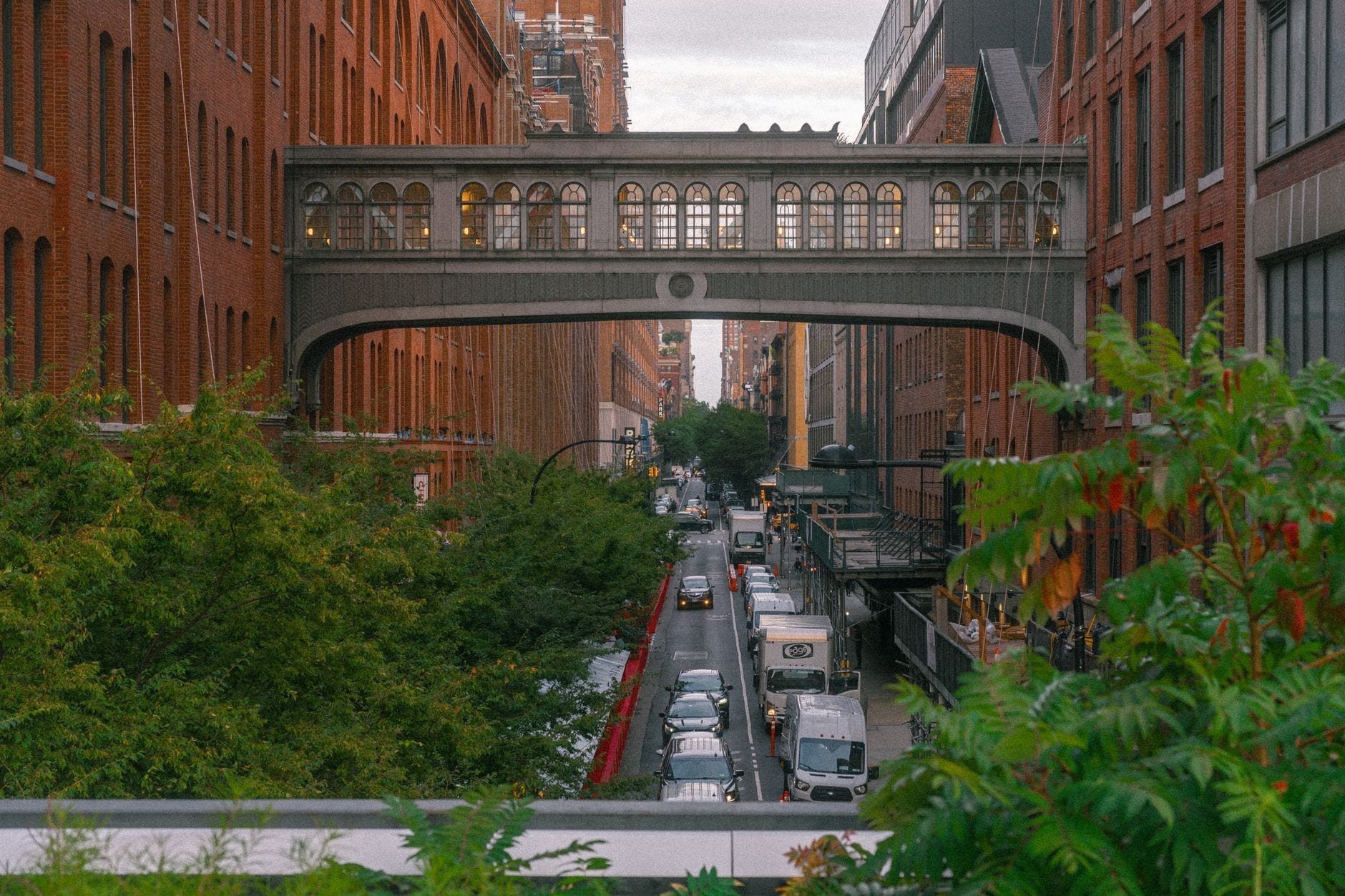
Most visitors enter at the southern end on Gansevoort Street, which puts the wind at your back and the sun in a useful position for morning photography. The Gansevoort entrance sits at the edge of the Meatpacking District, and within the first few hundred feet, you get a compressed preview of what the whole park offers: original rail tracks preserved under your feet and embedded into the planting beds, seating terraces that feel like outdoor amphitheaters, and a close-up relationship with building facades you would never notice from ground level.
The mid-section, roughly from 14th to 23rd Street, runs through the heart of West Chelsea, which has the densest concentration of contemporary art galleries in New York. From the elevated walkway you can look down into gallery loading docks and see oversized artworks being moved in and out of buildings. The architecture of this stretch is unusually layered: pre-war warehouse buildings with high ceilings sit directly beside glass-and-steel residential towers that were intentionally designed to interact with the park, with some incorporating terrace cutouts and windows oriented toward the rail bed.
The northern section, from approximately 23rd Street onward, passes through sections where the rail line runs directly through old warehouse buildings rather than above open street. The dark, tunnel-like passages through these structures are among the most distinctive moments on the walk, creating a brief, industrial quiet before the path opens back into sky. Near Hudson Yards, the park connects to the broader development at West 30th Street and continues to the West 34th Street terminus, where the approach to The Vessel and the Edge observation deck is a short walk away.
Tickets & tours
Hand-picked options from our booking partner. Prices are indicative; availability and final rates are confirmed when you complete your booking.
Chelsea Market, High Line and Meatpacking food and history tour
From 48 €Instant confirmationFree cancellationHigh Line, Chelsea, Hudson Yards Walking Tour with Edge Admission
From 44 €Instant confirmationFree cancellationSecrets of Hudson Yards, High Line & The Vessel
From 30 €Instant confirmationFree cancellationNew York City High-Line and Hudson Yards walking tour
From 36 €Instant confirmationFree cancellation
How the Experience Changes by Time of Day
Early morning, between 7:00 and 9:00 a.m., the High Line belongs almost entirely to locals. You will find runners, dog walkers, and people heading to work cutting through the park as a commuter route. The planting beds catch the morning light at a low angle, and the shadows cast by the steel rail structure fall long across the wooden decking. The air still carries some of the night's cool, and if you visit in late spring or summer, the grasses and perennials are dewy and upright before the day's heat flattens them.
Midday, particularly between 11:00 a.m. and 2:00 p.m. on weekends, is when the park is most crowded. This is the least comfortable window for a relaxed walk. Narrow sections around the 14th Street area and the built-in seating areas near 10th Avenue fill quickly, and moving at your own pace becomes difficult. The noise level rises considerably, and the vendors at small food kiosks attract clusters of people that block sightlines.
Late afternoon, roughly 4:00 to 7:00 p.m. in summer, is arguably the best all-around window. The crowds thin from the midday peak, the light turns warm and directional from the west over the Hudson River, and the shadows of the water towers and building parapets create texture across the path. In autumn, this hour is when the ornamental grasses catch the low sunlight and the park's planting design is at its most photogenic.
💡 Local tip
For photography, the section between 14th and 17th Streets offers the best combination of preserved track, dense planting, and building backdrop. The 10th Avenue Square overlook, with its floor-level window down to the street, is one of the most photographed spots on the entire route.
The Planting Design: More Intentional Than It Looks
The plant palette on the High Line is not incidental decoration. Landscape architect Piet Oudolf, who designed the planting scheme, drew direct inspiration from the wild self-seeded plants that colonized the abandoned tracks during the decades the structure sat unused. The result is a carefully engineered naturalistic garden that prioritizes plants with strong seasonal structure: grasses that move in winter wind, seed heads that catch frost, perennials that turn bronze and copper in autumn rather than simply dying back.
Around 500 species of plants, grasses, and trees are planted across the park, many of them native to the northeastern United States. The experience is deliberately different in each season: bare and architectural in February, green and lush in June, dramatically backlit in October. The planting beds are integrated with the original rail tracks in ways that reinforce the park's industrial history rather than erasing it.
Public Art and Cultural Programming
The High Line maintains a year-round rotating program of public art commissions, site-specific installations, and temporary projects organized by Friends of the High Line. These range from large-scale sculptural works installed at key sight lines to more subtle interventions embedded in the railing and seating infrastructure. The quality is consistently high, with past commissions from internationally recognized artists. If contemporary public art is a priority, pair your visit with a walk through the West Chelsea gallery district below, which is covered in more depth in the New York City art guide.
Beyond the permanent and temporary art, Friends of the High Line runs a schedule of guided tours, workshops, and seasonal events. Guided tours are available on select days and cover both the design history and current planting, with some offered free and others ticketed. Check the Friends of the High Line website for the current calendar, as programming changes seasonally and some events require advance registration.
Getting There and Practical Logistics
The most direct subway access is via the A, C, or E trains to 14th Street–8th Avenue, which puts you at one of the park's main access points. If you are coming from Midtown, the 7 train to 34th Street–Hudson Yards deposits you at the northern end. Multiple bus routes also stop within a block of the park: the M11, M12, M14A SBS, M14D SBS, M23 SBS, and M34 SBS all serve the West Side. For full transit options across Manhattan, the getting around New York City guide covers route planning in more detail.
Elevator access is available at Gansevoort Street, 14th Street, 23rd Street, and multiple points at 30th Street, making the park fully wheelchair accessible. Ramp access is also available at the 30th Street Hudson Yards entrance. The walking surface throughout is smooth hardwood decking or level paving, with no steps within the main walkway once you are on the elevated level.
Dogs are not permitted on the High Line. Bicycles and skateboards are not allowed on the High Line itself. There are food kiosks at several points along the route, and the surrounding neighborhood in Chelsea and the Meatpacking District offers a wide range of cafes and restaurants at street level if you want to eat before or after your walk.
⚠️ What to skip
The High Line is entirely exposed to the elements. In summer, there is almost no shade on the upper sections, and the metal and wood surfaces absorb heat significantly. Bring water, sunscreen, and a hat for midday visits between June and August. In winter, the elevated position makes it considerably windier and colder than street level.
Honest Assessment: Is It Worth Your Time?
For a first visit to New York City, the High Line is worth doing, but set realistic expectations. The views are interesting rather than spectacular: you see the neighborhood at close range, not the city skyline from a distance. If you want elevated panoramas of Manhattan, Summit One Vanderbilt or Top of the Rock deliver a fundamentally different kind of vantage point.
What the High Line does well is give you a slow, ground-level reading of the city's architectural layers and the texture of a neighborhood that is actively changing. It is not a place for fast walkers with a checklist. The full 1.45 miles typically takes around 30 minutes to walk without stopping, but the park rewards people who sit down, look at the details, and use it the way it was intended: as a public space for unhurried movement through the city.
Visitors who are primarily interested in iconic views, fast-paced sightseeing, or landmark monuments may find the High Line underwhelming. If that profile fits, consider combining it with nearby attractions rather than making it a standalone destination. The southern end connects directly to the Meatpacking District and the Whitney Museum of American Art, which sits at the Gansevoort Street base of the park and is worth planning into the same half-day.
Insider Tips
- Enter from the Gansevoort Street southern end and walk north: the light is better in the morning from this direction, and you move from the most intimate sections toward the wider, more open northern stretch rather than the reverse.
- The 10th Avenue Square, around 17th Street, has built-in bleacher seating facing a large window cut into the park's railing that frames the street below like a film shot. Arrive before 9:00 a.m. on a weekday and you can often have the whole bench to yourself.
- The sections where the path runs directly through old warehouse buildings, around 30th Street, are the least-photographed and most atmospheric parts of the walk. Most visitors rush through them. Slow down here.
- The Whitney Museum at the southern base of the park offers combined visit planning: go to the museum first when it opens, then walk the High Line afterward, finishing near Hudson Yards for lunch.
- In winter, the planting beds are at their most skeletal and the park is nearly empty on weekday mornings. The frost on the seed heads and grasses is striking against the grey sky, and the industrial steel structure reads more clearly without foliage.
Who Is The High Line For?
- Architecture and design enthusiasts interested in adaptive reuse and landscape design
- Photographers working in natural light, particularly in early morning or late afternoon
- Couples looking for a slow, low-pressure walk with changing scenery
- Travelers combining a half-day in Chelsea and the Meatpacking District
- Anyone visiting the Whitney Museum, which sits directly at the park's southern entrance
Nearby Attractions
Other things to see while in Chelsea & Meatpacking District:
- Chelsea Market
Chelsea Market is a sprawling indoor food hall and retail complex built inside the former National Biscuit Company factory on Ninth Avenue. Free to enter and open daily, it draws millions of visitors a year with a mix of specialty food vendors, independent shops, and raw industrial architecture that no purpose-built market can replicate.
- Hudson River Park
Stretching roughly 4–4.5 miles along Manhattan's Hudson River shoreline from the northern end of Battery Park City to West 59th Street, Hudson River Park is the second-largest park in Manhattan. With 550 acres, roughly 20 public piers, and free admission, it offers a rare combination of open sky, river views, and accessible green space in one of the world's densest cities.
- Little Island at Pier 55
Little Island at Pier 55 is a free, 2.4-acre public park that appears to float above the Hudson River on tulip-shaped concrete pillars. Opened in 2021, it combines landscape architecture, outdoor performance spaces, and sweeping river views in one of the most inventive public spaces New York City has built in decades.
- Whitney Museum of American Art
Perched between the High Line and the Hudson River in the Meatpacking District, the Whitney Museum of American Art is the country's foremost institution dedicated to art made in the United States. The Renzo Piano-designed building is as much a reason to visit as the collection inside.