Little Island at Pier 55: New York City's Floating Park Above the Hudson
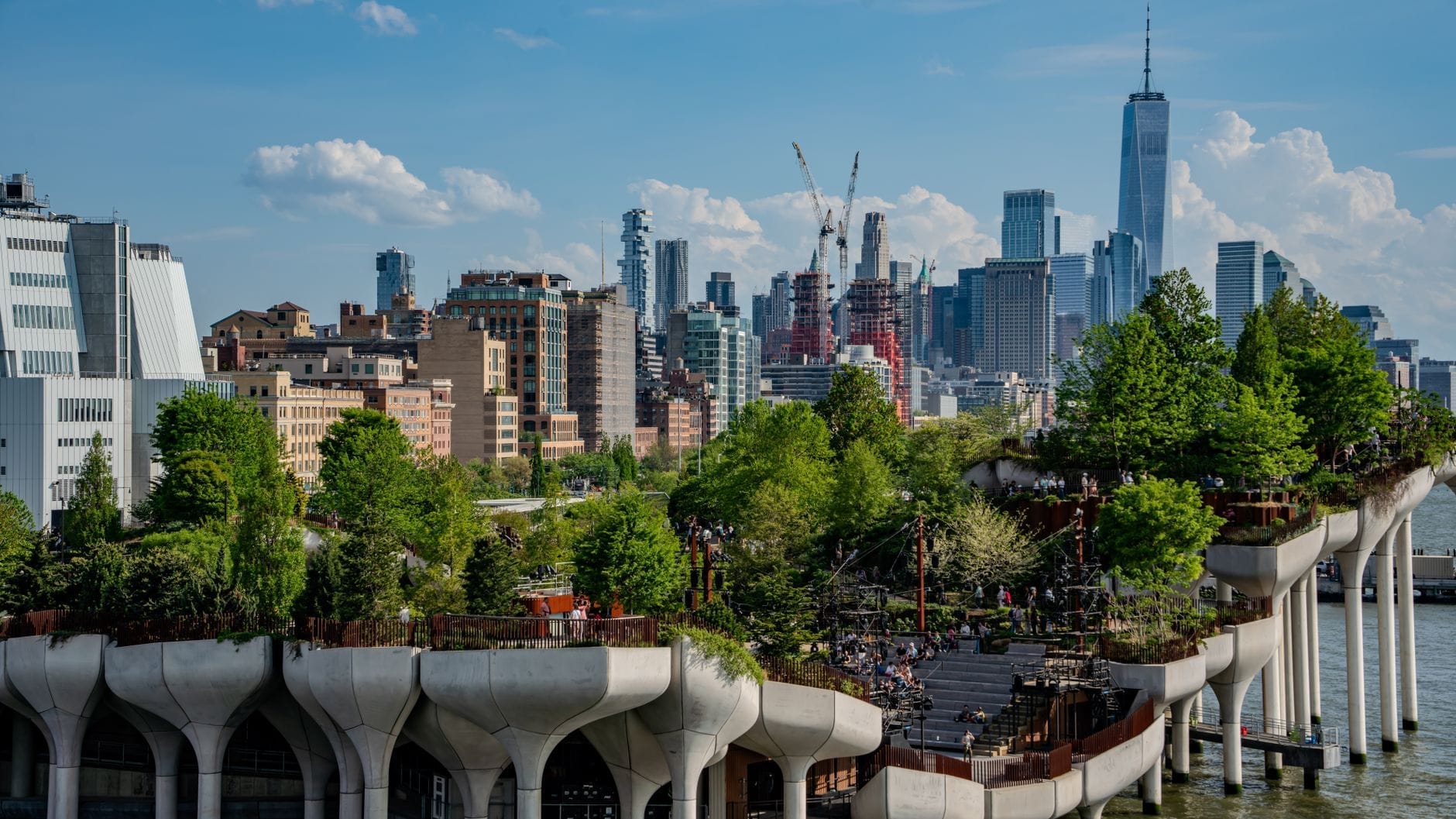
Little Island at Pier 55 is a free, 2.4-acre public park that appears to float above the Hudson River on tulip-shaped concrete pillars. Opened in 2021, it combines landscape architecture, outdoor performance spaces, and sweeping river views in one of the most inventive public spaces New York City has built in decades.
Quick Facts
- Location
- Pier 55, Hudson River Park, West 13th Street, New York, NY 10014 (Chelsea/Meatpacking District)
- Getting There
- A, C, E, and L trains to 14th Street/8th Avenue; walk west along 14th Street to the Hudson River Greenway and follow signs to Little Island
- Time Needed
- 45 minutes to 2 hours, depending on whether you catch a performance
- Cost
- Free entry; some ticketed performances and events
- Best for
- Architecture lovers, families, picnickers, live performance fans, sunset seekers
- Official website
- littleisland.org
What Little Island Actually Is
Little Island at Pier 55 is not a natural island and never was. It is an entirely constructed public park, opened on May 21, 2021, that sits above the Hudson River on 132 concrete piles shaped like oversized tulip blooms. Each column rises from the riverbed at a different height, creating an undulating topography across the park's 2.4 acres that rolls like a gentle hill when you walk it. That unusual ground-plane, so unexpected on a structure built above open water, is the first thing visitors register when they step onto the bridges leading in.
The park was funded primarily through a gift from Barry Diller and Diane von Furstenberg, designed by the London-based landscape architect Thomas Heatherwick of Heatherwick Studio, and developed in partnership with Hudson River Park. Heatherwick's signature approach, building forms derived from structural logic rather than aesthetic decoration, is legible in every pillar. The tulip columns are not decorative: each one is sized and placed according to load calculations, and their varying heights are what produce the topographic variation above.
💡 Local tip
Timed-entry reservations are sometimes required during peak seasons and for special events. Check littleisland.org before visiting on weekends between late spring and early fall to confirm whether a reservation is needed.
The Experience at Different Times of Day
At 6:00 AM, Little Island belongs mostly to joggers finishing their Hudson River Greenway route and a few residents from the surrounding Chelsea and Meatpacking District blocks who treat it as a morning garden. The light at that hour hits the water at a low angle, bounces off the glass towers of Hudson Yards to the north, and fills the park with a pale, directional glow that makes the plantings look almost studio-lit. The wooden amphitheater seating at The Amph, the park's main performance venue, is usually empty and makes for quiet sitting.
By mid-morning on weekends, strollers arrive in numbers. The paths are wide enough for two strollers to pass comfortably, and the ADA-accessible design means that the park's elevation changes are handled through gradual inclines rather than steps. Families with small children tend to gravitate toward the upper lawn areas, where there is open grass, sightlines to New Jersey across the river, and enough space to spread out. The park does not have a playground in the traditional sense, but the varied terrain and the theatrical quality of the space hold children's attention.
Late afternoon, particularly from around 4:00 PM onward in the warmer months, is when the park reaches something close to maximum atmosphere. The sun moves into position over New Jersey and begins a long, orange descent behind the Palisades cliffs across the river. The water picks up color. The park fills with picnickers, couples, and groups sitting on the hillside lawns. If there is a performance at The Amph that evening, crew members begin their setup and the park takes on a backstage-before-showtime energy that is distinct from any other green space in the city.
For sunset specifically, the western-facing viewing areas at Little Island rank among the more reliable spots in lower Manhattan for an unobstructed Hudson River sunset. The best views in New York City guides frequently cite observatories and rooftops, but Little Island offers something those elevated platforms cannot: you are standing at water level, watching the light change over a working river, with tugboats and ferries occasionally passing through the frame.
Tickets & tours
Hand-picked options from our booking partner. Prices are indicative; availability and final rates are confirmed when you complete your booking.
Soho, Chinatown and Little Italy audio-guide walking tour app
From 10 €Instant confirmationGuided walking tour through Chinatown, Little Italy and SoHo
From 31 €Instant confirmationFree cancellationSoHo, Little Italy & Chinatown guided walking tour
From 33 €Instant confirmationFree cancellationNew York Lower East Side, Chinatown and Little Italy food tour
From 67 €Instant confirmationFree cancellation
The Architecture and Landscape Design
The 132 piled columns replaced the deteriorating original Pier 55 structure and were engineered to support not just the weight of the park but the soil, trees, and water infrastructure required to maintain living plantings above the river. The planting palette was developed with landscape horticulturalist Piet Oudolf, whose work also shaped the High Line's famous perennial meadow aesthetic. At Little Island, Oudolf's approach produces a looser, more naturalistic feel than a conventional urban park: tall grasses catch the wind visibly, seed heads are left standing through winter, and the color scheme shifts across seasons rather than being swapped out for seasonal bedding plants.
The connection to the High Line is not only conceptual. The elevated linear park runs just a few blocks east, and the two projects represent a sustained investment in reclaiming post-industrial Manhattan waterfront infrastructure as public green space. Together they form a loose corridor of designed landscape through the western edge of Chelsea and the Meatpacking District that did not exist before 2009.
The Amph and Live Performances
Little Island contains two performance venues. The Amph is an outdoor amphitheater with seating for 687 people, built into the topography of the park so that it reads as a bowl rather than a stage bolted onto flat ground. The Glade is a smaller, more intimate space used for rehearsals, smaller performances, and community programming. Both spaces are intentional parts of the park's design rather than afterthoughts.
The programming at The Amph runs from late spring through fall and has included theater, dance, comedy, and music across genres. Admission to performances is typically ticketed and separate from general park entry. Tickets for popular shows can sell out quickly, particularly for weekend evening slots in summer. If you are visiting specifically to see a performance, check the Little Island website for the current season schedule and buy tickets in advance.
ℹ️ Good to know
Even without a ticket to a performance, arriving at the park during an event has its own character: the ambient sound from The Amph drifts across the upper lawns, and the energy of a sold-out evening show changes the feel of the whole park.
Practical Walkthrough: Getting There and Getting Around
The park sits within Hudson River Park, accessed from the Hudson River Greenway via pedestrian bridges near West 13th and 14th Streets. The most straightforward subway approach is the A, C, E, or L train to 14th Street/8th Avenue, followed by a roughly ten-minute walk west through the Meatpacking District. The route is flat and the walk itself passes through one of the more architecturally varied parts of lower Manhattan.
Cyclists can lock up at the Hudson River Greenway before crossing the pedestrian bridges; bikes are not permitted inside the park. There is no parking lot attached to Little Island. The park has accessible restrooms on site and the paths throughout are stroller-friendly and ADA-accessible, with all elevation changes handled via gradual inclines.
The park is currently open daily from 6:00 AM to 12:00 AM. There are no food vendors operating inside the park on a permanent basis, though pop-up food and beverage programming has appeared during special events. The Meatpacking District immediately to the east has no shortage of cafes and restaurants for before or after your visit.
⚠️ What to skip
Timed-entry reservations for general admission are not currently required, but policies have changed seasonally in past years; check littleisland.org for the latest information before a peak-season visit.
Weather, Seasons, and When to Visit
Little Island is fully exposed to Hudson River weather. Wind is a constant factor, and even on warm days the breeze off the water can be noticeably cooler than street level. Bring a layer in spring and fall regardless of the city forecast. Fall in New York City is one of the better seasons to visit: Oudolf's plantings look their most textured in September and October, crowds thin slightly from summer peaks, and the light over the Hudson in autumn has a particular warmth and clarity.
Winter visits are quiet and genuinely atmospheric if you dress appropriately. The park stays open through winter and the bare structure of the plantings against the river and sky has its own austerity. Summer is when the programming peaks and the park is most alive, but it is also when crowds and reservation requirements are most likely to complicate a casual visit.
Rain substantially diminishes the experience. The park has no covered shelter areas large enough to wait out a storm, and the open lawns and seating areas are unprotected. If rain is forecast, the park is not a good choice for that day.
Honest Assessment: Who Will Love It and Who Might Not
Little Island is genuinely worth the walk for anyone interested in landscape architecture, contemporary design, or simply sitting above the Hudson River on a clear afternoon. It is one of the few spaces in Manhattan where you can feel genuinely removed from the street grid without going underground or ascending to a rooftop. For visitors with limited time in the city, it pairs well with the High Line and the Chelsea and Meatpacking District into a half-day itinerary that covers some of the most interesting contemporary urbanism in the city.
That said, visitors arriving with expectations built on social media photographs should calibrate accordingly. The park is 2.4 acres. You can walk the entire perimeter in under ten minutes. The drama is in the details: the pillar geometry viewed from the pedestrian bridges, the way the planting moves in the wind, the quality of the river view at the right time of day. It is not a destination that sustains four hours. Travelers looking for a major cultural institution or a conventional park experience may find it more of a detour than a draw.
People with limited mobility will find the park more accessible than most NYC green spaces, with gradual slopes and paved paths throughout. Those who are sensitive to crowds should avoid summer weekend afternoons. Dog owners should note that dogs are not permitted inside Little Island.
Insider Tips
- The best photographic angle for the tulip columns is from the pedestrian bridge on the south side of the park, looking back toward the Manhattan skyline with the columns in the foreground. This view does not appear in most social media coverage and requires arriving from the southern access bridge.
- Weekday mornings between 8:00 and 10:00 AM offer the best combination of low crowds and good light. You will often have entire sections of the park to yourself on a Tuesday or Wednesday morning.
- If you want to see a performance at The Amph without buying a ticket, some of the upper lawn areas above the bowl allow you to hear the audio clearly even if sightlines to the stage are limited. This is not guaranteed and depends on the specific show setup, but it is worth knowing.
- The park connects naturally into a longer walk: head south along the Hudson River Greenway to reach the Whitney Museum of American Art in about 10 minutes on foot, making a clean pairing of landscape and art without backtracking.
- In late autumn and winter, the park empties almost entirely by mid-afternoon on weekdays. This is the one time of year you can reliably have the views to yourself without a reservation system or crowds.
Who Is Little Island at Pier 55 For?
- Architecture and landscape design enthusiasts who want to understand Heatherwick Studio's structural approach up close
- Families with young children who need open space, accessible paths, and a visually engaging environment without admission fees
- Couples looking for a late-afternoon or early-evening walk before dinner in the Meatpacking District, particularly during summer and fall
- Live performance attendees combining an outdoor show at The Amph with the pre-show park experience
- Visitors pairing it with the High Line for a half-day walking itinerary through Chelsea's contemporary public space corridor
Nearby Attractions
Other things to see while in Chelsea & Meatpacking District:
- Chelsea Market
Chelsea Market is a sprawling indoor food hall and retail complex built inside the former National Biscuit Company factory on Ninth Avenue. Free to enter and open daily, it draws millions of visitors a year with a mix of specialty food vendors, independent shops, and raw industrial architecture that no purpose-built market can replicate.
- The High Line
Built on a disused freight rail spur above the streets of Manhattan's West Side, the High Line is a 1.45-mile elevated public park running from the Meatpacking District to Hudson Yards. Free to enter year-round, it combines landscape architecture, rotating public art, and some of the best oblique views of the Hudson River and Chelsea's roofline. The experience shifts dramatically depending on the season and the hour you arrive.
- Hudson River Park
Stretching roughly 4–4.5 miles along Manhattan's Hudson River shoreline from the northern end of Battery Park City to West 59th Street, Hudson River Park is the second-largest park in Manhattan. With 550 acres, roughly 20 public piers, and free admission, it offers a rare combination of open sky, river views, and accessible green space in one of the world's densest cities.
- Whitney Museum of American Art
Perched between the High Line and the Hudson River in the Meatpacking District, the Whitney Museum of American Art is the country's foremost institution dedicated to art made in the United States. The Renzo Piano-designed building is as much a reason to visit as the collection inside.