Rockefeller Center: Art Deco Landmark, Skyline Views, and the Heart of Midtown
Rockefeller Center is a 22-acre Art Deco complex of 19 buildings between Fifth and Sixth Avenues in Midtown Manhattan. The public plazas are free to explore, while ticketed attractions like the Top of the Rock observation deck and seasonal ice rink draw visitors year-round. Few places in New York City pack this much architectural ambition, cultural history, and street-level activity into a single block.
Quick Facts
- Location
- Between 48th–51st Streets and Fifth–Sixth Avenues, Midtown Manhattan (central address: 30 Rockefeller Plaza, NY 10112)
- Getting There
- 47–50 Sts – Rockefeller Center station (B, D, F, M lines); multiple MTA bus routes on adjacent avenues
- Time Needed
- 1–2 hours for the plaza and concourse; 3–4 hours if adding Top of the Rock and NBC Studio Tour
- Cost
- Plaza and concourse: free. Top of the Rock: approx. USD 40–61 adults, USD 34–55 children (6–12), USD 38–59 seniors (verify current prices before visiting)
- Best for
- Architecture lovers, first-time NYC visitors, families, skyline photography, holiday atmosphere in December
- Official website
- www.rockefellercenter.com
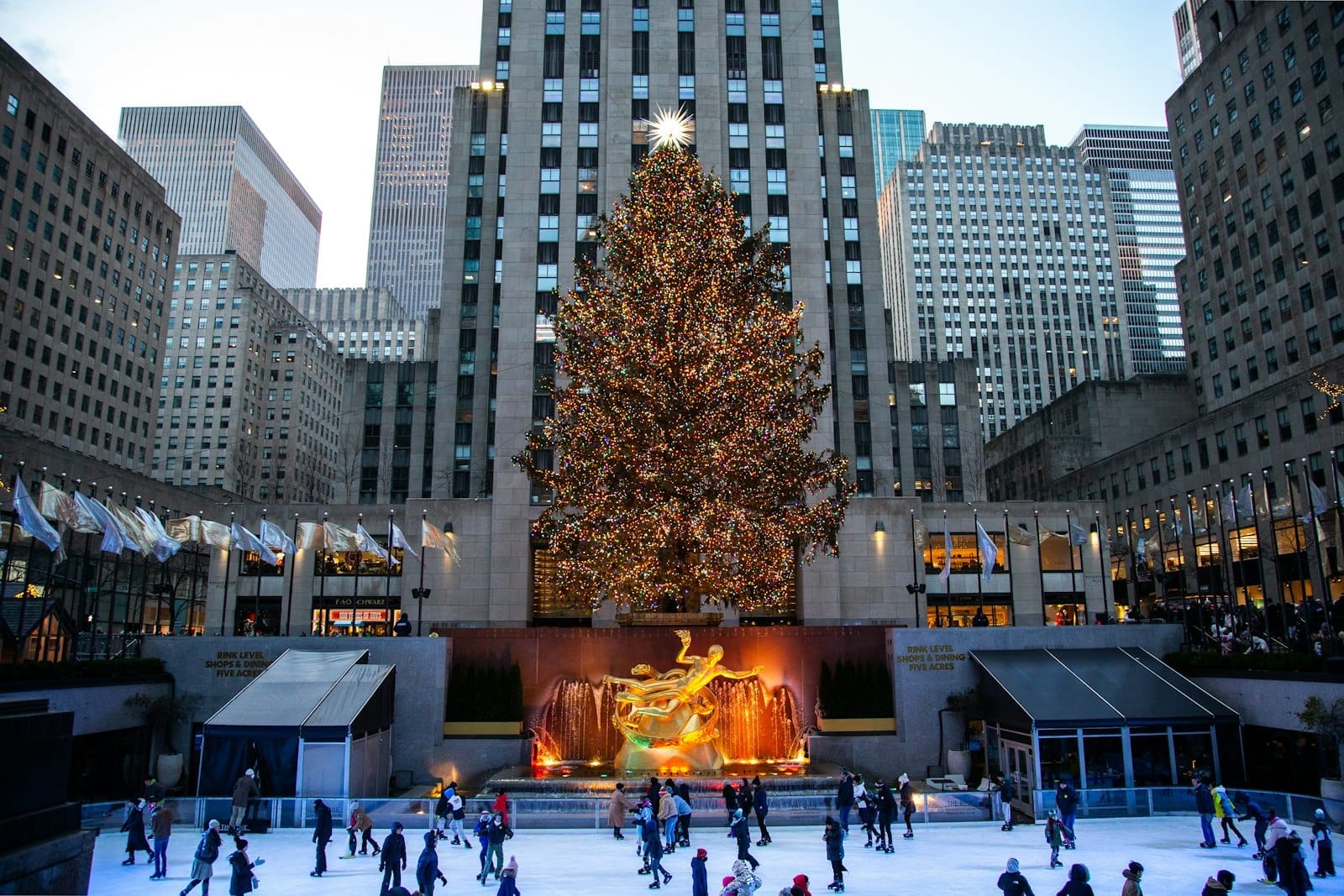
What Rockefeller Center Actually Is
Rockefeller Center is not a single building. It is a coordinated urban campus of 19 Art Deco skyscrapers spread across roughly 22 acres between Fifth and Sixth Avenues in the heart of Midtown Manhattan. Developed by John D. Rockefeller Jr. and largely constructed between 1930 and 1939, it remains one of the most ambitious privately funded building projects in American history. The centerpiece, 30 Rockefeller Plaza (now branded the Comcast Building), rises 70 stories and anchors a complex that includes outdoor plazas, underground concourses, retail, broadcast studios, restaurants, and the Top of the Rock observation deck.
The scale trips up many visitors who expect a single landmark. Walking the full perimeter from 48th to 51st Street, then from Fifth to Sixth Avenue, takes about 15 minutes at a relaxed pace. The sunken Lower Plaza at the center of the complex is the focal point in every season, and the Channel Gardens promenade connecting Fifth Avenue to that plaza is worth slowing down for.
ℹ️ Good to know
The public plazas, gardens, and underground concourses of Rockefeller Center are free to enter at any time. You only need a ticket for Top of the Rock, the ice rink (seasonal), or ticketed tours. Many visitors spend an enjoyable hour here without spending anything.
Architecture and History: Why This Complex Matters
Rockefeller Center was conceived in the late 1920s during a period of intense skyscraper construction in New York City. John D. Rockefeller Jr. leased the Columbia University-owned land in 1928 with plans initially tied to a new Metropolitan Opera house. When the opera project collapsed amid the Great Depression, Rockefeller pressed forward with a commercial development that would become a template for urban mixed-use planning. The Depression-era timeline matters: these towers were built largely between 1930 and 1939, providing thousands of construction jobs at a moment of acute unemployment.
The architecture reflects the optimism that the Art Deco style tried to project during that same period of economic difficulty. Clean vertical lines, geometric ornamentation, and integrated public art set the complex apart from purely utilitarian office construction. The facades carry carved limestone reliefs, allegorical sculptures, and gilded mosaics. The most photographed single element is the gilded Prometheus sculpture by Paul Manship, which presides over the Lower Plaza from a position above the sunken skating rink. The surrounding murals and mosaics inside 30 Rock's lobby, including the celebrated work by José Maria Sert (replacing an original Diego Rivera mural that Rockefeller had destroyed over political disagreements), reward close inspection.
For travelers interested in the broader architectural fabric of Midtown, the New York City architecture guide places Rockefeller Center within the wider story of the city's skyline development, from the pre-war Art Deco period to postwar International Style towers.
Tickets & tours
Hand-picked options from our booking partner. Prices are indicative; availability and final rates are confirmed when you complete your booking.
Rockefeller Center Guided Walking Tour With Optional Top of the Rock
From 33 €Instant confirmationFree cancellationSt. Patrick's Cathedral skip-the-line tickets audio tour and Rockefeller Center walking tour
From 32 €Instant confirmationFree cancellationRockefeller Center guided tour
From 25 €Instant confirmationFree cancellationNYC Christmas tour with 5th Avenue, Rockefeller Tree and Xmas Village
From 34 €Instant confirmationFree cancellation
The Experience by Time of Day
Early morning, roughly 7:00 to 9:00 AM, is the most peaceful window. The Channel Gardens, the long landscaped promenade running east from Sixth Avenue toward the Lower Plaza, are quiet enough that you can actually read the inscriptions on the flanking fountains without a crowd pressing in. The limestone facades catch pale morning light on the west-facing surfaces, and the plaza itself is swept and reset for the day. Office workers flow through purposefully, but tourists are sparse.
Midday brings the full weight of Midtown foot traffic. The Channel Gardens fill with visitors, the plaza railings around the sunken rink become standing-room, and the NBC Studios area on the west side sees tour groups assembling. If you are here primarily to look at the architecture and the public art, noon on a clear weekday is not the ideal time, though the crowds do contribute energy to the place.
Late afternoon through early evening is arguably the most photogenic window for the surrounding streetscape. The Comcast Building's vertical lines catch the low western sun, and the Channel Gardens become gold-toned. In winter, this is also when the Christmas tree illumination draws the largest crowds, sometimes making the Lower Plaza almost impassable on weekends between late November and early January.
💡 Local tip
For Top of the Rock, the hour before sunset is the most requested time slot because you get both the lit skyline and the last daylight. Book that slot online well in advance, particularly in summer and December.
Top of the Rock: The Observation Deck
Top of the Rock occupies the 67th, 69th, and 70th floors of 30 Rockefeller Plaza. Tickets are timed and sold online; walk-up availability exists but is limited at peak periods. The experience differs meaningfully from other Midtown observation decks: the outdoor observation level on the 70th floor has no glass barriers on the upper section, which produces genuinely unobstructed photographs. The view south takes in the Empire State Building at close-to-eye-level distance, which creates a compositional perspective that most rooftop views in New York cannot replicate.
Practically, expect a wait for the elevator even with a timed ticket during busy periods. Dressing in layers is advisable because wind on the open deck can be sharp even in mild weather. The deck operates daily with last elevator reported at approximately 22:00 (verify current hours at rockefellercenter.com before visiting). Travelers weighing observation deck options can compare this with the Summit One Vanderbilt and the Empire State Building for different vantage points across Midtown.
The Ice Rink, NBC, and the Rest of the Complex
The Lower Plaza rink operates seasonally, typically from November through March, and is operated by Wollman Rink Operations. Skating here costs significantly more than rinks in Central Park and the experience is compact: the rink is smaller than it looks on television. The real appeal is not the skating itself but the setting, ringed by flags and overlooked by the Prometheus sculpture. Reservations are strongly recommended during the holiday season. If you want to skate without the Rockefeller premium, the outdoor rink options in Central Park offer more space.
NBC's studios occupy a significant portion of the complex, and if you have a particular interest in television production, the NBC Studio Tour is a genuine walk through working broadcast facilities. The Today Show tapes in the street-level Studio 1A facing Rockefeller Plaza, and a crowd gathers outside the glass most weekday mornings. Arrival before 7:00 AM gives you a position at the front of that sidewalk audience.
The underground concourse connecting multiple buildings runs beneath the complex and links to the subway station. It is lined with shops and restaurants and stays busy through lunch hours. The concourse is useful for navigating the complex in bad weather and gives a sense of how the complex was designed as a self-contained environment, not just a collection of towers.
Getting There and Getting Around
The 47–50 Streets – Rockefeller Center subway station, served by the B, D, F, and M trains, deposits you directly beneath the complex. The station exits connect to the underground concourse, making navigation straightforward even in rain or winter cold. Fifth Avenue, one block east, is served by multiple MTA bus routes including the M1, M2, M3, M4, and M5. Sixth Avenue buses include the M7 and M55.
Driving to Rockefeller Center makes little practical sense. Parking garages in Midtown are expensive and the block-by-block navigation around the complex is slower than walking from a subway station. For general orientation around Midtown and beyond, the guide to getting around New York City covers subway, bus, and ride-hailing options in useful detail.
Accessibility: the official site states that Rockefeller Center is committed to an open and accessible environment. Elevators and accessible routes connect the major visitor areas, including Top of the Rock and the Lower Plaza rink. Check the official Visitor Information and Map and Directions section at rockefellercenter.com for current accessibility details before your visit, as accommodations can change.
What to Temper Your Expectations About
The Christmas tree, lit each year in late November or early December, is one of the most photographed objects in New York City during the holiday season. That fame translates into crowds that can feel overwhelming on evenings and weekends. The tree itself is genuinely impressive in person, typically 70 to 100 feet tall and covered in tens of thousands of LED lights. But approaching the Lower Plaza railing for a clear photograph requires patience and deliberate positioning, particularly on weekends. Visiting on a Tuesday or Wednesday evening rather than a weekend night makes a meaningful difference.
Travelers for whom the holiday atmosphere is the primary draw should also consult the broader guide to New York City in December, which covers the full range of seasonal programming across the city.
The plaza shopping, while convenient, is largely aimed at the mass-market tourist end of retail. The shops inside the complex are not where you would go to find distinctive New York-specific goods. The underground concourse food options are practical and quick but not destinations in themselves.
⚠️ What to skip
Visitors who are primarily interested in a quiet architectural experience should avoid the block in the week following Thanksgiving and on any December weekend. Crowd densities during the tree lighting ceremony (a single ticketed event in late November or early December) are extreme.
Insider Tips
- The Channel Gardens are replanted seasonally with sculptural plant installations that most visitors walk through without noticing. Stop and look at the flanking fountains and the inscription panels, which reflect the original intellectual ambitions of the complex.
- The observation deck at Top of the Rock has two timed-entry windows that are consistently underbooked: the first slot when it opens and the last slot of the evening. Both avoid the 4:00–7:00 PM rush.
- The lobby of 30 Rockefeller Plaza is open to the public during business hours and contains José Maria Sert's murals across a soaring ceiling. Most visitors miss it entirely because they head straight to the Top of the Rock elevator queue. The lobby is free to enter and takes about five minutes to appreciate properly.
- If you want a photograph of the Prometheus sculpture and the rink without other tourists in the frame, arrive at 7:00 AM on a weekday. By 9:00 AM the plaza is populated, and by 10:00 AM it is crowded.
- The B, D, F, and M trains all stop at 47–50 Streets – Rockefeller Center, but the exit closest to the Channel Gardens and the Lower Plaza is the one marked 49th Street and Rockefeller Plaza. The Sixth Avenue exit deposits you at the back of the complex near the rink entrance.
Who Is Rockefeller Center For?
- First-time visitors to New York City who want an orientation point in Midtown with multiple options in one location
- Architecture and design enthusiasts who appreciate Art Deco detail, integrated public art, and large-scale urban planning
- Families looking for a free outdoor experience with the option to add ice skating or a child-friendly observation deck
- Photographers seeking the Empire State Building framed from the north, a perspective unavailable from most other vantage points
- Visitors in December who want the full New York holiday experience, Christmas tree included
Nearby Attractions
Other things to see while in Midtown Manhattan:
- Broadway Theater District
The Broadway Theater District in Midtown Manhattan is the center of American live theater, home to 41 official Broadway houses spanning nearly a century of performance history. Whether you're booking months in advance or hunting same-day discount tickets, this guide covers everything from curtain times to architectural details.
- Bryant Park
Tucked behind the New York Public Library on Sixth Avenue, Bryant Park is an 8-acre public park that holds its own against the surrounding skyscrapers. Free to enter year-round, it shifts character dramatically by season, from a winter ice rink to a summer outdoor cinema — and remains one of the most functional and well-managed public spaces in New York City.
- Carnegie Hall
Carnegie Hall has anchored Midtown Manhattan's cultural life since 1891. With three auditoriums ranging from 268 to 2,790 seats, it hosts everything from orchestral premieres to intimate recitals. This guide covers the halls, the history, and exactly how to make the most of a visit.
- Chrysler Building
Completed in 1930 and briefly the tallest building on earth, the Chrysler Building remains the finest example of Art Deco architecture in New York City. Visitors generally can't go inside beyond the main lobby, but the experience of standing beneath its gleaming stainless steel crown is genuinely unforgettable.