Pullman National Historical Park: Chicago's Labor History Landmark
Pullman National Historical Park preserves one of America's first planned industrial communities, where the story of workers' rights, racial equity, and corporate power played out in red brick and stone. Located on Chicago's far South Side, this free National Park Service site is unlike anything else in the city.
Quick Facts
- Location
- 610 E 111th Street, Pullman neighborhood, Chicago's far South Side
- Getting There
- Metra Electric District (111th St/Pullman stop) or CTA buses to 111th St
- Time Needed
- 2–3 hours for the visitor center and self-guided neighborhood walk
- Cost
- Free — no entrance fee
- Best for
- History buffs, architecture enthusiasts, labor history researchers
- Official website
- www.nps.gov/pull
What Pullman National Historical Park Actually Is
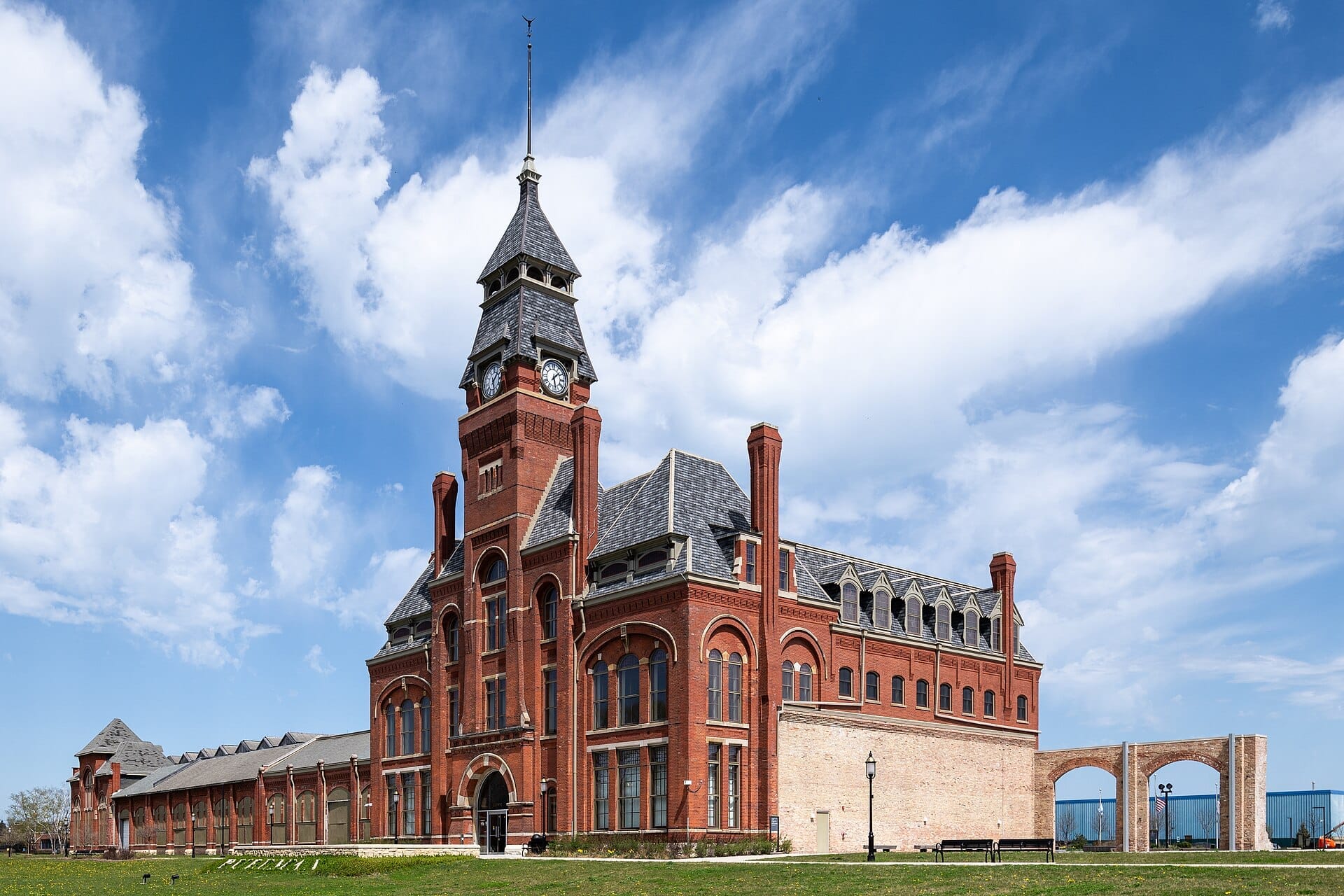
Pullman National Historical Park is not a park in the conventional sense. There are no trails through meadows or scenic overlooks. What you get instead is an entire neighborhood that functions as an outdoor museum: row after row of uniform red-brick workers' cottages, the imposing clock-towered Factory Administration Building, and the restored Visitor Center inside the old Market Hall, all built beginning in 1880 by railroad car magnate George Pullman to house and control his workforce.
The park was designated a National Monument in 2015, making it the first National Park Service unit in the city of Chicago. It was later elevated to National Historical Park status in December 2022. That upgrade matters: it signals the site's complexity. This is not simply the story of one industrialist's paternalistic experiment. It is also the story of the 1894 Pullman Strike, A. Philip Randolph's founding of the Brotherhood of Sleeping Car Porters in 1925, and the fact that Pullman was the single largest employer of African Americans in the country, with porters making up roughly 44% of the company’s workforce by the early twentieth century.
ℹ️ Good to know
The Pullman Visitor Center is generally open daily 9:00 a.m. to 5:00 p.m. Hours may vary on federal holidays. Confirm current hours at nps.gov/pull before you go.
The History You Need to Understand Before You Arrive
George Pullman built his town from scratch on marshy prairie land south of Chicago. The concept was radical for its time: house workers in decent conditions, provide clean water, gas, and access to shops and a library, and in return extract maximum productivity from a stable, grateful workforce. Construction began in 1880, and for a decade the Pullman community was widely admired as a model of industrial planning.
The model collapsed during the economic depression of 1893. Pullman cut wages but kept rents in company-owned housing unchanged. Workers who tried to negotiate were fired. In May 1894 they walked out, and the strike that followed paralyzed rail traffic across the country. Federal troops were deployed to break it. Eugene Debs, who led the American Railway Union's sympathy boycott, was arrested. The aftermath exposed how little protection workers had against company power.
The next chapter was written largely by African Americans. After the strike, Pullman began hiring Black men as sleeping car porters almost exclusively, a strategy that kept wages low and exploited existing racial hierarchies. But it also created the largest body of Black workers under one employer in the United States. A. Philip Randolph organized them into the Brotherhood of Sleeping Car Porters, which won a landmark labor agreement in 1937. That union became a financial and organizational backbone for the civil rights movement. Many porters' children became doctors, lawyers, and activists. The story of Pullman is inseparable from the story of Black economic progress in twentieth-century America.
For a broader view of how this fits into Chicago's South Side history, the DuSable Black History Museum and the Chicago History Museum both cover the Great Migration and labor movements in depth.
Tickets & tours
Hand-picked options from our booking partner. Prices are indicative; availability and final rates are confirmed when you complete your booking.
Go City | Chicago All-Inclusive Pass
From 127 €Instant confirmationFree cancellationiFLY Chicago Lincoln Park indoor skydiving experience
From 126 €Instant confirmationFree cancellationiFLY Chicago Rosemont indoor skydiving tickets
From 117 €Instant confirmationFree cancellationChicago lakefront neighbourhood bike tour
From 18 €Instant confirmationFree cancellation
The Visitor Center: Start Here
The Visitor Center occupies the restored Market Hall at 610 E 111th Street, a handsome building with arched windows and brick detailing that gives you an immediate sense of the original town's architectural ambition. Inside, the exhibits are well-organized and genuinely informative, moving chronologically from Pullman's founding vision through the 1894 strike and into the long arc of the porters' union. The scale models showing the original planned community are particularly useful before you head out on foot.
Rangers are typically on hand, and their knowledge goes beyond the placards. Ask about the Florence Hotel across the street — named after Pullman's daughter — which stands as one of the most architecturally significant structures in the district. If you have specific interests in labor history, architecture, or the civil rights connections, the staff can point you toward the parts of the outdoor district that reward closer attention.
💡 Local tip
Pick up the free NPS self-guided walking tour map at the Visitor Center before stepping outside. The outdoor district covers several blocks and the map makes the architectural sequence of the original town much easier to read.
Walking the District: What You See on the Ground
Outside the Visitor Center, the streets of the Pullman neighborhood feel different from the rest of Chicago. The architecture has a low, dense uniformity that you do not find in other South Side areas: repetitive gabled rooflines, identical front stoops, brick in varying shades of dark red and buff. It is quiet on weekday mornings, with the main sounds being wind off the flat urban terrain and the occasional Metra train. Early-afternoon light picks up the texture of the brickwork particularly well for photography.
The workers' row houses, the foremen's houses (noticeably larger), and the senior staff residences form a hierarchy that was literally built into the streetscape. Pullman used architecture to communicate rank, and walking the blocks makes that social engineering visible in a way that no exhibit fully captures. Look at the variations in window ornamentation and front porch depth as you move from block to block.
The Greenstone Church — officially the Greenstone United Methodist Church — is one of the most striking buildings in the district, built from green serpentine stone quarried in Pennsylvania. It stands on E 112th Street and is worth a slow look at the exterior even if it is not open for interior visits. The Factory Administration Building and its tall clock tower, visible from several streets away, serves as an orientation point throughout your walk.
Evening visits in summer offer softer light and fewer visitors, but the Visitor Center will be closed, so plan your indoor component first. The outdoor district is accessible at any hour. In winter, the brickwork takes on a harsher, more austere quality that arguably suits the site's history better than a bright summer afternoon.
Getting There: Transit Is Straightforward
Pullman is on Chicago's far South Side, about 14 miles from the Loop. It is not a quick trip, and that distance is part of why many visitors skip it. But the Metra Electric District line from Millennium Station or Van Buren Street Station in downtown Chicago runs to the 111th Street/Pullman stop, placing you within easy walking distance of the Visitor Center. The ride takes roughly 30-40 minutes from downtown. CTA bus routes also serve 111th Street, though rail is the more predictable option.
If you drive, street parking is generally available in the residential blocks around the park. The NPS accessibility page notes that parking and restroom facilities are available for visitors with mobility needs. Those with limited mobility should be aware that the outdoor walking component covers uneven sidewalks on older residential streets.
Pullman pairs naturally with a visit to Jackson Park or the Museum of Science and Industry in nearby Hyde Park, making a full South Side day itinerary viable without backtracking.
Who This Attraction Is Really For (And Who Should Skip It)
Pullman rewards visitors who come with some prior interest — in labor history, American urban planning, the civil rights movement, or late-nineteenth-century industrial architecture. The exhibits do a good job of building context, but the site does not have the sensory spectacle of a natural landmark or the curatorial density of a major art museum. If your Chicago time is tight and history is not your focus, this is a long trip for a quiet neighborhood walk.
For the right visitor, though, this is one of the most thought-provoking sites in the city. There is something powerful about standing in front of an identical row of workers' cottages knowing that the men who lived there went on strike in 1894, that their successors organized one of the most consequential unions in American labor history, and that the ripples of those events reached the March on Washington and the civil rights legislation of the 1960s. The place earns its National Historical Park designation.
If you are building a Chicago itinerary around undersung historic sites, Hull House Museum on the Near West Side offers a thematically related story of social reform in the same era, and is closer to downtown.
For a broader orientation on what Chicago history looks like across the city's different periods and communities, the guide to Chicago's layered historical sites and the Chicago neighborhoods guide are useful starting points.
Insider Tips
- Check the NPS website for ranger-led tours and special programming, particularly around Labor Day weekend, when the park sometimes holds events tied to the history of the Pullman Strike and the labor movement.
- The Florence Hotel, directly across from the Visitor Center, is one of the most architecturally detailed buildings in the district. Even if it is not open for tours on your visit, the exterior stonework and proportions are worth examining up close.
- Bring a wide-angle lens or use panorama mode if you want to photograph the long rows of workers' cottages — the repetition of identical facades is what makes the company-town logic visually legible.
- Weekday mornings are genuinely quiet here. You may have the Visitor Center and the streets nearly to yourself, which makes the scale and silence of the place land differently than a weekend visit with more foot traffic.
- The Metra Electric District is a more comfortable ride than the CTA 'L' for this trip — wider seats, less crowding, and a cleaner view of the South Side landscape on the way out.
Who Is Pullman National Historical Park For?
- Travelers with a serious interest in American labor history and workers' rights movements
- Architecture enthusiasts drawn to planned industrial communities and late-Victorian brick design
- Visitors researching the African American experience and the roots of the civil rights movement
- Educators and students looking for a well-interpreted National Park Service site
- Travelers who want to see a part of Chicago that most itineraries never reach
Nearby Attractions
Combine your visit with:
- Bahá'í House of Worship
The Bahá'í House of Worship in Wilmette, Illinois, is one of the most architecturally singular buildings in North America. Free to enter, open daily, and reachable by CTA from downtown Chicago, it rewards visitors with a 135-foot lace-like dome, meditative silence, and an unusual kind of spiritual calm that transcends denomination.
- Brookfield Zoo Chicago
Brookfield Zoo Chicago is one of the largest and most historically significant zoos in the United States, covering 216 acres about 14 miles west of downtown. With more than 511 species, landmark indoor exhibits, and a genuine conservation mission, it rewards a full day of exploration. But it takes planning to get the most out of it.
- Chicago Air and Water Show
Every August, the Chicago Air and Water Show transforms the lakefront into a grandstand for one of the most spectacular free public events in the United States. Fighter jets, military demonstrations, and precision flying teams perform over Lake Michigan while hundreds of thousands of spectators line the shore from Fullerton to Oak Street.
- Chicago Botanic Garden
A living museum spread across 385 acres and nine islands north of Chicago, the Chicago Botanic Garden offers 27 gardens, four natural areas, and six miles of lake shoreline in Glencoe, Illinois. Whether you visit for a single seasonal bloom or spend a full day exploring Japanese landscapes and native prairies, this guide covers everything you need to plan a worthwhile trip.