DuSable Black History Museum and Education Center: A Complete Visitor's Guide
Founded in 1961, the DuSable Black History Museum and Education Center is the nation's oldest independent African American museum. Set inside Washington Park on Chicago's South Side, it holds more than 15,000 works spanning art, history, and cultural memory — and rewards anyone willing to spend a full afternoon.
Quick Facts
- Location
- 740 E 56th Place, Washington Park, near Hyde Park, Chicago, IL 60637
- Getting There
- CTA Bus routes 3, 4, or 55 near 55th–56th Street; no direct 'L' stop — plan a short walk or ride from the Green or Red Line
- Time Needed
- 2–3 hours for a thorough visit; allow more time during special exhibitions
- Cost
- Paid general admission; free for active military, SNAP/Museums for All participants, select Bank of America cardholders (first full weekend monthly), UChicago students, and others — verify current prices at dusablemuseum.org
- Best for
- History enthusiasts, art lovers, educators, students, and anyone seeking deeper context on African American culture and the Black experience in America
- Official website
- dusablemuseum.org
What the DuSable Black History Museum Actually Is
The DuSable Black History Museum and Education Center — named for Jean Baptiste Point DuSable, the Haitian-born trader widely credited as Chicago's first non-indigenous settler — holds a singular place in American cultural history. Chartered in 1961, it is recognized as the nation's oldest independent African American museum, predating the Smithsonian's National Museum of African American History and Culture by more than five decades. The DuSable is also a Smithsonian affiliate, which speaks to the seriousness of its collection and scholarly standing.
It was founded by a coalition of artists, educators, and community organizers that included poet and visual artist Margaret Taylor-Burroughs and her husband Charles Burroughs, alongside Gerard Lew, Eugene Feldman, Bernard Goss, and Marian M. Hadley. They started the institution in the Burroughs' own South Side home before it eventually moved to its current home in Washington Park. That origin story — a museum born from kitchen-table activism — shapes everything about how the place feels. It does not have the pristine neutrality of a civic institution built from scratch with a nine-figure budget. It has intention.
ℹ️ Good to know
The museum is typically open every day during February for Black History Month, including Mondays when it is otherwise closed, If your visit falls in February, take advantage of the expanded schedule.
The Building and Its Setting
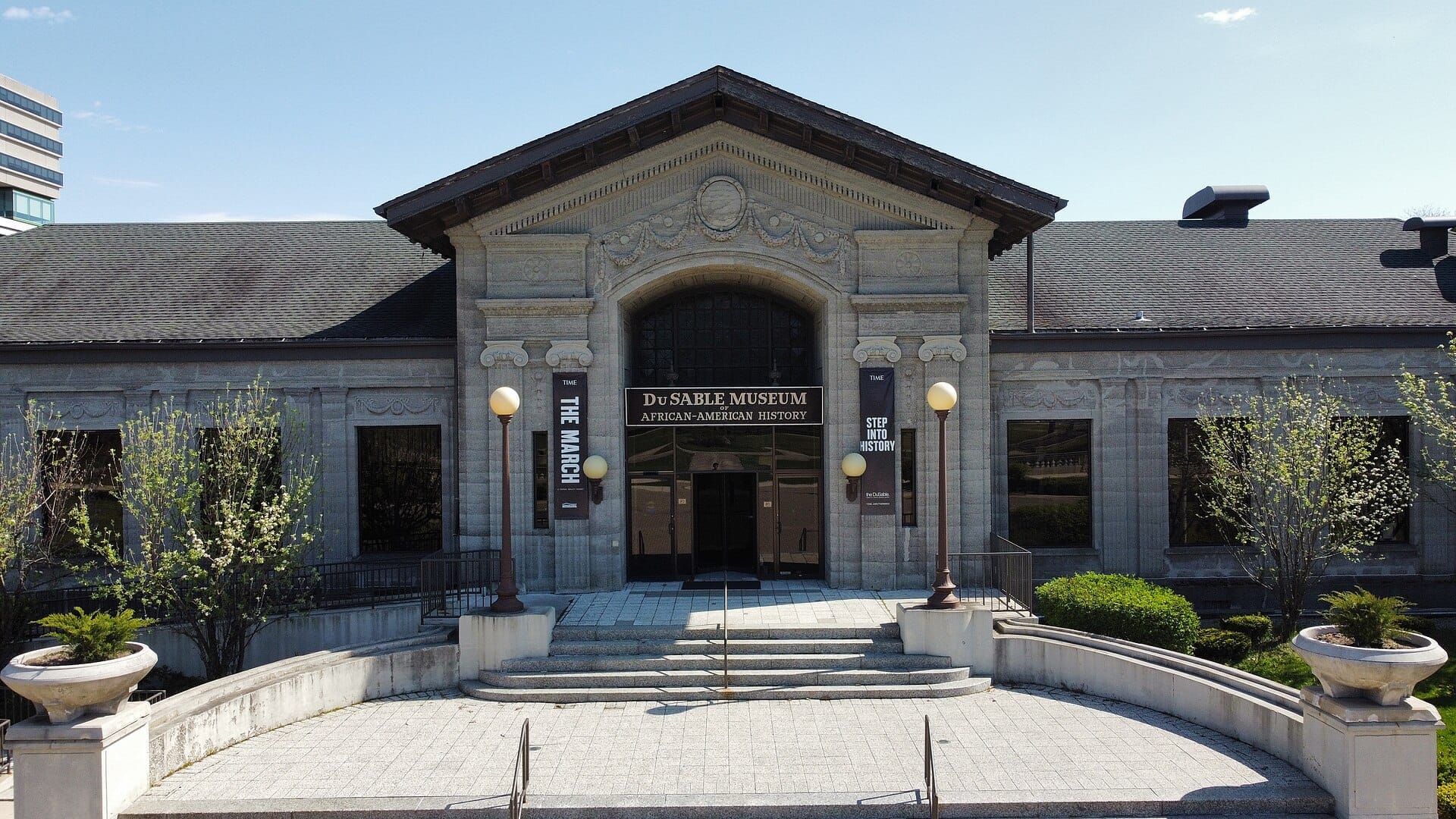
The museum occupies the former South Park Commission Refectory building inside Washington Park, a large green space designed by Frederick Law Olmsted and Calvert Vaux — the same partnership responsible for New York's Central Park. The park itself is significant: it sits at the western edge of Hyde Park, adjacent to the University of Chicago campus and a short distance from the future site of the Obama Presidential Center in Jackson Park.
The building has a civic, early 20th-century solidity to it — stone, wide steps, a presence that reads as permanent and serious. Approaching from the park on a clear morning, with the grass of Washington Park stretching out behind you, there is a quiet sense of arrival that feels proportionate to what the museum contains. It is not a flashy architectural statement like some contemporary museum buildings. The architecture says: the work inside is what matters.
If you are combining this with other South Side destinations, note that Jackson Park and the Museum of Science and Industry are both within a reasonable distance, making a full South Side cultural day entirely practical.
Tickets & tours
Hand-picked options from our booking partner. Prices are indicative; availability and final rates are confirmed when you complete your booking.
Chicago's Gold Coast Hidden History: A Self-Guided Audio Walk
From 5 €Instant confirmationFree cancellationField Museum of Natural History tickets and audio tour
From 44 €Instant confirmationGo City | Chicago All-Inclusive Pass
From 127 €Instant confirmationFree cancellationiFLY Chicago Lincoln Park indoor skydiving experience
From 126 €Instant confirmationFree cancellation
The Collection: What You Will Actually See
The permanent collection exceeds 15,000 objects: paintings, sculpture, prints, textiles, photographs, and historical memorabilia spanning from the era of slavery through the civil rights movement to the present. What distinguishes the DuSable from a general history museum is that its collection was assembled specifically to affirm, document, and celebrate Black life — not to explain it to an outsider audience. That shift in intended audience changes the entire register of a visit.
Highlights have included large-scale works documenting the Great Migration — the movement of millions of Black Americans from the rural South to Northern cities like Chicago during the early and mid-20th century. The museum also holds significant holdings in African art and diaspora objects, grounding the American story in a longer global one. Rotating temporary exhibitions cover everything from contemporary Black visual artists to archival photography, so repeat visits often reveal something new.
The Harold Washington Wing, dedicated to Chicago's first Black mayor, contains a detailed collection of memorabilia from his 1983 campaign and mayoral tenure. For anyone interested in Chicago's political history — or the history of race and urban politics in America — this section alone is worth the trip.
💡 Local tip
Check the museum's current exhibitions online before visiting. The rotating program means that what was on display six months ago may have changed entirely. Temporary exhibitions sometimes require separate timed-entry tickets.
Visiting by Time of Day
The museum is open Tuesday through Sunday, 10:00 to 17:00 (last admission 16:30), and is closed on Mondays except during February. Weekday mornings are noticeably quieter — you will often have entire gallery rooms to yourself between 10:00 and noon, which makes for a fundamentally different experience than weekend afternoons when school groups, families, and tour parties fill the spaces. The ambient sound in the galleries on a quiet Tuesday morning is close to silence: footsteps on hardwood, the occasional audio installation, and your own thoughts.
Weekend afternoons bring energy but also crowds near the most popular permanent exhibitions. If you are visiting with children and want them engaged by the activity around them, weekends work well. If you are there for sustained reading of wall text and quiet contemplation of individual works, aim for a weekday morning. Lighting in the galleries is controlled and consistent throughout the day, so there is no particular time-of-day advantage for photography inside.
Getting There: Transit and Access
The museum does not sit directly on an 'L' line, which is an important practical note. The nearest rapid transit options are the Green Line (Garfield station) and Red Line (Garfield station on the Red Line), both of which leave you with a walk of roughly 10 to 15 minutes depending on your pace. CTA bus routes 3, 4, and 55 serve the area more directly — the 55 in particular runs along 55th Street and gets you close. Verify current routes at transitchicago.com before travel, as schedules change.
Rideshare is a practical option here, particularly if you are combining the museum with other South Side stops. If you are driving, street parking is generally available in Washington Park, though it can fill during special events. The neighborhood is safe and walkable during daylight hours.
If you are planning a broader South Side day, the Hyde Park neighborhood has enough independent institutions, bookshops, and restaurants to fill an entire day without feeling rushed. The University of Chicago campus is walkable from the museum and worth a short detour.
💡 Local tip
Bank of America and Merrill Lynch cardholders get free general admission on the first full weekend of each month through the Museums on Us program. This is one of the most consistently useful free museum benefits in Chicago.
Cultural Weight and Honest Assessment
It would be dishonest to describe the DuSable as a polished, heavily-funded mega-museum with the production values of, say, the Art Institute. It is not. The experience is closer to a deeply curated, purposeful institution that has persisted through decades on community will and genuine scholarly commitment. Some exhibitions are presented with less slickness than you might find at institutions with larger endowments. That is not a reason to lower expectations — it is a reason to adjust them.
What the DuSable offers that no amount of budget can manufacture is authenticity and historical rootedness. This is an institution that was deciding what stories of Black American life were worth preserving before that conversation became mainstream. Its permanence in Washington Park — a historically Black South Side neighborhood — is itself a statement. Visitors who arrive expecting a passive, entertainment-forward museum experience may find the DuSable demands more active engagement. That is a feature.
For visitors building a broader itinerary around Chicago's Black cultural history, pair the DuSable with the Chicago History Museum in Lincoln Park, which holds extensive documentation of the Great Migration and the city's African American political movements. The two institutions complement each other well without much overlap.
Practical Walkthrough
Allow two to three hours for a thorough visit. The museum is compact enough that you will not run out of energy, but the density of text and imagery in the permanent collection rewards slow movement. Start with the permanent historical galleries to establish context, then move to temporary exhibitions. The gift shop carries books, prints, and cultural objects that skew more substantive than typical museum retail — budget time for it if you are interested in continuing your reading at home.
Wear comfortable shoes. The building has multiple levels and some galleries involve standing for extended periods. The temperature inside is controlled, so the season outside has no bearing on what to wear indoors. If you are visiting with young children, the museum's education programming is thoughtfully designed for school-age visitors, but some exhibitions deal with the history of slavery and racial violence in ways that are appropriate for older children and adults, and worth previewing before bringing very young kids.
- Photography policies: verify the current policy on-site, as rules differ between permanent and temporary galleries
- Coat check: available during colder months — useful given Chicago's winters
- Café or food: the museum does not operate a full restaurant; plan lunch at a nearby Hyde Park spot before or after
- Group visits: the museum has formal education programs for school and community groups; book well in advance
Insider Tips
- February is the single best month to visit: the museum opens daily (including Mondays), special programming is added throughout the month, and the exhibitions are often at their most robust. If your Chicago trip overlaps with February, prioritize this.
- The Harold Washington Wing is one of the most detailed archives of a single American mayoral career you will find anywhere — including campaign materials, correspondence, and personal effects. Political history enthusiasts should budget extra time here.
- University of Chicago students get free entry with a UCID. If you know a UChicago student who can accompany you, ask about the ArtsPass program — it covers multiple South Side institutions beyond just the DuSable.
- The park setting means you can extend your visit into Washington Park itself before or after — the Olmsted-designed landscape is undervisited and offers a genuine sense of Chicago's 19th-century urban planning ambitions.
- If you are visiting as part of a broader Chicago cultural itinerary and want to contextualize the DuSable's founding era, the neighborhood of Bronzeville — the historic heart of Black Chicago just north of Washington Park — rewards a post-visit walk or drive.
Who Is DuSable Black History Museum and Education Center For?
- History enthusiasts with a specific interest in African American history, the Great Migration, or Chicago's South Side
- Art lovers seeking work by Black American and African diaspora artists outside the mainstream gallery circuit
- Educators and students — the museum's collection and programming are explicitly designed with learning in mind
- Visitors building a full South Side cultural itinerary alongside Hyde Park, Jackson Park, and the University of Chicago
- Travelers on a budget: free admission programs (Banks of America Museums on Us, Museums for All/SNAP, military) make this accessible at no cost on qualifying visits
Nearby Attractions
Other things to see while in Hyde Park:
- Wooded Island & Jackson Park
Jackson Park is a 551-acre lakefront park on Chicago's South Side, designed by Frederick Law Olmsted and transformed into the grounds of the 1893 World's Columbian Exposition. Today it holds Wooded Island, the Osaka Garden, the Museum of Science and Industry, and one of the city's best birding spots — all free to enter.
- Museum of Science and Industry
The Griffin Museum of Science and Industry occupies one of only two surviving buildings from the 1893 World's Columbian Exposition, sitting at the edge of Jackson Park in Hyde Park. With hundreds of interactive exhibits across floors of Beaux-Arts grandeur, it rewards a full day and suits visitors of almost every age.
- Institute for the Study of Ancient Cultures
The Institute for the Study of Ancient Cultures Museum (ISAC) on the University of Chicago campus in Hyde Park houses one of North America's most significant collections of ancient Near Eastern and North African artifacts. With more than 350,000 objects spanning Egypt, Mesopotamia, Persia, and beyond, this is a serious museum for curious travelers who want depth over spectacle.
- Robie House
The Frederick C. Robie House in Hyde Park is widely regarded as the most complete expression of Frank Lloyd Wright's Prairie Style. A UNESCO World Heritage Site and National Historic Landmark, it offers guided tours through one of the most architecturally significant private homes ever built in the United States.