Wooded Island & Jackson Park: Chicago's Most Storied Green Space
Jackson Park is a 551-acre lakefront park on Chicago's South Side, designed by Frederick Law Olmsted and transformed into the grounds of the 1893 World's Columbian Exposition. Today it holds Wooded Island, the Osaka Garden, the Museum of Science and Industry, and one of the city's best birding spots — all free to enter.
Quick Facts
- Location
- 6401 S. Stony Island Ave., Hyde Park / Woodlawn, Chicago, IL 60637
- Getting There
- Metra Electric Line to 57th Street station; CTA Bus 6 or 10 along South Lake Shore Dr
- Time Needed
- 1.5–3 hours for a relaxed walk; half-day if visiting the Museum of Science and Industry
- Cost
- Free. Jackson Park, Wooded Island, and Osaka Garden all have no admission charge
- Best for
- Birders, history enthusiasts, photographers, families, and anyone who wants quiet green space away from downtown crowds
- Official website
- www.chicagoparkdistrict.com/parks-facilities/jackson-andrew-park
What Jackson Park Actually Is
Jackson Park is a 551-acre public park stretched along Lake Michigan on Chicago's South Side, sitting at the edge of the Hyde Park and Woodlawn neighborhoods. It is one of the largest parks in the city and, by any measure, one of the most historically loaded. The grounds were laid out in 1871 by Frederick Law Olmsted and Calvert Vaux, the same partnership behind Central Park in New York, then completely remade to host the 1893 World's Columbian Exposition. That world's fair drew more than 27 million visitors and left behind several permanent features that still define the park today.
The park holds a lagoon system, two harbors, 63rd Street Beach, the surviving World's Fair building that became the Museum of Science and Industry, the Statue of the Republic that presided over the fair's Court of Honor, and at its center, Wooded Island — a forested island accessible by footbridge that functions as both a nature sanctuary and the site of the Osaka Garden. None of it costs anything to visit.
ℹ️ Good to know
The Osaka Garden on Wooded Island is open Tuesday through Sunday, 10:00 to 18:00, and is closed Mondays for maintenance. Arrive before 11:00 or after 15:30 on weekends to avoid waiting.
The 1893 World's Fair and What It Left Behind
To understand Jackson Park, you need to understand what happened here in 1893. The World's Columbian Exposition transformed this marshy lakeshore into a temporary city of gleaming white neoclassical buildings that journalists called the "White City." The fair introduced millions of Americans to alternating current electricity, the dishwasher, and the original Ferris wheel. It was the setting for Erik Larson's popular history "The Devil in the White City," which brought renewed attention to both the fair's grandeur and the murders that took place nearby.
Almost everything built for the fair was demolished afterward, but three landmarks survived into the present. The former Fine Arts Palace, the exposition building constructed to last, became the Museum of Science and Industry in 1933. The gilded Statue of the Republic — a full-scale replica of the original 65-foot-tall gilded figure that towered over the fairgrounds — still stands on a traffic island inside the park at Hayes Drive and Cornell Avenue. And Wooded Island, which served as a Japanese concession and garden during the fair, retained its landscaped character and eventually became the Osaka Garden.
Walking through Jackson Park with this history in mind changes what you see. The wide roadways once carried fair visitors between pavilions. The lagoon was engineered for gondola rides. If you want deeper context before you arrive, the Museum of Science and Industry has permanent exhibits covering both the fair's legacy and the building's own transformation from exposition hall to working science museum.
Tickets & tours
Hand-picked options from our booking partner. Prices are indicative; availability and final rates are confirmed when you complete your booking.
Go City | Chicago All-Inclusive Pass
From 127 €Instant confirmationFree cancellationiFLY Chicago Lincoln Park indoor skydiving experience
From 126 €Instant confirmationFree cancellationiFLY Chicago Rosemont indoor skydiving tickets
From 117 €Instant confirmationFree cancellationChicago lakefront neighbourhood bike tour
From 18 €Instant confirmationFree cancellation
Wooded Island and the Osaka Garden
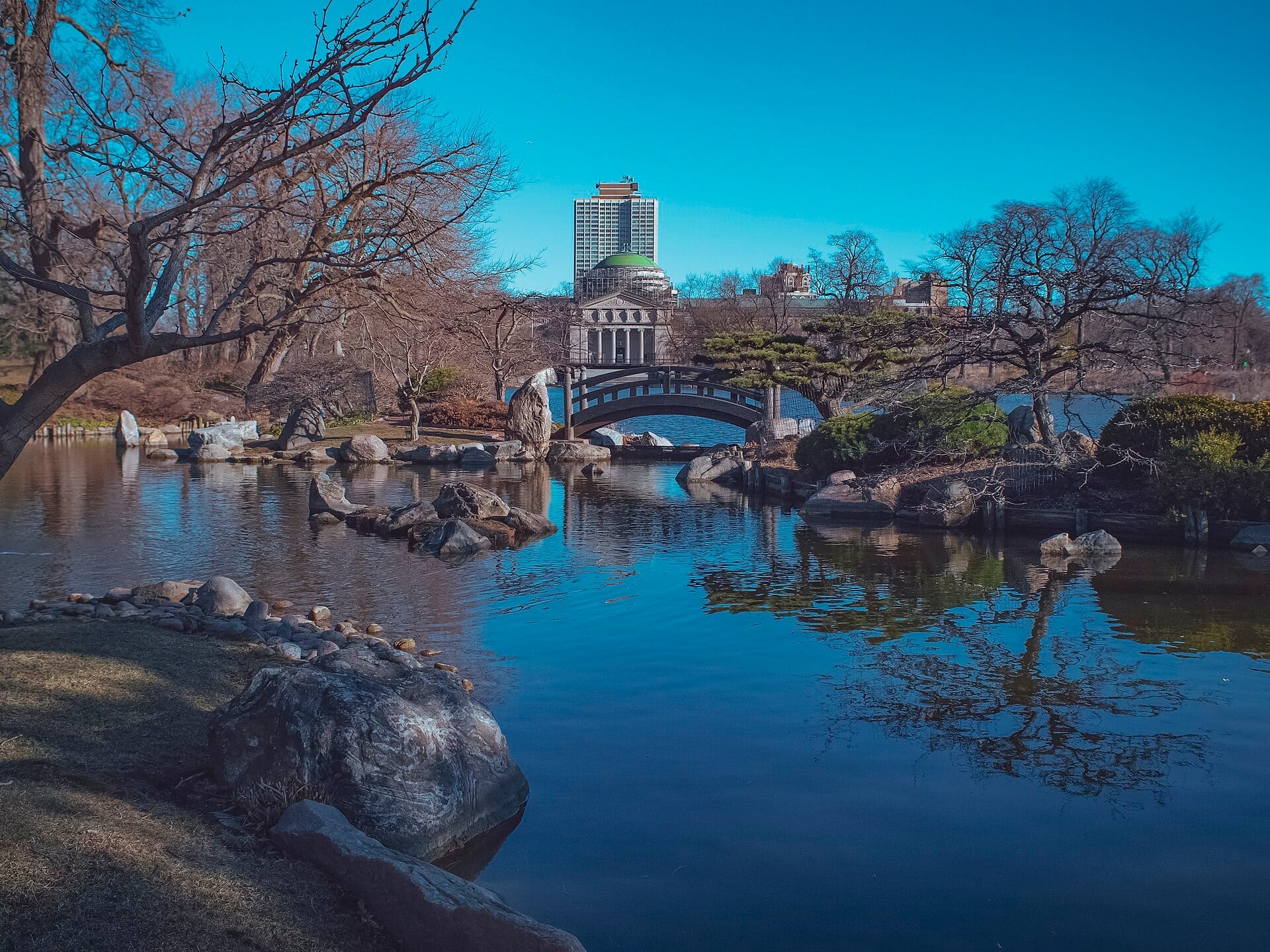
Wooded Island is the park's quietest and most photogenic section. Reached by a short footbridge from the main park, it is formally designated the Paul H. Douglas Nature Sanctuary, a recognition of the island's ecological role as a migratory stopover. The tree canopy is dense enough that even on a warm Saturday afternoon, the island feels noticeably cooler and more sheltered than the open park grounds around it. The sound of South Lake Shore Drive fades almost entirely within a few steps of the footbridge.
At the island's southern end sits the Osaka Garden, a Japanese-style garden gifted to Chicago by the city of Osaka as a symbol of a sister-city relationship dating to 1973. The garden features a moon bridge, stone lanterns, carefully shaped plantings, and a koi pond. In late April and May, the cherry blossoms draw visitors who would not otherwise think to come to this corner of the South Side. The garden is compact, about 2 acres, which keeps the experience focused rather than exhausting.
💡 Local tip
Photography tip: The best light in the Osaka Garden falls on the moon bridge and koi pond in the morning, roughly 9:30 to 11:00, when the sun is low enough to avoid harsh overhead contrast. The garden opens at 10:00, so arriving at opening gives you the best combination of light and thin crowds.
Birding on Wooded Island
The Chicago Bird Alliance lists Jackson Park and Wooded Island as one of the top birding spots in the Chicago area. The reason is geography: the island sits directly on the Mississippi Flyway, the major migratory corridor that funnels birds along the Lake Michigan shoreline each spring and fall. Migrants have few places to land along this stretch of developed lakeshore, which makes Wooded Island's tree cover an irresistible stopover. During peak spring migration, roughly late April through late May, the island can hold dozens of warbler species in a single morning.
You do not need to be a dedicated birder to notice the activity during migration season. Walk slowly along the island's inner paths before 9:00 and you will hear warblers, vireos, and thrushes calling from nearly every shrub layer. The island is small enough that a systematic walk of its perimeter takes under 30 minutes, but birders typically spend two or three hours looping the same path repeatedly. Fall migration is less dramatic but still productive, and the island in October and November, when leaves thin out, gives better views of lingering species.
If you arrive specifically to bird, keep to the inner unpaved paths rather than the paved perimeter road. Bring binoculars. On weekday mornings you will often find small groups of experienced birders who are generally happy to share what they have spotted.
The Rest of the Park: Lagoons, Beach, and the Statue
Jackson Park's lagoon system is more extensive than most visitors realize. The interconnected waterways that wind between Wooded Island and the park's mainland are used for kayaking and canoeing in warmer months, and the views across the water toward the Museum of Science and Industry building have a low-key grandeur that does not appear on many Chicago highlight reels. Early morning joggers and cyclists who use the park's internal path network regularly describe this stretch as one of the most pleasant in the city precisely because it is not on the standard tourist circuit.
63rd Street Beach, at the park's southern end, is a smaller and far less crowded alternative to North Avenue Beach or Oak Street Beach. On summer weekdays it draws mostly neighborhood residents, which gives it a relaxed, local character. The beach is narrow but clean, and the view north along the lakefront toward downtown is unobstructed.
The golden Statue of the Republic stands at the intersection of Hayes Drive and Cornell Avenue, roughly in the center of the park. It is easy to miss if you stick only to Wooded Island, but worth a five-minute detour. The current statue is a one-third-scale replica of Daniel Chester French's original 1893 statue — the original was 65 feet tall. For anyone interested in the park's full historical layer, the Chicago architecture guide covers the broader legacy of the 1893 fair on the city's built environment.
Getting There and Getting Around the Park
Jackson Park is accessible by the Metra Electric Line, which stops at the 59th Street (Jackson Park) station on its South Chicago branch. From downtown Millennium Station the ride takes roughly 20 minutes. This is the most direct transit option and drops you close to the Museum of Science and Industry and the northern park entrance.
CTA bus routes 6 and 28 run along South Lake Shore Drive and provide access from the Hyde Park corridor. If you are combining Jackson Park with other Hyde Park destinations, such as the University of Chicago campus or ISAC, bus connections within the neighborhood are straightforward. Driving is possible — the park has parking lots off South Lake Shore Drive and near the Museum of Science and Industry — but parking fills quickly on summer weekends and during special events.
The park is large enough that a car or bicycle is useful if you want to cover everything in a single visit. Cycling the internal roads is comfortable on weekdays when traffic is minimal. If you are building a broader South Side itinerary, the Hyde Park neighborhood has the University of Chicago, Robie House, and several museums all within a short distance of the park's western edge.
When to Go and What Affects the Experience
Spring is the strongest argument for visiting Jackson Park. From late April through May, migration activity on Wooded Island peaks, the Osaka Garden cherry blossoms arrive, and temperatures are generally in the 15 to 20 °C range (high 50s to low 70s Fahrenheit). The park is noticeably less crowded than downtown green spaces at this time of year.
Summer is pleasant for the beach and lagoon, but weekend afternoons can push crowds into the Osaka Garden hard enough to trigger the 50-person capacity limit. Go early or on a weekday. Late summer afternoons on the lagoon path have a particular quality of light — the low western sun bouncing off the water through the tree cover — that rewards a slow walk.
Winter visits are for the committed. The park is not maintained for snow removal on most internal paths, and the Osaka Garden is technically open Tuesday through Sunday but the bare-bones winter landscape strips the garden of much of its appeal. What winter does offer is a rare kind of quiet: the park is almost completely empty on cold weekday mornings, and the Museum of Science and Industry becomes an even more appealing indoor option just steps away.
⚠️ What to skip
Rain significantly affects the Wooded Island paths, which are partially unpaved and can become muddy after heavy summer thunderstorms. Wear shoes you are comfortable getting dirty, or stick to the paved perimeter road. Chicago's wettest months are May through August.
For a broader sense of how Jackson Park fits into Chicago's outdoor landscape across seasons, the Chicago lakefront guide covers the full 18-mile trail system that connects the park to neighborhoods as far north as Edgewater.
Insider Tips
- The Osaka Garden's 50-person capacity cap is enforced strictly on warm spring weekends. If you arrive and the garden is at capacity, the wait is usually under 20 minutes — people cycle through quickly. Alternatively, a Tuesday or Wednesday morning visit will almost certainly get you in immediately.
- The best birding path on Wooded Island is the inner loop closest to the lagoon's edge, not the outer perimeter. The shrubby understory along the water holds far more activity during migration than the dense canopy interior.
- The Statue of the Republic is lit in the evenings and looks better after dark than in midday sun. If you are in the park for a summer evening walk, it is worth timing a loop to pass by around dusk.
- Jackson Park has a field house and gymnasium at the northern end that is open to the public for certain hours — useful to know if you visit on a cold day and need somewhere to warm up briefly.
- The Museum of Science and Industry sits just outside the park's formal boundary but is effectively part of the same visit. Its parking lot off Cornell Drive is the easiest car access point for the northern park sections, even if you are not visiting the museum itself.
Who Is Wooded Island & Jackson Park For?
- Birders during spring and fall migration who want a serious migratory hotspot without leaving the city
- History travelers interested in the 1893 World's Columbian Exposition and its physical legacy
- Families combining a free outdoor walk with a visit to the Museum of Science and Industry next door
- Photographers seeking Japanese garden aesthetics and lakefront light without downtown crowds
- Hyde Park visitors looking to extend an afternoon after visiting the University of Chicago or Robie House
Nearby Attractions
Other things to see while in Hyde Park:
- DuSable Black History Museum and Education Center
Founded in 1961, the DuSable Black History Museum and Education Center is the nation's oldest independent African American museum. Set inside Washington Park on Chicago's South Side, it holds more than 15,000 works spanning art, history, and cultural memory — and rewards anyone willing to spend a full afternoon.
- Museum of Science and Industry
The Griffin Museum of Science and Industry occupies one of only two surviving buildings from the 1893 World's Columbian Exposition, sitting at the edge of Jackson Park in Hyde Park. With hundreds of interactive exhibits across floors of Beaux-Arts grandeur, it rewards a full day and suits visitors of almost every age.
- Institute for the Study of Ancient Cultures
The Institute for the Study of Ancient Cultures Museum (ISAC) on the University of Chicago campus in Hyde Park houses one of North America's most significant collections of ancient Near Eastern and North African artifacts. With more than 350,000 objects spanning Egypt, Mesopotamia, Persia, and beyond, this is a serious museum for curious travelers who want depth over spectacle.
- Robie House
The Frederick C. Robie House in Hyde Park is widely regarded as the most complete expression of Frank Lloyd Wright's Prairie Style. A UNESCO World Heritage Site and National Historic Landmark, it offers guided tours through one of the most architecturally significant private homes ever built in the United States.