Porto Pollo: Sardinia's Premier Wind Sports Beach
Porto Pollo sits on a narrow sand isthmus between Palau and Santa Teresa Gallura, where the Liscia river meets the sea. Its twin-sided beaches and near-constant wind have made it one of the best-known destinations for windsurfers and kitesurfers in northern Sardinia, while its dunes of juniper and mastic scrub give it a character unlike any resort beach on the island.
Quick Facts
- Location
- Between Palau and Santa Teresa Gallura, Gallura, northern Sardinia (Province of Olbia-Tempio)
- Getting There
- By car via SS133bis from Palau (well-signposted); no direct public bus service to the beach — a car or scooter is recommended
- Time Needed
- Half day to full day; wind sports schools typically operate morning and afternoon sessions
- Cost
- Free beach access; charges apply for parking, equipment rental, and wind sports lessons (prices set by private operators)
- Best for
- Windsurfers, kitesurfers, nature lovers, photographers, and anyone who prefers wild coastline over manicured resort beaches
- Official website
- www.sardegnaturismo.it/en/explore/porto-pollo
What Porto Pollo Actually Is
Porto Pollo — or Spiaggia di Porto Pollo, known locally in the Gallura dialect as Portu Puddu — is not a single beach but a sand isthmus connecting the mainland to a small headland called Isola dei Gabbiani (also called Isuledda). This slender strip of land has water on both sides: the open sea to the north and the calmer, shallower inlet of the Liscia river mouth to the south. The contrast between these two shores defines everything about the place.
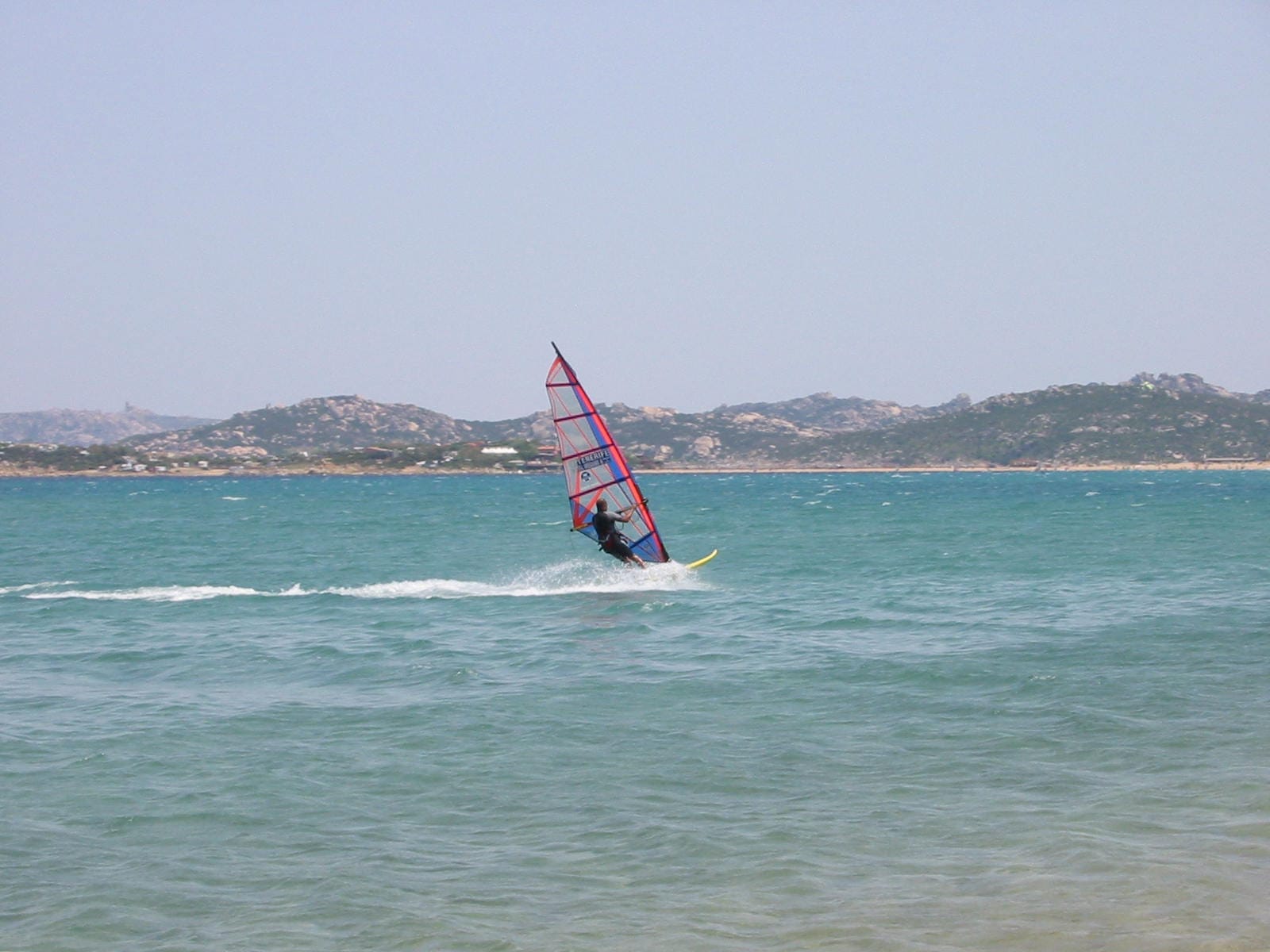
The northern side faces the wind head-on. On most days from spring through early autumn, the Mistral sweeps down from the northwest with enough force to lift kites and fill sails within minutes of rigging up. The southern side offers flatter water and slightly gentler conditions, which makes it popular for beginners and for longer, calmer swimming. Between the two, dunes covered in juniper, mastic, and lavender scrub create a buffer zone that smells, on warm afternoons, like a wild herb garden.
ℹ️ Good to know
Porto Pollo is a natural beach with no entrance fee and no official opening hours. It is accessible at all times. Seasonal beach services — bars, equipment rental, surf schools, parking areas — operate independently and are typically open from late spring through September or October.
The Wind: Why This Beach Exists the Way It Does
The geography of northern Sardinia channels the Mistral through the Strait of Bonifacio and into the bays of Gallura with particular intensity. Porto Pollo sits directly in this path. The result is a stretch of coastline that sees reliable, strong wind on the majority of summer days — which is exactly why the windsurfing and kitesurfing community discovered it decades ago and has never really left.
On a typical July morning, the beach is calm until around 10 or 11 a.m. The water is flat, the light is extraordinary — pale turquoise over sand, darkening to deep blue further out — and the few early visitors spread out along the shore without crowding. By midday, the wind picks up sharply. Within an hour, the launch areas fill with colorful kites, boards are carried to the water's edge, and the acoustic texture of the place changes completely: the hiss of lines, the snap of sails, the thud of boards over chop.
This daily rhythm means Porto Pollo effectively operates as two different beaches depending on the time. Early mornings and late afternoons — especially in September and early October when the wind eases sooner — belong to swimmers and families. Midday through late afternoon belongs to the water sports crowd. Understanding this rhythm before you arrive will shape your whole experience of the place.
💡 Local tip
If you want to swim in calm conditions without competing for space with kite lines and boards, arrive before 10 a.m. or visit the southern (inlet) side of the isthmus, where the water stays more sheltered even when wind conditions are at their peak on the northern shore.
Tickets & tours
Hand-picked options from our booking partner. Prices are indicative; availability and final rates are confirmed when you complete your booking.
Balai Bay snorkeling experience from Porto Torres
From 42 €Instant confirmationFree cancellationAsinara island e-bike rental from Porto Torres
From 48 €Instant confirmationFree cancellationBoat Tour of Porto Cervo's beaches from Porto Rotondo
From 84 €Instant confirmationFree cancellationBoat excursion and snorkeling in Porto Conte marine area in Alghero
From 90 €Instant confirmationFree cancellation
The Two Beaches: What Each Side Offers
The northern beach, facing the open sea, is the main event for wind sports. It is wider, more exposed, and backed by the dune vegetation that gives Porto Pollo its visual identity. The sand here is fine and pale, sometimes drifted into low ridges by the wind. Equipment rental and kitesurfing and windsurfing schools operate along this shore, with instructors, boards, wetsuits, and rigging areas occupying sections of the beach during peak season. Swimmers tend to cluster toward the edges of these zones or simply accept that they are sharing the water with fast-moving boards.
The southern beach, facing the Liscia inlet, is shallower and considerably calmer. The water warms up faster here and stays warmer through the season, which makes it more comfortable for children and for casual swimming. It is also where the isthmus connects to the mainland by a bridge over the Liscia river, which is the road access point visitors use. The vegetation on this side feels denser and more enclosed, with Mediterranean scrub growing close to the waterline in places.
One beach called Spiaggia dell'Arenaria sits within the Porto Pollo area and is noted for its dune formations. The dunes here are not enormous by Atlantic standards, but they are real — shaped by wind, held in place by juniper roots, and worth walking through for the transition they create between the scrubland interior and the open shore. The scent when the juniper is warm from the afternoon sun is one of those small sensory details that sticks with you.
Getting There and Around
Porto Pollo lies between Palau and Santa Teresa Gallura on the north coast of Sardinia, reached via the SS133bis road. From Palau, the drive takes roughly 6 to 10 minutes, and the beach is well-signposted. The access road crosses the bridge over the Liscia river and leads directly to the main parking area near the beach. In high season, this parking fills early — before 9 a.m. on busy weekends — and the road into the site can become congested. Arriving before the wind picks up solves both problems at once.
There is no reliable direct public bus service to Porto Pollo. Visitors without a car can reach Gallura's main towns by bus or ferry, but the final stretch to the beach requires private transport. A rental car or scooter is the practical solution for most independent travelers. The nearest ferry port is Palau, which connects to La Maddalena island — a useful base if you are combining Porto Pollo with exploration of the Caprera island nature reserve.
The closest airport is Olbia Costa Smeralda (IATA: OLB), roughly an hour's drive to the northwest. From Olbia, the drive to Porto Pollo takes around an hour via the SS125 and then north toward Palau. Car rental at Olbia airport is well-organized with multiple operators on site.
⚠️ What to skip
There is no public transport to Porto Pollo beach itself. Do not plan this visit without arranging private transport in advance, particularly in August when taxis and ride options near Palau are stretched thin.
Wind Sports: What to Expect If You Come to Kite or Surf
Several wind sports schools and equipment rental operations are based at Porto Pollo during the season. They offer lessons for beginners through advanced riders, as well as board and kite rental for experienced visitors who arrive without gear. Lesson prices, rental rates, and availability vary by operator and season; book directly with the school before arriving, particularly in July and August when course slots fill up.
The conditions at Porto Pollo are generally considered intermediate-to-advanced for kitesurfing on the open northern shore. The Mistral is powerful and consistent, but it can gust unpredictably, and the combination of other kites, boards, and swimmers in a relatively confined area requires spatial awareness and experience. Beginners will typically be taken to the calmer inlet side or introduced to equipment in controlled conditions first. If you are planning a wind sports holiday across northern Sardinia, the Sardinia windsurfing and kitesurfing guide covers the full range of sites and conditions across the island.
For those watching rather than participating: the spectacle of dozens of kites in the air simultaneously, with the La Maddalena archipelago visible on the horizon, is striking. There is a reason photographers arrive with long lenses in the early afternoon.
When to Visit and What to Expect by Season
Porto Pollo is at its busiest from late June through August, when Italian and European visitors pack the Gallura coast. The wind conditions during this period are typically at their most consistent, which is ideal for wind sports but means the beach itself is crowded, parking is difficult, and prices for nearby accommodation rise sharply. If you are visiting specifically for Sardinia in summer, factor in early arrival times and patience with the crowds.
May, June, and September offer a notably different experience. The wind is still present, the water temperature is comfortable for swimming from May onward, and the beach is less crowded. September in particular is often cited as one of the most pleasant months on this part of the coast: the sea has had all summer to warm up, the light turns golden earlier in the afternoon, and the wind sports crowd is more manageable. The September guide for Sardinia covers shoulder-season conditions across the island in more detail.
Winter visits are possible in the sense that the beach is always accessible, but there are no services operating, the wind can be brutal rather than exhilarating, and the isolation is complete. This is a landscape worth seeing in a different key, but not a practical beach day.
Photography, Practical Details, and Honest Limitations
The light at Porto Pollo is best in the morning, when low-angle sun catches the pale sand and the turquoise shallows on the southern side. The northern beach photographs well in the late afternoon when kites are in the air and the Mistral is up — wide-angle shots looking out toward the archipelago work particularly well. A polarizing filter makes a significant difference when shooting the water.
Accessibility information for Porto Pollo is limited. Official sources do not document wheelchair-accessible paths, adapted toilet facilities, or beach-entry equipment. The fine sand and dune terrain make unassisted wheelchair access difficult. Visitors with specific accessibility requirements should contact local operators or the Palau tourist office directly before planning a visit.
An honest note: Porto Pollo is not a beach for everyone. If you want calm water, shade, organized beach clubs with sun loungers, and a quiet afternoon, you will find it more stressful than relaxing here during peak season. The wind is not decorative — it blows sand, makes conversation difficult, and keeps the water choppy on the northern shore for hours at a time. Visitors looking for that kind of beach should consider the southern coastline near Chia or the sheltered coves of the Golfo di Orosei instead.
For those it suits, though, Porto Pollo is one of the most distinctive natural beaches in northern Sardinia: wild, energetic, visually striking, and free.
Insider Tips
- The southern inlet side of the isthmus warms up faster and stays calmer throughout the day — if you have children or want to swim without competing with wind sports equipment, start there and save the northern beach for the spectacle.
- Arrive before 9 a.m. in July and August to secure parking and get the beach to yourself before the Mistral picks up. The early morning light on the water is exceptional and the contrast with the midday chaos is remarkable.
- If you are taking a wind sports lesson, book at least a few days in advance during high season. Schools fill their morning slots quickly, and walk-ins in August often face long waits or no availability at all.
- The dune vegetation between the two beaches — juniper, mastic, and lavender — is best appreciated on foot in the late afternoon when the scrub releases heat and fragrance. A short walk through the dunes from north shore to south shore takes ten minutes and feels like a different place entirely.
- Bring more water than you think you need. There are seasonal bars and services, but they are not always open, they run out of cold drinks on hot afternoons, and the combination of sun and wind dehydrates you faster than a standard beach day.
Who Is Porto Pollo For?
- Experienced windsurfers and kitesurfers seeking consistent Mistral wind conditions
- Beginner wind sports enthusiasts willing to take structured lessons from on-site schools
- Photographers looking for dramatic coastal landscapes with kite action and archipelago backdrops
- Nature-oriented travelers who prefer wild dune environments over organized resort beaches
- Visitors combining north Sardinia's coast with the La Maddalena archipelago using Palau as a base
Nearby Attractions
Other things to see while in Gallura:
- Basilica di San Simplicio (Olbia)
The Basilica di San Simplicio is the oldest surviving building in Olbia and one of the finest Romanesque churches in Sardinia. Built between the late 11th and mid-12th centuries on a site with origins in a Roman necropolis and a Palaeo-Christian church, it offers a rare, unhurried encounter with pre-medieval Gallura — around ten minutes' walk from the ferry port crowds.
- Capo Testa
Capo Testa is a rugged granite promontory jutting into the Strait of Bonifacio near Santa Teresa Gallura, in Sardinia's far north. The headland is free to visit and rewards exploration with wind-sculpted rock formations, secluded sea pools, and the eerily beautiful Valle della Luna. It is one of northern Sardinia's most distinctive natural landscapes.
- Coddu Vecchiu Giants' Tomb (Arzachena)
The Giants' Tomb of Coddu Vecchiu is one of Sardinia's best-preserved Nuragic funerary monuments, featuring a roughly 4-metre granite entrance stele that has stood in the Gallura countryside for roughly 4,000 years. Located about 10 km from the Gulf of Arzachena, it offers a absorbing encounter with the island's prehistoric past in under an hour.
- Costa Paradiso
Costa Paradiso is a striking stretch of northern Sardinian coastline where ancient red and orange granite cliffs drop into transparent turquoise water. Largely a seasonal holiday settlement with under 200 year-round residents, it offers raw scenery, natural rock pools, and sheltered coves without the infrastructure of larger resorts.