Isola Caprera: Sardinia's Most Rewarding Wild Island
Caprera is a 15.7 km² island connected to La Maddalena by a causeway, entirely protected within the La Maddalena Archipelago National Park. It combines some of northeastern Sardinia's most untouched beaches with the preserved home and tomb of Italian unification hero Giuseppe Garibaldi, making it a rare place where natural drama and living history coexist.
Quick Facts
- Location
- La Maddalena Archipelago, northeastern Sardinia. Connected to La Maddalena island by causeway.
- Getting There
- Ferry Palau to La Maddalena (approx. 15–20 min crossing), then drive or take a bus across the causeway to Caprera. No direct ferry to Caprera itself.
- Time Needed
- Half day minimum; a full day recommended if combining beaches, hiking, and the Garibaldi museum.
- Cost
- Free to access the island by road. Separate admission for the Compendio Garibaldino museum (verify current prices on-site).
- Best for
- Hikers, snorkelers, history enthusiasts, and anyone seeking beaches without a beach club soundtrack.
What Isola Caprera Actually Is
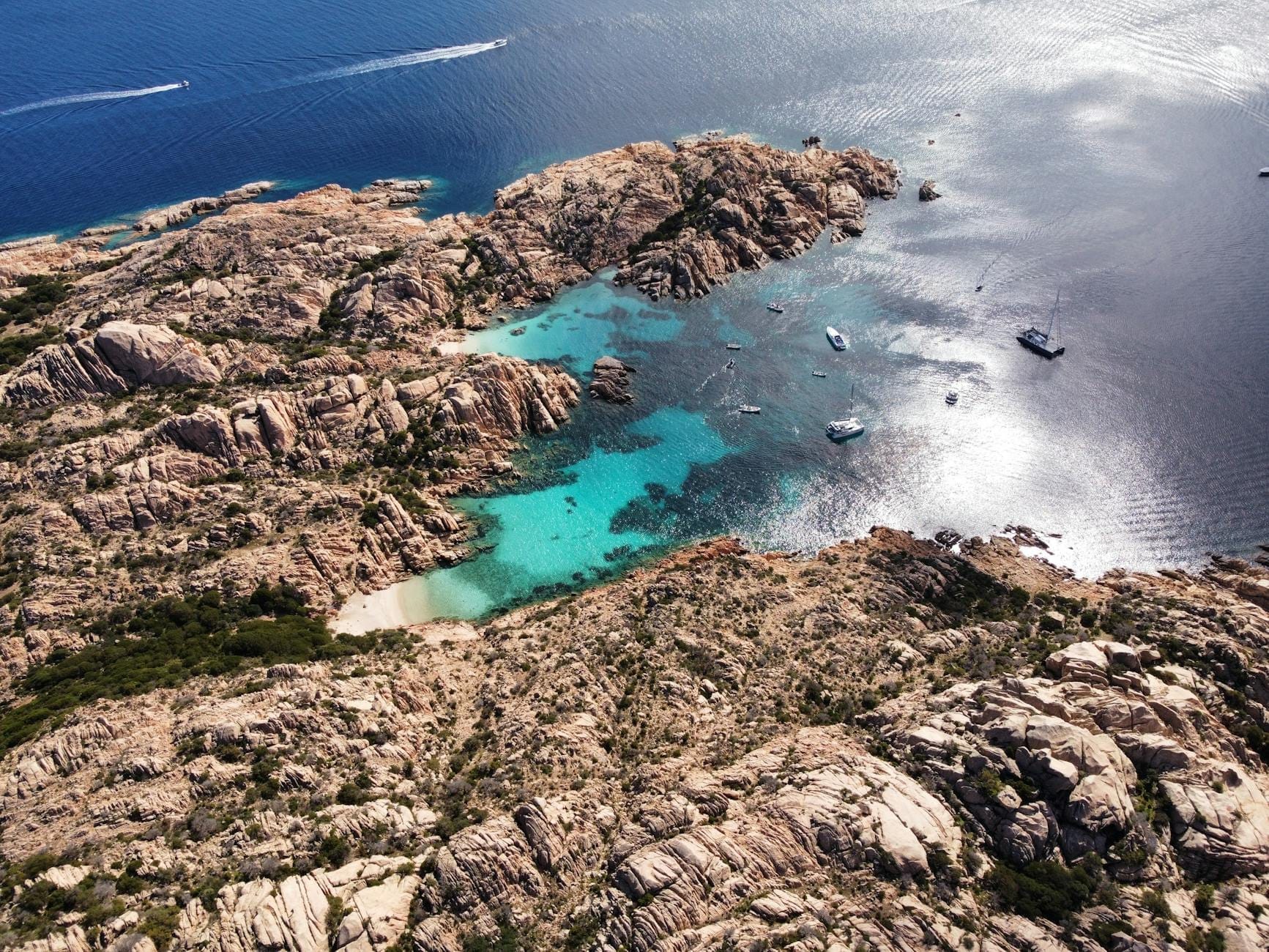
Isola di Caprera sits at the northern tip of Sardinia, part of the La Maddalena Archipelago and entirely enclosed within its national park boundaries. At about 15.7 km², it is not a tiny islet but a substantial chunk of granite, juniper, and pine, with nearly 35 km of coastline that ranges from cliff faces dropping straight into the sea to shallow sandy coves that barely register on maps. The island has been a classified natural reserve since 1980, which means development here stopped well before it started elsewhere in the archipelago.
What makes Caprera unusual is the combination of complete wildness and genuine historical weight. This is where Giuseppe Garibaldi, the 19th-century general who played a central role in Italian unification, chose to live from 1854 until his death on 2 June 1882. His farmhouse and tomb have been preserved as national monuments, and visiting them gives the landscape an extra dimension that most island day-trips lack.
The island sits within the broader La Maddalena Archipelago, a constellation of 60 islands and islets, but Caprera stands apart from La Maddalena town in character. While La Maddalena has shops, restaurants, and a lived-in port atmosphere, Caprera feels deliberately removed from all of that. Crossing the causeway is a clear transition.
Getting Here: The Practical Route
The standard approach is to drive or take a bus to Palau on the northeastern Sardinian coast, then take a short ferry crossing of roughly 15 to 20 minutes to La Maddalena. From La Maddalena town, a road causeway connects directly to Caprera. There is no general admission fee to access the island itself by road.
Palau is reachable by car from Olbia (about 40 km), which is the nearest major transport hub with an airport. Ferries between Palau and La Maddalena run frequently in summer and at reduced intervals in winter, operated by companies including Delcomar and Enermar. Car spaces on ferries fill quickly in July and August, so arriving early at the Palau embarkation point is strongly advisable during peak season.
⚠️ What to skip
If you plan to bring a car to Caprera in summer, book your ferry slot from Palau well in advance. Foot passengers have much more flexibility, but exploring Caprera without a vehicle means your range is limited unless you hire a bike or scooter on La Maddalena.
Once on Caprera, the main asphalted road runs through the island's interior and gives access to trailheads and a handful of beach parking areas. Most shoreline coves, however, are reached only on foot along unpaved paths or by arriving by boat. This is a feature, not a flaw, but it matters for trip planning.
Tickets & tours
Hand-picked options from our booking partner. Prices are indicative; availability and final rates are confirmed when you complete your booking.
Vineyard Guided Tour and 7 Wine Tasting in Palau
From 84 €Instant confirmationFree cancellationFull-Day Sailboat Tour in La Maddalena Archipelago from Cannigione
From 112 €Instant confirmationFree cancellationHiking excursion to the Devil's Saddle
From 35 €Instant confirmationFree cancellationExcursion to the Archaeological site of Nora
From 70 €Instant confirmationFree cancellation
The Coastline: What the Beaches Are Actually Like
Caprera's beaches are not one type of thing. The southeastern coast around Cala Coticcio is often cited as among the most striking in the entire archipelago: a narrow inlet with water that shifts from turquoise to near-transparent green depending on the light, flanked by rust-pink granite boulders worn smooth over millennia. Reaching it requires a walk of roughly 20 to 30 minutes on a rocky path from the nearest parking area. In July and August, you will encounter other people on that path, but the cove's geometry limits how crowded it can get.
Cala Portese on the southwestern side is more accessible and consequently busier, with a longer sandy beach suitable for families. Cala Brigantina and Cala Serena offer middle-ground options. The water quality across all of Caprera's beaches benefits directly from the national park protections. For a broader view of what the archipelago's beaches offer, the Cala Coticcio beach page covers the most celebrated of them in detail.
The mornings are the right time to be on the water. Before 10am, the light is lower, the wind is usually absent, and the coves hold a stillness that evaporates once day-trippers from La Maddalena and nearby charter boats begin arriving. By mid-afternoon in peak season, popular spots have motor boats anchored offshore and the rocks are occupied. If you want the version of Caprera that matches the photographs, be on the path by 8am.
💡 Local tip
Snorkeling along the granite rock edges rather than in the sandy centres of coves rewards attention. Sea urchins, wrasse, octopus, and small grouper are commonly visible in the clear, protected waters, and the rock formations create natural swim-throughs at several accessible points.
The Compendio Garibaldino: Garibaldi's House and Tomb
The Compendio Garibaldino is the preserved complex of buildings where Giuseppe Garibaldi lived, worked his land, and died. It is not a grand estate but a practical farmhouse adapted over time, which tells you something about Garibaldi himself. The Casa Bianca, his main residence, has been kept largely as it was at the time of his death, with original furniture, personal objects, and the bed in which he died still in place. The nearby tombs hold Garibaldi and several family members.
Garibaldi arrived on Caprera in 1856, between his military campaigns, and used the island as both a retreat and a working farm. He is reported to have appreciated its remoteness and the self-sufficiency it allowed. That context gives the site a weight that purely political monuments often lack: this was where someone chose to live an ordinary life between extraordinary events, and the island's character absorbed something of that preference for isolation.
The museum has seasonal opening hours and charges a separate admission fee. Prices and schedules should be confirmed directly before visiting, as they adjust between summer and the rest of the year. Photography inside is generally restricted or regulated. Allow at least an hour if you engage with the displays rather than moving through quickly.
Hiking and Moving Around the Island
Caprera's terrain is granite upland covered in macchia scrub: low aromatic plants, juniper, cork oak, and Mediterranean pine. The scent on a warm morning, especially after any overnight moisture, is sharp and resinous. The main ridge runs roughly north to south across the island and reaches Monte Teialone at 212 metres, which is modest in elevation but offers unobstructed views across the archipelago toward Corsica to the north, visible as a dark mass of mountains on clear days.
Trails vary from well-marked paths to faint goat tracks, and navigation requires some attention. The island lacks formal waymarking on many routes, so carrying a downloaded offline map or a dedicated hiking app is useful rather than optional. The national park framework that governs Caprera also governs access rules: some zones have stricter protections and should not be entered outside designated paths. For context on hiking conditions and route preparation in Sardinia generally, the hiking in Sardinia guide provides useful background.
In terms of footwear: sandals are insufficient for most trail routes here. The granite is often sharp-edged and the paths are uneven. Closed shoes with grip are the minimum. In July and August, the sun exposure on the open ridge walks is intense, and there is no shade on several stretches. Water from the island's interior is not reliably available, so carrying at least 1.5 litres per person is sensible for any walk longer than an hour.
How the Island Changes Through the Day
Caprera before 9am is a different place from Caprera at noon. In the early morning, the light on the granite is golden and low, picking out the orange and grey mineral streaks in the rock faces. The sea is glassy in the protected inlets. You might hear only water, wind in the scrub, and occasionally a gull. The roads are nearly empty except for the occasional car heading to an early beach spot.
By late morning, boats begin anchoring in the larger coves, and the beach parking areas fill. The heat becomes serious by noon in summer, and the scrub holds it rather than releasing it. Afternoons in August can be punishing for extended walking, which makes the early morning and the evening hours the practical windows for any serious exploration on foot.
In shoulder season, specifically May, June, and September, the dynamic shifts considerably. Cooler temperatures make midday walking manageable, the ferries carry far fewer visitors, and the coves can be empty on weekday mornings. September is particularly good: the sea is at its warmest after the summer, visibility for snorkeling is often better than in July, and the landscape has a slightly drier, more golden texture that photographs well.
For broader seasonal planning across northeastern Sardinia and the archipelago, the best time to visit Sardinia guide covers how crowd levels, temperatures, and ferry frequencies vary month by month.
What Caprera Is Not
Caprera is not a place that offers much in the way of infrastructure. There is no resort, no beach club, no reliable food or drink point at most beaches. If you arrive without water, food, sun protection, and a plan, a summer visit can become uncomfortable quickly. The island rewards preparation and self-sufficiency, not spontaneity.
It is also worth being clear about the effort involved in accessing the best beaches. Several of the most beautiful coves require 20 to 40 minutes of walking on rough terrain in direct sun. That is not a long walk in normal conditions, but at 35°C in August with a toddler and a beach bag, it changes character. Visitors expecting a drive-to-the-sand experience will be disappointed. Visitors willing to work for it a little will find some of the best water in the Mediterranean.
Those looking for a more developed beach experience with facilities nearby might find the mainland coast around the Costa Smeralda better suited to their preferences. Caprera is emphatically for people who want the opposite of that.
Insider Tips
- The best light for photography on the granite boulders is between 7am and 9am, when the sun is low and the rock's natural color range, orange, grey, and white, is fully visible. The same shots at noon look flat and overexposed.
- Arriving on the first or second ferry from Palau in the morning gives you roughly two hours on Caprera before the day-trip boats begin filling the coves from the sea. That window is the island at its most manageable and most beautiful.
- Carry cash. There are no ATMs on Caprera itself, and the small bar near the Garibaldi museum is the only reliable option for anything, and it is not always open outside peak months.
- The northeastern coast near protected-zone boundaries has some of the least-visited walking on the island. The views toward the open Tyrrhenian Sea are more dramatic than the sheltered western side, and foot traffic is minimal even in August.
- If you are coming by boat, anchoring off Cala Coticcio in the morning before 9am places you ahead of the charter flotillas that typically begin arriving between 10am and 11am. By afternoon, the cove can have a dozen or more boats.
Who Is Isola Caprera For?
- Hikers and walkers comfortable on rough, unshaded granite terrain
- Snorkelers and swimmers seeking clear, protected national park water without crowds
- History travelers interested in the Risorgimento period and Garibaldi's legacy
- Independent travelers who prefer planning their own route over organised tours
- Photographers working early mornings, when the granite coastline and light combine well
Nearby Attractions
Other things to see while in La Maddalena Archipelago:
- Isola di Budelli & Spiaggia Rosa
Spiaggia Rosa on Isola di Budelli is one of the Mediterranean's most photographed beaches — and one of the few you cannot set foot on. Landing has been banned since 1998 to protect its rare pink sand, made from crushed coral, shells, and foraminifera fragments. The only way to experience it is by boat, drifting close enough to see the color shift with the light.
- Spiaggia di Cala Coticcio
Cala Coticcio is a tightly guarded double-bay cove on Caprera Island in the La Maddalena Archipelago, ringed by pinkish granite boulders and reached only by guided trek or boat. Access is strictly regulated by national park quota, which keeps the crowds thin but requires advance planning.