Isola di Budelli & Spiaggia Rosa: Sardinia's Untouchable Pink Beach
Spiaggia Rosa on Isola di Budelli is one of the Mediterranean's most photographed beaches — and one of the few you cannot set foot on. Landing has been banned since 1998 to protect its rare pink sand, made from crushed coral, shells, and foraminifera fragments. The only way to experience it is by boat, drifting close enough to see the color shift with the light.
Quick Facts
- Location
- Isola di Budelli, Parco Nazionale dell'Arcipelago di La Maddalena, La Maddalena (SS), Northern Sardinia
- Getting There
- By boat only — organized archipelago tours depart from Palau or La Maddalena. No ferry or public transit reaches the island directly.
- Time Needed
- Half-day minimum (most boat tours of the archipelago last 5–8 hours)
- Cost
- Free to view from the sea (within the 70 m buoy boundary). Boat tour prices vary by private operator — check current rates when booking.
- Best for
- Nature lovers, photographers, snorkelers, sailing enthusiasts, and anyone wanting to see one of Europe's most protected coastlines
- Official website
- lamaddalenapark.iswebcloud.it/pagina20744_budelli.html
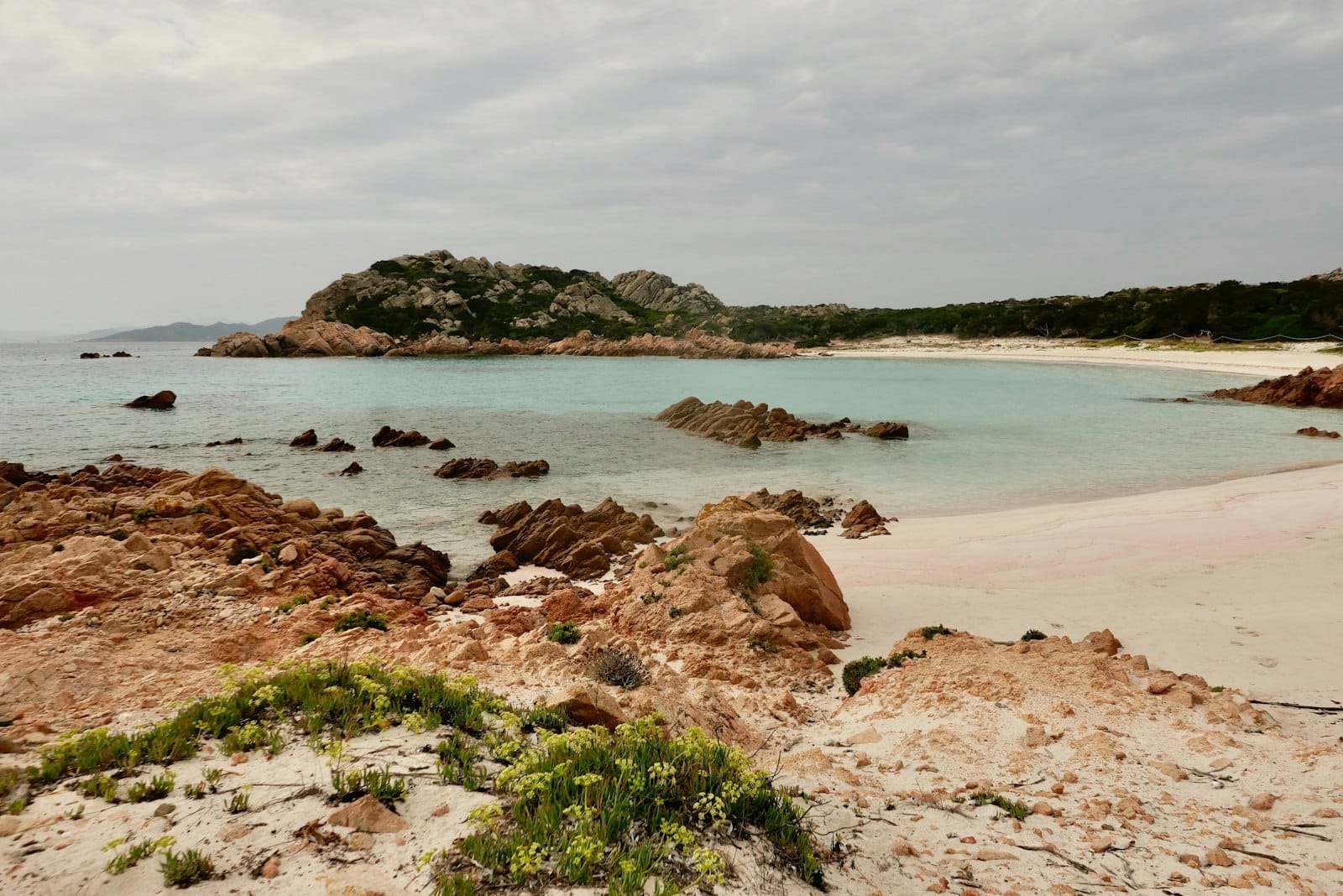
What Is Spiaggia Rosa — and Why Can't You Walk On It?
Isola di Budelli is a small island in the La Maddalena Archipelago National Park, covering roughly 25 hectares with about 12 km of coastline and a high point of about 88 metres at Monte Budello. It sits near the Bocche di Bonifacio, the strait between Sardinia and Corsica, in one of the most ecologically sensitive stretches of the northern Mediterranean.
Its famous beach, Spiaggia Rosa, occupies Cala di Roto on the island's south-eastern shore. The pink color comes from a very specific mix of crushed coral fragments, the shells of microscopic marine organisms called foraminifera, and fine white quartz. When dry, the sand appears pale salmon. When wet, the color deepens into a dusty rose. At certain angles in afternoon light, the whole cove glows.
Since the mid-1990s, and reinforced by stricter rules introduced in 1998, landing on, walking across, bathing at, or anchoring near Spiaggia Rosa has been strictly prohibited under Zona A integral protection rules. The ban exists because decades of tourism — people pocketing handfuls of sand as souvenirs, anchoring boats in the shallows, trampling the fragile shoreline — had visibly degraded the color and composition of the beach. The park decided the only way to save it was to close it entirely. Budelli itself was formally transferred to the national park's ownership in May 2016, ending a protracted legal dispute over its status.
⚠️ What to skip
Landing on Spiaggia Rosa is illegal and enforced. Boats must stay outside the buoy line approximately 70 metres from shore. Violations carry fines. Do not attempt to wade ashore from a dinghy or kayak — park rangers patrol the area, particularly during summer.
How to See It: The Boat Tour Experience
The standard way to see Spiaggia Rosa is on an organized boat tour of the La Maddalena Archipelago, departing from either Palau on the Sardinian mainland or from the town of La Maddalena on the main island of the same name. Most full-day tours run five to eight hours, looping through the archipelago and including swim stops at permitted beaches, usually with Budelli as one of several highlights.
From the boat, anchored at the permitted distance, the beach is clearly visible. Binoculars improve the detail, particularly if you want to study the texture and color of the sand. Many visitors find the view from the water more than sufficient — the turquoise of the surrounding sea contrasts sharply with the pink shoreline, and the granite boulders framing the cove add scale. The image is exactly what the photographs promise.
For those who want a land-based viewpoint, it is sometimes possible to reach a vantage point near Spiaggia del Cavaliere or Cala di Roto with an authorized park guide. This option is far less common, requires advance arrangement with tour operators connected to the park, and availability changes seasonally. Do not assume it is available on a casual visit.
Boat tours are run by private operators, not the park itself, so pricing, schedules, and quality vary considerably. Most operators launch from Palau, which is the nearest mainland port to Budelli. Tours typically depart in the morning, around 9:00–10:00, and return by late afternoon. High season runs from late June through early September, and berths on reputable boats can sell out days in advance.
💡 Local tip
Book your boat tour at least 2–3 days ahead in July and August. Ask specifically whether the tour includes a stop at Budelli — not all archipelago tours cover the same islands. A tour that promises 'all seven islands' is a marketing phrase; verify the actual itinerary.
Tickets & tours
Hand-picked options from our booking partner. Prices are indicative; availability and final rates are confirmed when you complete your booking.
Kayak tour in the Oasis of Biderosa
From 48 €Instant confirmationFree cancellationVineyard Guided Tour and 7 Wine Tasting in Palau
From 84 €Instant confirmationFree cancellationFull-Day Sailboat Tour in La Maddalena Archipelago from Cannigione
From 112 €Instant confirmationFree cancellationHiking excursion to the Devil's Saddle
From 35 €Instant confirmationFree cancellation
The Archipelago Around It: Context Makes the Visit
Budelli does not exist in isolation. The La Maddalena Archipelago comprises seven main islands and dozens of smaller islets, all within a national park established in 1994. The waters are among the clearest in the Mediterranean, with visibility sometimes exceeding 30 metres. On the same tour that passes Budelli, most boats also stop at Spargi, Caprera, Santa Maria, or Razzoli, offering proper swim and snorkel stops at beaches where landing is permitted.
Isola Caprera, adjacent to La Maddalena, carries its own historical weight as the home and burial site of Giuseppe Garibaldi, the 19th-century general central to Italian unification. His villa, the Compendio Garibaldino, is open to visitors. Most boat tours do not include it as a stop, but it is easily reached independently by ferry from La Maddalena town.
If you are spending more than a day in the area, the town of La Maddalena itself is worth a few hours, with a small but lively waterfront and ferry connections throughout the archipelago. For a broader look at Sardinia's north, Isola Caprera and the granite headlands of Capo Testa are both within reasonable driving distance from Palau.
Time of Day and Seasonal Conditions
The pink color of Spiaggia Rosa is most saturated in direct, warm-toned light. Early afternoon, when the sun is high and the sand is dry, tends to produce the clearest visual impression from the water. Morning light gives a softer effect, and the beach can look nearly white in harsh midday glare. Late afternoon, if the tour is still in position, offers the most photogenic conditions for longer-lens photography from the boat deck.
Wind is a genuine consideration. The Bocche di Bonifacio is notorious for the Mistral, a northwesterly wind that can turn calm seas rough with little warning. Tours are routinely cancelled or rerouted in strong wind conditions. If you are visiting in spring (April to May) or autumn (September to October), the Mistral is more unpredictable than in the height of summer. Check wind forecasts on the morning of your tour, and book with an operator who offers clear cancellation and rescheduling terms.
Shoulder season — late May through mid-June, and September — offers the most comfortable combination of calm seas, reasonable temperatures (typically 24–27°C), and lighter crowds on the boats. July and August bring peak heat and maximum visitor numbers, with boats sometimes crowded to capacity and the buoy boundary around Budelli lined with dozens of vessels simultaneously.
ℹ️ Good to know
September is often considered the optimal month for this tour: sea temperatures remain warm (around 24°C for swimming), summer crowds thin noticeably after mid-August, and afternoon light for photography is excellent. See the full breakdown in the guide to visiting Sardinia in September.
Photography: Getting the Shot From 70 Metres Out
A phone camera will capture the scene, but the 70-metre distance to the beach means detail is limited without optical zoom. A mirrorless or DSLR camera with a 200–300mm equivalent focal length will let you isolate the pink sand against the granite boulders and show the color gradation clearly. Polarizing filters cut glare off the water surface and saturate the colors in the bay.
Position yourself on the side of the boat facing the beach before the captain drops anchor — spots along the rail go quickly. Most boats spend 15–25 minutes in viewing position before moving on. If you are on a larger vessel, the elevated deck gives a better angle over the water surface than the main deck.
Drone flying is subject to national park regulations and requires prior authorization. Do not launch a drone over Budelli without confirmed written permission from the Parco Nazionale dell'Arcipelago di La Maddalena. Unauthorized flights risk significant fines and confiscation of equipment.
Managing Expectations Honestly
Spiaggia Rosa is a unusual natural phenomenon, and seeing it is worth the effort — but the experience is not what visitors raised on glossy travel photography might expect. The color is real, but it is subtle. This is not a beach that glows electric pink. In certain light conditions, from a distance, with the surrounding turquoise water for contrast, it reads as distinctly and beautifully pink. In flat light or from an unfavorable angle, it can look pale beige.
The viewing restriction is also significant. You are watching the beach from a boat, not standing on it. For travelers who prioritize beach swimming, the stops at other archipelago beaches during the same tour will be far more engaging. The Spiaggia Rosa moment is brief, primarily visual, and best understood as one element within a larger archipelago experience rather than the sole reason to make the journey.
If dramatic beaches you can actually access are what you are after, the Golfo di Orosei on Sardinia's east coast — including Cala Luna and Cala Mariolu — offers some of Europe's most spectacular swimming beaches. These are less restricted and can be reached by boat from Cala Gonone.
Visitors with limited mobility should note that getting a good view from the boat requires standing at the rail for several minutes on a rocking deck. Most tour boats are not equipped with accessible facilities, and boarding from a dock via a gangplank can be challenging. Contact your tour operator in advance to discuss specific requirements.
Insider Tips
- Ask your boat tour operator which side of the vessel will face Budelli, and position yourself on that side before departure. On a crowded boat in high season, late arrival means standing behind other passengers and shooting over their heads.
- The town of Palau, the main departure point for archipelago tours, has little to offer beyond ferry logistics. Arrive the evening before, sleep locally, and catch a morning tour departure rather than rushing from further afield on the day.
- Bring a dry bag for your camera and phone even on calm days. The Bocche di Bonifacio creates short, choppy waves and spray is common, especially on smaller open inflatable tour boats.
- If your priority is the quality of the viewing experience rather than a full-day party boat, look for smaller private or semi-private tours with a maximum of 10–12 passengers. These cost more but spend longer at each stop and position more carefully near Budelli.
- The sand color looks most pink in photographs taken in the two hours before sunset. If your tour returns via Budelli in late afternoon (some itineraries do), that is when to have your camera ready.
Who Is Isola di Budelli & Spiaggia Rosa For?
- Nature and conservation enthusiasts interested in one of the Mediterranean's most protected ecosystems
- Photographers seeking a rare natural color phenomenon with dramatic granite backdrops
- Sailing and boating travelers who want to explore an entire archipelago rather than a single spot
- Couples and honeymooners looking for a scenic, crowd-limited day on the water in northern Sardinia
- Curious travelers who want to understand why some places are deliberately kept inaccessible — and what that preservation looks like in practice
Nearby Attractions
Other things to see while in La Maddalena Archipelago:
- Isola Caprera
Caprera is a 15.7 km² island connected to La Maddalena by a causeway, entirely protected within the La Maddalena Archipelago National Park. It combines some of northeastern Sardinia's most untouched beaches with the preserved home and tomb of Italian unification hero Giuseppe Garibaldi, making it a rare place where natural drama and living history coexist.
- Spiaggia di Cala Coticcio
Cala Coticcio is a tightly guarded double-bay cove on Caprera Island in the La Maddalena Archipelago, ringed by pinkish granite boulders and reached only by guided trek or boat. Access is strictly regulated by national park quota, which keeps the crowds thin but requires advance planning.