Spiaggia di Chia: The Southwest Coast Beach Worth the Drive
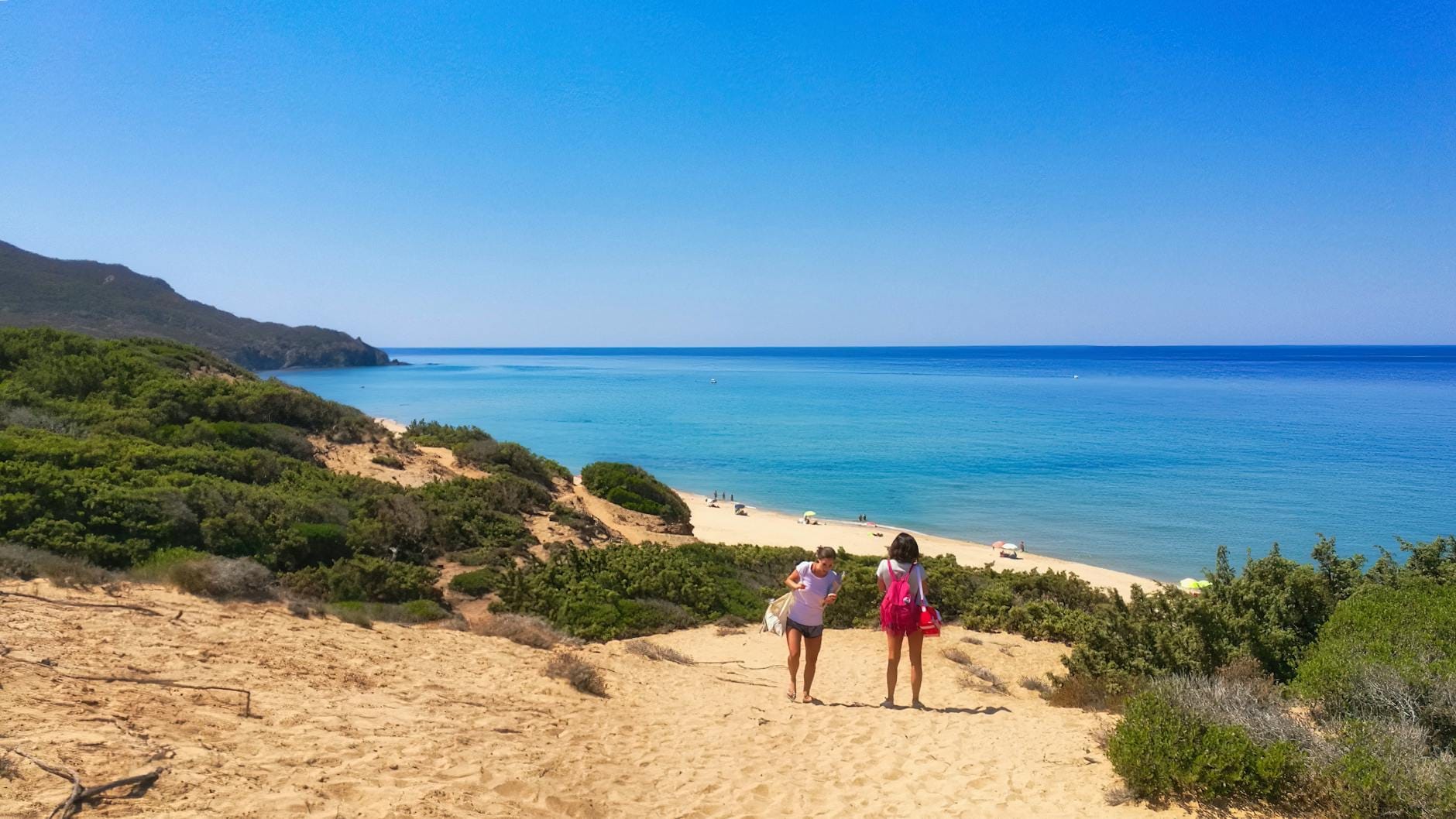
Stretching almost 4 kilometres along Sardinia's southwestern tip, Spiaggia di Chia is a sequence of distinct beaches backed by protected juniper dunes that reach 26 metres above sea level. The water is shallow and brilliantly clear, the archaeology is genuine, and the crowds in July and August are real. Here is what to expect and how to make the most of it.
Quick Facts
- Location
- Baia di Chia, Domus de Maria, Province of South Sardinia – approximately 60 km southwest of Cagliari via the SS195
- Getting There
- Car is the most practical option; follow the SS195 from Cagliari toward Pula and Chia, then turn onto Viale del Porto at the Chia junction. Seasonal ARST buses run from Cagliari to Baia di Chia, but there is no direct bus to the sand itself and a walk is required from the stop to the beach.
- Time Needed
- Half-day minimum; a full day if you want to walk multiple beach sections and visit the Torre di Chia
- Cost
- Beach access is free. Paid parking applies in summer; sunbed and umbrella hire is available from private operators at varying rates. Verify current parking tariffs locally.
- Best for
- Families with young children, photographers, archaeology enthusiasts, shoulder-season swimmers
- Official website
- www.sardegnaturismo.it/en/explore/su-portu-chia
What Chia Actually Is: A Bay, Not Just One Beach
The name Spiaggia di Chia covers a coastline that extends for almost 4 kilometres along the southwestern edge of the Gulf of Cagliari. It is not a single uniform stretch of sand but a sequence of distinct beach sections, each with its own character: Su Portu, Sa Colonia, Porto Campana, Monte Cogoni, and Su Giudeu, among others. The main Chia beach section is around 750 metres long and up to 90 metres wide, with other sections varying in size. The variety means that finding a quieter corner is possible, even in the peak summer weeks, if you are willing to walk.
Behind the sand, an unusual landscape takes over. A dune cordon, vegetated with juniper scrub and protected under the EU LIFE PROVIDUNE conservation project between 2009 and 2014, rises to a maximum height of around 26 metres above sea level. The juniper gives the air a sharp, resinous scent that is strongest in the morning heat. These are not decorative dunes: they represent a fragile ecosystem, and the wooden boardwalks that channel visitors to the water exist specifically to stop foot traffic from destabilising them.
ℹ️ Good to know
The dune vegetation at Chia is legally protected. Stick to the designated boardwalk paths across the dunes rather than cutting through the scrub. Fines apply.
The Water and the Sand: What the Experience Actually Feels Like
The seabed at Chia slopes gently and is predominantly sandy. This matters practically: the water stays shallow for a long way out, which makes it suitable for young children and for anyone who prefers to wade before swimming. The colour moves from pale turquoise near the shore to deeper blue-green further out. On calm days in May, June, or September, the clarity is remarkable: you can watch your feet on the bottom in water that reaches your chest.
The sand itself is fine and pale, tending toward white in direct sun. It heats up quickly and holds that heat into the afternoon, so footwear is advisable if you are walking any distance between parking areas and the shoreline. There is no coarse gravel or rock underfoot at the main beach sections, which distinguishes Chia from some of the more dramatic beaches on Sardinia's eastern coast.
The sea at Chia is generally swimmable from May through to early October, with conditions at their most reliable and warmest in July and August. Shoulder-season swimming, particularly in September, is often the most pleasant: the water retains summer warmth while the beach itself is considerably less crowded. For broader context on when conditions suit different types of visitors, the best time to visit Sardinia guide covers the island's seasonal patterns in detail.
Tickets & tours
Hand-picked options from our booking partner. Prices are indicative; availability and final rates are confirmed when you complete your booking.
Beach Tour Between Chia and Tueredda from Cagliari
From 107 €Instant confirmationFree cancellationBeaches and mountains of Chia full-day 4x4 tour from Cagliari
From 84 €Instant confirmationFree cancellationVineyard Guided Tour and 7 Wine Tasting in Palau
From 84 €Instant confirmationFree cancellationFull-Day Sailboat Tour in La Maddalena Archipelago from Cannigione
From 112 €Instant confirmationFree cancellation
How the Beach Changes Through the Day
Early morning at Chia, before 9am, has a quality that the midday crowds erase completely. The light comes in at a low angle over the dunes, picking out the individual grains of sand and turning the shallows a near-luminous green. A flamingo population uses the lagoon behind the main beach section as a feeding area; they are most reliably present in morning and evening, standing in the brackish water with a casual indifference to observers. By late morning they typically retreat or move elsewhere.
Between 11am and 4pm in July and August, the main parking areas fill completely and the beach in front of the sunbed concessions packs tightly. The sound shifts from wind and bird calls to music from beach bars, the rattle of rental equipment, and a general hum of conversation in Italian, German, and French. This is the honest version of Chia in high season: appealing to people who enjoy a sociable beach atmosphere, crowded for those who do not.
Late afternoon brings relief. The sun drops toward the headland and the light warms considerably. Some visitors leave around 5pm, freeing up space and reducing noise. The final hours before sunset are when the beach earns its photographic reputation: long shadows on rippled sand, the Torre di Chia silhouetted against an orange sky, the shallow water turning colours that no filter needs to improve.
💡 Local tip
If you are visiting in July or August, arrive before 9am to secure parking and a good position. Alternatively, come after 5pm for the best light and a noticeably quieter experience, though services may close earlier in the evening.
The Torre di Chia and the Archaeology Underneath
The square watchtower on the headland between Sa Colonia and the sea is the Torre di Chia, a Spanish coastal defense tower built during the period when the Crown of Aragon controlled Sardinia. It is the most immediately visible historical element at Chia, visible from most of the beach sections, and it functions as a natural navigation point when you are orienting yourself along the coastline.
Less obvious but historically more significant are the remains beneath the surrounding area. Near the tower and the Sa Colonia section of the beach, archaeological investigation has identified a Phoenician-Punic necropolis and the remnants of the ancient settlement of Bithia, a coastal town that was active during the Phoenician and Roman periods. The Ministry of Culture's cultural heritage documentation lists the Porto Campana and Chia beaches area explicitly in connection with these finds. This is not a reconstructed display site: the remains are fragmentary and the area is not developed for tourism in the way that, for example, the archaeological site at Nora is.
Travellers with a serious interest in Sardinia's ancient past will find Chia's archaeology intriguing as background context but should not expect a walkable archaeological park here. For that, the Nora archaeological site, a short drive north near Pula, offers properly excavated and signposted Phoenician-Roman ruins directly beside the sea and is worth combining with a Chia visit on the same day.
Getting There and Moving Between Beach Sections
Chia sits approximately 60 kilometres southwest of Cagliari along the SS195 coastal road. The drive takes around 50 to 60 minutes depending on traffic, which in August can add time on the final approach. The road itself is not a motorway: Sardinia has no motorway network, which is a notable distinction from mainland Italian regions. The SS195 is a single-carriageway road and requires attention, particularly on the bends above the coast.
There is no public transit that drops you directly on the sand at the main beach sections. ARST regional buses serve the Chia area with limited frequency and routes that change seasonally. For most visitors, a hire car is the practical solution. From the main Chia junction, follow signs for Torre Chia or Campeggio Torre Chia, and parking areas for the different beach sections are signed from the main access road. Paid parking applies in summer; verify current tariffs on arrival as rates change by season and operator.
If you are basing yourself in Cagliari for a few days and considering Chia as a day trip, it pairs well with Pula and Nora. The day trips from Cagliari guide outlines this combination and other options along the southern coast.
Walking between beach sections is possible along the shoreline and via paths through the dune area, but distances add up quickly and the terrain can be tiring in the midday heat. The Su Giudeu section, at the western end of the bay, is a separate and slightly less busy beach that many visitors miss because it requires a slightly different approach road. It tends to attract a younger, more independent crowd and has a wilder feel than the more serviced central sections.
Photography, Conditions, and What to Bring
Chia is a photogenic location and is reasonably well known in travel photography circles because of the combination of the tower, the dunes, the flamingos, and the water colour. The best light for wide shots of the bay is in the hour after sunrise, when the dunes are warm-toned and the beach is empty. Midday light is flat and harsh, which makes candid shots of swimmers workable but landscape photography less rewarding.
Bring more water than you think you need. The kiosks and beach bars on the main sections are open in summer but the further you walk from the central area, the fewer services there are. Sun protection at Chia is serious business: the sand reflects light effectively, there is little natural shade away from the dune vegetation, and the breeze from the sea can make the temperature feel deceptively moderate while UV exposure remains high.
Snorkelling is possible in the calmer sections of the bay, particularly near rocky outcrops at the edges of the sandy areas, though Chia is not primarily a snorkelling destination. The sandy seabed in the central sections supports less marine life than the rockier environments found further along the coast. For serious underwater exploration along this part of Sardinia, other sites in the southwest offer more rewarding conditions.
⚠️ What to skip
Wind can be significant at Chia, particularly in spring and early June. The Mistral, which affects Sardinia's western coast, can make conditions rough and water entry uninviting. Check local forecasts before making a long drive specifically for swimming.
Who Will Love It — and Who Might Not
Chia delivers on its reputation for the water quality and the landscape, particularly outside the peak weeks of mid-July to mid-August. The sand is fine, the sea clear, and the dune backdrop is unlike most beaches on the Italian mainland. The flamingo presence near the lagoon is a genuine surprise for first-time visitors.
In high season, though, the main beach sections operate as a fully commercialised beach resort. Sunbed rows are tightly packed in the concession areas, parking pressure is real, and the sense of a remote or peaceful coast disappears between 10am and 5pm. Visitors who value solitude and expect to find wild, unoccupied beach in August will be disappointed. Those who enjoy a well-organised, sociable beach day with good facilities and beautiful water will be satisfied.
Travellers for whom crowds are a dealbreaker should consider timing their visit for May, early June, or September, or look at the Sardinia in September guide for a fuller picture of what the island offers once summer begins to wind down. The southern coast in September is often at its most pleasant.
Accessibility for visitors with mobility limitations is worth addressing honestly. The beach has wooden boardwalks across the dunes and the seabed is gentle, both of which help. However, detailed information about wheelchair-specific infrastructure, adapted facilities, or beach wheelchair hire is not comprehensively documented in official sources and should be verified directly with local operators before visiting.
Insider Tips
- The Su Giudeu beach section at the western end of the bay requires a slightly different approach road and is consistently less crowded than the central areas near the tower. It is worth the minor navigational effort if the main parking areas look full.
- The lagoon behind the beach is the flamingo feeding area. Bring binoculars and position yourself near the lagoon edge in the early morning for the best sighting. By mid-morning, activity there typically slows.
- The final 90 minutes before sunset are when Chia earns its best photographs and its most pleasant atmosphere. Many day-trippers leave between 4pm and 5pm, which opens up the beach noticeably even in August.
- Combine Chia with a morning visit to the Nora archaeological site near Pula on the same day. Nora is about 25 kilometres northeast along the coast and makes for a satisfying half-day before the drive down to Chia for the afternoon.
- Freshwater showers and basic toilet facilities exist in the main service areas but can be crowded in peak hours. Arriving early means access is easier and the facilities are cleaner.
Who Is Spiaggia di Chia For?
- Families with young children: the shallow, sandy seabed and gentle entry make it one of the safer swimming environments on the southern coast
- Photographers: the combination of the Spanish watchtower, protected dunes, flamingo lagoon, and clear water offers varied subjects at golden hour
- Archaeology-minded travellers who want to combine a beach day with a visit to the nearby Nora ruins
- Shoulder-season visitors in May, June, or September who want reliable water quality without summer crowds
- Road-trippers working their way around the southwest coast of Sardinia with flexibility on timing
Nearby Attractions
Other things to see while in Sulcis & the Southwest Coast:
- Carloforte (Isola di San Pietro)
Carloforte is the sole inhabited centre on Isola di San Pietro, a small island off Sardinia's southwestern coast with a strikingly un-Sardinian character. Founded in 1738 by Ligurian settlers from Tabarka, it retains its own dialect, cuisine, and urban architecture — a place that rewards slow exploration rather than quick sightseeing.
- Costa Verde
Costa Verde is a 47-kilometre arc of coastline in the Comune di Arbus, in Sardinia's southwest, running from Capo Frasca to Capo Pecora. It holds some of the most remote beaches on the island, including Piscinas, where dunes reach up to 60 metres high, making it one of the largest dune systems in Europe. There are no entry fees, minimal resort infrastructure directly on the beaches, and no public transport. That combination is exactly why it rewards visitors who make the effort to get here.
- Is Zuddas Caves (Santadi)
Carved into 530-million-year-old Cambrian dolomite beneath Monte Meana, the Is Zuddas Caves near Santadi are among the most geologically significant showcaves in Sardinia. Guided tours of a flat 500-metre route reveal towering stalactites, aragonite helictites, and chambers that once served as an alabaster quarry before local speleologists rescued them for science and tourism in 1971.
- Isola di Sant'Antioco
Sant'Antioco Island sits off Sardinia's southwest coast, connected to the mainland by a bridge over an ancient isthmus. With roots stretching back to Phoenician colonizers in the 8th century BC, it pairs serious archaeology with quiet beaches, a still-functioning fishing port, and some of the least-crowded coastline in the region.