Poolbeg Lighthouse & Great South Wall Walk: Dublin's Most Dramatic Coastal Walk
The Great South Wall walk leads you along one of Europe's longest seawalls to the candy-red Poolbeg Lighthouse at the mouth of the River Liffey. Free to access, raw in character, and unlike anything else in Dublin, this 5km causeway offers wide-open bay views, industrial history, and a genuine sense of being at the edge of the city.
Quick Facts
- Location
- Great South Wall, Dublin Bay, Dublin 4 — mouth of the River Liffey
- Getting There
- Drive to South Wall car park near Poolbeg Generating Station (~20 min from city centre); or DART to Sandymount, then walk to Sandymount Strand for the longer route
- Time Needed
- 1.5–3 hours depending on route chosen
- Cost
- Free — no tickets, no entry fee
- Best for
- Coastal walkers, photographers, history lovers, anyone wanting open space away from the crowds
- Official website
- www.visitdublin.com/guides/south-wall-stroll
What the Poolbeg Lighthouse Walk Actually Is
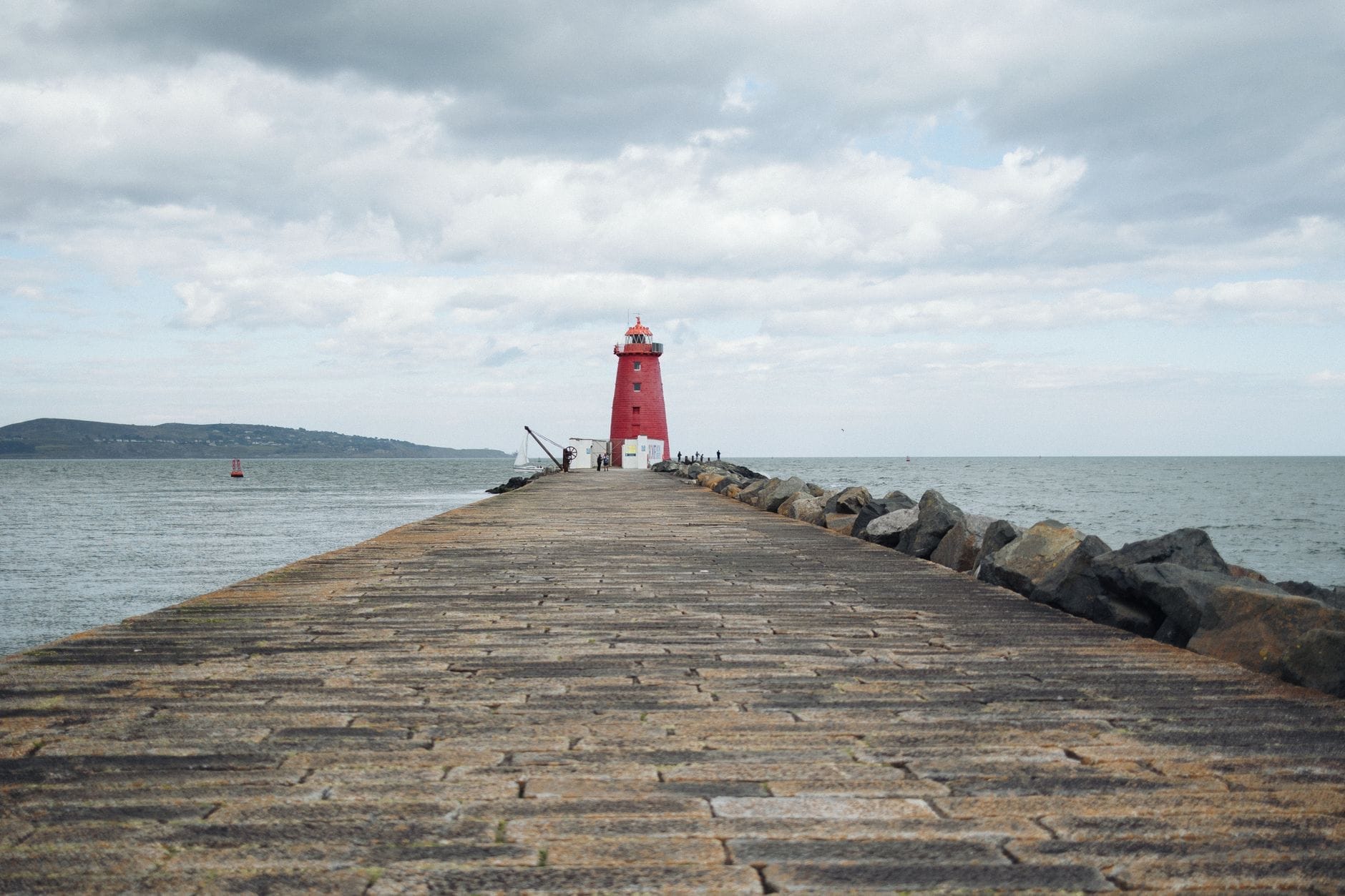
The Poolbeg Lighthouse walk is not a manicured trail. It is a walk along the Great South Wall, a granite causeway that stretches nearly 5 kilometres into Dublin Bay, separating the mouth of the River Liffey from the open sea. At the far end stands Poolbeg Lighthouse: a squat, bright red tower that has guided ships into Dublin Harbour since the 1760s. The wall itself, also known historically as the South Bull Wall, was completed in its earlier form by 1731, with construction continuing until around 1795. When finished, it was considered the longest seawall in the world. Today it remains one of the longest in Europe.
This is a walk with almost no facilities, no shelter, and no handrails on large sections of the wall. The surface is flat but the stone is uneven in places and the exposure to wind off the bay is relentless. In exchange for that rawness, you get unobstructed 360-degree views across Dublin Bay, the Wicklow Mountains to the south, Howth Head to the north, and the unmistakable twin red-and-white striped chimneys of the Poolbeg Generating Station rising behind you. It is one of the few places in Dublin where the city feels genuinely distant.
⚠️ What to skip
The walk is not recommended after dark or in poor weather. The stone surface becomes slippery when wet, there are no barriers along much of the wall, and exposure to wind and waves can be extreme in autumn and winter. Check conditions before you go.
The History Behind the Wall and the Lighthouse
The Great South Wall was an engineering project of extraordinary ambition for its era. Dublin's port had long been plagued by a shifting sandbar called the North Bull, which blocked ships from entering the Liffey mouth at low tide. By funnelling the river's flow through a narrower, defined channel, engineers hoped to scour the bar away. The wall achieved that goal over time, transforming Dublin into one of the busiest ports in the British Isles.
Poolbeg Lighthouse was first established as a lightship in the mid-18th century, with a permanent tower erected in 1767 to 1768 using candlepower as its original light source. That was converted to oil in 1786. The current structure, the iconic red cylindrical tower visitors see today, was redesigned and rebuilt in 1820. It remains an active navigational aid, maintained by the Commissioners of Irish Lights, and is not open to the public for interior access. Its vivid red paintwork makes it instantly recognisable, and it has become one of the most photographed landmarks in the Dublin Bay area.
The lighthouse and wall exist in a part of Dublin that often gets overlooked in favour of the city's Georgian squares and pub-lined streets. If you have already covered the Ha'penny Bridge and the National Museum, this walk offers something genuinely different: open sky, tidal smell, and a horizon with nothing between you and Wales.
Tickets & tours
Hand-picked options from our booking partner. Prices are indicative; availability and final rates are confirmed when you complete your booking.
Dublin Self-Guided Audio Walking Tour
From 5 €Instant confirmationFree cancellationDublin city guided walking tour
From 17 €Instant confirmationFree cancellationOld Dublin guided walking tour
From 28 €Instant confirmationFree cancellationEssential Dublin guided walking tour
From 19 €Instant confirmationFree cancellation
The Walk Itself: Two Ways to Approach It
The Short Route: Start at the Car Park
Most visitors drive or take a taxi to the car park near Poolbeg Generating Station at the end of Pigeon House Road. From there, the lighthouse is roughly 1.7 kilometres along the wall, making for a return walk of around 3.4 kilometres. This version takes 45 minutes to an hour at a comfortable pace and is the right choice if you have limited time or if you simply want to reach the lighthouse without a lengthy approach.
From the car park, you pass through a gate and the wall begins almost immediately. The granite surface is broad enough for two people to walk side by side, though the edges drop directly into the water on both sides. The wall curves gently as it extends into the bay, and the lighthouse grows larger with each minute. At the tip, you can stand directly in front of the red tower, look back at the Poolbeg chimneys framing the Dublin skyline, and look out to where Dublin Bay opens toward the Irish Sea.
The Long Route: From Sandymount Strand
A more complete version of this walk begins at Sandymount Strand, reached via DART to Sandymount station (roughly a 15-minute walk from the station to the beach) or via Dublin Bus route 47. From the strand, you walk along the tidal flats and then onto the wall itself, covering around 8 to 10 kilometres in total as a return journey. This route gives you Sandymount's wide, bird-rich tidal flats before the causeway section, and is the better choice if you want a proper half-day outing.
Sandymount Strand itself is worth time. The tidal flats at low tide attract oystercatchers, dunlin, and bar-tailed godwits in season. If coastal birdwatching interests you, plan your timing around low tide on the strand. For a comparison with Dublin's other coastal walking options, see the guide to Clontarf Promenade on the city's north side.
How the Experience Changes By Time of Day and Season
Early morning, particularly in the hour after sunrise, is when the walk is at its quietest and most atmospheric. The light on the lighthouse at that hour is warm and direct from the east, and the bay is often glassy before the wind builds. On weekday mornings you may have the wall almost entirely to yourself. Weekend afternoons, by contrast, draw a steady stream of Dubliners: runners, dog walkers, families, and groups who have made it a regular outing. The wall never gets truly crowded because its narrow nature naturally spreads people out, but weekend afternoons do feel considerably busier than mornings.
Summer evenings offer something special. Dublin's long daylight hours mean the sun does not set until after 9pm in June and July, and the lighthouse in low golden light, with the bay calm and the city visible as a smudge of buildings behind the chimneys, is one of the more quietly spectacular sights the city offers. Bring layers regardless of season: the temperature on the wall always feels colder than the city, and the wind does not stop.
In autumn and winter, the walk becomes a different experience entirely. Swells sometimes send spray across the wall in rough conditions, and the sky takes on a low, grey quality that suits the industrial character of the surroundings. It is still walkable in mild winter weather, but short daylight hours mean you need to plan carefully. Sunset in December comes before 4:30pm, and the wall should not be on your itinerary if weather is deteriorating.
💡 Local tip
For photography, the best position for the lighthouse shot is from about 100 metres back along the wall, using the granite surface as a leading line. A clear morning with the Wicklow Mountains in the background gives you the classic image. The Poolbeg chimneys behind you add industrial contrast when shooting back toward the city.
Practical Information for Visiting
The walk is free and has no official opening hours: it is an unsupervised public access route. There are no toilets, no cafes, and no facilities of any kind on the wall itself. The car park near the generating station provides the most direct access point, and parking there is generally straightforward. If you choose the Sandymount approach, the DART is the most reliable public transport option: Sandymount station is on the coastal DART line serving Dublin Bay.
Footwear should have some grip. The granite stones are smooth in places and uneven in others, and wet conditions make the surface genuinely slippery. Trainers are adequate in dry conditions, but waterproof boots are more comfortable in autumn and winter. The wall has no formal barriers along much of its length, so those with a strong discomfort around open water edges should be aware of that before committing to the walk.
Accessibility is limited. The surface and the absence of handrails mean the Great South Wall is not suitable for most wheelchairs or mobility scooters, and pushchairs require care on the uneven sections. There is nothing at the lighthouse end that compensates for the effort of the crossing if mobility is significantly restricted.
If you are planning a broader day around this area, the Sandymount Strand and the Docklands are both within easy reach. The EPIC Irish Emigration Museum is also a short distance away at Custom House Quay if you want to pair outdoor and indoor time.
Who Will Get the Most From This Walk, and Who Should Think Twice
This is an attraction that rewards patience and an appetite for open, unadorned spaces. There is no interpretation, no visitor centre, no audio guide. The lighthouse cannot be entered. What you get is the physical experience of standing at the end of a 250-year-old seawall, with the bay on all sides and the city behind you. That is either exactly what you want or it is not.
Visitors who come expecting a heritage experience with signage and context will feel underwhelmed. Children old enough to be trusted near open water edges will generally enjoy the novelty and scale of the walk, but it is not a walk for toddlers or anyone who needs frequent rest stops. Solo walkers, couples, photographers, and anyone who simply wants to feel the city loosen its grip for an hour will find it worthwhile.
If the open, unstructured character of this walk does not appeal but you still want coastal scenery, the Howth Cliff Walk offers more varied terrain and a proper village at the end. For something closer to the city centre with a different kind of bay view, Dún Laoghaire Pier is a more accessible alternative.
Insider Tips
- Time your visit around low tide if you are starting from Sandymount Strand. The tidal flats are walkable at low water and add real character to the approach, but at high tide the strand section is reduced significantly.
- The Poolbeg chimneys, though not officially part of the walk, are the visual anchor of the whole experience. For the best skyline photograph, position yourself at the wall's mid-point on the return journey with the late afternoon sun behind you.
- There is a small harbour and boat slipway at the base of the wall near the car park. On summer weekends, kayakers and small boats use this area, and it is a good spot to watch activity before setting out.
- Wind direction matters more than temperature here. A northerly or easterly wind makes the outward journey into the wall genuinely tough; turning around is much faster. Check the forecast for wind speed, not just rain.
- The walk has no food or water stops. Bring water and, if you are planning the full Sandymount route, pack something to eat. There are cafes in Sandymount village, a short walk from the DART station, which work well as a pre-walk stop.
Who Is Poolbeg Lighthouse & Great South Wall Walk For?
- Photographers after the definitive Dublin Bay shot with the red lighthouse and Poolbeg chimneys
- Walkers who want open coastal space without driving far from the city
- Couples looking for a dramatic, crowd-light alternative to the standard tourist circuit
- Birdwatchers combining the Sandymount tidal flats with the wall walk
- Anyone wanting a genuinely free, weather-dependent Dublin experience with real historical depth
Nearby Attractions
Combine your visit with:
- Abbey Theatre
Founded in 1904 by W.B. Yeats and Lady Gregory, the Abbey Theatre is Ireland's National Theatre and one of the most historically significant stages in the English-speaking world. Sitting on Lower Abbey Street in the heart of Dublin city centre, it continues to produce new Irish work alongside classic plays that shaped a nation's identity.
- Blessington Street Basin
Once the Royal George Reservoir supplying water to Dublin's north side, Blessington Street Basin is now a free public park in Phibsborough. The central lake, Tudor gate lodge, and resident wildfowl make it one of the most quietly rewarding green spaces within walking distance of Dublin city centre.
- Casino Marino
Casino Marino is an 18th-century Neo-Classical pleasure house in north Dublin, designed by Sir William Chambers for the Earl of Charlemont. Despite its compact exterior, the building conceals 16 rooms across three floors — a feat of architectural illusion that continues to astonish visitors. Access is by guided tour only, with admission from €3 for children and students and €5 for adults.
- Clontarf Promenade
Clontarf Promenade stretches 4.5 kilometres along Dublin Bay from Fairview to the Bull Wall at Dollymount, offering open sea views, public art, and a marked cycle route along much of its length. It costs nothing to visit, runs along a flat sea wall path, and delivers some of the most expansive coastal scenery accessible from Dublin city centre.