Sandymount Strand: Dublin's Tidal Shore Worth the Walk
Sandymount Strand is a wide, open tidal beach in Dublin 4, about 3–4 km from the city centre. Free to access year-round, it combines a paved promenade, sweeping views across Dublin Bay, a Martello tower dating to 1804, and a stretch of sand made famous by James Joyce. It rewards visitors who time the tides right.
Quick Facts
- Location
- Sandymount, Dublin 4 — approx. 3–4 km south-east of Dublin city centre
- Getting There
- DART to Sandymount station (5-min walk to promenade); Dublin Bus routes to Sandymount and Merrion Road
- Time Needed
- 45 minutes to 2 hours depending on tide and pace
- Cost
- Free — no ticket, no entry fee, generally accessible at all hours
- Best for
- Early morning walks, birdwatching, literary history, low-key sea air without leaving the city
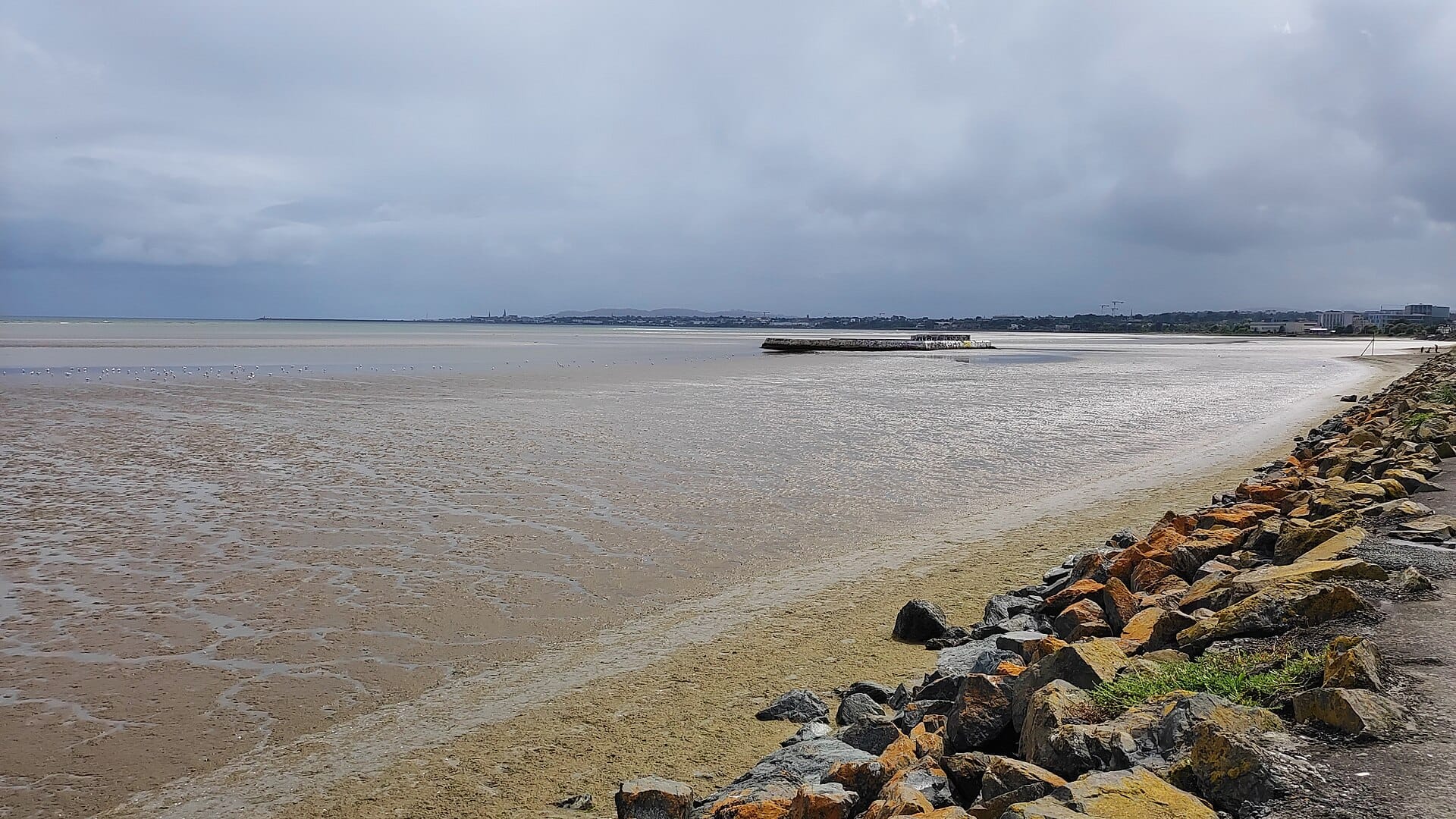
What Sandymount Strand Actually Is
Sandymount Strand is a broad tidal beach on the southern shore of Dublin Bay, running along the coast road between the suburb of Sandymount and Merrion Gates. In Irish it is known as Dumhach Thrá, and as a protected site it lies within the South Dublin Bay and River Tolka Estuary Special Area of Conservation. That last detail matters: this is not a resort beach with cafés and sun loungers. It is a working intertidal zone, a conservation site, and one of the most significant wading-bird habitats on the east coast of Ireland.
The beach forms part of the South Bull, the large sandbank on the south side of Dublin Bay. At low tide, the sea retreats a considerable distance, exposing hundreds of metres of flat, firm sand and mudflat. At high tide, the water comes fully in and the walkable beach largely disappears. Understanding this rhythm is not optional — it determines what kind of visit you get.
⚠️ What to skip
Tide timing is essential. At high tide there is little to no accessible sand. At low tide you can walk far out across the flats — but the tide returns quickly across flat ground. Check tide tables before you plan to walk out any distance. People have been caught by the incoming tide here.
The Promenade: The Reliable Backbone of the Visit
Whatever the tide, Sandymount Promenade gives you something concrete to do. This paved, level walkway runs the length of the strand along the coast road and is genuinely accessible — flat, smooth, and wide enough for prams and wheelchairs. The promenade is what most Dublin residents actually use on a regular basis: a place to walk the dog, clear the head, or simply face the sea for twenty minutes before turning back into the city.
At the northern end of the promenade stands a sculpture called An Cailín Bán, also known as Awaiting the Mariner. It was donated by the Mexican government and created by Mexican sculptor Sebastián, installed in November 2002. The figure faces out toward the bay with a stillness that suits the location. It is easy to miss if you are walking south, so look for it at the Sandymount end as you begin.
The views from the promenade are unobstructed and genuinely impressive in clear weather. Across the bay you can see Howth Head to the north and the outline of the Dublin Mountains to the south. On a clear day the shape of the Wicklow Mountains forms the southern horizon. The twin Poolbeg chimneys — red-and-white striped and iconic on the Dublin skyline — stand directly across the bay and are hard to miss.
Tickets & tours
Hand-picked options from our booking partner. Prices are indicative; availability and final rates are confirmed when you complete your booking.
Giant's Causeway, Dark Hedges, and Belfast Tour from Dublin
From 85 €Instant confirmationFree cancellationDublin self-guided audio tour
From 10 €Instant confirmationBird of Prey, Cliffs of Moher and Aillwee Cave from Dublin
From 201 €Instant confirmationFree cancellationGame of Thrones Studio tour with return transfer from Dublin
From 63 €Instant confirmationFree cancellation
Time of Day: How the Experience Changes
Early morning is the version of Sandymount Strand that regular visitors know best. Between roughly 7am and 9am on weekdays, the promenade belongs mostly to joggers, dog walkers, and the occasional swimmer heading to the tidal pools. The light on Dublin Bay in the morning — particularly in spring and autumn — has a horizontal quality that photographers respond to. The city is quiet enough that you can hear wading birds working the tideline.
By midday on a weekend in summer, the promenade fills with families from the surrounding residential suburbs. The strand itself, if the tide is low, draws children and people paddling at the water's edge. The atmosphere is companionable rather than crowded — this is a local beach serving a local population, not a tourist draw in the traditional sense. That said, there are no food kiosks on the strand itself, so bring your own water and snacks if you plan to stay a while.
Winter visits, especially on clear days between November and February, can be some of the most rewarding. The light is low and golden from mid-afternoon, the strand is quiet, and the birdlife is at its peak. Temperatures on the promenade feel colder than inland due to the sea wind, so dress accordingly. For more on planning a visit to Dublin in cooler months, the
For more on planning a visit to Dublin in cooler months, the Dublin in winter guide covers what to expect across the city.
Historical and Literary Significance
A Martello tower stands on the strand, built around 1804 as part of the coastal defence network constructed against the threat of Napoleonic invasion. These squat, thick-walled round towers were erected at intervals along the Irish coast and this one is among the better-preserved examples in the Dublin Bay area. It is not open to visitors, but it reads clearly as a marker of the era when this stretch of shore was a military frontier rather than a suburban amenity.
Sandymount has deeper literary significance through James Joyce, who set a key episode of Ulysses on this strand. The Proteus episode, the third chapter, takes place here: Stephen Dedalus walks across the sand at low tide, philosophising about perception, time, and the material world. The passage includes some of the densest and most celebrated prose in the novel. For visitors interested in tracing Joyce's Dublin, Sandymount Strand is one of the few locations in Ulysses where the setting is both specific and physically unchanged in character.
The Dublin literary trail places Sandymount in a broader itinerary of Joyce and Beckett locations across the city.
The strand also has a modest bathing history. Sandymount swimming baths, measuring approximately 40 by 40 metres, were built in 1883, with a 75-metre pier added the following year in 1884. The baths are long gone, but the tidal pools at the southern end of the promenade still attract sea swimmers year-round, particularly hardy regulars who treat the cold water as a daily ritual rather than a seasonal event.
Wildlife and Conservation
The formal designation of Sandymount Strand/Tolka Estuary as a Special Area of Conservation reflects its genuine ecological importance. The intertidal mudflats support large populations of invertebrates, which in turn sustain significant numbers of migratory and overwintering wading birds. Dunlin, knot, oystercatcher, and bar-tailed godwit are among the species regularly recorded here. During autumn and winter migration periods, the numbers can be substantial enough that birdwatchers come specifically to count and photograph them from the promenade.
This is one practical reason why drone flights are often discouraged on Sandymount Strand. Conservation and safety regulations may restrict drone use here, so photographers should note this before arriving with aerial equipment. Conventional photography from the promenade is unrestricted and the long sightlines across the bay make it well-suited to telephoto work on the bird populations.
Getting There and Practical Logistics
The DART coastal rail line stops at Sandymount station, which is a short walk from the promenade. This is the simplest way to arrive from the city centre or from the southern suburbs. Dublin Bus routes serving Sandymount and the Merrion Road also run frequently from the city. There is no dedicated transport to the strand itself — it is simply a matter of reaching the neighbourhood and walking to the coast road.
Driving is possible and there is some on-street parking along the coast road, but it fills quickly on sunny weekend afternoons. The DART is the better option for a stress-free arrival. The strand is approximately 4 km from Dublin city centre and is reachable by bicycle via relatively flat coastal routes.
For a broader overview of moving around Dublin, see the getting around Dublin guide, which covers DART routes, Dublin Bus, and cycling infrastructure.
💡 Local tip
Wear shoes you do not mind getting muddy or wet if you plan to walk on the sand. The surface near the waterline is firm wet sand and mud, not the dry beach texture you might expect. Good trainers or walking shoes are fine; formal footwear is not.
The promenade is wheelchair and pram accessible along its full length. The sand and tidal flats are not. For visitors with limited mobility, the promenade walk itself provides full access to the views, the sculpture, and the bay — nothing essential is lost by staying on the paved path.
Who Should Manage Their Expectations
If you are travelling to Dublin specifically for beaches and want warm water, soft sand, and seaside amenities, Sandymount Strand will disappoint. The water is cold year-round, the sand is tidal and intermittent, and there are no beach bars or hire facilities of any kind. Visitors expecting a Mediterranean experience will find it underwhelming.
Similarly, those who arrive at high tide expecting a long walk across the flats will find very little strand to walk on. The tidal nature of the beach is not a minor detail — it fundamentally shapes what the place is and what it offers on any given visit. Plan around the tide rather than ignoring it.
If a more structured beach experience is what you are after, the Dublin beaches guide covers the full range of options around the bay, including Dollymount Strand and the Dún Laoghaire shoreline.
Insider Tips
- Check tide tables before you go — the difference between low and high tide completely changes what you can do on the strand. The Met Éireann website and various tide apps list Dublin Bay times accurately.
- The best birdwatching is in the two hours around low tide in autumn and winter. Position yourself on the promenade looking south toward Merrion and you will typically see the largest concentrations of waders working the exposed mudflats.
- The Poolbeg chimneys across the bay are most dramatically lit in the thirty minutes before sunset on clear evenings. The view from the mid-promenade looking north-east is one of the better vantage points in Dublin for this shot — without the crowds you would find at Poolbeg itself.
- If the tide is fully out, walk south along the strand toward Merrion Gates rather than staying near Sandymount village. The southern stretch is quieter, the views are wider, and you are further from the road noise.
- Sea swimmers use the tidal pools near the southern end of the promenade year-round. If you want to join them, early morning is when the regular community is out — and the water temperature in December is around 9–10°C, so come prepared.
Who Is Sandymount Strand For?
- Joggers and walkers looking for a flat seafront route close to the city
- Birdwatchers targeting migratory waders in autumn and winter
- James Joyce readers who want to stand on the actual ground where the Proteus episode of Ulysses is set
- Families with young children wanting a free, open space close to Dublin 4 with no entry fee or crowd pressure
- Photographers after low-light coastal shots with the Poolbeg chimneys and Dublin Mountains as backdrops
Nearby Attractions
Combine your visit with:
- Abbey Theatre
Founded in 1904 by W.B. Yeats and Lady Gregory, the Abbey Theatre is Ireland's National Theatre and one of the most historically significant stages in the English-speaking world. Sitting on Lower Abbey Street in the heart of Dublin city centre, it continues to produce new Irish work alongside classic plays that shaped a nation's identity.
- Blessington Street Basin
Once the Royal George Reservoir supplying water to Dublin's north side, Blessington Street Basin is now a free public park in Phibsborough. The central lake, Tudor gate lodge, and resident wildfowl make it one of the most quietly rewarding green spaces within walking distance of Dublin city centre.
- Casino Marino
Casino Marino is an 18th-century Neo-Classical pleasure house in north Dublin, designed by Sir William Chambers for the Earl of Charlemont. Despite its compact exterior, the building conceals 16 rooms across three floors — a feat of architectural illusion that continues to astonish visitors. Access is by guided tour only, with admission from €3 for children and students and €5 for adults.
- Clontarf Promenade
Clontarf Promenade stretches 4.5 kilometres along Dublin Bay from Fairview to the Bull Wall at Dollymount, offering open sea views, public art, and a marked cycle route along much of its length. It costs nothing to visit, runs along a flat sea wall path, and delivers some of the most expansive coastal scenery accessible from Dublin city centre.