Patpong Night Market: Bangkok's Most Notorious After-Dark Bazaar
Patpong Night Market transforms a narrow strip in Silom into a wall-to-wall souvenir market every evening. Flanked by neon-lit go-go bars and Thai street food stalls, it's one of Bangkok's most layered and genuinely unusual night-out experiences.
Quick Facts
- Location
- Patpong 1 & 2 Roads, Silom, Bang Rak, Bangkok
- Getting There
- BTS Sala Daeng (Exit 1) or MRT Si Lom (Exit 2) – 5 min walk
- Time Needed
- 1–2 hours
- Cost
- Free to enter; souvenirs from 50–300 THB; budget 100–300 THB for street food
- Best for
- Souvenir shopping, street food grazing, curious first-time visitors to Bangkok
What Patpong Night Market Actually Is
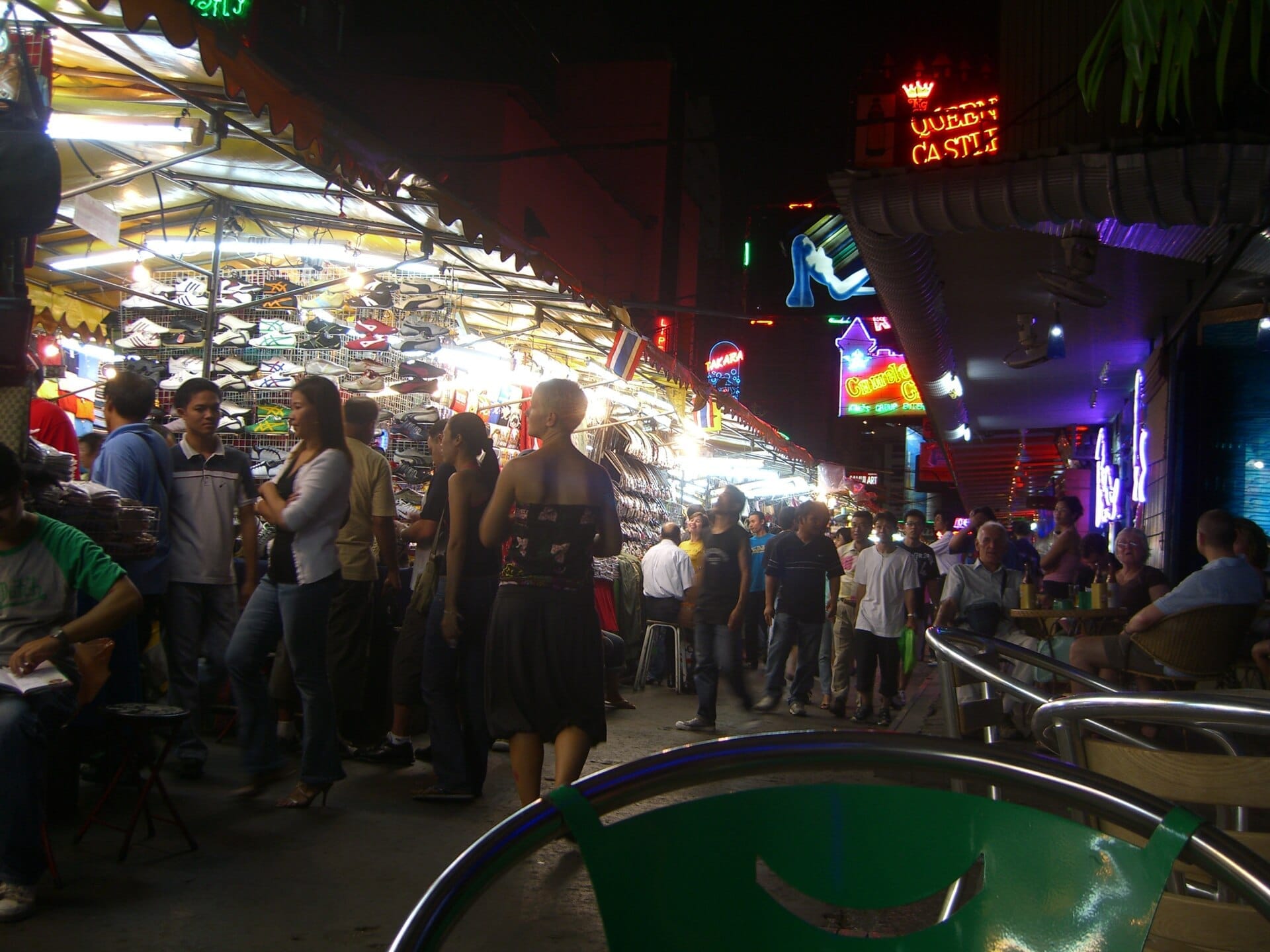
Patpong Night Market occupies a pedestrianised lane running between Patpong 1 and Patpong 2 Roads in the Silom district. Every night from roughly 6pm onward, vendors set up parallel rows of stalls selling the standard Bangkok souvenir repertoire: Chang beer singlets, elephant-print trousers, carved wooden elephants, novelty keychains, fake designer watches, and silk scarves. It is loud, compressed, and entirely unapologetic about what it is.
What makes Patpong different from other Bangkok night markets is its context. The stalls sit between two streets with an open-secret after-dark entertainment industry on either side. Go-go bars occupy the ground floors of buildings along Patpong 1 and 2, their neon signs competing with market lighting. Touts stand at entrances and will approach you regardless of whether you show any interest. This is not a curated cultural experience. It is a genuinely unfiltered slice of a particular chapter in Bangkok's urban history, and understanding that context makes the visit far more interesting.
ℹ️ Good to know
Patpong Night Market is free to enter and open every evening. There are no admission gates or formal boundaries. The stalls are independently operated, so quality and prices vary stall to stall.
A Brief History of the Patpong District
The two Patpong roads are named after Uthum Patpongpanich, a Sino-Thai businessman who purchased the land in 1946. His family developed it commercially over subsequent decades. During the Vietnam War era in the 1960s and 1970s, Patpong became a significant R&R destination for US military personnel stationed in Southeast Asia, and the entertainment industry that grew around that demand became deeply embedded in the area's identity.
The night market itself emerged in the 1980s as vendors began operating stalls in the lane between the two roads. Over time it became a tourist fixture, drawing visitors who might not otherwise venture into that part of the city. The market has evolved into a relatively safe, well-lit public space, even as the surrounding establishments have remained largely unchanged. Walking through Patpong today means occupying a space that is simultaneously a tourist souvenir stop and a living document of Bangkok's mid-20th century urban development.
Tickets & tours
Hand-picked options from our booking partner. Prices are indicative; availability and final rates are confirmed when you complete your booking.
Bangkok tuk-tuk night tour with Chinatown street food meal
From 28 €Instant confirmationFree cancellationBangkok by night bike ride and dinner at a local restaurant
From 32 €Instant confirmationFree cancellationGuided e-scooter night tour with local street food
From 33 €Instant confirmationFree cancellationChao Phraya River longtail boat cruise with night city views
From 40 €Instant confirmationFree cancellation
What the Market Looks and Feels Like
The stalls form two tight rows down the central lane, leaving just enough space for two people to pass side by side comfortably. Overhead, bare bulbs and fluorescent strip lights cast everything in a warm yellow-white glow. The smell changes as you move: frying garlic and chilli from a food cart, incense drifting from a small spirit house at one end, cigarette smoke near the bar entrances on either side. The combined noise is considerable: vendor calls, music leaking from open bar doors, tuk-tuks idling on the road beyond.
Merchandise quality ranges considerably. Some stalls carry well-made cotton goods and silk items at reasonable prices. Others sell tourist-grade trinkets that will not survive the journey home. Counterfeit watches and bags are openly displayed at certain stalls, which is worth knowing if you are concerned about inadvertently purchasing counterfeits. Prices are never fixed. Bargaining is expected, and starting at roughly 50 to 60 percent of the first quoted price is a reasonable opening position for most items.
💡 Local tip
The best genuinely useful souvenirs here are cotton Thai script t-shirts, linen elephant trousers, and silk accessories. These are available across Bangkok but prices at Patpong are competitive if you are willing to negotiate.
How It Changes Through the Evening
Arriving at 6pm gives you the quietest version of Patpong. Vendors are still arranging their stalls, the bar touts are not yet at full volume, and you can move through the lane without being pressed from both sides. The light is still partially natural, mixing with the market lamps in a way that makes photography considerably easier. This is the best window for anyone who wants to browse seriously without distraction.
By 8pm the market is at full density. Office workers from the nearby Silom financial district pass through on their way home, tourists navigate the lane with phones raised, and the surrounding bars are generating consistent pedestrian traffic. This is the hour when the market feels most alive but also most chaotic. Navigating it requires patience.
After 10pm the souvenir vendors begin to pack down, but the bar strip stays active considerably later. If your interest is primarily the market rather than the surrounding entertainment, arriving before 9:30pm ensures you see stalls fully operational. Late arrivals will find gaps where stalls once stood.
Eating and Drinking Around Patpong
Several food carts operate at the market's edges, selling pad thai, grilled skewers, fresh mango with sticky rice, and fried tofu. These are perfectly adequate, but the better street food in this part of the city is found a short walk away. The Silom Road itself has a string of affordable Thai restaurants that are popular with locals working in the area. For a more substantial meal before or after the market, Silom Soi 20 has several unpretentious Thai restaurants with English menus.
If you want to pair the Patpong visit with a broader evening exploration of the area, Silom has a much larger food and nightlife scene extending south toward Lumphini Park and east toward Sala Daeng. The neighbourhood rewards exploration on foot, particularly along the smaller sois running off the main road.
Getting There and Getting Around
The most straightforward approach is via BTS Sala Daeng station (Exit 1), which deposits you on Silom Road roughly a 5-minute walk from the Patpong entrance. Alternatively, MRT Si Lom station (Exit 2) is similarly close. Both lines intersect nearby, making Patpong one of the more transit-accessible markets in Bangkok.
Arriving by taxi during evening hours is less reliable due to congestion on Silom Road. Tuk-tuks from further afield are not recommended for this destination as drivers frequently use the trip to propose commission-based detours. The BTS or MRT is faster and more predictable on any evening of the week.
Patpong sits within easy walking distance of several of Bangkok's more significant cultural sites. Lumphini Park is roughly 10 minutes north on foot, making it a reasonable pairing if you want to balance a daytime green-space visit with an evening market stop.
Who Should Think Twice
Patpong Night Market is not the best Bangkok market for atmosphere, food variety, or product quality. If those are your priorities, the options are much stronger elsewhere. Families with young children will find the surrounding environment uncomfortable in the later evening hours given the bar touts and adult entertainment signage on both sides of the lane. Visitors who are easily overwhelmed by high-density crowds, persistent vendor attention, or loud noise may find the experience exhausting rather than enjoyable.
For a more relaxed and considerably more varied shopping experience, Chatuchak Weekend Market offers far greater scale, craft variety, and a more comfortable browsing environment. And for markets with more authentic street food depth, Chinatown's street food scene along Yaowarat Road is a worthwhile comparison.
⚠️ What to skip
Be aware of common scams: individuals outside the market who offer to take you to a 'special sale' elsewhere are running a commission scheme. Likewise, men with ping pong show sign boards quoting low entry prices will add undisclosed charges inside. Neither is recommended.
Photography and Practical Notes
The market's mixed lighting conditions, combining fluorescent strips, neon signage, and ambient streetlight, produce photographs that look much better with a phone set to auto or night mode rather than flash. The most photogenic stretch is the central lane looking toward the illuminated bar signs beyond, best captured between 7pm and 8pm when the light has a layered quality. Vendors generally do not mind being photographed if you have bought something or ask politely.
Wear closed shoes rather than sandals. The lane surface is uneven and can become slippery in wet weather. A small bag rather than a large backpack makes navigating the compressed stalls considerably easier. The area is well-lit and generally safe for solo travellers, but keep your phone and wallet in a front pocket given the crowd density at peak hours.
If your Bangkok itinerary includes the broader Silom area, the Silom Road strip itself offers a useful orientation walk that connects several of the district's distinct zones. For a complete picture of what Bangkok's night markets offer across different neighbourhoods, the best markets in Bangkok guide is a useful planning reference.
Insider Tips
- Arrive between 6pm and 7pm for the least crowded browsing experience and better photography light. Stalls are fully set up but the peak tourist flow hasn't yet arrived.
- The stalls nearest the Silom Road entrance tend to have slightly better quality cotton goods than those deeper in the lane, likely because they see more passing foot traffic and price competitively.
- If a vendor quotes a price and you walk away without serious interest, they will frequently call you back at a lower number before you have taken three steps. This is normal negotiation behaviour, not personal.
- There is a small convenience store at the Silom Road end of the market that is useful for picking up cold water or snacks before you browse, particularly on humid evenings.
- Silom Soi 4, just a short walk from Patpong, has a very different character in the evenings with an openly LGBTQ-friendly bar and restaurant scene that is low-key and welcoming.
Who Is Patpong Night Market For?
- First-time visitors to Bangkok who want to see one of the city's most talked-about night spots without committing significant time
- Souvenir shoppers who enjoy bargaining and are happy with mainstream tourist goods
- Travellers interested in Bangkok's modern urban history and the layered social geography of Silom
- Evening walkers using the market as a prelude to dinner in the Silom restaurant district
- Photographers interested in neon-lit street scenes and the visual density of a Thai night market
Nearby Attractions
Other things to see while in Silom:
- Bangkok Snake Farm
The Bangkok Snake Farm, officially the Queen Saovabha Memorial Institute, is one of the oldest snake farms in the world and a functioning antivenom research center run by the Thai Red Cross. It offers up-close encounters with venomous species alongside educational shows and a small natural history museum, making it a genuinely unusual stop in the Silom district.
- Dusit Central Park
Dusit Central Park is a landmark mixed-use development in the heart of Silom that combines a publicly accessible rooftop green space, upscale dining, a redesigned Dusit Thani Hotel, and curated retail. It occupies one of Bangkok's most historically significant corners and offers a different kind of urban experience from the city's older malls and markets.
- King Power Mahanakhon Skywalk
The King Power Mahanakhon Skywalk is Bangkok's tallest observation point, perched atop the city's most recognizable tower. A glass-floor platform, an open-air rooftop, and sweeping 360-degree views make it the benchmark sky experience in the Thai capital — if you're prepared for the price.
- Lumphini Park
Lumphini Park is Bangkok's most significant public green space, a 142-acre urban park where early-morning tai chi sessions, rowing boats, and metre-long monitor lizards coexist within walking distance of Silom's office towers. The experience changes dramatically depending on the hour you arrive.