Silom Road: Bangkok's Business District That Comes Alive After Dark
Silom Road runs through the heart of Bangkok's financial district, lined with banks, embassies, and office towers during the day. Come evening, the sidewalks fill with food stalls, night markets, and one of the city's most famous entertainment streets. It rewards visitors who stay long enough to see both sides.
Quick Facts
- Location
- Silom, Bang Rak District, Bangkok
- Getting There
- BTS Sala Daeng (Silom Line) or MRT Si Lom Station
- Time Needed
- 2–4 hours, or a full evening for food and nightlife
- Cost
- Free to walk; food from 40–150 THB per dish; Patpong varies
- Best for
- Street food, people-watching, nightlife, and city atmosphere
What Silom Road Actually Is
Silom Road stretches roughly 3 kilometres through Bang Rak District, connecting Charoen Krung Road near the Chao Phraya River at its western end to the Rama IV Road intersection at the east. It is the closest thing Bangkok has to a traditional central business district, home to the Stock Exchange of Thailand's original site, major bank headquarters, foreign consulates, and towers of glass and concrete built during the economic booms of the 1980s and 1990s.
But Silom Road is not simply an office corridor. Compressed into the same stretch of asphalt is some of the city's most accessible street food, a famous night market with a complicated reputation, a significant LGBTQ+ entertainment district, and quieter sois lined with old shophouses that recall what this neighbourhood looked like before the high-rises arrived. The contrast between rush-hour Bangkok and post-sunset Silom is sharper here than almost anywhere else in the city.
ℹ️ Good to know
Silom Road is best understood as two different experiences: a corporate daytime artery and a social evening destination. If you only visit at one time of day, you are seeing half the picture.
Daytime Silom: Finance, Architecture, and Hidden Calm
Between roughly 8am and 6pm, Silom Road moves fast. The pavements carry streams of office workers, couriers on motorbikes weave between taxis and buses, and the air near the main road carries exhaust and the faint sweetness of jasmine garlands sold at spirit shrines on almost every corner. The scale of the street is imposing: wide lanes, elevated expressway ramps visible in the distance, and office towers that block the morning sun for much of the lower footpath.
Architecturally, Silom is a patchwork. The Silom Complex and Silom Village trade centres represent the commercial Bangkok of the 1970s. Further east, the glass curtain walls of more recent towers reflect the sky. Between them, surviving two- and three-storey shophouses in faded cream and ochre still house tailors, small restaurants, and convenience stores. These gaps in the skyline are worth pausing at: they show how the neighbourhood grew incrementally rather than being planned as a whole.
If you are walking Silom in the afternoon, the sois running south toward the river offer relief from traffic. Soi Convent, for example, leads to a cluster of long-established restaurants popular with office workers, and the streets around it have a quieter, almost residential feel despite being two minutes from the main road. This is also the area to find the Sri Mariamman Temple (Wat Khaek), a South Indian Hindu temple founded in 1870 that sits incongruously between office blocks and is open to respectful visitors at no charge.
Tickets & tours
Hand-picked options from our booking partner. Prices are indicative; availability and final rates are confirmed when you complete your booking.
Silom Thai Cooking with Market Tour
From 48 €Instant confirmationFree cancellationTemples of Bangkok and Grand Palace half-day guided tour
From 18 €Instant confirmationFree cancellationDamnoen Saduak floating market and Maeklong railway guided tour
From 36 €Instant confirmationFree cancellationBangkok tuk-tuk night tour with Chinatown street food meal
From 28 €Instant confirmationFree cancellation
The Erawan Shrine and the Surrounding Spiritual Landscape
Bangkok's street-level spiritual life is unusually visible along Silom. Small shrines occupy pavement corners, office building forecourts, and the base of elevated walkways. Workers pause briefly before them in the morning, leaving offerings of lotus buds, incense, and coloured soft drinks before continuing to their desks. This is not performance for tourists; it is routine.
The most significant place of worship within easy reach of Silom Road sits further north at the Ratchaprasong intersection: the Erawan Shrine, a Brahmin shrine to the four-faced deity Thao Maha Brahma that draws worshippers and curious visitors in equal numbers. It is worth a detour if you have not seen it, though it sits outside the Silom area proper.
Evening Silom: Street Food, Patpong, and Soi 4
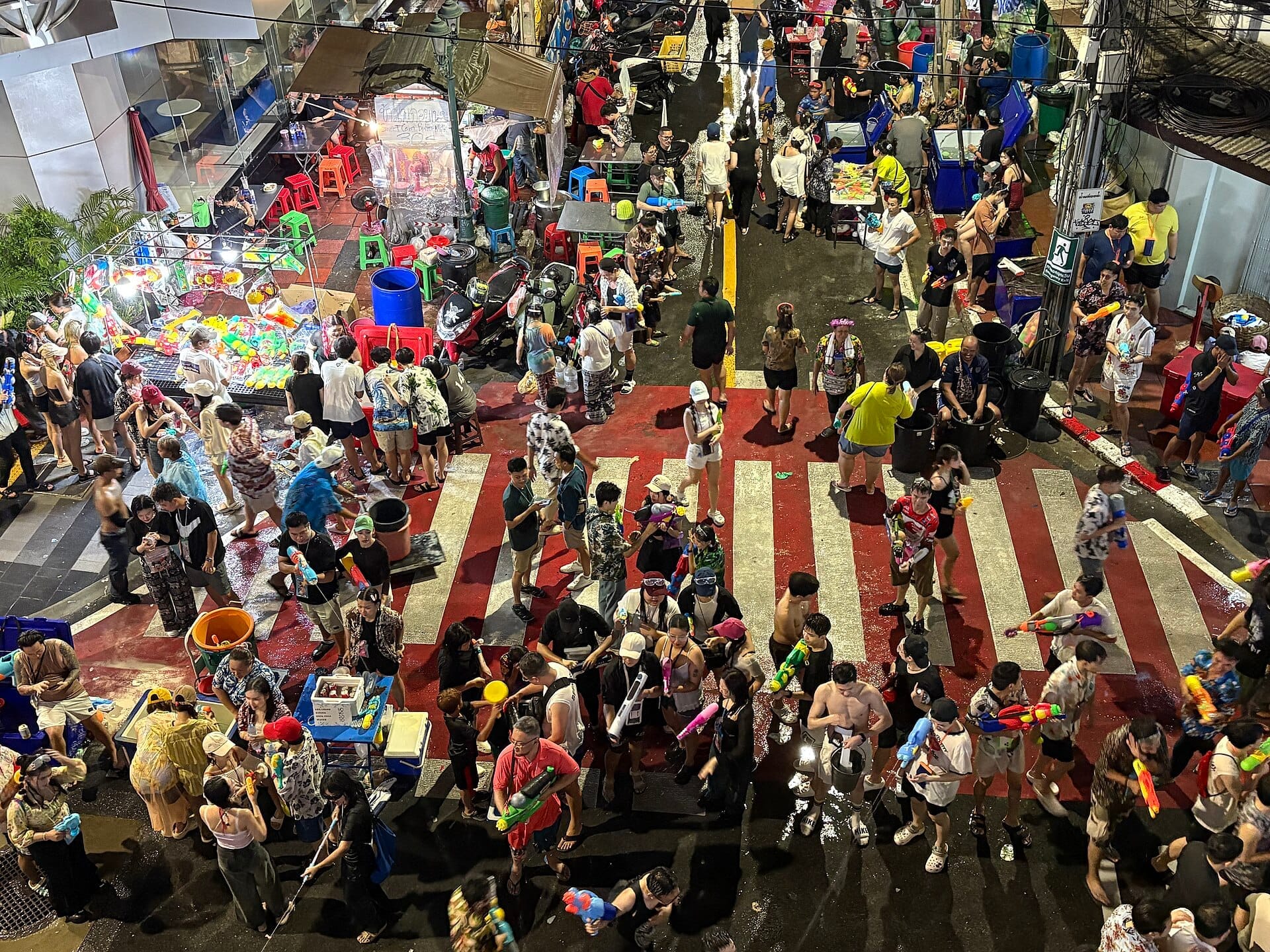
From around 5:30pm onward, the nature of Silom Road shifts noticeably. The office crowds thin, food cart vendors who have been setting up since mid-afternoon open for business, and the footpaths near the BTS station become genuinely difficult to navigate quickly. The smells change too: charcoal smoke from satay grills, the sharpness of fresh-cut green papaya from som tam stalls, and the steam rising from pots of boat noodle soup.
The stretch between BTS Sala Daeng and Surasak offers the densest concentration of evening street food. Grilled pork skewers (moo ping), pad krapao cooked to order over high heat, and mango sticky rice sold from baskets are among the staples. For a more curated market experience, the Patpong Night Market occupies the covered lane between Patpong Soi 1 and Soi 2, running most evenings from around 6pm to midnight. The market sells clothes, souvenirs, and tourist goods of varying quality.
Patpong itself is one of Bangkok's most historically significant entertainment districts. It was established in the 1960s and expanded rapidly during the Vietnam War era when American servicemen on rest and recreation leaves made it internationally notorious. Today it operates mainly as a tourist attraction with go-go bars, live music venues, and the street market running down its centre. Visitors should be clear-eyed about what Patpong is: it is not rough or dangerous as a rule, but it is unapologetically commercial, and the 'upstairs shows' advertised via laminated menus typically involve aggressive upselling. Knowing this in advance removes most of the confusion.
Silom Soi 4 (often written simply as Soi 4) is the centre of Bangkok's LGBTQ+ nightlife scene and has a notably different atmosphere from Patpong. The bars and small clubs along Soi 4 are generally welcoming, the clientele is mixed, and the street has a more relaxed energy. Weekend nights draw large crowds who spill out onto the pavement, and the street becomes effectively pedestrian by 10pm.
⚠️ What to skip
Tuk-tuk drivers near Patpong frequently offer 'free' city tours that route through gem shops and tailor stores paying commission. Politely decline and use the BTS or metered taxis instead.
Getting There and Getting Around
The BTS Sala Daeng station sits directly above the eastern end of Silom Road and is the most convenient entry point for most visitors. MRT Si Lom Station is at the same intersection and connects to the underground network, making it easy to link Silom with Lumphini Park, Hua Lamphong, and Chinatown without surface traffic. Both stations have step-free access via lifts.
The western end of Silom Road, closest to Charoen Krung Road, is accessible by river taxi from the Sathorn Pier (Central Pier), which also serves as the main gateway to Thonburi and Wat Arun. The Chao Phraya Express Boat stops at Sathorn on its central route, making it possible to arrive by river from as far north as Nonthaburi or as far south as Wat Rajsingkorn.
Walking the full length of Silom Road takes approximately 30 minutes at a leisurely pace without stops. In the heat of the day, the elevated walkways connecting BTS stations offer shade and a useful aerial perspective on the neighbourhood's layout. Comfortable footwear matters: the pavements are uneven in places, and the sois running off the main road often involve steps, raised kerbs, and surfaces interrupted by street food equipment.
Photography, Timing, and What to Bring
Early morning, before 8am, offers the clearest light and emptiest streets for photography. The shophouses near the western end photograph well in the golden hour: their faded facades and ground-floor activity reflect a Bangkok that is incrementally disappearing. By 9am the pavements are filling and the shadows from overhead infrastructure complicate compositions on the main road.
Evening photography around the street food stalls and the Patpong market is approachable without specialist equipment. The warm artificial light from food cart lamps creates naturally flattering conditions. Ask before photographing vendors at close range; most are fine with it but appreciate the courtesy.
If you are visiting Silom as part of a broader Bangkok itinerary, consider combining it with Lumphini Park in the morning (a five-minute walk from MRT Si Lom) and the evening food scene afterward. The park offers a genuine contrast to the office district that surrounds it.
💡 Local tip
Wear light, breathable clothing year-round. The reflective glass towers on Silom make the street noticeably hotter than side streets during the afternoon. A reusable water bottle is essential from March through May.
Who Should Skip Silom Road
Silom Road is not the right choice if you are looking for Bangkok's historical or temple district. The Rattanakosin area, home to the Grand Palace and Wat Pho, is the place for that, and the two neighbourhoods are not easily combined on foot. Silom also has limited appeal as a daytime destination for travellers who are not interested in architecture or urban observation: without the evening food culture and nightlife, the street is primarily a functional commercial road.
Travellers seeking the classic Bangkok market experience will find Chatuchak or the markets along Yaowarat more rewarding than Patpong's tourist-oriented stalls. For a sense of what Bangkok's street food culture looks like in a less tourist-dense context, the Chinatown street food scene on Yaowarat Road offers a more local atmosphere.
Families with young children can walk Silom comfortably during the day, but the evening strip around Patpong is not designed for mixed-age groups. The Soi 4 nightlife area is adult-oriented by nature. There is nothing threatening about either area for adults, but the entertainment focus becomes unambiguous after 9pm.
Insider Tips
- The elevated walkway connecting BTS Sala Daeng to Chong Nonsi passes directly above Silom Road and gives a useful bird's-eye view of how the neighbourhood is laid out, including the scale of the expressway interchange that dominates the western skyline. Walk it before descending to street level.
- The Sri Mariamman Temple on Silom Soi 14 is free to enter and almost entirely overlooked by guidebooks. Friday afternoons see the most active worship, with flower vendors outside and incense filling the interior courtyard.
- If you are eating at the street food stalls near Sala Daeng in the evening, arrive before 7pm. The most popular vendors, particularly the satay and boat noodle sellers, sell out or begin packing up by 8:30pm on weekdays.
- Metered taxis on Silom Road during evening peak hours (6–8pm) can be frustrating due to traffic. The MRT to MRT Sam Yan or BTS to the next station is almost always faster than road transport during this window.
- Silom Soi 20 and the lanes around it contain several old-school Thai lunch restaurants that have served the same office clientele for decades, with handwritten menus in Thai only. Pointing at dishes on other tables works perfectly well and the food quality is consistently high at very low prices.
Who Is Silom Road For?
- Urban explorers interested in Bangkok's commercial and architectural evolution
- Solo travellers and couples looking for a self-guided evening food and nightlife itinerary
- LGBTQ+ visitors, particularly around Soi 4 and the surrounding venues
- First-time Bangkok visitors wanting to understand the city's modern business centre
- Photographers interested in the contrast between corporate Bangkok and street-level daily life
Nearby Attractions
Other things to see while in Silom:
- Bangkok Snake Farm
The Bangkok Snake Farm, officially the Queen Saovabha Memorial Institute, is one of the oldest snake farms in the world and a functioning antivenom research center run by the Thai Red Cross. It offers up-close encounters with venomous species alongside educational shows and a small natural history museum, making it a genuinely unusual stop in the Silom district.
- Dusit Central Park
Dusit Central Park is a landmark mixed-use development in the heart of Silom that combines a publicly accessible rooftop green space, upscale dining, a redesigned Dusit Thani Hotel, and curated retail. It occupies one of Bangkok's most historically significant corners and offers a different kind of urban experience from the city's older malls and markets.
- King Power Mahanakhon Skywalk
The King Power Mahanakhon Skywalk is Bangkok's tallest observation point, perched atop the city's most recognizable tower. A glass-floor platform, an open-air rooftop, and sweeping 360-degree views make it the benchmark sky experience in the Thai capital — if you're prepared for the price.
- Lumphini Park
Lumphini Park is Bangkok's most significant public green space, a 142-acre urban park where early-morning tai chi sessions, rowing boats, and metre-long monitor lizards coexist within walking distance of Silom's office towers. The experience changes dramatically depending on the hour you arrive.