Bangkok Snake Farm (Queen Saovabha Memorial Institute): What to Expect Before You Go
The Bangkok Snake Farm, officially the Queen Saovabha Memorial Institute, is one of the oldest snake farms in the world and a functioning antivenom research center run by the Thai Red Cross. It offers up-close encounters with venomous species alongside educational shows and a small natural history museum, making it a genuinely unusual stop in the Silom district.
Quick Facts
- Location
- 1871 Rama IV Road, Pathum Wan, Bangkok (Silom/Lumphini area)
- Getting There
- BTS Sala Daeng (Exit 2) or MRT Silom (Exit 2) — 5-minute walk
- Time Needed
- 1 to 2 hours
- Cost
- Adults 250 THB, children 100 THB (subject to change; verify on-site)
- Best for
- Curious travelers, families with older children, wildlife enthusiasts
What the Bangkok Snake Farm Actually Is
The Bangkok Snake Farm is not a commercial attraction that happened to acquire snakes. It is a working scientific institution. Established in 1923 by the Thai Red Cross Society, the Queen Saovabha Memorial Institute was created with one primary mission: producing antivenom for snakebite victims across Southeast Asia. The snake exhibits, the live shows, and the visitor program exist alongside a fully operational venom extraction laboratory and medical research division.
That dual identity is what makes this place unlike any zoo or reptile house you have visited. The cobras, king cobras, kraits, and vipers on display here are not just specimens. They are actively contributing to a public health effort. Signs throughout the facility explain the medical science behind venom extraction and antiserum production with surprising clarity, and the staff are knowledgeable in a way that reflects genuine expertise rather than rehearsed showmanship.
ℹ️ Good to know
Opening hours: Monday-Friday 8:30am-4:30pm (ticket sales end 4pm), Sat-Sun & holidays 8:30am-12:30pm. Snake shows at 10:30 AM and 2:00 PM weekdays, 10:30 AM weekends/holidays. Confirm the schedule when you arrive, as it can shift.
The Exhibits: What You Will Actually See
The compound is compact, covering perhaps the area of two city blocks. A series of open-air and glass-fronted enclosures house Thailand's most medically significant snake species: the monocled cobra, the banded krait, the Malayan pit viper, the green pit viper, and the reticulated python among others. Labels provide both common names and scientific nomenclature, along with venom toxicity information and geographic range. This is not a collection of tropical novelties. Every species here has a documented record of causing human fatalities or serious injury in Thailand.
A small indoor museum covers the history of the institute, the biochemistry of snake venom, and first-aid protocols for bites. The displays are slightly dated in their design, but the content is accurate and genuinely useful. For travelers heading into rural areas of Thailand, the section on bite treatment and the map of venomous species by region carries practical weight beyond mere curiosity.
The larger pythons and non-venomous constrictors are typically housed in a separate section closer to the entrance. These are the snakes available for photographs, and handlers will drape them around willing visitors for a fee paid directly on-site. The experience is calm and well-managed: the animals appear healthy and are handled with practiced routines that keep both snake and visitor comfortable.
Tickets & tours
Hand-picked options from our booking partner. Prices are indicative; availability and final rates are confirmed when you complete your booking.
Bangkok Floating Market and Orchid Farm Tour with Boat Ride
From 60 €Instant confirmationFree cancellationTemples of Bangkok and Grand Palace half-day guided tour
From 18 €Instant confirmationFree cancellationBangkok tuk-tuk night tour with Chinatown street food meal
From 28 €Instant confirmationFree cancellationAfternoon Tea at Hyatt Regency Hotel Bangkok
From 900 €Instant confirmationFree cancellation
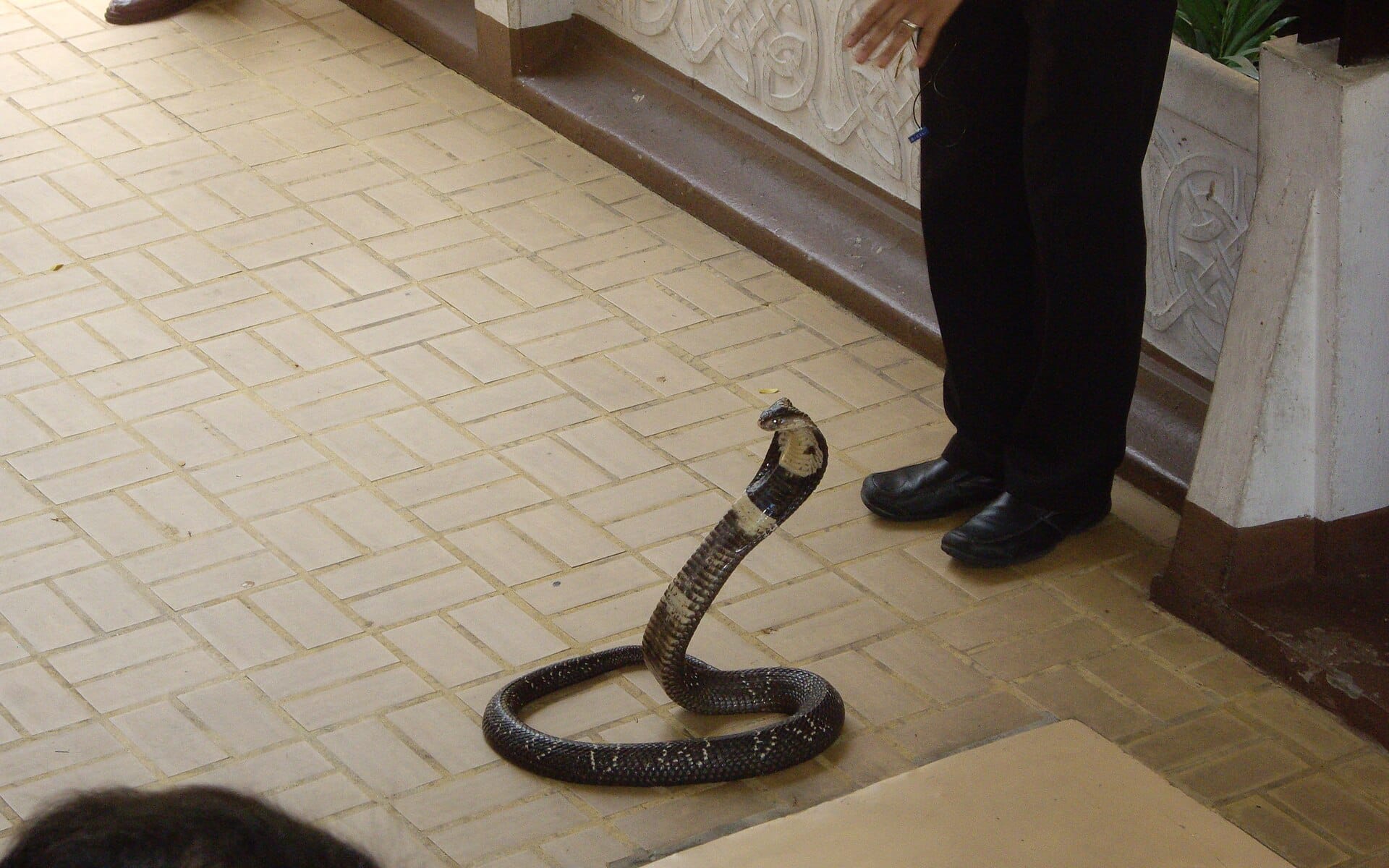
The Live Show: Controlled Drama, Not Theater
The highlight for most visitors is the live snake handling demonstration. A trained handler enters a large open arena, extracts venomous cobras from containers, and demonstrates behaviors including hood spreading, defensive strikes, and venom extraction into a glass vessel. The narration runs in Thai with an English translation provided separately by another staff member, so visitors who arrive early and position near the English-speaking guide get considerably more from the experience.
This is not a circus performance designed to manufacture artificial danger. The handlers are clearly experienced, and the protocols are structured to minimize risk, both to staff and snakes. What the show conveys effectively is how little margin for error exists when working with these animals daily, which gives the antivenom research mission a visceral kind of context that a museum display cannot replicate.
💡 Local tip
Arrive 10 to 15 minutes before the show starts to claim a spot with a clear sightline and proximity to the English narrator. Latecomers often end up at the back of a standing crowd in direct sun.
Time of Day and Crowd Patterns
Weekday mornings are the quietest window. The 11:00 AM show on a Tuesday or Wednesday will draw a mixed crowd of tourists and school groups, but the overall numbers remain manageable. The venue itself is small enough that even a moderate crowd can feel congested around the main arena during showtime.
Weekend visits compress the schedule into the morning hours, which concentrates visitor traffic. If you are going on a Saturday or Sunday, aim to arrive at opening rather than trying to time your arrival around the single 11:00 AM show. This gives you time to walk the enclosures at your own pace before the crowd assembles for the demonstration.
The outdoor sections of the farm get direct sun through most of the day, and Bangkok's heat between 11:00 AM and 2:00 PM is considerable. Wearing light clothing and bringing water is practical advice, not optional. There is limited shade between enclosures, and the arena seating for the show has partial cover but is not air-conditioned.
How the Snake Farm Fits Into the Silom Area
The Queen Saovabha Memorial Institute sits on Rama IV Road, a major arterial road that separates the Silom commercial district from the Lumphini area. This positioning makes it straightforward to combine with other visits in the same part of the city. Lumphini Park is a short walk north and offers a complete change of pace with shaded green space, a lake, and its own population of monitor lizards in a less structured setting. The Silom neighborhood itself, known primarily for its office towers and the Patpong Night Market, surrounds the institute with everyday Bangkok urban texture that gives the visit a grounding sense of place beyond the attraction itself.
For travelers interested in exploring more of Bangkok's religious and cultural landmarks, the broader area around Silom and adjacent neighborhoods holds a concentration of significant sites. The Wat Hua Lamphong is close by, and the best temples in Bangkok are accessible via the same BTS and MRT lines that serve Sala Daeng and Si Lom stations.
Honest Assessment: Is It Worth Your Time?
For travelers with a genuine interest in wildlife, herpetology, or Southeast Asian public health history, the Snake Farm is a substantive and undervisited attraction. The combination of live animals, working science, and carefully documented natural history covers ground that no air-conditioned museum in Bangkok quite replicates.
For travelers expecting a full zoo experience or seeking maximum spectacle, the compact size and constrained schedule may feel like a partial experience. The farm does one thing well: snakes, venom, and the human response to both. It does not try to be more than that, which is either a virtue or a limitation depending on what you came for.
Children under eight may find the show intimidating rather than engaging, particularly the close-range cobra demonstrations. Older children and teenagers tend to respond with genuine fascination. Adults with ophidiophobia should not expect exposure therapy from a single visit. The enclosures are well-maintained but not hermetically sealed from a sensory standpoint: you will smell the animals, and the handling areas place you at closer range to venomous snakes than most people have previously encountered.
⚠️ What to skip
Photography during the live show is permitted, but flash photography is prohibited near the snakes. Bring a camera capable of shooting in moderate outdoor light without relying on flash.
Insider Tips
- The English-language narration during the show is delivered by a separate staff member standing to the side of the arena. Arrive early and position yourself near that person rather than near the primary handler's entrance, which is where most visitors instinctively congregate.
- Ask at the ticket desk about the venom extraction viewing schedule. On certain days, visitors can observe the extraction process from an adjacent viewing area, which is not widely advertised in standard tour descriptions.
- The small gift shop sells reference books on Thai snakes and reptiles that are genuinely hard to find elsewhere in Bangkok. These are useful for naturalists continuing into rural provinces.
- Combine the visit with Lumphini Park immediately after. The park's monitor lizards roam freely along the lake edges and provide an unscripted wildlife encounter that contrasts interestingly with the controlled environment of the farm.
- Weekday visits during school holidays can be unexpectedly crowded with Thai student groups. Check the Thai academic calendar before planning a midweek visit if you want a quieter experience.
Who Is Bangkok Snake Farm For?
- Travelers curious about Southeast Asian wildlife and medical science in a single stop
- Families with children aged 8 and above who have expressed interest in animals or biology
- Visitors spending multiple days in Bangkok who have already covered the major temple circuit
- Naturalists or hikers preparing for time in Thailand's national parks and rural areas
- Photographers looking for unusual, well-lit subject matter outside the standard Bangkok itinerary
Nearby Attractions
Other things to see while in Silom:
- Dusit Central Park
Dusit Central Park is a landmark mixed-use development in the heart of Silom that combines a publicly accessible rooftop green space, upscale dining, a redesigned Dusit Thani Hotel, and curated retail. It occupies one of Bangkok's most historically significant corners and offers a different kind of urban experience from the city's older malls and markets.
- King Power Mahanakhon Skywalk
The King Power Mahanakhon Skywalk is Bangkok's tallest observation point, perched atop the city's most recognizable tower. A glass-floor platform, an open-air rooftop, and sweeping 360-degree views make it the benchmark sky experience in the Thai capital — if you're prepared for the price.
- Lumphini Park
Lumphini Park is Bangkok's most significant public green space, a 142-acre urban park where early-morning tai chi sessions, rowing boats, and metre-long monitor lizards coexist within walking distance of Silom's office towers. The experience changes dramatically depending on the hour you arrive.
- Patpong Night Market
Patpong Night Market transforms a narrow strip in Silom into a wall-to-wall souvenir market every evening. Flanked by neon-lit go-go bars and Thai street food stalls, it's one of Bangkok's most layered and genuinely unusual night-out experiences.