Dusit Central Park: Bangkok's Rooftop Park and Urban Retreat in Silom
Dusit Central Park is a landmark mixed-use development in the heart of Silom that combines a publicly accessible rooftop green space, upscale dining, a redesigned Dusit Thani Hotel, and curated retail. It occupies one of Bangkok's most historically significant corners and offers a different kind of urban experience from the city's older malls and markets.
Quick Facts
- Location
- Corner of Rama IV Road and Silom Road, Silom / Sala Daeng area, Bangkok
- Getting There
- BTS Sala Daeng or MRT Silom — roughly 3-5 minutes on foot
- Time Needed
- 1.5 to 3 hours depending on dining and exploration
- Cost
- Free to enter the rooftop park; dining and retail at standard Bangkok prices
- Best for
- Architecture lovers, urban green space seekers, design-conscious travelers
- Official website
- www.dusitcentralpark.com
What Is Dusit Central Park?
Dusit Central Park is one of Bangkok's most ambitious recent developments, rising from the site that once held the original Dusit Thani Hotel, which opened in 1970 and was for decades one of the city's most recognizable skyline fixtures. The new complex, completed in phases from 2023 to 2025, integrates a rebuilt Dusit Thani Bangkok hotel tower, a publicly accessible rooftop park spanning several floors, retail and food hall spaces, and Class-A office buildings. The result is a development that blurs the line between urban infrastructure and public amenity.
The location matters as much as the architecture. Sitting at the intersection of Rama IV Road and Silom Road, this corner has anchored Bangkok's business and hotel district for more than half a century. The Erawan Shrine at Ratchaprasong is a short BTS ride north along the same transit corridor, and Lumphini Park stretches along the eastern side of Rama IV just minutes away. Dusit Central Park slots into this corridor as a place where office workers, hotel guests, and casual visitors all share the same elevated green walkways.
ℹ️ Good to know
The rooftop park area is accessible to the public without a hotel booking or paid ticket. Look for the dedicated park entrances separate from the hotel lobby.
The Rooftop Park: Bangkok's Most Unusual Green Space
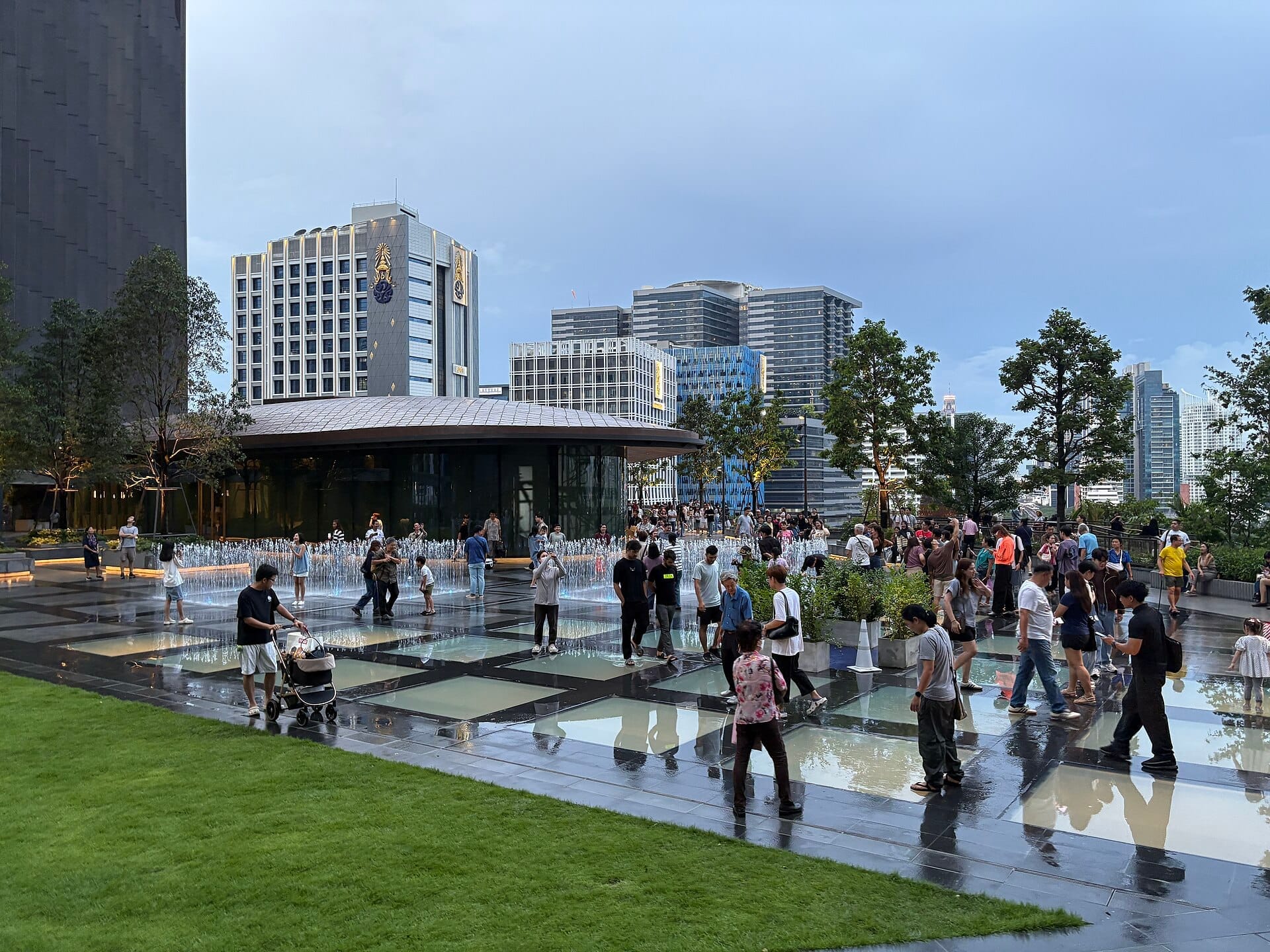
The defining feature of Dusit Central Park is its elevated park, a landscaped green deck positioned above the retail podium. Unlike the flat, ground-level lawns of Lumphini Park or the river-facing gardens of Wat Arun, this park is architectural in feel: sculpted planters, canopy trees in raised beds, and open-air walkways with city views on multiple sides. In the early morning, before the retail floors open, the park has a genuine stillness. The skyline of Silom is visible to the northwest, and you can trace the Chao Phraya corridor on clear days.
The planting scheme mixes tropical species typical of Bangkok's parks with more ornamental landscaping, giving it a manicured quality that feels more like Singapore's Gardens by the Bay lite than the organic sprawl of Chatuchak Park. That is not a criticism. The design intention is legible: this is a curated urban retreat, not a wildlife habitat. Benches and shaded seating are distributed along the walkways, and the scale is intimate enough that it never feels overwhelming.
Late afternoon is arguably the best time to visit the park level. The harsh midday sun retreats, the ambient temperature drops slightly, and the light catches the surrounding glass towers in ways that reward photography. Weekday evenings see office workers from the adjacent towers using the space as a decompression zone. On weekends, the crowd shifts toward younger visitors and hotel guests.
💡 Local tip
For photography, arrive around 5:00 PM on a clear day. The angle of light from the west catches the Dusit Thani tower and gives the green spaces a warmth that the midday overhead glare eliminates entirely.
Tickets & tours
Hand-picked options from our booking partner. Prices are indicative; availability and final rates are confirmed when you complete your booking.
Temples of Bangkok and Grand Palace half-day guided tour
From 18 €Instant confirmationFree cancellationDamnoen Saduak floating market and Maeklong railway guided tour
From 36 €Instant confirmationFree cancellationBangkok tuk-tuk night tour with Chinatown street food meal
From 28 €Instant confirmationFree cancellationAfternoon Tea at Hyatt Regency Hotel Bangkok
From 900 €Instant confirmationFree cancellation
Architecture and Historical Context
The original Dusit Thani Hotel was designed by Thai architects and opened in 1970 under the vision of the Dusit Thani Group founder Thanpuying Chanut Piyaoui. At the time, it was one of the tallest buildings in Thailand and became a reference point in Bangkok's skyline for an entire generation. Its demolition in 2019, necessary to make way for the new development, was controversial among preservation advocates and Bangkok residents who had grown up using the hotel's restaurants and lobbies.
The new Dusit Thani Bangkok tower, which forms the vertical anchor of Dusit Central Park, has been designed to echo certain formal qualities of the original while conforming to contemporary construction standards and hotel specifications. The lower podium that houses the park and retail floors uses a language of terraced levels and open-air circulation that distinguishes it from Bangkok's typical enclosed mall typology. Whether the architecture fully honors the site's history is a question that visitors with an interest in urban design will want to consider themselves.
For deeper context on this part of the city, the Silom district immediately adjacent has its own layered history stretching from the nineteenth-century trading era to the present financial center. Understanding Silom helps situate what Dusit Central Park represents: the latest iteration of a corridor that has always mixed commerce, hospitality, and public life.
Food Hall and Retail: What to Expect Inside
The lower levels of the complex house a food hall and curated retail that position Dusit Central Park toward the premium end of Bangkok's dining landscape. The food offerings lean toward Thai fine-casual and international concepts rather than street food pricing. If you are looking for a 50-baht bowl of noodles, this is not the right stop. If you want a well-executed Thai lunch in an air-conditioned setting before heading back out into the heat, the options here are solid.
Visitors spending a full afternoon in this part of Bangkok often combine Dusit Central Park with a stop at Lumphini Park a short walk east along Rama IV, particularly in the cooler hours of early morning or after 4:00 PM. The two spaces together give a rounded picture of how Bangkok residents actually use urban green and civic space.
Retail within the complex is curated rather than comprehensive. You will not find the full department store grid of the Siam corridor malls here. The selection focuses on lifestyle brands, Thai design labels, and wellness concepts that suit the hotel-adjacent demographic. If retail is your primary goal, the Siam cluster of malls is 10 to 15 minutes north by BTS.
Getting There and Moving Around
Access from BTS Sala Daeng is the most direct route: a covered walkway system connects the station area to the complex, keeping you shaded for most of the walk. MRT Silom is an equally valid option if you are arriving from the Sukhumvit or Hua Lamphong direction. Taxis and ride-shares drop off at the Rama IV Road entrance. Motorbike taxis from Sala Daeng BTS can also deposit you at the door in under two minutes for around 20 baht.
Internally, the complex uses escalators, elevators, and open-air ramps to move visitors between levels. The routing to the park deck is not always immediately obvious from the ground-floor retail entrance, so look for signage directing you to the park or ask at the information desk near the main atrium. Accessibility for wheelchair users and those with mobility considerations is built into the design with elevator access to all major levels.
If you are building a broader day itinerary, the things to do in Bangkok guide covers how to connect this area with attractions across the city using the BTS and MRT networks efficiently.
Honest Assessment: Is It Worth Your Time?
Dusit Central Park is genuinely interesting as a piece of urban design and as a signal of where Bangkok's development is heading. The rooftop park is real, accessible, and pleasant. It is not, however, a destination in the way that the Grand Palace or Wat Arun command your itinerary. Think of it as a high-quality stop that rewards those who are already in the Silom or Sala Daeng area, rather than a place worth crossing the city specifically to see.
Travelers who are focused on temples, markets, or street food as their primary Bangkok experiences may find the premium positioning of the food and retail floors slightly disconnected from the city they came to explore. For that, areas like Chinatown street food or the guides to Bangkok street food offer a different and more immersive entry point into Thai urban life.
Architecture enthusiasts, urban planners, and visitors curious about how a major Asian city reintegrates large-scale private development with public green space will find Dusit Central Park genuinely worth a few hours. The comparison to older Bangkok developments is instructive: where older malls sealed themselves off from the street, this complex at least attempts permeability, and that attempt is visible in how people actually use it.
For those assembling a temple-focused itinerary in a nearby area, the best temples in Bangkok covers the major religious sites that can be combined with a Silom-area day.
Insider Tips
- The park deck is noticeably less crowded on weekday mornings before 11:00 AM. If you are sensitive to heat, this window also benefits from shade from the tower before the sun shifts overhead.
- The Erawan Shrine at the Ratchaprasong intersection is a 10-minute BTS ride north. Both sites together make for an interesting study in how Bangkok layers the sacred and the commercial in its urban fabric.
- Bring a reusable water bottle. The rooftop can be warm even in the late afternoon, and while the retail levels are air-conditioned, the park itself is open-air and exposed.
- The complex is designed for Instagram-friendly photography but the most architecturally honest shots come from street level on Rama IV Road at dusk, when the podium lighting activates and the tower reflects the last light from the west.
Who Is Dusit Central Park For?
- Architecture and urban design enthusiasts who want to see Bangkok's new development model in action
- Hotel guests at the Dusit Thani Bangkok looking to understand the full scope of the complex
- Travelers combining a Silom or Sala Daeng afternoon with Lumphini Park and Silom Road dining
- Visitors seeking a shaded, design-quality environment to rest between temple or market visits
- Design and lifestyle shoppers interested in Thai contemporary brands rather than mass-market retail
Nearby Attractions
Other things to see while in Silom:
- Bangkok Snake Farm
The Bangkok Snake Farm, officially the Queen Saovabha Memorial Institute, is one of the oldest snake farms in the world and a functioning antivenom research center run by the Thai Red Cross. It offers up-close encounters with venomous species alongside educational shows and a small natural history museum, making it a genuinely unusual stop in the Silom district.
- King Power Mahanakhon Skywalk
The King Power Mahanakhon Skywalk is Bangkok's tallest observation point, perched atop the city's most recognizable tower. A glass-floor platform, an open-air rooftop, and sweeping 360-degree views make it the benchmark sky experience in the Thai capital — if you're prepared for the price.
- Lumphini Park
Lumphini Park is Bangkok's most significant public green space, a 142-acre urban park where early-morning tai chi sessions, rowing boats, and metre-long monitor lizards coexist within walking distance of Silom's office towers. The experience changes dramatically depending on the hour you arrive.
- Patpong Night Market
Patpong Night Market transforms a narrow strip in Silom into a wall-to-wall souvenir market every evening. Flanked by neon-lit go-go bars and Thai street food stalls, it's one of Bangkok's most layered and genuinely unusual night-out experiences.