Parque Revolución (Parque Rojo): Guadalajara's Beloved Red Park
Designed by Luis Barragán and inaugurated in 1929, Parque Revolución sits at the heart of Colonia Americana, just steps from the Juárez light-rail station. Known locally as Parque Rojo for its distinctive red benches and paving, this free public park draws students, commuters, and curious visitors into one of the city's most genuinely local green spaces.
Quick Facts
- Location
- Avenida Juárez & Calzada del Federalismo, Colonia Americana, Guadalajara, Jalisco
- Getting There
- Juárez station, SITEUR Line 1 (directly beneath the park)
- Time Needed
- 20–45 minutes for a leisurely visit; longer if you linger at a café nearby
- Cost
- Free (public park, no admission fee)
- Best for
- Architecture history, people-watching, short breaks between sights
What Is Parque Revolución?
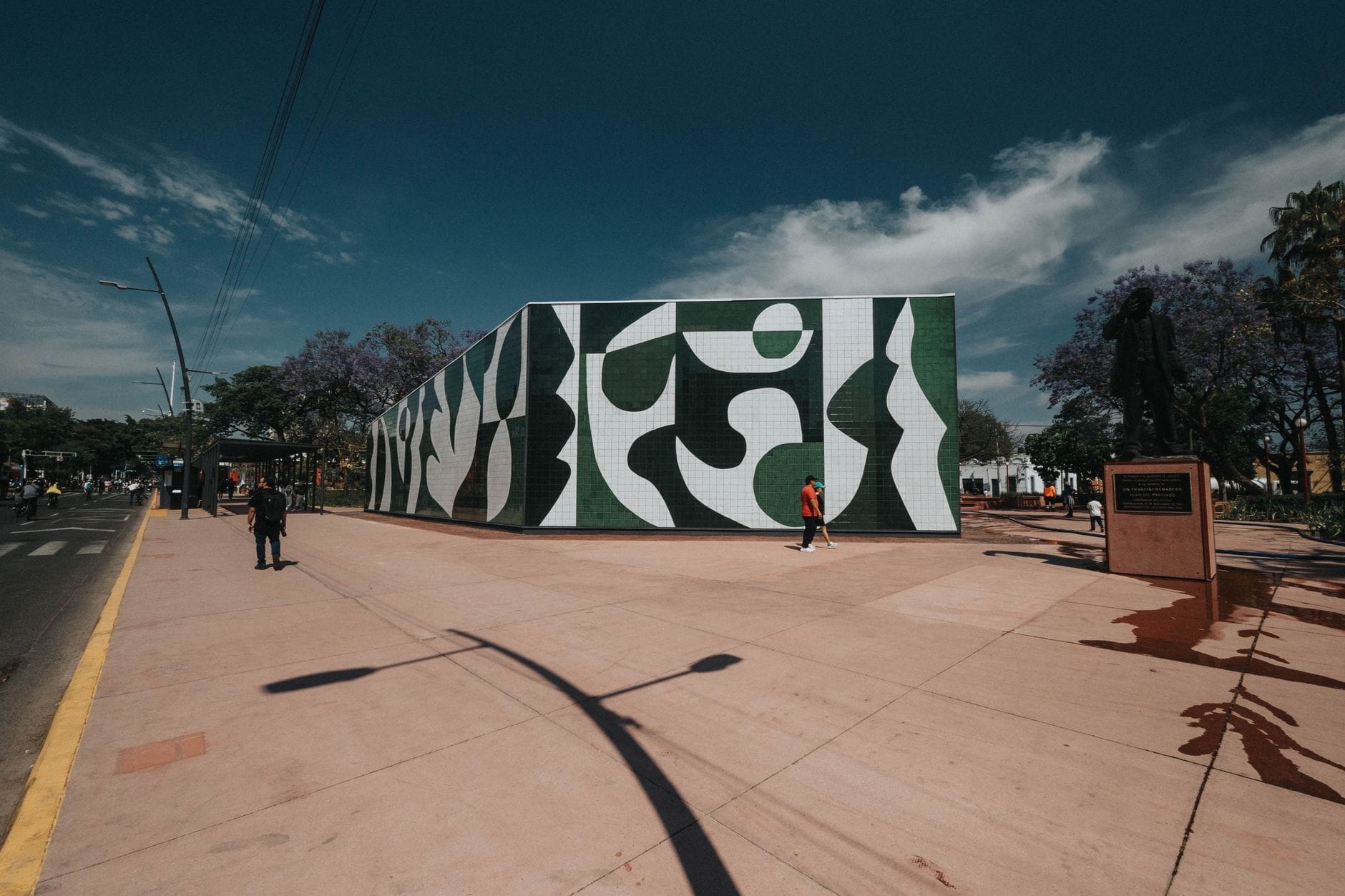
Parque Revolución, universally known around Guadalajara as Parque Rojo (Red Park), occupies a flat, tree-shaded block in Colonia Americana, one of the city's most architecturally rich neighborhoods. The nickname comes from the park's signature palette of deep red: benches, pathways, and sculptural elements that give it an immediately recognizable character compared to the greener, more conventional parks elsewhere in the city.
The park is split into two sections by Avenida Juárez, one of the main east-west arteries connecting downtown Guadalajara to the Minerva roundabout. Both halves are pedestrian-friendly and paved, with mature trees providing shade across most of the surface area. Despite sitting directly above a busy metro station, the park manages a surprisingly calm atmosphere for most of the day.
What makes a brief stop here worthwhile is not the park's size (it is small) but its context: you are standing on a site that has been, successively, a convent orchard, a 19th-century prison, and a public park commissioned from one of Mexico's most celebrated architects. That layered history is written into the bones of the space even if it is not immediately obvious.
A Barragán Design You Can Walk Through for Free
Parque Revolución was designed by architect Luis Ramiro Barragán Morfín, working alongside his brother, engineer Juan José Barragán Morfín. It was inaugurated in 1929 during the governorship of Jalisco politician Sebastián Allende Rojas. This places the park firmly in Barragán's early career, before he moved to Mexico City and developed the minimalist, light-saturated residential style that would later earn him the Pritzker Architecture Prize in 1980 for his later work, particularly Casa Barragán in Mexico City.
The 1935 design reflects a different Barragán: younger, influenced by Moorish garden traditions he had absorbed during travels in Europe and North Africa, and working within the context of post-revolutionary Mexico's push to create civic green space for urban residents. The result is a park that reads as formal without being cold, geometric without being sterile.
For anyone following Guadalajara's architectural history, Parque Revolución is a useful data point: it shows what Barragán was doing a decade before his most famous residential work, and it remains publicly accessible without a ticket, a tour, or a reservation. That is genuinely rare for Barragán-connected spaces.
💡 Local tip
If you want to photograph the red geometry at its cleanest, arrive before 9 a.m. on a weekday. The light hits the paving and benches at a low angle, and foot traffic is light enough that you can frame a clear shot.
Tickets & tours
Hand-picked options from our booking partner. Prices are indicative; availability and final rates are confirmed when you complete your booking.
Lake Chapala and Ajijic guided tour from Guadalajara
From 68 €Instant confirmationFree cancellationGuadalajara and Tlaquepaque guided tour
From 73 €Instant confirmationFree cancellation
The Site's History: From Convent Orchard to Prison to Park
The ground Parque Revolución occupies once belonged to the Convento del Carmen, whose adjacent temple still stands a short walk away on Avenida Juárez. The orchard that served the convent was donated in 1845 for use as a penitentiary, a common 19th-century repurposing of religious land following Mexico's Reform Laws. For decades, the site functioned as a prison at the edge of what was then the city's developing western neighborhoods.
The demolition of the prison came as part of the widening of Avenida Juárez in the 1930s, a modernization project that reshaped this part of the city. The cleared land became the basis for Barragán's commission. Today, the Templo del Carmen still stands nearby, and the visual and historical connection between the old religious complex and this park adds a layer of meaning that is easy to miss if you arrive without context.
What the Park Looks Like Throughout the Day
Mornings at Parque Revolución belong to commuters and dog walkers. The Juárez metro station entrance draws a steady flow of people who pause briefly, check their phones, and move on. A few regulars occupy the red benches with coffee from nearby stands. The tree canopy is dense enough that even in summer, the central paths feel cooler than the surrounding streets.
Midday on weekdays brings university students from the area's many schools, using the park as an outdoor classroom or lunch spot. The two sculptures at the park's focal points, honoring revolutionary figures Venustiano Carranza and Francisco I. Madero, become impromptu landmarks where groups gather and arrange to meet. The fountains, when running, add a low background sound that softens the traffic noise from Juárez and Federalismo.
Weekend afternoons shift the park's character most noticeably. Families with children use the play areas, vendors set up near the perimeter, and the pace slows considerably. This is when the park most resembles its original civic function: a place designed not to impress tourists but to give residents somewhere to simply exist outside their homes.
After dark, the park is used but unevenly lit. It is not unsafe by any general standard, but if you are visiting primarily for the architecture or sculpture, the evening offers little visual reward. The red surfaces lose their color in low light, and the most interesting details of the Barragán design become hard to read.
Getting There and Getting Around
The Juárez station on Tren Ligero Line 1 sits directly beneath the park, making this one of the most transit-accessible green spaces in the city. Line 1 runs on a roughly north-south corridor and connects to major transfer points. Fares are standard metro fares; verify current pricing with SITEUR before travel as costs are subject to change.
On foot, the park is roughly ten minutes west of the Plaza de la Liberación and the cathedral area, making it a natural stop on any walk through the city's central corridor. Avenida Juárez is one of the more pedestrian-hospitable streets in this part of Guadalajara, with reasonably wide sidewalks and regular crossings.
The park's paved surfaces make it accessible for wheelchair users and those with limited mobility, and the flat terrain presents no obstacles. The metro station has elevators, though as with any infrastructure detail, it is worth confirming current functionality before relying on it.
ℹ️ Good to know
Parque Revolución is divided by Avenida Juárez into two halves. Both sides are worth walking; the sculptures of Carranza and Madero are positioned in different sections, and the spatial character shifts slightly between them.
The Surrounding Neighborhood and What to Combine
Parque Revolución is located where downtown Guadalajara meets Colonia Americana, and this edge position makes it a useful anchor for a longer walk. The stretch of Avenida Juárez heading west leads into the heart of Colonia Americana, where you will find the Templo Expiatorio, one of the city's most architecturally striking neo-Gothic churches, about a ten-minute walk away.
The neighborhood immediately around the park is dense with cafés, bookshops, and independent restaurants, partly because of the student population and partly because Colonia Americana has developed a strong food and cultural scene over the past decade. For a broader picture of what the neighborhood offers, see the Guadalajara food guide for current recommendations in the area.
The Templo del Carmen, which shares historical roots with this site, is also within easy walking distance. Together, these three points, the park, the Templo del Carmen, and the Templo Expiatorio, make a concentrated half-day architecture and history circuit that requires no transport and no admission fees.
⚠️ What to skip
Visitors primarily interested in dramatic natural scenery, large-scale museums, or immersive cultural experiences may find Parque Revolución underwhelming. It is a small urban park. Its value is contextual and architectural rather than spectacular. If that framing doesn't appeal, prioritize other stops.
Photography and Practical Notes
The park photographs best in the first two hours after sunrise and in the late afternoon when the sun is at a lower angle and the red surfaces read with more warmth and contrast. Overcast days can also work well, as the diffuse light eliminates harsh shadows and lets the geometric layout of the paths and benches read more clearly.
The sculptures of Carranza and Madero are large-scale bronze works set on stone plinths. They are not considered among Guadalajara's most significant public sculptures from an art-historical standpoint, but they provide useful compositional anchors and give the park its formal, civic weight.
Guadalajara's rainy season runs primarily from June through September, with the heaviest rainfall in July and August. The park's paved surfaces drain reasonably well, but afternoon thunderstorms are common during these months and can arrive quickly. If you are visiting during this period, carry a small rain layer or plan your visit for the morning, which tends to be drier before afternoon convective storms build.
Insider Tips
- The Juárez metro station entrance is on the park's perimeter. If you arrive by metro and exit toward the park, you surface almost exactly at the center of the space, which is the best orientation point for first-time visitors.
- The red benches closest to the central fountain on the east section tend to hold shade from the large trees through the late morning, making them the most comfortable seating during the warmer months of April through June.
- Barragán's connection to this park is not marked by any prominent signage on-site. If you want context before arriving, the MoMoGDL architecture database (momogdl.com) has a concise entry on the park's design history.
- The stretch of Avenida Juárez between the park and the Templo Expiatorio has a concentration of good independent cafés. Grab coffee before or after your visit rather than expecting vendors inside the park to be consistently present.
- On Sunday mornings, the streets around the park are noticeably quieter than weekdays, and the reduced traffic on Juárez makes the split-park structure easier to photograph and navigate on foot.
Who Is Parque Revolución (Parque Rojo) For?
- Architecture enthusiasts tracking Luis Barragán's early career in Guadalajara
- Travelers walking between the historic center and Colonia Americana who want a natural midpoint stop
- People-watchers who prefer a local, non-touristy setting
- Visitors doing a free, self-guided city walk without museum admission fees
- Anyone combining a morning visit with café time in the surrounding Colonia Americana blocks
Nearby Attractions
Other things to see while in Chapultepec:
- Arcos Vallarta (Arcos de Guadalajara)
Built to mark Guadalajara's 400th anniversary and completed in 1942 after work began in 1939, the Arcos de Guadalajara are a pair of eclectic-style arches with Californian neocolonial elements rising 21 meters above Avenida Vallarta. Free to visit at any hour, they serve as one of the city's most recognized landmarks and a natural orientation point in the western corridor.
- Avenida Chapultepec
Avenida Chapultepec is a 14-block pedestrian-friendly boulevard in Guadalajara's Colonia Americana that shifts character by the hour. Sunday mornings bring cyclists and skaters under closed traffic conditions; Saturday nights pull in a younger crowd for an outdoor cultural market. On any weekday it functions as a relaxed commercial spine lined with cafes, restaurants, and small shops.
- Glorieta de La Minerva
The Glorieta de La Minerva is the symbolic heart of modern Guadalajara, a monumental 1950s roundabout where a bronze goddess rises about 23 metres above six converging avenues. Free to visit at any hour, it reads differently depending on when you show up: rush-hour spectacle, Sunday cycling route, or golden-hour photography backdrop.