Glorieta de La Minerva: Guadalajara's Defining Urban Landmark
The Glorieta de La Minerva is the symbolic heart of modern Guadalajara, a monumental 1950s roundabout where a bronze goddess rises about 23 metres above six converging avenues. Free to visit at any hour, it reads differently depending on when you show up: rush-hour spectacle, Sunday cycling route, or golden-hour photography backdrop.
Quick Facts
- Location
- Intersection of Av. Ignacio L. Vallarta, Adolfo López Mateos, Diagonal Golfo de Cortés and Circunvalación Agustín Yáñez, Guadalajara, Jalisco, Mexico
- Getting There
- No metro station at the roundabout; best reached by taxi, Uber/DiDi, or city bus along Av. Vallarta. Arcos Vallarta is a 5-minute walk west.
- Time Needed
- 15–30 minutes to view the monument; up to 1–2 hours on Sunday mornings to walk the car-free vía recreativa
- Cost
- Free. No tickets, no barriers — public outdoor monument open 24/7
- Best for
- City orientation, architecture photography, Sunday morning walks, and understanding Guadalajara's modern identity
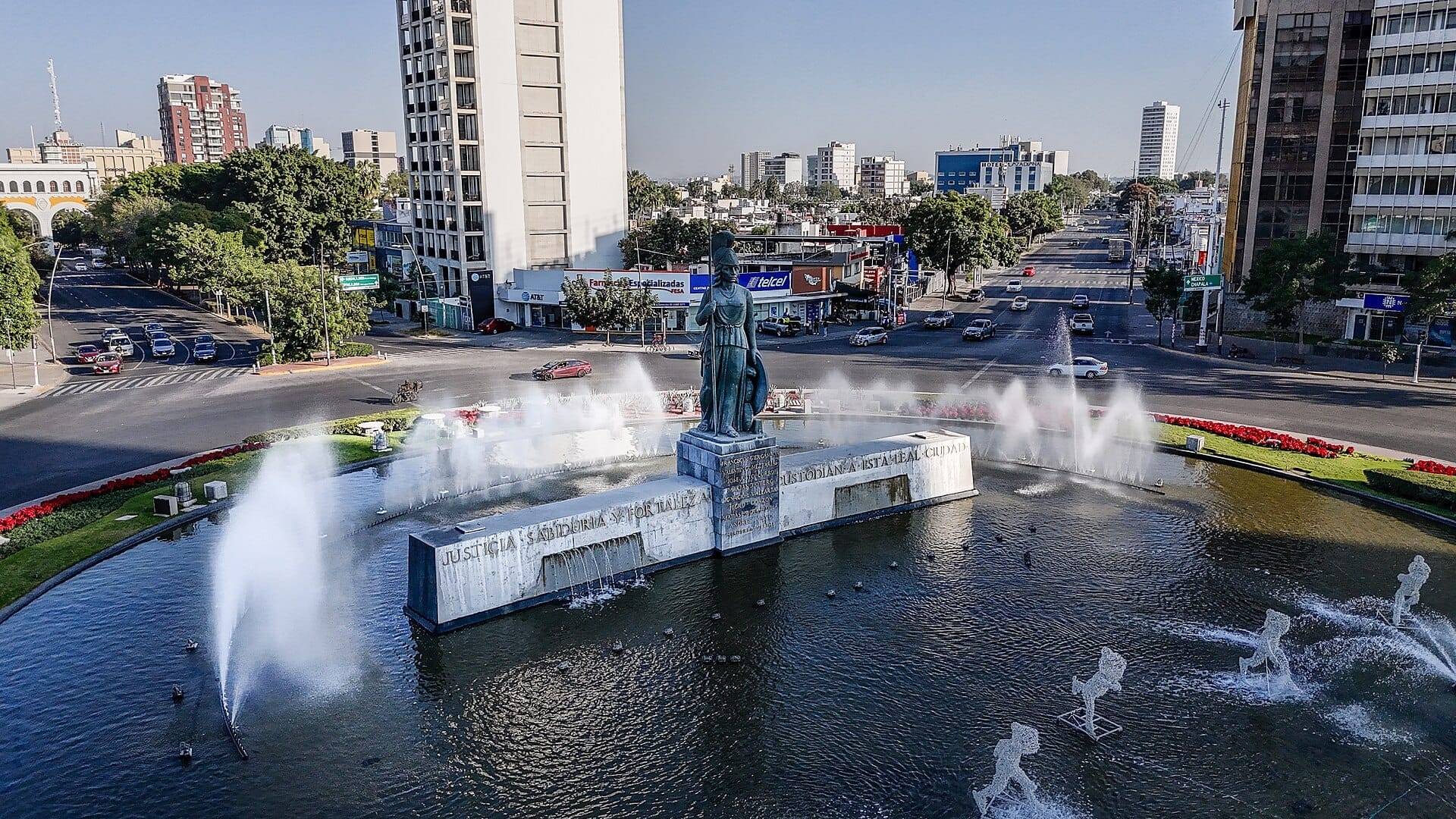
What Is Glorieta de La Minerva?
The Glorieta de La Minerva is Guadalajara's most recognisable modern landmark, a massive traffic roundabout anchored by a bronze statue of the Roman goddess Minerva, patron of wisdom, craft, and commerce. At roughly 8 metres tall and set on a 15-metre pedestal, she stands just over 23 metres above a circular fountain 74 metres in diameter. You cannot miss her: six major avenues converge here, and she faces outward toward the flow of the city with a shield in one hand and a spear in the other.
For tapatíos (as Guadalajara's residents call themselves), Minerva is not just a statue. She functions the way the Eiffel Tower does for Parisians or Big Ben for Londoners: as shorthand for the city itself. Local football fans celebrate Chivas titles here. Political demonstrations march past her. And every visitor who wants to understand how Guadalajara sees itself ends up standing on the surrounding sidewalk, looking up.
ℹ️ Good to know
The roundabout is a working high-traffic intersection on weekdays. You view the statue from surrounding sidewalks and pedestrian zones, not from the traffic island itself. Sunday mornings during the vía recreativa are the main time you can freely walk the full perimeter of the glorieta without traffic.
History and Architecture: A City Asserting Itself
The monument was commissioned during the governorship of Agustín Yáñez and inaugurated in the mid-1950s, with sources citing 1956 for the project and 15 September 1957 for the statue's formal inauguration. The design came from architect Julio de la Peña, while sculptor Joaquín Arias produced the bronze figure. The choice of Minerva was deliberate. Guadalajara had been associated with the goddess since colonial times, and placing her at the meeting point of the city's new western expansion was a statement: this was a metropolis growing with purpose, not just sprawl.
The roundabout anchors what became known informally as the Zona Minerva and the broader Vallarta corridor, which stretches east toward the historic centre along Avenida Vallarta. The scale of the pedestal relative to the statue is worth noting up close: the stone tower is almost three times the height of the bronze figure herself, giving the whole composition a quality more obelisk than figurative sculpture from a distance. Up close, the goddess's details are finer than the highway-speed impression suggests.
The Arcos Vallarta, another of Guadalajara's mid-century civic monuments, stand a short walk west of the roundabout. The two landmarks together frame the western approach to the city centre along Vallarta, and seeing both on the same walk adds meaningful architectural context. For more on how Guadalajara's built environment developed across centuries, the Guadalajara architecture guide covers the full picture from colonial plazas to modernist avenues.
Tickets & tours
Hand-picked options from our booking partner. Prices are indicative; availability and final rates are confirmed when you complete your booking.
Lake Chapala and Ajijic guided tour from Guadalajara
From 68 €Instant confirmationFree cancellationGuadalajara and Tlaquepaque guided tour
From 73 €Instant confirmationFree cancellation
What the Visit Actually Feels Like
On a weekday morning, the glorieta is pure urban energy. Traffic feeds into the roundabout from six directions simultaneously, and the noise is considerable: horns, buses accelerating, tyres on pavement. The statue herself seems to preside over controlled chaos. From the sidewalk on the south side, you get a clear frontal view of Minerva with the pedestal inscription visible. The fountain base at the roundabout's centre is occasionally lit at night and sometimes features seasonal water effects, though the water is not always active depending on maintenance cycles.
At dusk, the mood shifts. The surrounding restaurants and hotel lobbies along López Mateos fill up, the light catches the bronze at a warmer angle, and the volume of traffic actually makes for dramatic long-exposure photography if you have a tripod. The statue catches amber and gold tones as the sun drops toward the western horizon, roughly in line with Avenida Vallarta. This is the most photogenic window of the day.
Early on Sunday mornings, the roundabout transforms. As part of the city's vía recreativa programme, car traffic is closed until around 2 pm on Sundays, and the avenues become a linear park of joggers, cyclists, families with pushchairs, and vendors selling juice and fruit. You can walk the full 74-metre circular perimeter of the fountain base and get up closer to the base of the pedestal than at any other time. This is genuinely the best version of a Minerva visit, both for photography and for the ambient experience of the city at rest.
💡 Local tip
Arrive by 8 am on a Sunday to see the vía recreativa at its most active and photograph the statue with soft morning light and minimal crowds. By 11 am, it becomes considerably busier with families.
The Surrounding Neighbourhood
The glorieta sits in the Chapultepec neighbourhood, which extends south and southwest from the roundabout. The area is broadly upscale and commercial, with hotels, corporate offices, car dealerships, and some of the city's larger restaurant chains concentrated along López Mateos. It is a different feel from the walkable café streets of Colonia Americana to the east, which is a 15–20 minute walk or a short Uber ride away.
Avenida Chapultepec, the neighbourhood's most pedestrian-friendly axis, runs parallel a few blocks south. That street has more independent cafés and restaurants suitable for lingering before or after visiting the glorieta. If you are combining sights in a single afternoon, the sequence of Minerva, a walk east along Vallarta, and then into Colonia Americana makes good geographic sense.
For a broader view of the city on foot, the Guadalajara walking tour guide maps out logical routes that connect the Minerva zone to the historic centre and other central neighbourhoods.
Photography Notes and Practical Walkthrough
The statue faces roughly east, which means morning light hits her front face and afternoon light catches her back. For a lit frontal shot, go early in the morning or wait for the softer backlit look in late afternoon that gives the bronze a glowing outline. Night shots work best from the south sidewalk, where you can include traffic trails with the statue and pedestal in frame. A 35–50mm equivalent focal length captures the full statue and enough pedestal to convey scale without excessive distortion.
The surrounding roundabout is not a place to linger in traffic. Use the designated pedestrian crossings, of which there are several around the perimeter. The widest and most comfortable viewing position is from the southeast corner of the intersection, where you have a clear sightline and enough pavement width to stop without obstructing other pedestrians. There are no cafés or benches directly at the roundabout itself, but the commercial strips on López Mateos within half a block have multiple options.
⚠️ What to skip
Do not attempt to cross the traffic island to get closer to the base on a weekday. Traffic moves fast and continuously. Sunday mornings are by far the safest and most convenient time to approach the fountain base on foot.
How the Glorieta Fits Into a Guadalajara Itinerary
Glorieta de La Minerva is rarely a destination in itself for visitors spending more than a day in Guadalajara. It earns its place as an orientation point and a connector. Most visitors pass through on their way between the Guadalajara Cathedral and the historic centre to the east, and the upscale commercial zones further west and northwest toward Zapopan. Factoring in a 20-minute stop here costs nothing and anchors the city's modern geography in a way that maps alone do not.
If your itinerary includes the Hospicio Cabañas or the Teatro Degollado in the historic centre, adding Minerva as an endpoint or starting point on Av. Vallarta adds perhaps 25 minutes of total walking time and connects the colonial and modernist layers of the city in a single east-west route.
Visitors who find big-city traffic circles fundamentally uninteresting and are primarily focused on museums, markets, or natural sites may not find this stop worth a dedicated journey. The monument does not have an interior, no interpretive signage in English, and no managed visitor experience. What it offers is symbolic weight and photographic value, which are real but not universal.
Insider Tips
- Sunday vía recreativa closes the surrounding avenues to traffic until 2 pm, the only time you can walk the full fountain perimeter. Pair it with a morning ride along Av. Vallarta toward the historic centre for one of the city's best free experiences.
- The southeast corner of the roundabout gives you the cleanest sightline to the statue's front face with the least visual clutter from traffic signage. This is the angle used in most professional photographs of the monument.
- At night, the pedestal is lit, but illumination quality and the water features in the fountain base vary depending on city maintenance schedules. Night visits are worthwhile for long-exposure photography but do not guarantee a fully operational fountain.
- The inscription on the pedestal reads 'Guadalajara, Guadalajara, tienes el alma de provincia y de olor a tierra mojada' — a line from a famous mariachi song that tapatíos regard as affectionately characterising their city. Reading it in context adds a layer to the statue's local meaning that no photograph conveys.
- Ride-hailing pickups from the roundabout itself can be chaotic during peak hours. Set your pickup pin one block down on López Mateos or Vallarta to avoid the traffic flow confusion at the intersection.
Who Is Glorieta de La Minerva For?
- First-time visitors wanting to understand Guadalajara's modern civic identity beyond its colonial centre
- Architecture and urban design enthusiasts interested in mid-20th-century Mexican civic planning
- Photographers looking for a landmark with strong golden-hour and night-photography potential
- Sunday morning cyclists and joggers using the vía recreativa along Av. Vallarta
- Travellers connecting between Colonia Americana and the western commercial zones who want a meaningful midpoint stop
Nearby Attractions
Other things to see while in Chapultepec:
- Arcos Vallarta (Arcos de Guadalajara)
Built to mark Guadalajara's 400th anniversary and completed in 1942 after work began in 1939, the Arcos de Guadalajara are a pair of eclectic-style arches with Californian neocolonial elements rising 21 meters above Avenida Vallarta. Free to visit at any hour, they serve as one of the city's most recognized landmarks and a natural orientation point in the western corridor.
- Avenida Chapultepec
Avenida Chapultepec is a 14-block pedestrian-friendly boulevard in Guadalajara's Colonia Americana that shifts character by the hour. Sunday mornings bring cyclists and skaters under closed traffic conditions; Saturday nights pull in a younger crowd for an outdoor cultural market. On any weekday it functions as a relaxed commercial spine lined with cafes, restaurants, and small shops.
- Parque Revolución (Parque Rojo)
Designed by Luis Barragán and inaugurated in 1929, Parque Revolución sits at the heart of Colonia Americana, just steps from the Juárez light-rail station. Known locally as Parque Rojo for its distinctive red benches and paving, this free public park draws students, commuters, and curious visitors into one of the city's most genuinely local green spaces.