Templo del Carmen: Guadalajara's Baroque Landmark in the Historic Center
Completed in 1758 as part of a Discalced Carmelite convent, the Templo de Nuestra Señora del Carmen is now considered a notable example of neoclassical religious architecture in Guadalajara's historic center, following a 19th-century renovation. Entry is free, the adjacent Jardín del Carmen offers a quiet pause from the city, and the interior rewards anyone willing to step off the main tourist trail.
Quick Facts
- Location
- Calle Puerto del Carmen 116, Zona Centro, Guadalajara 44300, Jalisco
- Getting There
- Walkable from Guadalajara Centro Histórico; multiple Mi Transporte bus routes along Avenida Hidalgo and surrounding streets
- Time Needed
- 30–60 minutes for the church and garden
- Cost
- Free (active place of worship; no admission fee)
- Best for
- Architecture lovers, photography, quiet reflection, history walks
What Is the Templo del Carmen?
The Templo de Nuestra Señora del Carmen is an 18th-century Catholic church in the heart of Guadalajara's historic center, completed in 1758 as the centerpiece of a Discalced Carmelite convent complex. It is one of several colonial-era churches within easy walking distance of the main plaza, but it tends to draw fewer crowds than the cathedral or Hospicio Cabañas, which gives it a noticeably quieter atmosphere.
Today the temple belongs to the Parroquia del Sagrario Metropolitano, under the Archdiocese of Guadalajara, and continues to function as an active place of worship. Visitors are welcome throughout the day, and the adjacent Jardín del Carmen, a small public garden immediately beside the church, gives the whole site a rare sense of calm for a spot located so close to the downtown core.
ℹ️ Good to know
Opening hours are commonly reported as Monday to Sunday, 07:00–20:00, but Mass times vary and schedules should be confirmed locally. If you plan to visit during a morning or evening service, expect limited movement inside the nave. The feast day of Our Lady of Carmen on July 16 draws a larger congregation and special celebrations.
The Architecture: What to Look For
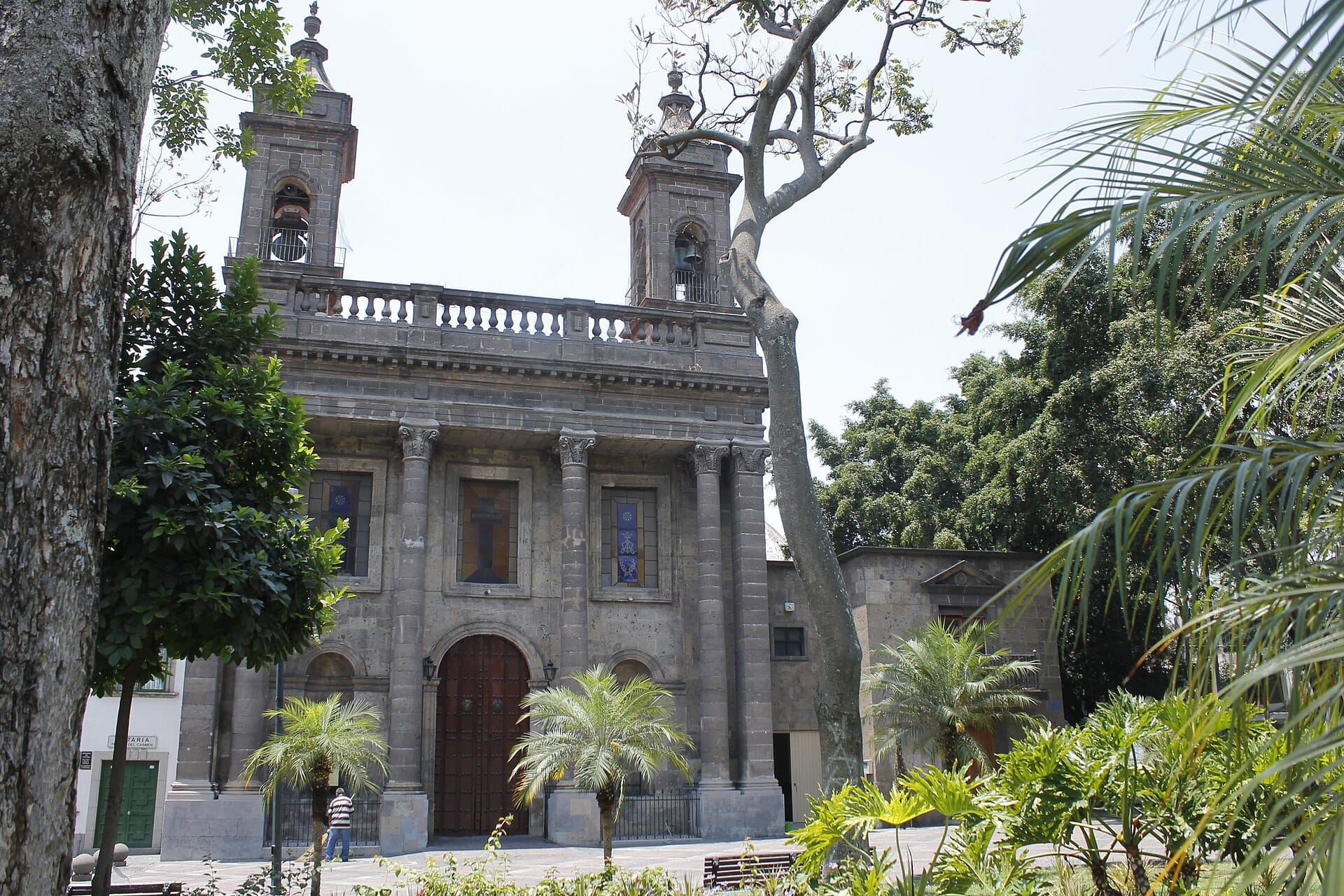
The façade of the Templo del Carmen is the first thing that stops you. Built originally in the colonial period but now presenting a restrained neoclassical style after 19th-century remodeling, it uses warm-toned stone that shifts color depending on the light: pale gold in the midday sun, a deeper amber in the late afternoon. The main portal features carved stonework around the entrance arch, with relief detail that rewards close inspection. Two flanking towers frame the composition, though they are more modest in scale than the paired towers of Guadalajara Cathedral a few blocks north.
Inside, the proportions are generous: a single broad nave with side altars and ornate retablos along the walls. The ceiling draws the eye upward, and natural light enters through windows positioned to illuminate the altar during morning hours, which is arguably the best time to see the interior at its most dramatic. The gilded elements catch that light in a way that feels genuinely theatrical without being excessive.
For a deeper reading of how this temple fits into the broader fabric of colonial Guadalajara, the city's architecture guide places the Carmen complex alongside other surviving 17th and 18th-century religious buildings and explains the stylistic conventions that shaped them.
Tickets & tours
Hand-picked options from our booking partner. Prices are indicative; availability and final rates are confirmed when you complete your booking.
Lake Chapala and Ajijic guided tour from Guadalajara
From 68 €Instant confirmationFree cancellationGuadalajara and Tlaquepaque guided tour
From 73 €Instant confirmationFree cancellation
The Experience at Different Times of Day
Early morning, before 09:00, is when the Templo del Carmen shows its most concentrated character. A small number of worshippers attend morning Mass, the street outside is quiet, and the light falls almost horizontally across the stone façade. The smell of incense lingers near the entrance, and the sounds from the city outside are muffled the moment you step inside.
Midday brings foot traffic from office workers and students crossing through the adjacent garden, and the interior fills with more casual visitors. The stone exterior gets harsh and flat in direct overhead light, which makes this the least rewarding time for photography of the façade. The interior remains photogenic, however, and the garden is pleasant under shade trees.
Late afternoon, roughly 16:00 to 18:00, is when the warm western light catches the carved stonework at a low angle and gives the façade strong texture. Shadows fall across the relief work around the portal, making architectural details far more legible than at midday. This is also when the garden fills with people sitting on benches, and the scene outside the church feels genuinely local rather than touristic.
The Jardín del Carmen: Why the Garden Matters
The Jardín del Carmen directly beside the church is a small but well-maintained public garden that most visitors overlook in favor of the larger plazas elsewhere in the historic center. It provides a useful sense of what the convent grounds might have once felt like: a contained, tree-shaded space that interrupts the hard geometry of the surrounding streets.
Benches face the side wall of the church, giving a view of the building from an oblique angle that many photographers find more interesting than the straight-on façade shot. It is also one of the few quiet places in this part of downtown where you can sit without being surrounded by traffic noise, making it a practical stop if you are doing a longer walk through the historic center and need a moment to rest.
Historical Context: The Carmelite Order in Guadalajara
The Discalced Carmelites, a reformed branch of the Carmelite Order known for strict contemplative practice, established their Guadalajara convent in the colonial period. Construction on the complex began near 1690 and was completed in 1758, making it an 18th-century addition to a historic center that already contained the cathedral, the Palacio de Gobierno, and several other major religious and civic buildings.
The temple sits within a broader concentration of colonial architecture that includes the Hospicio Cabañas, a UNESCO World Heritage Site several blocks to the east, and the Guadalajara Cathedral to the north. While the Carmen temple is not on UNESCO's list, it represents a well-preserved example of the Baroque religious architecture that shaped the city's colonial identity.
The convent complex was affected by the Reform War and subsequent secularization laws of the 19th century, which dissolved religious orders across Mexico and transferred many convent properties to public use. The church itself survived and continues to function, though the broader complex around it has changed substantially over the decades.
Practical Walkthrough: How to Visit
The Templo del Carmen is an easy addition to any walk through the historic center. From the main Cathedral square, the walk takes about 10 to 15 minutes on foot through streets lined with smaller shops and street vendors. The church does not advertise itself aggressively, and the entrance on Calle Puerto del Carmen can feel understated if you arrive from the wrong angle. Look for the garden first, and the church entrance is immediately adjacent.
Entry is free. As an active church, photography inside is generally tolerated but should be handled discreetly: avoid using flash, keep noise to a minimum, and do not photograph worshippers without consent. A modest dress code applies, as in most Mexican Catholic churches: covered shoulders and knees are expected.
If you are planning a broader walk of the historic center, the Guadalajara walking tour guide maps out a route that connects the main colonial-era sites and can incorporate the Templo del Carmen as part of a half-day itinerary.
⚠️ What to skip
As an 18th-century structure, the church interior involves steps at various points, and surfaces may be uneven. Detailed accessibility information for wheelchair users is not currently verified; visitors with mobility needs should confirm conditions on site before visiting.
Photography Tips
The best exterior shots come in the late afternoon when the sun is low and to the west, casting raking light across the carved stone portal. A wide-angle lens or phone held at chest height captures the full twin-tower composition without excessive distortion. The garden provides an alternative angle along the side of the building that includes shade trees in the frame, softening the composition.
Inside, the nave photographs well in the early morning when natural light streams through the windows toward the altar. A slightly elevated ISO setting helps in the low ambient light without requiring flash. The retablos along the side walls have fine gilded detail that rewards a closer, tighter composition rather than wide-angle shots of the whole interior.
Who Should Skip This Attraction
Travelers who have already visited the Guadalajara Cathedral, the Templo Expiatorio, and Hospicio Cabañas on a short itinerary may find the Templo del Carmen adds relatively little if their interest in colonial architecture is already satisfied. It is not the most impressive church interior in the city by any measure: the cathedral is larger and more elaborately appointed, and the Templo Expiatorio has more dramatic neo-Gothic stonework. The Carmen temple's value is in its quietness, its intact Baroque character, and the pleasant garden beside it, which are qualities that matter more to some travelers than others.
Families with young children looking for interactive or hands-on experiences will find better options nearby, including the child-friendly attractions in Guadalajara that prioritize engagement over architectural contemplation.
Insider Tips
- Visit on July 16, the feast day of Our Lady of Carmen, to see the church during its most significant annual religious celebration. The exterior and interior are decorated, and the surrounding streets have a noticeably different atmosphere than an ordinary weekday.
- The garden bench directly facing the side wall of the church, toward the northwest corner, offers the most interesting photographic angle of the building. Most visitors photograph only the front façade and miss this view entirely.
- If you arrive during Mass, wait near the entrance or sit at the back. The liturgical setting actually enhances the experience of the interior: the acoustics, the incense, and the low lighting create an atmosphere that an empty church does not replicate.
- The immediate streets around the temple, particularly in the late afternoon, have small taco and torta stands that serve the local office-worker crowd. These are significantly less expensive and less tourist-oriented than food options near the main cathedral plaza.
- Opening hours are reported as 07:00 to 20:00 daily, but like most active parish churches in Mexico, actual access depends on services and events. Arriving between 09:30 and 11:30, or between 15:00 and 17:00, generally avoids both early Mass and the midday lull when doors are occasionally restricted.
Who Is Templo del Carmen For?
- Architecture enthusiasts interested in colonial Baroque design outside the main tourist circuit
- Photographers seeking soft late-afternoon light on carved stonework
- Travelers doing a self-guided historic center walk who want quieter stops between the major landmarks
- Visitors interested in the history of religious orders in colonial Mexico
- Anyone looking for a calm, shaded spot in the downtown area without entering a museum
Nearby Attractions
Other things to see while in Centro Histórico:
- Calandrias (Horse-Drawn Carriage Rides)
Calandrias are Guadalajara's traditional horse-drawn carriages, operating through the colonial streets of the Centro Histórico since the early 20th century. A slow, unhurried circuit past cathedral facades, plazas, and pedestrian corridors, they offer a different pace from the city's foot traffic. This guide covers what to expect, when to go, and whether it's worth your time.
- Guadalajara Cathedral (Catedral de Guadalajara)
The Catedral Basílica de la Asunción de María Santísima anchors Guadalajara's historic center, surrounded by four plazas and centuries of layered history. Its twin neo-Gothic spires are the city's most recognized silhouette, and entry is free. Here is everything you need to know before you go.
- Instituto Cultural Cabañas (Hospicio Cabañas)
A UNESCO World Heritage Site at the heart of Guadalajara's Centro Histórico, Hospicio Cabañas houses José Clemente Orozco's most celebrated murals inside a neoclassical complex of staggering scale. This is the single most significant cultural site in western Mexico, and one of the most important in all of Latin America.
- Lienzo Charro de Jalisco
The Lienzo Charro Charros de Jalisco, on Av. R. Michel near Parque Agua Azul, is one of Mexico's most storied charro arenas. Home to one of Mexico's oldest charro associations, this is where Jalisco's equestrian traditions are kept alive through competitive charreadas, pageantry, and music.