Parco Naturale Molentargius-Saline: Cagliari's Flamingo Wetland on the City's Doorstep
Parco Naturale Molentargius-Saline is a roughly 1,600-hectare protected wetland and Ramsar site sitting between the Poetto beach road and the urban edge of Cagliari. Entry is free, flamingos are present year-round, and the park is reachable by bike from the city centre in under 30 minutes.
Quick Facts
- Location
- Between Cagliari and Quartu Sant'Elena, adjacent to the Poetto seafront. Main info point: Via La Palma 9, Edificio Sali Scelti, 09126 Cagliari (park headquarters and InfoPoint).
- Getting There
- By bike or on foot along the Poetto coast road from central Cagliari (approx. 25–35 min cycling). Car parking available in Via Don Giordi (Quartu side) and near Via La Palma (Cagliari side). No direct metro stop at the park entrance.
- Time Needed
- 1.5–3 hours for a self-guided walk or cycle. Half a day if you join a guided boat or electric minibus excursion.
- Cost
- Free entry to the park. Guided tours and electric minibus or boat excursions are paid; prices vary by operator — check parcomolentargius.it for current options.
- Best for
- Birdwatchers, photographers, cyclists, families with young children, and anyone wanting green space close to Cagliari city.
- Official website
- parcomolentargius.it
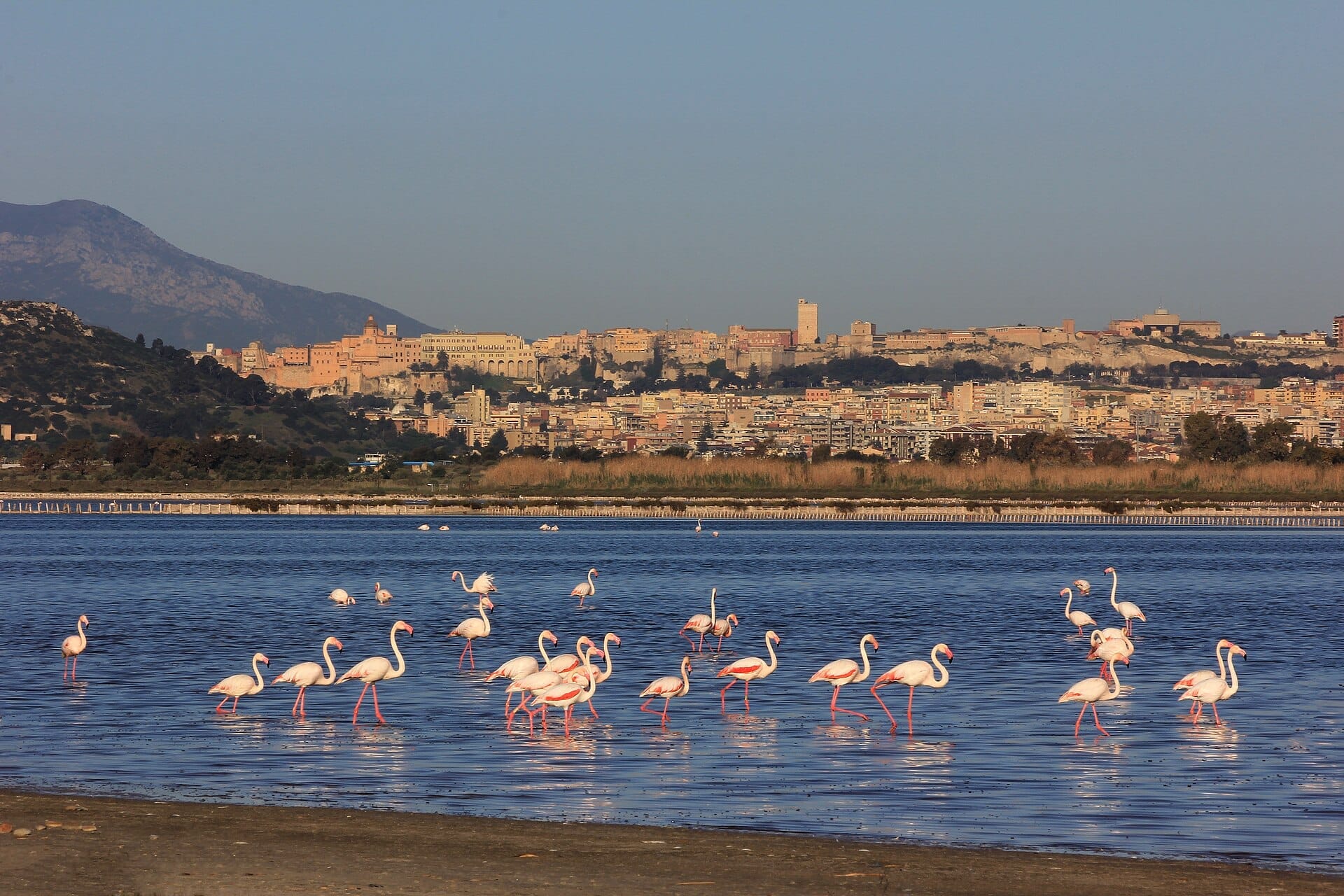
What Parco Molentargius-Saline Actually Is
Parco Naturale Regionale Molentargius-Saline is a protected wetland of about 1,600 hectares squeezed between the southern edge of Cagliari, the seaside strip of Poetto beach, and the municipality of Quartu Sant'Elena. It was designated a Ramsar site (a wetland of international importance under the 1971 Ramsar Convention) in 1977, and it became a formal Regional Natural Park in 1999 under Sardinian regional law (Regional Law No. 5 of 26 February 1999). That combination of early international recognition and later legal protection has allowed the ecosystem to recover substantially from industrial salt extraction that once dominated the area.
The park's most immediate visual feature is its network of shallow, brilliantly coloured lagoons and ponds. In summer, the water turns shades of pink and rust as algae and brine shrimp concentrate in the heat. The flamingos feed on those same organisms, which is why the birds appear in such numbers here. But Molentargius is also a mixed ecosystem: freshwater reed beds, brackish ponds, dry salt flats, and former salt-processing infrastructure all coexist within its boundaries, creating a patchwork of habitats unusual in an urban fringe context.
ℹ️ Good to know
Opening hours: visitor access hours vary by gate and season; check current schedules on parcomolentargius.it or at the Sali Scelti Infopoint before your visit. Entry to the park and its walking and cycling paths is free of charge.
The Flamingos: What to Expect and When
Greater flamingos (Phoenicopterus roseus) are present at Molentargius throughout the year, which makes this park unusual even by European standards. Most flamingo populations in the Mediterranean are migratory, but the Cagliari lagoon complex has become a year-round colony. The birds began breeding here regularly in the 1990s, and the park has since recorded thousands of nesting pairs during successful seasons.
Numbers and visibility shift depending on the time of year. Spring, from March through May, tends to bring the most dramatic congregation as birds gather for courtship and nesting. In summer, adults can be seen feeding in the shallower ponds closest to the Poetto road, often close enough to photograph without a telephoto lens. Winter groups are smaller but the low light in the cooler months gives the pink plumage a warmer, more saturated tone that photographers often find more satisfying than the harsh midday glare of July.
Beyond flamingos, the bird list at Molentargius is substantial. Grey herons, little egrets, avocets, black-winged stilts, coots, and various wader species use the park depending on season. Kingfishers appear along the reed-edged freshwater channels. Serious birders should bring binoculars as a minimum; a spotting scope on a tripod will pay dividends, especially at the observation platforms positioned along the main internal paths.
💡 Local tip
Best birding window: arrive at or just after opening time (08:00), when birds are most active and the light is low and directional. By mid-morning in summer, heat shimmer distorts views across open water and many birds retreat to shade.
Tickets & tours
Hand-picked options from our booking partner. Prices are indicative; availability and final rates are confirmed when you complete your booking.
Vineyard Guided Tour and 7 Wine Tasting in Palau
From 84 €Instant confirmationFree cancellationFull-Day Sailboat Tour in La Maddalena Archipelago from Cannigione
From 112 €Instant confirmationFree cancellationHiking excursion to the Devil's Saddle
From 35 €Instant confirmationFree cancellationExcursion to the Archaeological site of Nora
From 70 €Instant confirmationFree cancellation
How the Park Feels at Different Times of Day
Early morning is the park's strongest hour. The air carries the particular mineral sharpness of salt flats mixed with the green, vegetal smell of reed beds warming up. Sound carries differently here than in an ordinary urban park: the call of wading birds echoes across open water, and the distant rumble of Cagliari traffic fades quickly once you move even 200 metres into the interior. At this hour the paths are mostly occupied by local joggers and cyclists who treat Molentargius as an extension of the Poetto seafront circuit.
By mid-morning on summer days, the temperature climbs quickly and the exposed salt flat sections offer no shade. If you are visiting between June and August, either arrive early or come back in the two hours before closing, when light softens again and the heat begins to ease. Autumn mornings are arguably the most comfortable time overall: temperatures sit between 18 and 24°C, migratory species are passing through, and the crowds are a fraction of what the park sees in peak summer.
Winter visits have a specific quality that suits contemplative walkers. The flat grey-white light of a January morning transforms the landscape into something almost monochromatic, with the pink of flamingos providing the only strong colour. The park is quiet to the point of solitude on weekday mornings in winter, which can feel like a remarkable thing for a site this close to a regional capital.
Walking and Cycling the Park: A Practical Walkthrough
The simplest approach is to arrive via the Poetto coast road, which runs along the park's southern boundary. From central Cagliari, the seafront promenade connects directly to Poetto, making this one of the more accessible nature parks in Sardinia — you do not need a car. The Poetto beach itself runs parallel to the park's southern edge, so combining a beach visit with a park walk is entirely practical in one afternoon.
Internal paths are well-marked and largely flat, which makes the park suitable for families with strollers and visitors who are not looking for strenuous exercise. A standard circuit covering the main viewpoints and lagoon edges takes around 90 minutes on foot. Cyclists can cover more ground in less time; the park has designated cycle routes and bike hire is available in the Poetto area, though you should verify current hire operators on arrival.
The inner section known as Is Arenas is best accessed from the Quartu Sant'Elena side, via Via Don Giordi, where there is a dedicated car park. This area includes some of the freshwater habitat, which attracts a different mix of species from the saltier western ponds. If you only enter from the Cagliari side, you will likely miss this zone entirely.
Guided excursions by electric minibus or flat-bottomed boat are offered through operators affiliated with the park. These are worth considering if you want a narrated introduction to the ecology, or if walking long distances in heat is not practical for your group. Prices and availability are not fixed — check the official park website or call the Infopoint on +39 070 379191 before your visit.
💡 Local tip
What to bring: sun protection and water are essential in summer; there are no kiosks inside the park. A brimmed hat and light long trousers help against sun exposure and the occasional mosquito along reed-bed sections, especially at dusk.
Historical Context: Salt, Reclamation, and Recovery
The Molentargius basin has been used for salt production since at least the medieval period, when the lagoons were managed to extract sodium chloride for trade. Industrial-scale extraction continued well into the twentieth century. The old salt-processing infrastructure, including evaporation ponds with their characteristic raised embankments, shaped the topography that visitors walk through today. Several of the original buildings from the salt-working era have been preserved and are visible near the Sali Scelti Infopoint on Via La Palma.
When commercial salt production wound down, the wetland was under pressure from urban encroachment on both the Cagliari and Quartu sides. Its Ramsar designation in 1977 provided international recognition of its ecological value, but substantive legal protection came only with the regional park law of 1999. Since then, active habitat management has included controlling invasive plant species and monitoring water salinity levels to support flamingo nesting. The recovery of breeding flamingo populations here is one of the more tangible conservation success stories in urban Italy.
Photography Tips and Practical Notes
The main challenge for photography at Molentargius is distance and light. The flamingos are not always close to the path, and in summer the heat shimmer over open water can make long-distance shots soft and indistinct. A lens of at least 300mm equivalent is worth bringing if flamingo photography is your primary goal. The observation platforms on the western side of the park give elevated angles that reduce foreground reed clutter.
For landscape photography, the reflection of pink and terracotta-coloured water in the salt ponds photographs well in the golden hour before sunset, particularly in late September and October when the algae concentration is still high but the air has cleared after summer heat. Wide-angle shots work better from elevated embankment sections rather than at water level.
If you are spending a full day in Cagliari and want to build an itinerary around Molentargius, consider pairing it with a morning visit to the Sella del Diavolo promontory on the opposite end of Poetto, which provides a contrasting elevated view over the entire bay and lagoon complex. Alternatively, the Orto Botanico di Cagliari offers a more shaded green-space experience for the hotter part of the afternoon.
Who Should Think Twice Before Visiting
Molentargius is not a manicured tourist attraction. There are no cafés, no indoor exhibits, and no guaranteed close-up encounters with wildlife. Visitors expecting a zoo-style experience with flamingos in defined viewing areas may be frustrated. The birds move freely and can be far from the path. On a bad day in high summer, you might walk for an hour in intense heat and see only distant pink shapes across shimmering water.
Travellers with limited time in Cagliari who are primarily interested in beaches, archaeology, or the city's Castello district should note that Molentargius is rewarding mainly for those with a genuine interest in wildlife or landscape. If your Cagliari visit is short, prioritize the Castello district or the Museo Archeologico Nazionale first, and treat Molentargius as an add-on if time permits.
Cagliari sits within a broader context of Sardinian wetland and coastal nature. The Laguna di Santa Gilla on the western side of the city is another major flamingo habitat worth knowing about, while for travellers exploring the island more widely, the Sardinia's Blue Zone traditions offer context for understanding the island's relationship with its natural environment.
Insider Tips
- Enter from the Quartu Sant'Elena side (Via Don Giordi car park) for access to the Is Arenas freshwater zone, which most visitors arriving from Poetto never reach. The bird mix here is distinctly different from the saltier western ponds.
- Flamingo nesting activity peaks in spring. If breeding is your interest, aim for April or May rather than summer, when the birds are often more dispersed and less conspicuous.
- The old salt-working buildings near the Sali Scelti Infopoint on Via La Palma are worth a look before heading into the park proper. They provide visual context for the industrial history that shaped the current landscape.
- Electric minibus tours cover sections of the park interior that are closed to unguided visitors. If you want to get significantly closer to nesting areas during the breeding season, a guided excursion is the only legitimate option. Book directly through the Infopoint: +39 070 379191.
- Combine a park visit with the adjacent Poetto beach in shoulder season (May, September, October). Swim in the morning, walk the park at sunset. Both are free, and the thermal contrast between the cool sea and warm salt-flat air in late afternoon is distinctive.
Who Is Parco Naturale Molentargius-Saline For?
- Birdwatchers and wildlife photographers who want flamingo access without travelling to more remote Sardinian wetlands
- Cyclists based in Cagliari looking for a flat, scenic loop that connects the city to a natural landscape
- Families with young children who need free, open green space with easy, flat walking paths
- Travellers who want to understand Cagliari beyond its urban core, without committing to a full-day excursion
- Nature-oriented visitors in Cagliari during the shoulder seasons of spring and autumn, when the ecology is at its most active and temperatures are comfortable
Nearby Attractions
Other things to see while in Cagliari:
- Anfiteatro Romano di Cagliari
The Roman Amphitheatre of Cagliari is the most significant Roman monument in Sardinia, partially carved into the limestone hillside of Colle di Buoncammino. With a capacity estimated at 10,000 spectators, it dates to the late 1st or early 2nd century AD. Ongoing restoration limits what you can explore, but the scale of the structure and its setting repay the modest entrance fee.
- Bastione di Saint Remy
Standing at the southern edge of the Castello district, the Bastione di Saint Remy is a monumental Belle Époque terrace that offers some of the most commanding views in Cagliari. Free to enter and, as a public terrace, generally accessible at all hours, it rewards visitors who time their ascent right — especially at dusk, when the city lights begin to compete with the last colour in the sky.
- Castello District
Perched about 100 metres above sea level on a fortified limestone hill, the Quartiere Castello is the oldest and most historically layered part of Sardinia's capital. Enclosed by 13th-century Pisan walls, it holds the city's cathedral, major museums, and some of the best rooftop views in the Mediterranean. Entry is free, and the streets can be walked at any hour.
- Cattedrale di Santa Maria (Cagliari)
Rising above the Castello quarter on Piazza Palazzo, the Cattedrale di Santa Maria e Santa Cecilia is Cagliari's most important religious monument. First documented in the mid‑13th century and remodelled across several centuries, it layers Pisan Romanesque, Gothic, Baroque, and Neo-Romanesque styles into a single compelling structure. Entry is free, and the interior rewards anyone willing to look closely.