Bastione di Saint Remy: Cagliari's Great Terrace Above the City
Standing at the southern edge of the Castello district, the Bastione di Saint Remy is a monumental Belle Époque terrace that offers some of the most commanding views in Cagliari. Free to enter and, as a public terrace, generally accessible at all hours, it rewards visitors who time their ascent right — especially at dusk, when the city lights begin to compete with the last colour in the sky.
Quick Facts
- Location
- Piazza Costituzione, 09124 Cagliari, Sardegna
- Getting There
- Walk from Via Roma via Viale Regina Margherita; panoramic elevator available from Piazza Costituzione
- Time Needed
- 30–60 minutes for the terrace; longer if you explore the Castello district on foot
- Cost
- Free admission
- Best for
- Sunset views, architecture lovers, city orientation, photography
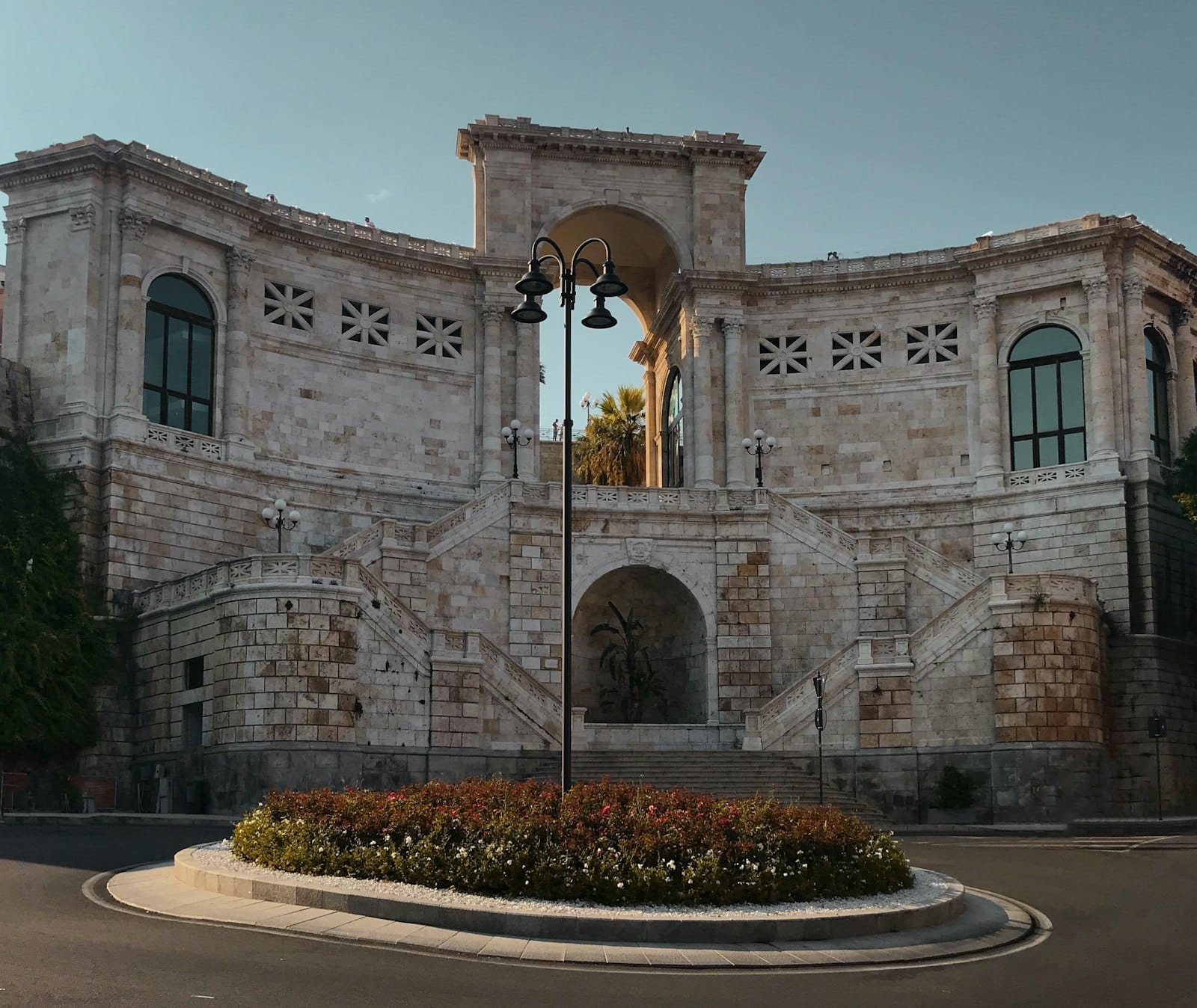
What Is the Bastione di Saint Remy?
The Bastione di Saint Remy is a monumental public terrace and neoclassical loggia built between 1896 and 1902 on top of the old Spanish-era defensive walls dating from the second half of the sixteenth century at the southern flank of Cagliari's Castello district. Inaugurated in 1902, it was conceived as a grand civic promenade connecting the medieval hilltop neighbourhood to the lower modern city — a piece of urban ambition that was very much of its era, when Italian cities were rebuilding their public spaces to match the aspirations of the newly unified nation.
The structure centres on a broad, triumphal-arch gateway called the Umberto I arch, which frames the ceremonial staircase ascending to the upper terrace. From that terrace, the panorama sweeps across the rooftops of the Marina district, over the port, and on clear days extends to the Stagno di Cagliari lagoon and the hills ringing the gulf. The effect is one of genuine scale — you are standing on what was once a fortification wall, now transformed into a civic balcony.
💡 Local tip
The panoramic elevator rises from Piazza Costituzione directly to the upper terrace level — useful if you want the view without climbing the long ceremonial staircase. Both options arrive at the same terrace.
The Architecture: Belle Époque on Medieval Foundations
The design is confidently neoclassical, full of pilasters, stone balustrades, and decorative detailing that feels more northern Italian than typically Sardinian. The covered loggia — a vaulted gallery running along the upper level — is particularly striking at close range. Its arched ceilings and pale stonework absorb light differently depending on the hour, feeling almost luminous in the early morning and warm amber-toned in the late afternoon.
Construction used the existing Spanish-era walls as a foundation, which means the Bastione is effectively a 17th-century defensive structure wearing a late 19th-century face. That layering of histories is easy to miss if you approach it purely as a viewpoint, but it explains the sheer mass of what you are standing on. The stone underfoot is older than anything the Belle Époque builders put above ground.
The bastion was badly damaged by Allied bombing in 1943 — part of the sustained air campaign against Cagliari during World War II that left large parts of the lower city in ruins. Post-war reconstruction work eventually restored the structure, and post-war reconstruction work restored the structure substantially according to the original design. The covered promenade section has more recently been repurposed as a museum and exhibition space.
Tickets & tours
Hand-picked options from our booking partner. Prices are indicative; availability and final rates are confirmed when you complete your booking.
Vineyard Guided Tour and 7 Wine Tasting in Palau
From 84 €Instant confirmationFree cancellationFull-Day Sailboat Tour in La Maddalena Archipelago from Cannigione
From 112 €Instant confirmationFree cancellationHiking excursion to the Devil's Saddle
From 35 €Instant confirmationFree cancellationExcursion to the Archaeological site of Nora
From 70 €Instant confirmationFree cancellation
The View: What You Actually See from the Top
The upper terrace faces roughly south and southwest, which makes it one of the best sunset positions in Cagliari. In the immediate foreground you get the rooftile geometry of the Marina neighbourhood and the campanile of the Cathedral of Santa Maria Assunta. Further out, the port infrastructure and the blue-grey expanse of the Gulf of Cagliari open up. On exceptionally clear winter days, the mountains of the Sulcis interior are visible as a dark line on the horizon.
The terrace does not rotate or frame its views artificially — what you see is the real city, in real proportion. That makes it more useful for orientation than many purpose-built viewpoints, since you leave with an accurate mental map of how the Castello district sits above the rest of Cagliari, and how the port and the lagoon system relate to each other. Visitors doing a first day in the city often find that coming here early helps every subsequent walk make more sense.
ℹ️ Good to know
Morning light falls across the terrace from the east, making it well-suited for photography of the city fabric below. Sunset is when the terrace is at its most photogenic from the outside — the warm light catches the pale stone facade beautifully — but the view westward from the top is also excellent at dusk.
How the Experience Changes by Time of Day
In the early morning — say, before 9am — the terrace is nearly empty. The stone is cool underfoot, the port below is already active with cargo operations, and the Cathedral bells mark the hour from close by. The smell of salt air and the faint diesel scent from the harbour make it feel like a working Mediterranean city rather than a postcard.
Midday in summer is the least comfortable time to visit. The stone terrace absorbs heat quickly and there is minimal shade at the top level. The crowds are also at their thickest between roughly 11am and 2pm in peak season. If you are visiting in July or August, the early morning or post-6pm window is a significant quality-of-experience improvement.
Late afternoon and early evening are when the terrace becomes a genuine social space. Local residents, couples, and groups of friends gather along the balustrade as the light softens. Street vendors sometimes set up near the base of the stairs. The atmosphere shifts from sightseeing to something more like the Italian passeggiata tradition — unhurried, conversational, oriented around being outside rather than consuming a specific attraction.
Getting There and Getting Up
The bastion sits at the southern end of the Castello hill, directly above Piazza Costituzione. From the lower city, the most direct approach is along Viale Regina Margherita from Via Roma, the seafront boulevard. The ceremonial staircase rising from Piazza Costituzione is the classical approach — long, wide steps under the Umberto I arch — and the ascent takes two to three minutes at a normal pace. The steps can be slippery when wet.
The panoramic elevator is the practical alternative, located in Piazza Costituzione at the base of the structure. It deposits you directly at the upper terrace level. For visitors with mobility limitations, this is the only realistic option, as the staircase has no ramp alternative. It is worth noting that the elevator is a public facility and operational status should be checked on arrival — public urban elevators of this type occasionally undergo maintenance closures.
Once on the terrace, the Castello district's streets are directly accessible through the loggia. From here you can walk uphill to the Cattedrale di Santa Maria, or continue into the narrow lanes of the old quarter. The bastion works well as either a starting point or an endpoint for a walking loop through Castello.
⚠️ What to skip
Wear shoes with grip if visiting during or after rain. The terrace stones and the ceremonial staircase can become slick, and the incline of the approach steps is steeper than it looks in photographs.
Photography Notes
The terrace itself is best photographed from below and slightly to the side — the full facade with the Umberto I arch reads well from the middle of Piazza Costituzione in the late afternoon, when the stone catches warm directional light. From above, the standard shot looks straight south over the rooftops toward the port, ideally with a slightly elevated angle available from the far corners of the terrace balustrade.
For city-wide panoramas, a wide-angle lens is more useful than a telephoto. The view is about breadth rather than a single tight subject. In golden hour, the rust-orange rooftiles of the Marina quarter and the pale stone of the Cathedral tower photograph particularly well as a combined subject.
Context: Where It Fits in a Cagliari Visit
Cagliari rewards visitors who understand its vertical structure: the Castello hilltop where the old city and its fortifications sit, the Marina and Stampace districts below, and the seafront along Via Roma at the base. The Bastione di Saint Remy is the physical hinge between those layers. Combining it with a visit to the Museo Archeologico Nazionale nearby, or a walk through the ancient district to the Roman Amphitheatre, gives a much richer sense of the city's full timeline than either site offers in isolation.
If you have a full day in the city, the bastion pairs naturally with a morning walk along the Spiaggia del Poetto — Cagliari's long city beach a few kilometres to the east — and a stop at the Mercato di San Benedetto for lunch. The bastion then works as an early evening viewpoint to close the day.
For broader context on what to do in the Sardinian capital, the Cagliari destination guide covers the city's neighbourhoods, beaches, and day-trip options in detail.
Who Might Not Enjoy This
Travellers expecting a purpose-built observation deck with enclosed platforms, information panels, or café facilities at the top will find the Bastione more austere than anticipated. There is no interpretive signage explaining the view or the history on-site — you get the panorama and the architecture, without the tourism infrastructure some visitors expect. On a grey winter day with cloud cover, the view loses much of its impact, and the open terrace can be cold and windswept.
The bastion is also not a destination for people primarily interested in beaches, hiking, or Nuragic history — those are the kinds of attractions that define Sardinia's broader appeal, and this is very specifically an urban experience in the island's capital city.
Insider Tips
- The best angle for photographing the full facade of the bastion is from the northern side of Piazza Costituzione, roughly 30 metres back from the base of the stairs. From this position the Umberto I arch frames cleanly without perspective distortion.
- The loggia level, which functions as an exhibition space, is worth checking even when no temporary show is running — the vaulted ceilings and the quality of the stonework are best appreciated from inside the covered gallery, not from the open terrace above.
- On Sunday mornings, the area around the base of the bastion connects naturally with the antiques and second-hand market that sometimes sets up along the lower Castello perimeter — combining both gives a useful sense of how locals actually use this part of the city.
- If you arrive by elevator and descend via the ceremonial staircase, you get the best sequence: the view first, then the monumental approach framing the lower city as you descend — it reads architecturally in that direction.
- In summer, a gelato from one of the cafes on Via Roma before climbing is a practical investment. There is nothing to buy at the top, and the stone terrace in July afternoon sun is hot work.
Who Is Bastione di Saint Remy For?
- First-time visitors to Cagliari who want a fast city orientation
- Photographers, especially those working at golden hour
- Architecture and urban history enthusiasts interested in post-unification Italian civic design
- Couples looking for a low-key sunset location that does not require a reservation
- Travellers combining the bastion with a broader Castello district walking itinerary
Nearby Attractions
Other things to see while in Cagliari:
- Anfiteatro Romano di Cagliari
The Roman Amphitheatre of Cagliari is the most significant Roman monument in Sardinia, partially carved into the limestone hillside of Colle di Buoncammino. With a capacity estimated at 10,000 spectators, it dates to the late 1st or early 2nd century AD. Ongoing restoration limits what you can explore, but the scale of the structure and its setting repay the modest entrance fee.
- Castello District
Perched about 100 metres above sea level on a fortified limestone hill, the Quartiere Castello is the oldest and most historically layered part of Sardinia's capital. Enclosed by 13th-century Pisan walls, it holds the city's cathedral, major museums, and some of the best rooftop views in the Mediterranean. Entry is free, and the streets can be walked at any hour.
- Cattedrale di Santa Maria (Cagliari)
Rising above the Castello quarter on Piazza Palazzo, the Cattedrale di Santa Maria e Santa Cecilia is Cagliari's most important religious monument. First documented in the mid‑13th century and remodelled across several centuries, it layers Pisan Romanesque, Gothic, Baroque, and Neo-Romanesque styles into a single compelling structure. Entry is free, and the interior rewards anyone willing to look closely.
- Laguna di Santa Gilla
The Laguna di Santa Gilla is a major coastal wetland complex immediately west of Cagliari, protected under the Ramsar Convention and the EU Natura 2000 network. It hosts thousands of flamingos alongside dozens of other bird species, and carries layers of Phoenician, Carthaginian, and medieval history beneath its still, reflective surface. Entry to the natural area is free, and even a short stop along the SS 195 road can be surprisingly rewarding.