Laguna di Santa Gilla: One of Sardinia's Largest Coastal Wetlands at Cagliari's Edge
The Laguna di Santa Gilla is a major coastal wetland complex immediately west of Cagliari, protected under the Ramsar Convention and the EU Natura 2000 network. It hosts thousands of flamingos alongside dozens of other bird species, and carries layers of Phoenician, Carthaginian, and medieval history beneath its still, reflective surface. Entry to the natural area is free, and even a short stop along the SS 195 road can be surprisingly rewarding.
Quick Facts
- Location
- Between Cagliari, Elmas, Assemini and Capoterra, southwest Sardinia (approx. 39°12′N, 9°03′E)
- Getting There
- By car via SS 195 from Cagliari (10–15 min); local ARST and CTM buses serve the Capoterra and Elmas areas. No direct urban tram stop at the lagoon edge.
- Time Needed
- 1–3 hours for a drive-and-stop visit; half a day for a guided boat tour or full birdwatching session
- Cost
- Free to access the natural area. Guided tours and MuLag museum entry are ticketed separately (verify current prices with CEAS Laguna di Santa Gilla or MuLag)
- Best for
- Birdwatchers, nature photographers, history enthusiasts, families wanting outdoor space near Cagliari
- Official website
- www.sardegnaturismo.it/en/protected-oases-between-land-and-sea
What Is the Laguna di Santa Gilla?
The Laguna di Santa Gilla, also known officially as the Stagno di Cagliari, is among the largest coastal wetlands in Sardinia, with the wider protected complex often cited at roughly 15,000 hectares. It sits directly west of Cagliari's city limits, bordered by the municipalities of Elmas, Assemini, and Capoterra, with the industrial salt flats of Macchiareddu occupying part of its southern edge. From a distance it reads as a flat, glittering expanse, but look closer and you begin to see the teeming biological activity that has earned it protection under the 1971 Ramsar Convention and inclusion in the EU Natura 2000 network as a Special Area of Conservation (formerly Site of Community Importance, code ITB040023) and a Special Protection Area under the EU Birds Directive.
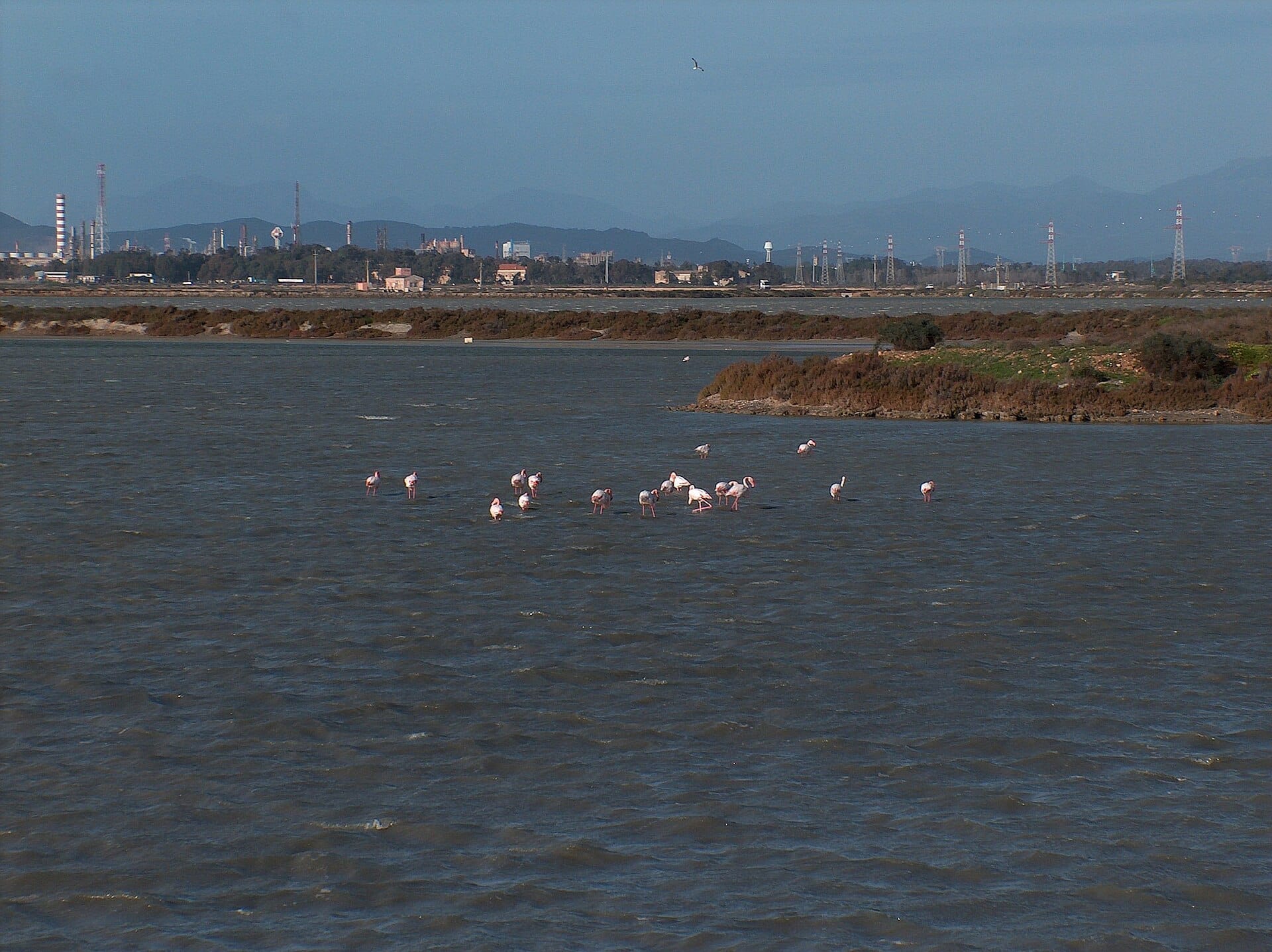
This is not a manicured nature reserve with marked boardwalks at every turn. Much of the lagoon is accessible only by boat, and the landscape shifts between open water, reed beds, and salt marsh depending on where you stand. The industrial infrastructure of Macchiareddu is visible on the southern horizon, which some visitors find jarring. That contrast, though, is part of what makes Santa Gilla honest: it is a working, living wetland that has survived millennia of human activity, not a preserved postcard.
💡 Local tip
The most accessible birdwatching spots are along the SS 195 road (toward Capoterra). Pull-offs allow you to scan the water with binoculars without needing a boat or guide. Arrive before 9 am for the best light and fewest cars.
The Flamingos: What to Actually Expect
Greater flamingos (Phoenicopterus roseus) are the headline attraction, and they deliver. The lagoon supports one of the most significant flamingo populations in the western Mediterranean, with birds present in large numbers for most of the year. In winter and early spring, flocks of several thousand can gather at the shallow edges, their pale pink plumage catching the low southern sun at an angle that makes the whole waterline glow. In summer, numbers fluctuate as some birds disperse to breeding sites elsewhere, but the lagoon never feels empty.
Beyond flamingos, the wetland hosts herons, egrets, cormorants, black-winged stilts, avocets, and various wader species during migration. The brackish conditions support a food chain dense enough to attract birds in serious numbers. Serious birders will want a spotting scope; casual visitors will be satisfied with good binoculars. The bird life is the single strongest reason to come here, and it rarely disappoints.
If birdwatching is a recurring theme in your Sardinia plans, the Parco Molentargius-Saline on Cagliari's opposite edge offers a complementary experience with more formal trail infrastructure, and the two make a natural pairing for a full day outdoors near the city.
Tickets & tours
Hand-picked options from our booking partner. Prices are indicative; availability and final rates are confirmed when you complete your booking.
Catamaran excursion to La Maddalena from Santa Teresa di Gallura
From 118 €Instant confirmationFree cancellationQuad biking tour from Santa Teresa di Gallura
From 0 €Instant confirmationFree cancellationSanta Teresa di Gallura hiking tour of Valle della Luna
From 30 €Instant confirmationFree cancellationSailboat trip to Maddalena archipelago from Santa Teresa Gallura
From 167 €Instant confirmationFree cancellation
Layers of History Beneath the Still Water
The shoreline of Santa Gilla has been inhabited since at least the 8th century BC, when Phoenician traders established fishing and commercial settlements here. The Carthaginians later developed these into the trading centre known as Carales, and the lagoon became an economic artery for the settlement that would eventually grow into Roman Karalis, the predecessor of modern Cagliari. Fish from the lagoon, preserved in salt extracted from its shallows, was traded across the western Mediterranean. That same salt-production logic continued through the medieval period and, in altered industrial form, still operates at the Macchiareddu saline today.
The lagoon also served as the theatre for one of medieval Sardinia's most consequential military confrontations. In 1194, a naval battle between the Republic of Genoa and the Republic of Pisa for control over the local Judicate of Cagliari was fought on these waters. The political fallout from that contest shaped the subsequent centuries of Sardinian history. Standing on the shore now, with the city reflected on the water and flamingos feeding in the shallows, the idea of fleets clashing here strains the imagination, but the history is genuine.
For visitors wanting to extend their understanding of Cagliari's deep history, the Nora archaeological site on the coast south of Pula offers extensive Phoenician and Roman remains in a dramatic coastal setting, and makes a logical day trip from the city.
How the Lagoon Changes Through the Day
Early morning is the most rewarding time to visit, without question. Before the sun rises fully above the Cagliari hills to the east, the water takes on a dense silver-blue colour, and the flamingos are most active, wading and filter-feeding in the shallows. The sounds at this hour are worth pausing for: the low, goose-like honking of flamingo flocks, the sharp calls of stilts, the occasional slap of a mullet jumping. Traffic on the SS 195 is light, and the industrial skyline of Macchiareddu disappears into morning haze.
By midday in summer, heat shimmer blurs the far shore and the birds retreat to deeper, cooler water. The lagoon feels quieter, almost drowsy. This is not the ideal photography window, but the reflective quality of the light on flat water can produce striking images in the right conditions. Afternoon, especially in autumn and spring, brings softer directional light from the west, which is useful for photography from the Capoterra side of the road.
Sunset draws a local audience. Cagliari residents drive out to pull over on the SS 195 verge, some with folding chairs, to watch the sky turn over the water. In autumn the sunsets can be spectacularly long, with the pink of the dying light competing visually with the pink of the flamingos below. It is an unscripted and pleasant local ritual.
Practical Walkthrough: How to Visit
The lagoon has no single entrance gate or ticket booth. The most practical approach for a first visit is to drive the SS 195 southwest from Cagliari toward Capoterra. Within ten to fifteen minutes of leaving the city centre, the road begins to skirt the lagoon's northern edge, and pull-off points allow for roadside observation. A good pair of binoculars transforms this from a passing glance into a genuine experience. The flamingos are typically visible from the road without any specialist equipment when numbers are high.
For a more structured experience, the CEAS Laguna di Santa Gilla (Centro di Educazione Ambientale e alla Sostenibilità) organises guided boat tours and educational visits. These are the most effective way to access the interior of the lagoon and reach areas not visible from the road. Check current schedules and availability directly with the CEAS, as these are not year-round on demand. The MuLag (Museo della Laguna) provides broader ecological and historical context and is worth a visit if you want background before or after time outdoors. Verify current opening hours and ticket prices for both before visiting, as they are subject to seasonal adjustment.
ℹ️ Good to know
The lagoon spans four municipalities. There is no single visitor centre covering the whole area. If you are planning a guided tour or a visit to MuLag, contact CEAS Laguna di Santa Gilla or MuLag directly in advance, particularly outside the April–October period when services may be reduced.
Santa Gilla fits naturally into a wider Cagliari itinerary. The city's Castello district and the Museo Archeologico Nazionale pair well for a morning of history before an afternoon lagoon visit as the light becomes more favourable.
What to Bring, and What the Weather Means Here
Sardinia's climate around Cagliari is Mediterranean, with dry summers and most rainfall concentrated in autumn and winter. Summer temperatures along the lagoon frequently reach 30°C or above, and the flat, open terrain offers no shade. A sun hat, sunscreen, and water are essential from May through September. In winter and early spring, coastal wind off the lagoon can be sharp even when the air temperature seems mild; a light windproof layer is worth carrying.
Mosquitoes are present near the reed beds in warm months, particularly in the hour before dusk. Insect repellent is not optional for an evening visit. Footwear should be closed and comfortable for any walking along unpaved tracks near the water; the ground can be uneven and sometimes muddy near the shore after rainfall.
Photography conditions vary significantly with weather. Overcast days reduce glare from the water surface and produce more even colour in bird plumage, which is an advantage in winter. Clear days in autumn and winter, when low sun angles provide warm directional light, are often the most photogenic. Summer midday light tends to bleach colour from the scene and create strong shadows on white bird feathers.
⚠️ What to skip
The lagoon's industrial fringe at Macchiareddu is clearly visible from parts of the SS 195. If you are expecting a purely wild, remote landscape, manage expectations: this is a protected natural area within an urban and industrial context. The birds are real and abundant, but the setting is not pristine wilderness.
Who Should Skip This, and Who Should Stay Longer
Visitors who need structured amenities, clearly signed trails, or a visitor experience that works without a car will find Santa Gilla frustrating. Public transport options serve the broader area but do not deposit you at an obvious lagoon access point, and there are no cafes, toilets, or information boards along the SS 195 viewing stretch. This is a place for self-sufficient visitors comfortable navigating open natural areas without handholding.
Equally, anyone hoping for the kind of manicured wetland reserve experience found in northern European nature parks will be disappointed. Santa Gilla is compelling precisely because it is not manicured. But that requires a tolerance for ambiguity about where to stand, what you are allowed to do, and where the actual birds are on any given day.
Families with younger children who want outdoor space near Cagliari without the complexity of self-navigation might find the lagoon better approached through an organised CEAS tour. For independent families, the Spiaggia del Poetto offers a more straightforward and child-friendly outdoor experience on Cagliari's eastern edge.
Insider Tips
- The northern shore of the lagoon, viewed from the SS 195 heading toward Capoterra, offers the best roadside flamingo sightings. The stretch roughly between the Elmas junction and the Capoterra turnoff is the sweet spot for pull-over observation.
- Autumn (late September through November) is arguably the most rewarding season overall: flamingo numbers are high, temperatures are comfortable at 19–27°C, light quality is excellent in the late afternoon, and you will share the road with very few other visitors.
- If you contact CEAS Laguna di Santa Gilla in advance, guided boat tours can be arranged that access interior channels of the lagoon completely invisible from the road. These give a fundamentally different and more immersive experience than any roadside stop.
- The Macchiareddu salt flats on the southern edge of the lagoon system occasionally attract species different from the main lagoon, including terns and waders that prefer more open saline conditions. Ask a local birding contact or the CEAS whether the flats are accessible when you visit.
- If you arrive at dusk and the light turns extraordinary, resist the temptation to stop on the main carriageway: traffic moves faster than it appears, and the SS 195 verge is narrow in sections. Use a designated pull-off rather than a roadside stop.
Who Is Laguna di Santa Gilla For?
- Birdwatchers and wildlife photographers seeking flamingos and wader species within easy reach of Cagliari
- History-minded travellers curious about Phoenician, Carthaginian, and medieval Sardinian heritage
- Photographers looking for dawn and dusk landscape conditions with water reflections and bird activity
- Visitors wanting a free, outdoor half-day experience that contrasts with Cagliari's urban sightseeing
- Families or small groups on an organised guided boat tour who want structured ecological interpretation
Nearby Attractions
Other things to see while in Cagliari:
- Anfiteatro Romano di Cagliari
The Roman Amphitheatre of Cagliari is the most significant Roman monument in Sardinia, partially carved into the limestone hillside of Colle di Buoncammino. With a capacity estimated at 10,000 spectators, it dates to the late 1st or early 2nd century AD. Ongoing restoration limits what you can explore, but the scale of the structure and its setting repay the modest entrance fee.
- Bastione di Saint Remy
Standing at the southern edge of the Castello district, the Bastione di Saint Remy is a monumental Belle Époque terrace that offers some of the most commanding views in Cagliari. Free to enter and, as a public terrace, generally accessible at all hours, it rewards visitors who time their ascent right — especially at dusk, when the city lights begin to compete with the last colour in the sky.
- Castello District
Perched about 100 metres above sea level on a fortified limestone hill, the Quartiere Castello is the oldest and most historically layered part of Sardinia's capital. Enclosed by 13th-century Pisan walls, it holds the city's cathedral, major museums, and some of the best rooftop views in the Mediterranean. Entry is free, and the streets can be walked at any hour.
- Cattedrale di Santa Maria (Cagliari)
Rising above the Castello quarter on Piazza Palazzo, the Cattedrale di Santa Maria e Santa Cecilia is Cagliari's most important religious monument. First documented in the mid‑13th century and remodelled across several centuries, it layers Pisan Romanesque, Gothic, Baroque, and Neo-Romanesque styles into a single compelling structure. Entry is free, and the interior rewards anyone willing to look closely.