Roman Amphitheatre of Cagliari: Ancient Stone, What to Expect
The Roman Amphitheatre of Cagliari is the most significant Roman monument in Sardinia, partially carved into the limestone hillside of Colle di Buoncammino. With a capacity estimated at 10,000 spectators, it dates to the late 1st or early 2nd century AD. Ongoing restoration limits what you can explore, but the scale of the structure and its setting repay the modest entrance fee.
Quick Facts
- Location
- Via Fra' Ignazio, Cagliari – on the southern slopes of Colle di Buoncammino, between the Castello and Stampace districts
- Getting There
- CTM urban buses lines 8 and 10 serve the area nearby; also walkable from central Via Roma via Corso Vittorio Emanuele II (allow 20–25 min uphill)
- Time Needed
- 45–90 minutes, including the walk along the accessible viewing route
- Cost
- €3 standard; €2 reduced (students up to age 26, over-65s, groups of 15+); €1 schools; free for children under 6 and persons with disabilities and their companions. Combined 7-day 'Monumenti di Cagliari' ticket: €8
- Best for
- Roman history enthusiasts, architecture visitors, and anyone based in Cagliari with a morning to fill
What You're Actually Looking At
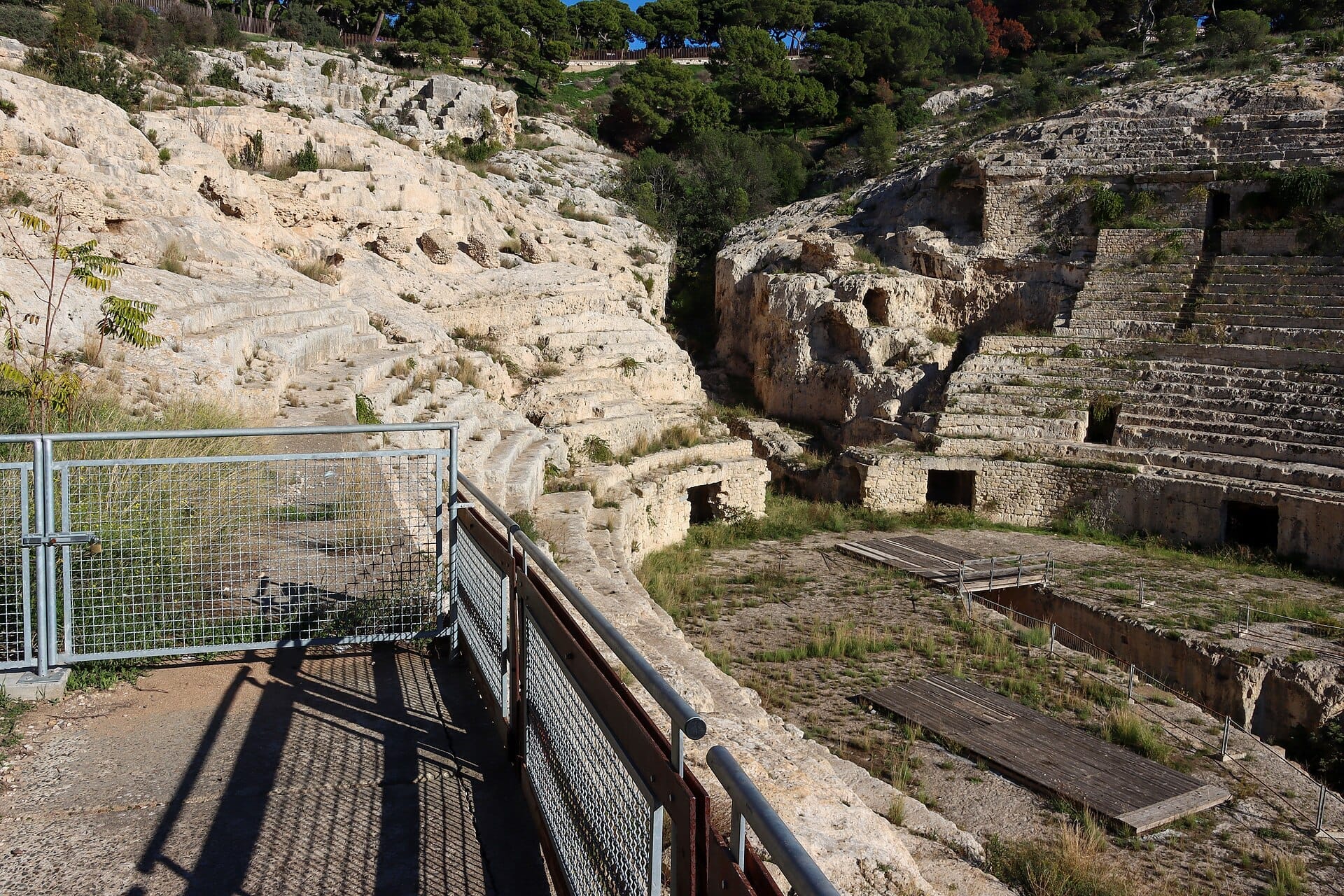
The Roman Amphitheatre of Cagliari — known in Italian as the Anfiteatro Romano di Cagliari — is not a ruin that has been tidied up for photographs. It is raw, partially excavated, and still mid-restoration in places. That unvarnished quality is part of its value. What survives is substantial: a structure with a capacity estimated at 10,000 spectators on a rock-cut hillside above the modern city.
The amphitheatre was built during the Roman Imperial period on the site of the ancient city of Karales, probably dating from the late 2nd century AD. Its designers took full advantage of the terrain: approximately half the structure was carved directly into the limestone of Colle di Buoncammino, with the remaining sections built from local white limestone blocks. The result is a building that is literally part of the hill. You can see the grain of the rock in the seating tiers, and in summer the pale stone holds warmth well into the evening.
At its peak the amphitheatre held an estimated 10,000 spectators — a figure that underlines how significant the Roman city of Karales was on the island. As a reference point, Cagliari today has a population of around 150,000, and this was a monument built for a city that commanded the whole of Sardinia's southern coast.
⚠️ What to skip
Current access is partial. As of the latest municipal information, the arena floor and underground spaces are not open to visitors due to ongoing restoration works. You follow an accessible viewing route along the upper perimeter. Check with the Comune di Cagliari before visiting if full access matters to your plans.
The Visit in Practice: What You See and How It Changes by Hour
The entrance is on Viale Sant'Ignazio da Laconi, a broad avenue lined with university buildings and overlooked by the faculty of law — an appropriately civic neighbourhood for a civic monument. You buy your ticket at the gate without needing to reserve in advance. The accessible route begins at street level and continues along a viewing path.
Morning visits, before 11:00, tend to be quiet. The limestone is still cool to the touch, pigeons move through the carved tiers, and you can hear the city below more than you can see it. The scale of the stone seating registers slowly at this hour — the rows of carved rock look almost abstract until you position yourself at one end and look down the full length of the oval. By midday in summer the heat reflecting off the pale stone becomes uncomfortable, and the site has no significant shade inside the viewing area. Bring water and a hat if you visit between June and September.
Late afternoon, particularly during the April to September season when the site stays open until 19:00, offers the best photographic light. The low sun catches the texture of the carved rock faces and brings out the contrast between the cut limestone and the darker, older surface of the hill. Crowds at this hour are light to moderate; the amphitheatre does not draw the same volume as Cagliari's cathedral or the Bastione di Saint Remy, so you are unlikely to be competing for viewpoints.
Tickets & tours
Hand-picked options from our booking partner. Prices are indicative; availability and final rates are confirmed when you complete your booking.
Gulf of Cagliari kayak tour
From 72 €Instant confirmationFree cancellationCagliari Sunset Boat Tour With Prosecco, Focaccia and Swimming
From 75 €Instant confirmationFree cancellationSmall Group Tour to Su Nuraxi Unesco Site From Cagliari
From 90 €Instant confirmationFree cancellationCagliari Small Group Tour by Minibus
From 85 €Instant confirmationFree cancellation
Historical and Cultural Context
Sardinia's Roman period is less studied than its Nuragic prehistory, but Karales — the Roman predecessor to Cagliari — was one of the most important administrative centres in the western Mediterranean. An amphitheatre of this scale signals that the city had both the population and the civic ambition to maintain the full suite of Roman public spectacle. Gladiatorial combat, animal hunts (venationes), and public executions all took place in structures like this one across the empire.
After the fall of the Western Roman Empire, the amphitheatre was gradually dismantled for building material — a fate shared by most Roman structures across the Mediterranean. Blocks of limestone from the upper sections were repurposed across the medieval city. What remained intact was largely what was embedded in the hillside and too difficult to extract. For anyone wanting to place this monument in the wider context of Sardinian archaeology, the Museo Archeologico Nazionale di Cagliari holds the most significant collection of Roman-era finds from the island, including objects excavated from the Karales site.
The site was properly excavated and studied from the late 19th century onward, and the Italian Ministry of Culture (Ministero della Cultura) lists it among the protected cultural heritage sites of Sardinia. It is managed by the Comune di Cagliari, and it is included in the Monumenti di Cagliari combined ticket.
Getting There: Routes and Transit
CTM bus lines 8 and 10 serve the area around Viale Sant'Ignazio da Laconi. If you are staying in the Marina or Stampace districts, the walk is achievable but involves a sustained uphill stretch of around 20 to 25 minutes. The route via Corso Vittorio Emanuele II and then Via Porto Scalas is the most straightforward: follow the corso until you can turn up toward the university area, then look for the signs on Viale Sant'Ignazio da Laconi. The amphitheatre sits on the right side of the road after the Law Faculty building.
The site is most naturally combined with a visit to the Museo Archeologico Nazionale di CagliariCastello district, which sits on the same hill and shares its elevated limestone geography. Plan the amphitheatre first, then walk uphill into Castello for lunch — you will be moving with the gradient rather than against it.
💡 Local tip
If you plan to visit multiple Cagliari monuments, the combined 'Monumenti di Cagliari' ticket at €8 covers seven days of access to several municipal sites and is significantly better value than individual entries. Ask for it at the amphitheatre ticket desk.
Opening Hours and Seasonal Differences
The amphitheatre operates on two seasonal schedules. From 1 October to 27 April, it opens daily from 10:00 to 17:00. From 28 April to 30 September, it opens daily from 10:00 to 13:00 and from 15:00 to 19:00, with a midday closure during the hottest part of the day. This split-hours summer schedule is common at Cagliari's outdoor heritage sites and is worth building into your itinerary — arriving at 13:30 means a locked gate and a two-hour wait.
The cooler months from October through March are underrated for this site. You get the full single-session opening, the stone is less punishing, and the surrounding university area is quieter during academic holidays. Winter light in Cagliari is clear and low-angled, which accentuates the carved rock surfaces more dramatically than flat summer overhead light. Rainfall is more likely between November and March, but a single wet morning rarely lasts all day in Cagliari.
Practical Notes: Strengths and Limitations
The Roman Amphitheatre of Cagliari is not on the same visual scale as the Colosseum in Rome or the amphitheatre at Verona. The partially restricted access means you cannot walk the arena floor or explore the underground passages that once staged the spectacle. If you have visited well-preserved Roman amphitheatres elsewhere in Europe, the experience here will feel more fragmentary.
That said, the entrance fee is low enough that the value calculation is simple. At €3 for a standard ticket, you are paying for a genuine Roman site with 2,000 years of layered history, carved into a hillside above a working Mediterranean city. The viewing route is accessible, unhurried, and never crowded. The context — a Roman monument embedded in the geography of a living city — gives it an authenticity that fully reconstructed sites lack.
Travelers who need high visual drama or immersive exhibits should note that the amphitheatre has no indoor interpretive space or multimedia installation. For deeper context on Sardinia's Roman period, the Museo Archeologico Nazionale di Cagliari provides the interpretive layer that the site itself does not. Visitors focused on Sardinia's prehistoric past may find more to engage with at the island's Nuragic sites: the guide to Sardinia's Nuragic sites covers the best options across the island.
People with very limited mobility should note that while the entrance ramp and main viewing walkway are accessible, the surrounding hillside streets are steep and uneven, and the walk from central Cagliari involves significant gradient. The bus is the practical option for anyone who cannot manage extended uphill walking.
Insider Tips
- Visit in the first hour after opening (10:00) on weekday mornings. The site is reliably quiet, the stone is still cool, and you will have clear sightlines for photographs without other visitors in frame.
- The summer midday closure (13:00–15:00) is non-negotiable. If you arrive during that window, head up to Castello for lunch and return at 15:00 rather than waiting at the gate.
- The combined 'Monumenti di Cagliari' ticket at €8 gives seven-day access to multiple municipal sites. If you are spending two or more days in Cagliari, it covers its cost almost immediately.
- The Law Faculty building opposite the entrance has a small bar where students get coffee. It is cheaper than anything in the Marina and a useful stop before or after your visit.
- Bring sun protection in summer — there is almost no shade on the viewing route inside the amphitheatre, and the pale limestone reflects heat intensely between June and September.
Who Is Anfiteatro Romano di Cagliari For?
- Travelers with an interest in Roman provincial history and architecture who want to understand Sardinia beyond its beaches
- Anyone spending two or more days in Cagliari who has already seen the Castello district and wants to extend their historical itinerary
- Budget-conscious visitors: at €3 standard entry, it is one of the most affordable heritage sites in the city
- Visitors combining it with the Museo Archeologico Nazionale di Cagliari for a full day of Roman-era Sardinia
- Photographers interested in the texture of carved limestone and Roman stonework in natural light, particularly in the late afternoon
Nearby Attractions
Other things to see while in Cagliari:
- Bastione di Saint Remy
Standing at the southern edge of the Castello district, the Bastione di Saint Remy is a monumental Belle Époque terrace that offers some of the most commanding views in Cagliari. Free to enter and, as a public terrace, generally accessible at all hours, it rewards visitors who time their ascent right — especially at dusk, when the city lights begin to compete with the last colour in the sky.
- Castello District
Perched about 100 metres above sea level on a fortified limestone hill, the Quartiere Castello is the oldest and most historically layered part of Sardinia's capital. Enclosed by 13th-century Pisan walls, it holds the city's cathedral, major museums, and some of the best rooftop views in the Mediterranean. Entry is free, and the streets can be walked at any hour.
- Cattedrale di Santa Maria (Cagliari)
Rising above the Castello quarter on Piazza Palazzo, the Cattedrale di Santa Maria e Santa Cecilia is Cagliari's most important religious monument. First documented in the mid‑13th century and remodelled across several centuries, it layers Pisan Romanesque, Gothic, Baroque, and Neo-Romanesque styles into a single compelling structure. Entry is free, and the interior rewards anyone willing to look closely.
- Laguna di Santa Gilla
The Laguna di Santa Gilla is a major coastal wetland complex immediately west of Cagliari, protected under the Ramsar Convention and the EU Natura 2000 network. It hosts thousands of flamingos alongside dozens of other bird species, and carries layers of Phoenician, Carthaginian, and medieval history beneath its still, reflective surface. Entry to the natural area is free, and even a short stop along the SS 195 road can be surprisingly rewarding.