Castello District, Cagliari: Walking the City's Medieval Heart
Perched about 100 metres above sea level on a fortified limestone hill, the Quartiere Castello is the oldest and most historically layered part of Sardinia's capital. Enclosed by 13th-century Pisan walls, it holds the city's cathedral, major museums, and some of the best rooftop views in the Mediterranean. Entry is free, and the streets can be walked at any hour.
Quick Facts
- Location
- Hilltop historic quarter, central Cagliari, Sardinia — approximately 100 m above sea level
- Getting There
- CTM city buses stop near Bastione di Saint Remy; a public elevator links the lower city directly to the quarter
- Time Needed
- 2–4 hours for a thorough walk; half a day if visiting museums or the cathedral
- Cost
- Free to enter the district; individual museums and towers charge separate admission
- Best for
- History enthusiasts, photographers, architecture lovers, slow walkers who want depth over beaches
What Castello Is — and Why It Matters
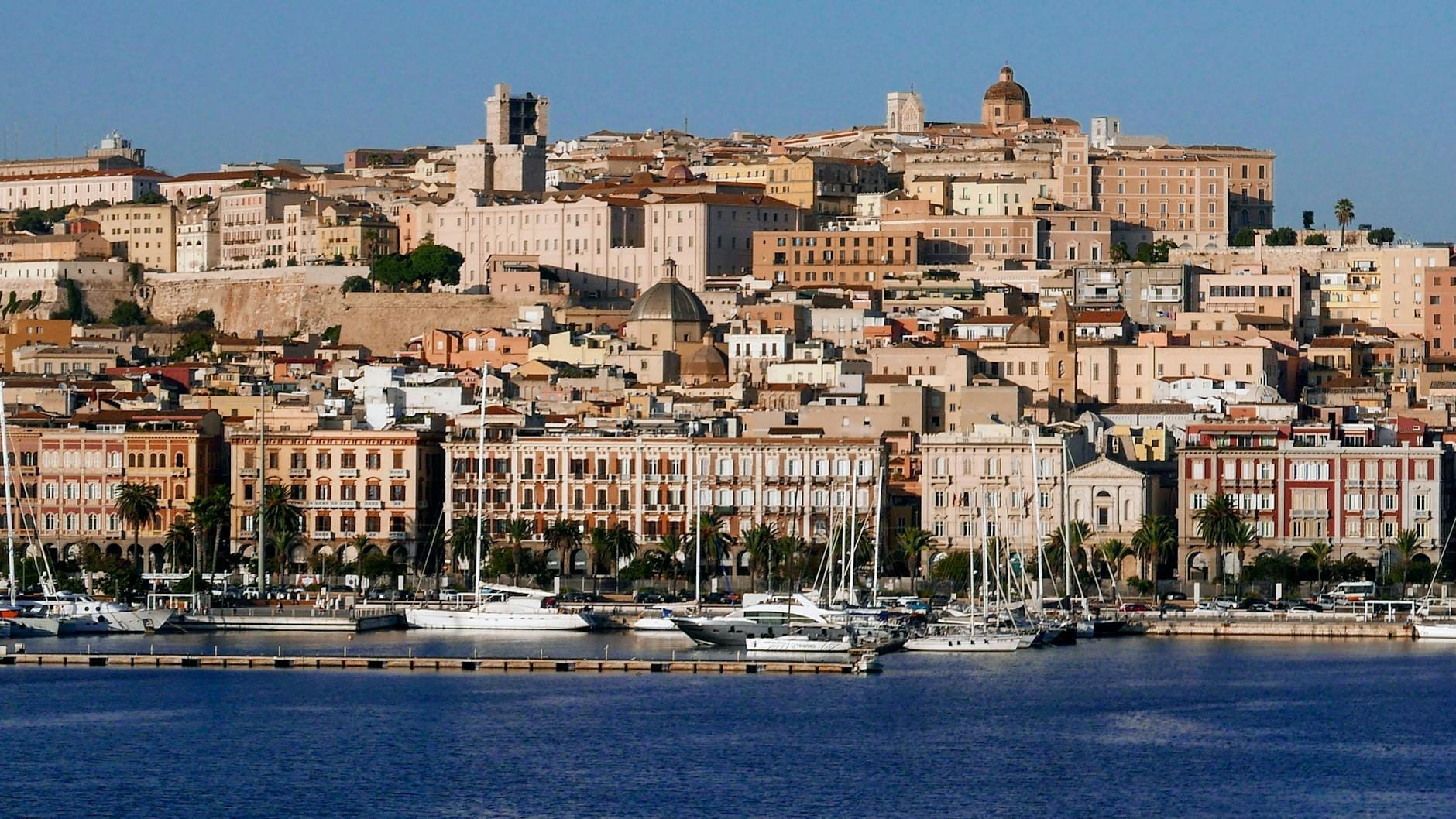
The Castello District, known locally as Quartiere Castello or historically as Castel di Castro, is the elevated, walled nucleus around which the rest of Cagliari grew. It sits on the city's highest hill, ringed by medieval defensive walls that have separated it from the lower quarters for centuries. This is not a reconstructed heritage zone or an open-air museum: people live here, cars occasionally squeeze through narrow lanes, and laundry hangs between buildings that have stood since the Aragonese period. The layering of eras is immediate and physical.
For visitors spending time in Cagliari, Castello rewards slower exploration far more than a quick loop between landmarks. The district's streets shift from broad, sunlit terraces with sweeping sea views to steep, shadowed alleys where the stonework is damp year-round. Getting lost here is both easy and worthwhile.
💡 Local tip
Use the public elevator (ascensore) connecting the lower city near Via Roma to Castello — it eliminates the steepest section of the climb and deposits you inside the walls with energy left for exploring.
A Brief History: Pisans, Aragonese, and Seven Centuries of Walls
Castello's fortified hilltop dates to the 13th century, when Pisan merchants and administrators built a walled city-within-a-city during the final phase and subsequent collapse of the Giudicato of Cagliari. The Pisans understood the military logic of the site immediately: a near-vertical limestone hill commanding the bay, with sightlines across the Campidano plain and out to sea. They constructed towers, gates, and walls that still define the district's outline today.
Aragonese control replaced Pisan rule in the 14th century, and the new rulers reinforced the social hierarchy that Castello's geography already implied. The nobility and the ruling classes lived on the hill; the merchant and working populations were confined to the lower quarters of Stampace, Marina, and Villanova. The walls were not purely defensive — they were instruments of social separation, and access through the gates was controlled. Traces of that stratification survive in the architecture: palazzi with worn coats of arms, the cathedral rebuilt and extended across several centuries, and the medieval towers that still punctuate the skyline.
By the 20th century, Castello had transitioned from aristocratic enclave to a somewhat overlooked quarter, its population thinned and many buildings in partial disrepair. The ongoing restoration process, still visible in scaffolding on several facades, has been gradual and uneven — which is part of what makes the district feel inhabited rather than polished for tourism.
Tickets & tours
Hand-picked options from our booking partner. Prices are indicative; availability and final rates are confirmed when you complete your booking.
Gulf of Cagliari kayak tour
From 72 €Instant confirmationFree cancellationCagliari Sunset Boat Tour With Prosecco, Focaccia and Swimming
From 75 €Instant confirmationFree cancellationSmall Group Tour to Su Nuraxi Unesco Site From Cagliari
From 90 €Instant confirmationFree cancellationCagliari Small Group Tour by Minibus
From 85 €Instant confirmationFree cancellation
Arriving and Orientating Yourself
There are several ways to enter Castello, and the approach shapes the experience. The most dramatic entry is via the Bastione di Saint Remy, the monumental neo-classical terrace-belvedere built between 1899 and 1902 that connects the lower city to the hill in a single architectural gesture. Climbing the curved staircase or the ramp, you emerge onto a broad terrace with an immediate panorama over the Gulf of Cagliari. The pale stone and the quality of Mediterranean light at that height — especially in the late afternoon — are striking.
Other entry points include the historic gates set into the Pisan walls: Porta dei Leoni and Porta dell'Aquila are the most recognizable. If you arrive by the public elevator from the lower city, you enter through a less ceremonial but perfectly functional passage that drops you near the upper residential streets. For visitors combining Castello with other city sights, the Bastione di Saint Remy is worth treating as an attraction in its own right, not merely a gateway.
ℹ️ Good to know
The district streets are open at all hours. However, the Bastione di Saint Remy terrace, the cathedral, and the museums each have their own opening times and some close on Mondays or during the afternoon riposo. Check individual sites before planning a tight itinerary.
What You See: Landmarks, Streets, and Sensory Detail
The Cattedrale di Santa Maria di Castello — officially the Cathedral of Santa Maria — occupies a prominent position at the top of the hill. The current facade, in a Pisan Romanesque style, was largely reworked in the early 20th century, which divides opinion among architectural purists, but the interior retains genuine medieval elements including the pulpit originally carved for the cathedral of Pisa. The crypt beneath holds the remains of members of the House of Savoy, a reminder that Cagliari served as a royal seat during the Savoyard period.
The Museo Archeologico Nazionale di Cagliari, located within the district, is one of the most significant archaeology museums in the Mediterranean. Its collections cover the prehistoric Nuragic civilization, the Phoenician and Carthaginian periods, and the Roman city of Nora. If the Nuragic bronzetti — small votive figurines recovered from sacred wells across Sardinia — are on display, they alone justify the visit. The museum provides essential context for anyone planning to visit Nuragic sites around the island. Pair it with the nearby Su Nuraxi di Barumini, the island's most complete Nuragic complex, to understand Sardinia's remarkable prehistoric legacy.
The two surviving medieval towers, Torre di San Pancrazio and Torre dell'Elefante, are among the finest examples of Pisan military architecture in Sardinia. Torre dell'Elefante, named for a small stone elephant carved on its base, is particularly well-preserved. Both towers were built in the early 14th century (Torre di San Pancrazio in 1305 and Torre dell'Elefante in 1307), and both have open sides facing the interior of the city — a deliberate design choice to prevent enemies who had breached the outer walls from using the towers as further strongholds against the Pisans themselves.
Away from the main landmarks, the residential streets of Castello have a texture that no photograph fully captures: rough limestone pavement that becomes slick after rain, the faint smell of stone dust and damp plaster in the narrow alleys, cats sleeping on sun-warmed steps in the early afternoon, and the occasional sound of voices from an open window several floors above. In the smaller piazzas, particularly around Piazza Palazzo, elderly residents use the benches with the ease of people who have been doing so for decades.
How the District Changes Through the Day
Early morning, before 9 a.m., Castello belongs almost entirely to its residents. The bakeries and the few cafes near the main streets are open, but tourist foot traffic is minimal. The quality of light at this hour — low-angle, golden, cutting through the narrow lanes — is the best the district offers for photography. The streets are quiet enough to hear your own footsteps.
Midday brings the sharpest crowds in summer, particularly around the Bastione terrace and the cathedral piazza. Between roughly 1 p.m. and 4 p.m. in peak season, the district quiets again as the afternoon heat discourages lingering outdoors; many of the smaller museums and some churches close during this period. This is actually a good time to be in the shaded alleys of the upper quarter, where the temperature is several degrees cooler than the open terraces.
Late afternoon and evening are the most atmospheric. From around 5 p.m. onwards, the low sun turns the limestone facades amber and rust-coloured. The Bastione terrace fills with a mix of locals and visitors, and the view over the city toward the Stagno di Cagliari lagoon and the sea takes on a different character entirely. A handful of restaurants and wine bars open for the evening in the quiet streets near the Torre di San Pancrazio. The district at dusk, when the walls are lit and the city below is settling into its evening rhythm, is one of Cagliari's most distinctive experiences.
Practical Walkthrough: A Suggested Route
A logical route for first-time visitors: arrive via the Bastione di Saint Remy, take the terrace views before the crowds build, then enter the quarter through the gate and walk uphill to Piazza Palazzo and the cathedral. Continue to Torre dell'Elefante, then loop through the residential lanes toward Torre di San Pancrazio. If visiting the Museo Archeologico, allocate at least 90 minutes. Descend through one of the original Pisan gates to see the full profile of the walls from below.
The total walking distance within Castello is not large — the quarter is compact — but the elevation changes are constant and the surfaces are uneven. Comfortable shoes with grip are non-negotiable. In summer, carry water; the district has limited shade on the upper terraces and the exposed sections can be significantly hotter than the streets below.
Castello fits naturally into a broader day in Cagliari. The lower neighbourhood of Marina, directly below the hill, has concentrated restaurant options for lunch or dinner. The area around the Mercato San Benedetto — Cagliari's vast covered market — is a 10-15 minute walk from the base of the hill and makes an excellent morning complement before climbing into Castello.
⚠️ What to skip
The cobblestone streets become hazardous when wet. If rain is expected, avoid the steeper descending lanes and stick to the main paths. Mobility-impaired visitors should use the public elevator and note that significant sections of the quarter remain inaccessible by wheelchair due to steps, gradients, and uneven surfaces.
Photography, Viewpoints, and Weather Considerations
The two best viewpoints are the Bastione di Saint Remy terrace for the lower city and gulf panorama, and the upper area near Torre di San Pancrazio for views across the lagoon toward the Sella del Diavolo headland. Wide-angle lenses suit the open terraces; for the lanes, a standard prime captures the compressed, layered quality of the streets more faithfully than a zoom.
In July and August, midday light is harsh and bleaches the stone. The golden hours, roughly 7–9 a.m. and 6–8 p.m., are when the limestone takes on colour and the shadows give the streets depth. Winter visits — Cagliari averages highs around 14–16°C in December and January — are dramatically quieter and equally photogenic, with low winter light that suits the architecture well. See our best time to visit Sardinia guide for a fuller seasonal breakdown.
Who Should Reconsider This Visit
Visitors with significant mobility limitations will find Castello difficult. Even with the public elevator, the interior streets involve steep gradients, uneven cobblestones, and staircases with no alternative route. The main terrace of the Bastione is accessible, but reaching the upper quarter and the towers independently is not straightforward for wheelchair users.
Travelers who are primarily in Cagliari for beaches and coastal scenery may find Castello absorbs time they would prefer elsewhere. It is a historical and architectural district; the appeal is layered and quiet rather than immediately spectacular. If your priority is getting to the coast quickly, Castello can reasonably be compressed into a 90-minute walk focused on the Bastione terrace and the main piazza — but the museums and the deeper streets reward those who stay longer.
Insider Tips
- The public elevator (ascensore) is often overlooked by first-time visitors who exhaust themselves on the climb up Via Università. It connects the lower city to the quarter directly and is the practical choice for hot days or when visiting with luggage.
- Torre dell'Elefante occasionally opens for visitors to climb to the top for a 360-degree view over Castello and the city below. Opening days vary and the tower is sometimes closed without notice — check the current schedule at the base before planning around it.
- The small streets between Via Canelles and Via dei Genovesi, in the northwestern section of the quarter, see almost no tourist traffic. The architecture here is as old as anywhere in the district, and the afternoon light in these alleys is exceptional.
- For the best version of the Bastione di Saint Remy terrace view, arrive just before sunset on a clear day when the sea reflects the light and the Sella del Diavolo headland is visible to the southwest. Arrive at least 20 minutes before sunset to get a good position.
- Several of the bars and small restaurants near the cathedral stay open until late. The evening crowd here is largely local, and a glass of Vermentino di Sardegna from a wine bar near Piazza Palazzo offers a quieter alternative to the more tourist-facing restaurants in the lower Marina quarter.
Who Is Castello District For?
- Architecture and history travelers who want to understand Cagliari's medieval and Aragonese past through its physical fabric
- Photographers seeking quality morning and evening light on aged limestone streets with minimal crowds
- Museum visitors: the Museo Archeologico Nazionale is one of Sardinia's most important, and Castello is the logical base for it
- Slow travelers happy to sit in a piazza, observe daily life, and let a neighbourhood reveal itself over several hours
- Visitors making a day trip to Cagliari from elsewhere in Sardinia who want the most concentrated historic experience the city offers
Nearby Attractions
Other things to see while in Cagliari:
- Anfiteatro Romano di Cagliari
The Roman Amphitheatre of Cagliari is the most significant Roman monument in Sardinia, partially carved into the limestone hillside of Colle di Buoncammino. With a capacity estimated at 10,000 spectators, it dates to the late 1st or early 2nd century AD. Ongoing restoration limits what you can explore, but the scale of the structure and its setting repay the modest entrance fee.
- Bastione di Saint Remy
Standing at the southern edge of the Castello district, the Bastione di Saint Remy is a monumental Belle Époque terrace that offers some of the most commanding views in Cagliari. Free to enter and, as a public terrace, generally accessible at all hours, it rewards visitors who time their ascent right — especially at dusk, when the city lights begin to compete with the last colour in the sky.
- Cattedrale di Santa Maria (Cagliari)
Rising above the Castello quarter on Piazza Palazzo, the Cattedrale di Santa Maria e Santa Cecilia is Cagliari's most important religious monument. First documented in the mid‑13th century and remodelled across several centuries, it layers Pisan Romanesque, Gothic, Baroque, and Neo-Romanesque styles into a single compelling structure. Entry is free, and the interior rewards anyone willing to look closely.
- Laguna di Santa Gilla
The Laguna di Santa Gilla is a major coastal wetland complex immediately west of Cagliari, protected under the Ramsar Convention and the EU Natura 2000 network. It hosts thousands of flamingos alongside dozens of other bird species, and carries layers of Phoenician, Carthaginian, and medieval history beneath its still, reflective surface. Entry to the natural area is free, and even a short stop along the SS 195 road can be surprisingly rewarding.