Mercato di San Benedetto: Cagliari's Extraordinary Municipal Market
The Mercato Civico di San Benedetto is Italy's largest covered market by surface area, with around 300 stalls spread across two floors dedicated to fresh fish, meat, produce, and local Sardinian specialities. Currently operating from a temporary location in Piazza Nazzari while the historic 1957 building undergoes renovation, it remains one of the most vivid and clear windows into daily Cagliari life.
Quick Facts
- Location
- Temporary site: Piazza Nazzari (near Teatro Lirico), Cagliari. Historic address: Via Francesco Cocco Ortu, Quartiere San Benedetto, Cagliari.
- Getting There
- Reachable by CTM city bus toward the San Benedetto / Teatro Lirico / Piazza Nazzari area. Check current CTM timetables for specific lines.
- Time Needed
- 45 minutes to 2 hours for a typical visit, depending on whether you browse or shop seriously.
- Cost
- Free entry. Guided tours from private operators available from approx. €10.
- Best for
- Food lovers, photographers, self-caterers, and anyone curious about Sardinian daily life.
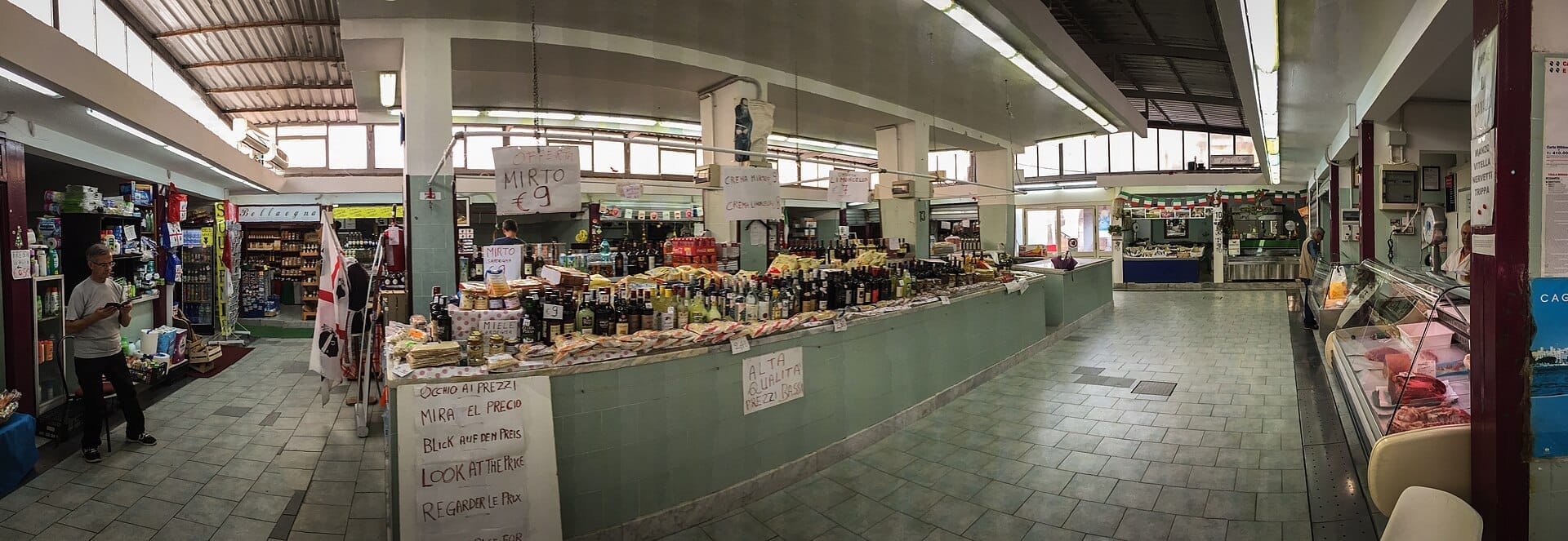
What Is the Mercato di San Benedetto?
The Mercato Civico di San Benedetto is not a tourist attraction in the conventional sense. There are no audio guides, no entrance queues, and no ticket booths. It is a working municipal market where Cagliari residents shop for their daily food, and it happens to be the largest covered market in Italy by surface area, with approximately 8,000 square metres spread across two floors and around 300 stalls in its historic building. That scale alone makes it worth understanding before you arrive.
The market was inaugurated on 1 June 1957, built as part of Cagliari's postwar urban expansion into the San Benedetto quarter. Its design reflected a rational, functional approach to urban food infrastructure: a ground floor dedicated primarily to fish, and an upper floor housing fruit, vegetables, meat, cheese, olives, and dry goods. For decades it served as the city's primary food distribution hub, and despite the rise of supermarkets, it retained a loyal clientele who trust its quality and prefer its rhythms to those of a refrigerated aisle.
⚠️ What to skip
The historic San Benedetto market building on Via Francesco Cocco Ortu remains closed for renovation. Since March 2025, market activities have operated from a temporary structure in Piazza Nazzari, near the Teatro Lirico di Cagliari — still the active location in 2026. Typical hours are Monday to Friday, 07:00–14:00, and Saturday, 07:00–15:00. Verify current conditions via the Comune di Cagliari website before visiting.
The Temporary Market at Piazza Nazzari
The provisional structure in Piazza Nazzari was set up by the municipality to accommodate vendors during the renovation of the historic building. While it lacks the architectural drama of the original two-storey shell, the essential character of the market travels with the traders rather than the building. The fish vendors are still there early in the morning; the cheese and cured meat stalls still draw a line of regulars; the noise, the smells, the narrow passages between laden counters all survive the relocation.
The Piazza Nazzari site is close to the Teatro Lirico di Cagliari, which places it within walking distance of the city centre. From Via Roma or Largo Carlo Felice, you can reach it on foot in around 15 to 20 minutes, or take a CTM city bus toward the San Benedetto or Teatro Lirico stops. The exact bus lines serving this stop are best confirmed on the CTM website or at the local transit offices, as routes are updated periodically.
💡 Local tip
Arrive between 08:00 and 09:30 for the best selection and the most active atmosphere. By 12:30 many stalls begin winding down, and the fish section in particular can look sparse toward closing time.
Tickets & tours
Hand-picked options from our booking partner. Prices are indicative; availability and final rates are confirmed when you complete your booking.
Vineyard Guided Tour and 7 Wine Tasting in Palau
From 84 €Instant confirmationFree cancellationFull-Day Sailboat Tour in La Maddalena Archipelago from Cannigione
From 112 €Instant confirmationFree cancellationHiking excursion to the Devil's Saddle
From 35 €Instant confirmationFree cancellationExcursion to the Archaeological site of Nora
From 70 €Instant confirmationFree cancellation
What You Will Find: A Floor-by-Floor Guide
In the original building, the market operated on a clear two-floor logic: fish below, everything else above. In the temporary Piazza Nazzari structure the layout has been adapted, but vendors retain their specialisations. The fish section remains the anchor. Sardinian waters produce a serious variety: sea bass, bream, red mullet, swordfish in season, and local bottarga (cured grey mullet roe) that you will not find in any supermarket with the same provenance or freshness. The smell here is oceanic and immediate, the ice shaved and gleaming under fluorescent lights.
Move through the produce section and the colour contrast is immediate: pale fennel, deep purple aubergines, the orange-red of ripe tomatoes, bundles of wild herbs whose names vendors will often explain if you show curiosity. Sardinian pecorino in multiple ageing stages, local ricotta, lard cured with rosemary, house-made pasta shapes like malloreddus and lorighittas, jars of artichoke hearts in oil, and an overwhelming assortment of olives occupy the dry and deli stalls. Bottarga is available in both pressed and powdered form; the vendors who specialise in it can advise on which suits cooking versus serving raw.
This is also a practical base for understanding what grows in Sardinia and when. The produce changes meaningfully by season, which connects directly to understanding Sardinian cuisine at its source rather than via a restaurant menu. Visiting in spring, you will see artichokes in abundance; summer brings figs and tomatoes; autumn produces the first local citrus, mushrooms, and pecorino made from milk enriched by late-season grazing.
How the Market Changes Through the Morning
At 07:00 the market opens and the atmosphere is almost professional in its focus. Regular shoppers arrive with purpose, moving directly to known vendors, exchanging brief greetings. Voices carry across the stalls in a mixture of Italian and Sardinian. This first hour belongs to the locals, and if you arrive then you will feel it: there is no performance for outsiders here.
By 09:00 the pace opens up slightly. Vendors have settled into their rhythm and are more likely to engage with a curious visitor, explain what something is, or offer a taste of a cured cheese. This window between roughly 09:00 and 11:00 is arguably the best time for anyone who wants both good selection and a slightly slower pace to ask questions. The light in the covered structure is artificial but bright, making it workable for photography without a flash.
From around 12:00 onward the market begins its gradual close. Fish displays shrink as vendors clear unsold stock. The noise level drops. By 13:30 some stalls are already shuttered. The final thirty minutes before 14:00 can yield discounts on produce, but it is not the time for variety or browsing. If you are cooking for yourself that evening, this late window is useful for saving money on fruit and vegetables; if you want the full experience, come earlier.
Cultural and Historical Context
Markets in Mediterranean cities carry a social function that is distinct from simple commerce. In Cagliari, the San Benedetto market has been a neighbourhood institution for nearly seven decades, and the San Benedetto quarter takes its civic identity in part from the market's presence. The building's 1957 inauguration coincided with a period of rapid postwar urbanisation in Cagliari, as the city expanded beyond its historic hilltop Castello district into planned residential quarters. The market served as the social infrastructure for these new neighbourhoods, a daily gathering point that helped bind a community still forming its identity.
The claim that it is the largest covered market in Italy is made consistently across multiple sources and refers primarily to its surface area (around 8,000 square metres) and historically high vendor count. By those measures, it outscales more famous markets in Rome or Florence, though it operates with far less tourist traffic, which is part of what makes it interesting. For context on Cagliari as a city, the market sits within the broader urban landscape that includes the medieval Castello district and the long seafront of the Poetto beach to the east.
The renovation of the historic building, which began in March 2025, represents a significant moment for the market's future. Such projects carry risk: renovations of historic public markets in Italian cities have in some cases altered the character of the trading environment. Whether the restored building will preserve the density and informality of the original is something only the completed project will reveal. For now, the market continues at Piazza Nazzari with its original vendor community largely intact. If you are planning a broader visit to Cagliari, the market pairs naturally with a morning walk through the city's main streets, followed by the Bastione di Saint Remy for views over the rooftops.
Photography and Practical Tips
The market is photogenic in a genuine rather than staged way: the geometry of stacked fish on ice, the colours of layered produce, the concentration on vendors' faces. Most traders do not object to being photographed if you ask first and show respect for their work. A 35mm or 50mm lens suits the confined spaces well; wide angles tend to distort the human scale. Lighting inside the provisional structure is even if not especially warm in tone.
Bring a reusable bag if you plan to buy. Plastic bags are available but not always offered freely. Cash is the dominant payment method at most stalls, though card readers are increasingly common; do not assume card payment is available without checking. The stalls do not typically provide English-language labelling, but prices are generally displayed clearly and vendors are accustomed to communicating across a language gap using numbers and gestures.
The market is not suitable for visitors with significant mobility limitations without prior research. The provisional structure may lack step-free access throughout; contact the Comune di Cagliari directly for current accessibility information. For a broader orientation to Cagliari and how to structure a visit around the market and other attractions, the day trips from Cagliari guide provides useful context on how to plan your time.
Who Should Skip the Mercato di San Benedetto
If you are not particularly interested in food, local commerce, or urban daily life, the market offers little else to hold attention. There is nothing here oriented toward entertainment or sightseeing in the conventional sense: no views, no architectural flourish visible from outside, no historical artefacts. Travellers whose itinerary is driven by beaches, archaeological sites, or landscape will likely find the time better spent elsewhere.
It is also worth noting that the temporary Piazza Nazzari location lacks the character of the original building. Visitors coming specifically to see an impressive piece of postwar market architecture will be disappointed until the renovation is complete. Those interested in Sardinia's archaeological and natural heritage should focus their Cagliari time on the Museo Archeologico Nazionale or the lagoon at Parco Molentargius instead.
Insider Tips
- Bottarga from San Benedetto vendors is among the best available in Cagliari. Buy it whole rather than pre-grated if you plan to use it within a week or two; the flavour is considerably more complex. Vacuum-packed whole lobes also travel well.
- The fish section early in the morning is where you hear the most Sardinian spoken, particularly among older vendors and regular customers. If you are interested in the language, this is a rare opportunity to hear it in natural use rather than performance context.
- Do not overlook the dried goods and pantry stalls: local honey, myrtle liqueur, jars of preserved artichokes, and bottarga powder make compact and local gifts that are not available in the airport shops at anything close to market price.
- If you want to cook from the market, buy fish in the first hour and produce on your way out. Fish deteriorates quickly in summer heat; carry a cool bag or head directly home. July and August temperatures in Cagliari regularly exceed 30°C by late morning.
- During the renovation period, the market footprint is smaller than usual. Arrive with a specific shopping list if you need particular items, rather than assuming the full vendor range is present. Some specialist stalls may not have relocated to the temporary structure.
Who Is Mercato di San Benedetto For?
- Food travellers who want to shop for, cook, or simply understand Sardinian ingredients at source
- Photographers interested in documentary or street-style images of working urban life
- Self-catering visitors based in Cagliari who want quality local produce at local prices
- Travellers curious about how a Mediterranean city operates outside its tourist-facing spaces
- Anyone building an itinerary around Sardinian cuisine and wanting a grounding in what is seasonal and local
Nearby Attractions
Other things to see while in Cagliari:
- Anfiteatro Romano di Cagliari
The Roman Amphitheatre of Cagliari is the most significant Roman monument in Sardinia, partially carved into the limestone hillside of Colle di Buoncammino. With a capacity estimated at 10,000 spectators, it dates to the late 1st or early 2nd century AD. Ongoing restoration limits what you can explore, but the scale of the structure and its setting repay the modest entrance fee.
- Bastione di Saint Remy
Standing at the southern edge of the Castello district, the Bastione di Saint Remy is a monumental Belle Époque terrace that offers some of the most commanding views in Cagliari. Free to enter and, as a public terrace, generally accessible at all hours, it rewards visitors who time their ascent right — especially at dusk, when the city lights begin to compete with the last colour in the sky.
- Castello District
Perched about 100 metres above sea level on a fortified limestone hill, the Quartiere Castello is the oldest and most historically layered part of Sardinia's capital. Enclosed by 13th-century Pisan walls, it holds the city's cathedral, major museums, and some of the best rooftop views in the Mediterranean. Entry is free, and the streets can be walked at any hour.
- Cattedrale di Santa Maria (Cagliari)
Rising above the Castello quarter on Piazza Palazzo, the Cattedrale di Santa Maria e Santa Cecilia is Cagliari's most important religious monument. First documented in the mid‑13th century and remodelled across several centuries, it layers Pisan Romanesque, Gothic, Baroque, and Neo-Romanesque styles into a single compelling structure. Entry is free, and the interior rewards anyone willing to look closely.