Sella del Diavolo: Hiking Cagliari's Devil's Saddle
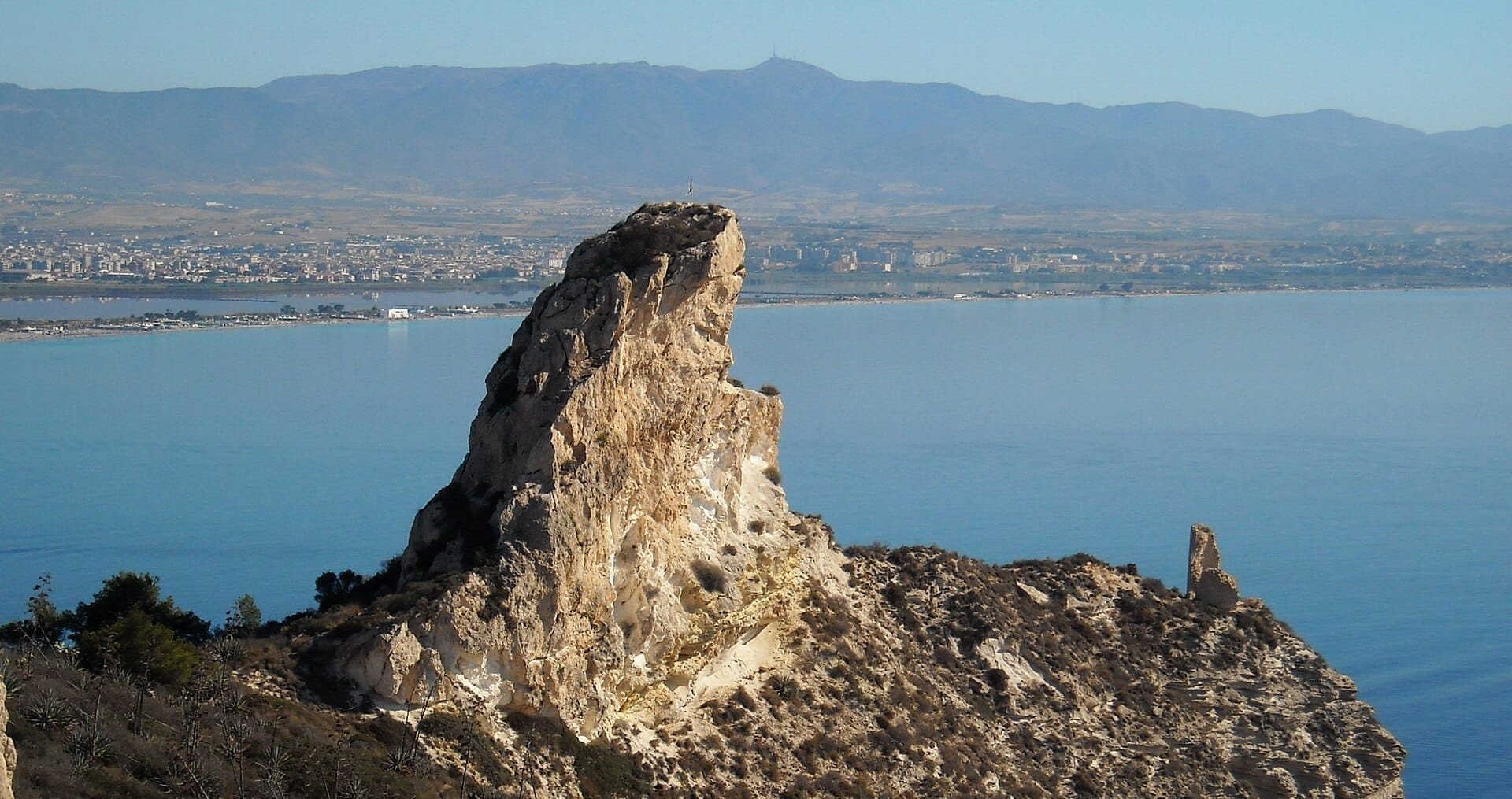
Sella del Diavolo, or Devil's Saddle, is a limestone promontory rising above Cagliari's southeastern coastline, separating the long arc of Poetto Beach from the calmer waters of Calamosca. A short hike rewards visitors with panoramic views over the Gulf of Angels, a landscape occupied by humans since the Neolithic, and one of the most striking natural formations within reach of any Italian regional capital.
Quick Facts
- Location
- Viale Calamosca, 09126 Cagliari, Sardinia — southeastern tip of the Sant'Elia promontory
- Getting There
- CTM bus line 11 toward Calamosca (other CTM lines 5 and 5/11 also serve the area); the main trailhead starts near Calamosca beach, while another path begins near Marina Piccola
- Time Needed
- 2–3 hours for the round trip, including time at the summit viewpoint
- Cost
- Free — no entrance ticket required. Guided tours available via private operators at their own rates
- Best for
- Sunset views, casual hikers, history enthusiasts, photographers, and anyone based in Cagliari with a free morning
- Official website
- cagliariturismo.comune.cagliari.it/en/vivicagliari/devils-saddle
What Is Sella del Diavolo?
Sella del Diavolo, which translates to Devil's Saddle in English, is a dramatic limestone promontory forming the southeastern boundary of Cagliari's coastline. It sits at the southern end of the Sant'Elia headland, dividing the long sandy sweep of Poetto Beach to the east from the smaller, sheltered bay of Calamosca to the west. From a distance, the ridge line does loosely resemble a saddle, and local legend gives this shape a vivid backstory: the Devil himself is said to have lost his saddle here while fleeing from the Archangel Michael during a heavenly battle over the beautiful Gulf of Angels below.
The geology is relatively young in the grand scheme of things. The promontory is composed primarily of Miocene sedimentary rock, formed within the last 20 million years, with a surface texture that shifts from pale limestone to earthy ochre depending on the light. The rock is riddled with small caves and hollows, and this is not accidental: those cavities were frequented by human communities from Neolithic times. Archaeological evidence of Neolithic settlement has been found across the site, making the Sella del Diavolo one of the oldest continuously significant places in the entire Cagliari area.
ℹ️ Good to know
Access to the Sella del Diavolo promontory and its hiking trails is completely free. There are no entrance gates or ticket booths, and access is not controlled by fixed opening hours, though visitors typically use the trails during daylight for safety.
The Hike: What to Expect on the Trail
The main trail begins near Calamosca beach, just past the small hotel that sits at the water's edge. The path is unpaved but well-trodden, a mix of compacted dirt, loose gravel, and occasional bare limestone underfoot. The ascent is gradual at first, cutting through low Mediterranean scrub: rosemary, cistus, and lentisk that brush against your legs and release a faint herbal scent when disturbed. The air here carries a particular quality in the mornings, sea salt mixing with the dry vegetation in a way that feels distinctly Sardinian.
The trail gains elevation steadily, and within 15 to 20 minutes you begin to clear the vegetation line and open up onto rockier ground with the first real views. Both Poetto Beach and Calamosca appear below, and on clear days the coastline extends far enough that you can pick out the distant coastline of southern Sardinia to the southwest, including prominent headlands on clear days. The full ascent to the main viewpoint near the summit takes most walkers between 30 and 45 minutes at a relaxed pace. The path does involve uneven rocky sections and some mild scrambling near the top, so footwear with grip matters more than it might seem from the trailhead.
The summit area is not marked by any formal structure. There is no viewing platform or fence. The reward is simply the space itself: a wide limestone shelf with a near-360-degree outlook, wind-scoured and quiet except for whatever breeze is coming off the sea. Cagliari's urban spread fills the view to the northwest, with the lagoon of Molentargius visible as a flat, reflective strip behind the Poetto shoreline.
💡 Local tip
Wear closed-toe shoes with a grip sole. The rock surface near the top is slippery when wet, and sandals or smooth-soled shoes are risky in places. Bring at least half a litre of water per person in warm months — there are no water sources along the trail.
Tickets & tours
Hand-picked options from our booking partner. Prices are indicative; availability and final rates are confirmed when you complete your booking.
Cagliari small-group boat escape to Sella del Diavolo with swim stops
From 0 €Instant confirmationFree cancellationGuided Tasting of Sardinian Food and Drink Delicacies
From 48 €Instant confirmationFree cancellationSanta Teresa di Gallura hiking tour of Valle della Luna
From 30 €Instant confirmationFree cancellationCala Goloritze, Mariolu, Gabbiani, Biriala, Grotta del Fico boat tour
From 69 €Instant confirmationFree cancellation
Best Time to Visit and How the Experience Changes
The Sella del Diavolo is worth visiting year-round, but the experience varies considerably by season and time of day. Early morning in spring and autumn, specifically between late April and early June and again from September through October, offers the clearest light, the most manageable temperatures, and the fewest other hikers. The vegetation is greener in spring, the wildflowers are out, and the sea below catches the low morning sun in a way that makes the Gulf of Angels look almost implausibly blue.
Sunset visits are popular with locals and reward patience with extraordinary light over the gulf. However, note that the descent after dark on an unlit dirt trail is not trivial, so factor in enough daylight for your return. In July and August, midday temperatures on exposed limestone can be punishing, reaching above 35°C on the rock surface. If you visit in summer, go early, before 8:30 in the morning, or wait until at least 5 in the afternoon.
Winter visits are underappreciated. The air is clear, the trail is often deserted, and the views extend further than in the heat haze of summer. Average highs in Cagliari from December through February sit around 14 to 15°C, which is comfortable hiking weather. The main risk is wet rock: a spell of autumn rain leaves the limestone treacherous, so check the weather before going.
The Sella del Diavolo makes an excellent half-morning addition to a broader day in the city. For more on structuring time in the area, the day trips from Cagliari guide covers how to combine this with other destinations further afield.
Historical and Cultural Context
The promontory has been significant to successive human populations for millennia. Neolithic communities carved out and occupied the natural caves in the limestone from around the 6th millennium BC, drawn by the defensive position, proximity to the sea, and access to fresh water sources in the surrounding area. The Sant'Elia headland, of which Sella del Diavolo is the southernmost point, sits at the entrance to what was historically an important stretch of the Sardinian coast, and later populations including Phoenicians, Carthaginians, and Romans all passed through or settled in the wider Cagliari area.
The legend of the devil losing his saddle here is one of those local myths that has proven durable precisely because the landscape supports it so well. The saddle silhouette is clearest when viewed from the sea or from the Poetto beachfront, and the story connects this unusual rock formation to the broader Sardinian tradition of associating dramatic natural features with supernatural explanations.
If Sardinia's deep prehistoric past interests you, the promontory pairs well contextually with the island's broader Nuragic heritage. The Sardinia Nuragic sites guide covers the Bronze Age civilization that followed these Neolithic settlements, and several sites are accessible from Cagliari as day trips.
Getting There from Cagliari
The most straightforward public transport option is CTM bus line 11, which runs from central Cagliari toward Calamosca, with additional CTM routes 5 and 5/11 (on Sundays) also reaching the area. The journey takes roughly 20 to 30 minutes depending on traffic and where you board. Get off at the Calamosca stop and the trailhead is a short walk from the beach. Schedules and fares are managed by CTM (Consorzio Trasporti e Mobilità) and should be checked directly on their official site before your visit, as times and routes are subject to seasonal changes.
By car, the access road via Viale Calamosca brings you to the southern base of the promontory where limited parking is available near the beach. In July and August, this small parking area fills early. Cycling from the Poetto beachfront is a realistic option if you are staying in that part of the city; the flat coastal stretch to Calamosca is easy, and you can lock a bike at the base before ascending on foot.
The wider Cagliari area is best navigated with some understanding of how the city connects to its coastline. The Cagliari destination guide covers the city's layout, transport options, and key neighbourhoods in more detail.
Photography and Practical Details
The viewpoint at the top is one of the better urban panorama spots in all of southern Sardinia, and it is almost entirely free of the crowds that would gather at an equivalent viewpoint in a more touristy city. Poetto Beach stretches for roughly 8 kilometres to the north, and on a clear day the lagoon of Molentargius behind it is visible as a separate, calmer body of water. The view south over Calamosca is more intimate: a small bay with turquoise water and almost no development behind it.
For photography, the golden hour before sunset produces the most dramatic results, particularly in late spring and early autumn when the sun drops over the hills behind Cagliari rather than directly into the sea. A wide-angle lens or phone shot captures the double-beach panorama well from the summit. Bring sun protection regardless of season: above the vegetation line there is no shade.
Accessibility is limited to those who are comfortable on uneven terrain. Official sources do not list any wheelchair-accessible routes, and the trail involves sections of exposed rock and loose ground that make it unsuitable for pushchairs or mobility aids. The walk along the base near Calamosca beach is flat and accessible, however, and offers partial views of the promontory from below without requiring any ascent.
⚠️ What to skip
There are no facilities at the trailhead or on the trail: no toilets, no water, no shade, and no phone reception in some sections. Plan accordingly, particularly in summer.
Is It Worth the Time?
For most visitors in Cagliari with even a half-morning to spare, yes. The trail is short enough that it does not require committing a full day, the access is free, and the views justify the modest effort required. It is not a wilderness experience in any serious sense; the city is visible the whole time and you can hear traffic at the lower section of the trail. But the summit itself feels removed from the urban environment in a way that is disproportionate to the time it takes to reach.
That said, if you have already done serious hiking elsewhere in Sardinia, particularly in the interior or along the eastern coast, the Sella del Diavolo will feel gentle to the point of being mild. It is an accessible natural landmark, not an adventurous climb. Manage expectations accordingly and it delivers reliably.
Cagliari's wider coastline beyond the Sella del Diavolo is worth understanding before you plan your days. Poetto Beach lies directly to the north of the promontory and is easy to combine with a morning hike on the same outing.
Insider Tips
- The best viewpoint for photographing the saddle shape itself is from the Poetto beachfront looking south, not from the summit. If you want the iconic silhouette shot, walk toward the Marina Piccola end of Poetto and look back toward the promontory.
- Local guided night hikes are offered by private operators on summer evenings, particularly around the full moon. These are a different experience, with the city lights of Cagliari reflecting across the Gulf of Angels below. Search for operators via Sardegna Turismo or ask at your accommodation.
- The Calamosca beach at the base of the trail is smaller and far less crowded than Poetto, and the water quality there is consistently good. Bringing a bag to swim after the hike extends the outing into a full morning without needing to travel anywhere else.
- If you arrive by bus, the stop for Calamosca puts you slightly past the main trailhead. Walk back along the road toward the small hotel on the water and you will see the path begin on the inland side of the road, marked by foot traffic rather than official signage.
- Spring visits in late April and May bring wildflowers along the lower sections of the trail, particularly yellow-flowered oxalis and pink cistus. This is the most photogenic the vegetation gets, and temperatures at that time of year typically sit around the low 20s °C at midday.
Who Is Sella del Diavolo For?
- Travellers based in Cagliari looking for an active morning that does not require a car or full-day commitment
- Photographers wanting a free, crowd-light panoramic viewpoint over the Gulf of Angels
- History and archaeology enthusiasts interested in Neolithic-era Sardinia and the Sant'Elia promontory's long human past
- Families with older children (10+) who are comfortable on uneven terrain and want a short trail with a clear visual reward
- Off-season travellers visiting Cagliari in winter or shoulder season who want outdoor time without beach crowds
Nearby Attractions
Other things to see while in Cagliari:
- Anfiteatro Romano di Cagliari
The Roman Amphitheatre of Cagliari is the most significant Roman monument in Sardinia, partially carved into the limestone hillside of Colle di Buoncammino. With a capacity estimated at 10,000 spectators, it dates to the late 1st or early 2nd century AD. Ongoing restoration limits what you can explore, but the scale of the structure and its setting repay the modest entrance fee.
- Bastione di Saint Remy
Standing at the southern edge of the Castello district, the Bastione di Saint Remy is a monumental Belle Époque terrace that offers some of the most commanding views in Cagliari. Free to enter and, as a public terrace, generally accessible at all hours, it rewards visitors who time their ascent right — especially at dusk, when the city lights begin to compete with the last colour in the sky.
- Castello District
Perched about 100 metres above sea level on a fortified limestone hill, the Quartiere Castello is the oldest and most historically layered part of Sardinia's capital. Enclosed by 13th-century Pisan walls, it holds the city's cathedral, major museums, and some of the best rooftop views in the Mediterranean. Entry is free, and the streets can be walked at any hour.
- Cattedrale di Santa Maria (Cagliari)
Rising above the Castello quarter on Piazza Palazzo, the Cattedrale di Santa Maria e Santa Cecilia is Cagliari's most important religious monument. First documented in the mid‑13th century and remodelled across several centuries, it layers Pisan Romanesque, Gothic, Baroque, and Neo-Romanesque styles into a single compelling structure. Entry is free, and the interior rewards anyone willing to look closely.