Orto Botanico di Cagliari: Ancient Valley, Living Collection
Tucked into the Palabanda Valley between Cagliari's Roman Amphitheatre and the Stampace district, the Orto Botanico dell'Università di Cagliari is a 5-hectare garden holding around 2,000 plant species. Inaugurated in 1866, it combines serious botanical science with one of the city's most peaceful green spaces.
Quick Facts
- Location
- Viale Sant'Ignazio da Laconi 9–11, Stampace district, Cagliari
- Getting There
- Within walking distance of Cagliari's historic centre; closest CTM bus stops are on Viale Buon Cammino and Viale Fra Ignazio
- Time Needed
- 1.5 to 2.5 hours for a relaxed visit; longer if you add the museum or guided tour
- Cost
- €4 standard entry; €2 reduced. Guided tour packages from €6 (€3 reduced). Children under 6 free.
- Best for
- Plant lovers, history enthusiasts, families seeking shade, quiet midday escape from the city
- Official website
- http://www.ortobotanicoitalia.it/sardegna/cagliari/
What Is the Orto Botanico di Cagliari?
The Orto Botanico dell'Università di Cagliari — formally the Hortus Botanicus Karalitanus — is a working university botanical garden occupying roughly 5 hectares in the natural depression of the Palabanda Valley. It sits at the foot of the same limestone ridge that holds the Roman Amphitheatre, and its entrance on Viale Sant'Ignazio da Laconi places it squarely within walking distance of Cagliari's oldest neighbourhoods.
Unlike many botanical gardens that feel like manicured city parks, this one has a slightly wilder, more scientific personality. The collection comprises around 2,000 plant species, with roughly 600 trees and 550 shrubs. Mediterranean flora forms the backbone of the collection, but there are dedicated sections for succulents, tropical species, and plants of ethnobotanical interest. For anyone already exploring the nearby Roman Amphitheatre or the Castello district, folding in an hour at the garden costs almost nothing and adds real depth to a day in the city.
💡 Local tip
The garden is closed on Mondays. Hours change with the seasons: April–October 09:00–18:00 (Tuesday–Sunday and holidays); November–March 09:00–14:00 (Tuesday–Sunday and holidays). Guided tours may also be arranged on Mondays by appointment. Always confirm times before visiting via the official HBK site.
History and Scientific Context
The garden was inaugurated in 1866 under the direction of Professor Patrizio Gennari, who established it as part of the University of Cagliari's natural sciences faculty. The location was not accidental: the Palabanda Valley offered a natural microclimate sheltered from the city's summer winds, and the presence of pre-existing Roman-era water infrastructure in the area made irrigation more feasible.
Over 150 years later, the garden still belongs to the university and functions as a genuine research and teaching resource, not just a public amenity. It houses a seed bank and a small natural history museum, both of which are accessible through the higher-tier ticket packages. The research mission is visible in how the garden is laid out: beds are labelled with Latin nomenclature, plant families are grouped logically, and the general aesthetic prioritises botanical legibility over Instagram aesthetics.
The valley itself carries layers of history that predate the garden by centuries. Archaeological remains have been documented on the slopes, and the proximity to the Roman Amphitheatre is a reminder that this part of Cagliari was occupied long before the university existed. Visitors curious about that deeper timeline should also consider the Museo Archeologico Nazionale di Cagliari, which holds much of what has been excavated in and around the city.
Tickets & tours
Hand-picked options from our booking partner. Prices are indicative; availability and final rates are confirmed when you complete your booking.
Gulf of Cagliari kayak tour
From 72 €Instant confirmationFree cancellationCagliari Sunset Boat Tour With Prosecco, Focaccia and Swimming
From 75 €Instant confirmationFree cancellationSmall Group Tour to Su Nuraxi Unesco Site From Cagliari
From 90 €Instant confirmationFree cancellationCagliari Small Group Tour by Minibus
From 85 €Instant confirmationFree cancellation
What You Will Actually See
The valley descends gently from the entrance, and the first section you encounter holds the Mediterranean collection: holm oaks, strawberry trees, cistus, rosemary stands, and several species of Sardinian endemic plants. The air here carries a faintly resinous, herb-like quality, especially on warm mornings when the sun hits the lower scrub. It smells like the Sardinian macchia itself.
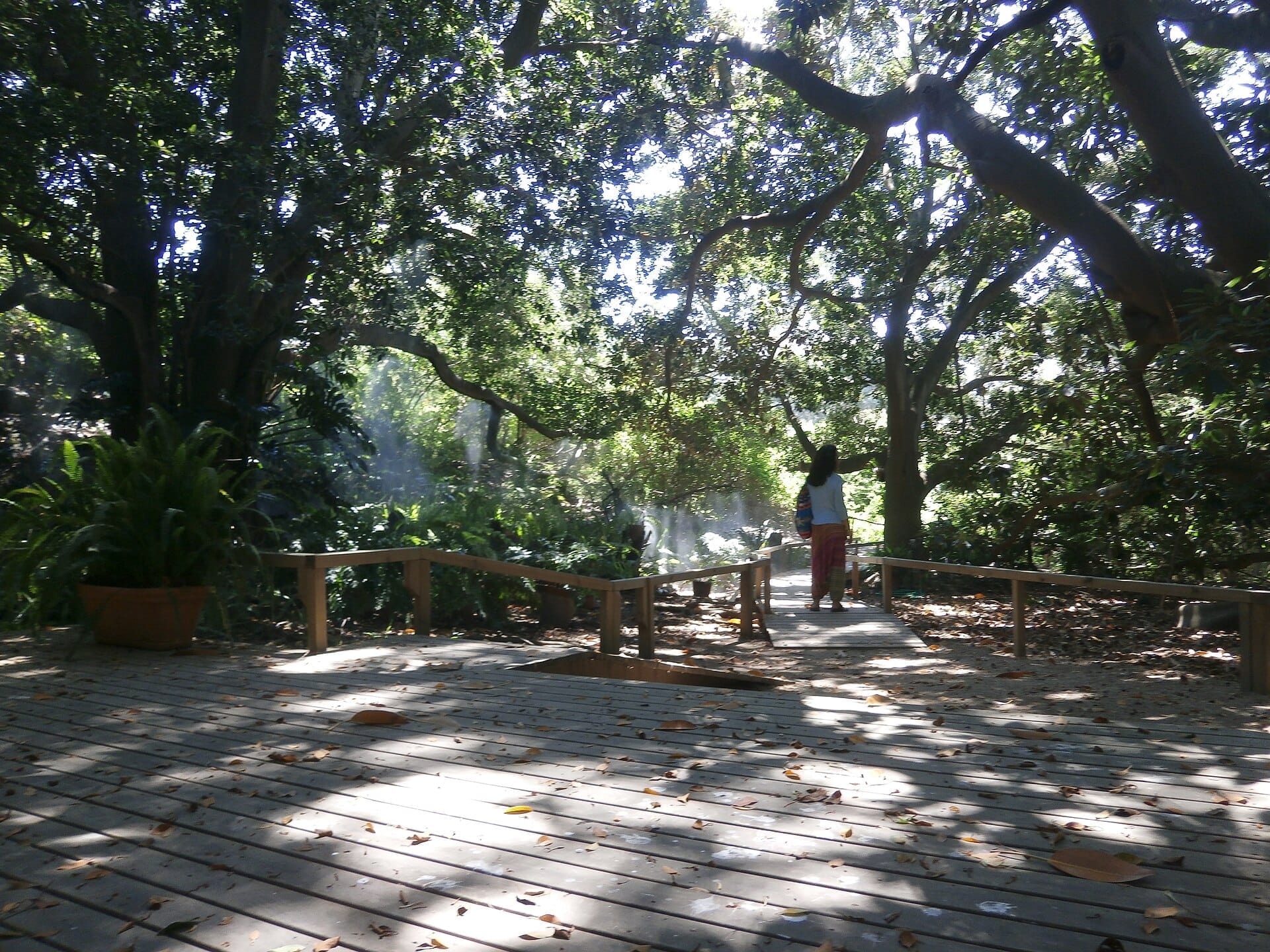
Moving deeper into the garden, the canopy thickens. Large Ficus species, Washingtonia palms, and various exotic introductions shade the central paths. The textures shift noticeably: rough-barked conifers give way to the waxy smoothness of succulent leaves, and in the cactus section the geometry becomes almost architectural. Benches are placed regularly along the main paths, and this is where you will often find locals eating lunch or reading in the shade during the hotter months.
The museum is housed in a small building within the garden and contains botanical collections, herbarium specimens, and natural history materials connected to the university's research. It is not a large or particularly theatrical museum, but it rewards visitors with a specific interest in natural history and Sardinian flora. Access requires one of the combined ticket packages.
ℹ️ Good to know
Ticket options: €4 entry only; €6 entry + guided garden tour; €8 entry + guided tour + museum; €10 entry + guided tour + museum + seed bank. Reduced prices (roughly half) apply to children aged 6–18 (on all ticket types). University of Cagliari students who have paid their fees and university technical-administrative and teaching staff on official teaching or research visits enter free; people with disabilities and one accompanying person also enter free.
How the Experience Changes by Time of Day and Season
Morning visits, particularly before 11:00, are consistently the best. The light in the valley is soft and directional, picking out the texture of bark and leaves cleanly. Bird activity is high — the garden attracts a range of urban-edge species, and the sound of sparrows and blackbirds overlaps with the distant hum of Cagliari's streets in a way that reinforces the sense of being in a protected pocket of calm.
By midday in July and August, the garden earns its reputation as a refuge. Temperatures inside the canopy run several degrees cooler than the surrounding city streets. The downside is that afternoon light in summer is flat and harsh for photography, and some paths in the open succulent sections offer little shade. If you are visiting in peak summer, come early and plan to leave before 13:00.
Spring is the strongest season overall. From March through May, the garden shows its full colour range: flowering shrubs, fresh foliage, and the Mediterranean section at its most aromatic. Autumn brings a quieter beauty, with the garden thinning out and the low-angle light excellent for photography. Winter visits are short by necessity (the garden closes at 14:00 from November through March), but the garden is rarely crowded and the skeletal forms of the larger trees are worth seeing.
Practical Walkthrough: Getting There and Getting Around
The garden's address is Viale Sant'Ignazio da Laconi 9–11, in the Stampace district. It is walkable from several central Cagliari landmarks: roughly 10 minutes on foot from Piazza Yenne, and a similar distance from the Roman Amphitheatre entrance. CTM city buses serve the surrounding streets; the stops on Viale Buon Cammino and Viale Fra Ignazio are the most useful.
If you are combining this with a broader day in Cagliari, a logical sequence runs from the Castello district downhill through the Stampace neighbourhood to the garden, then continues to Piazza Yenne for lunch or coffee. The entire loop is comfortable on foot.
Terrain matters here. The garden occupies a natural valley and the paths range from level gravel tracks to steeper, less even sections on the slopes. The university's own documentation notes that parts of the garden are steeply inclined and uneven. People using wheelchairs or pushchairs can access the lower central sections, but the full circuit involves gradients and surfaces that may be difficult. No official step-free route map is published, so it is worth contacting the garden directly if accessibility is a significant concern.
⚠️ What to skip
Wear comfortable shoes with grip. Some paths on the valley slopes are steeply inclined and can be slippery after rain. This is not a flat park stroll.
Photography and Practical Tips
The garden is a strong photography subject, but it rewards patience more than speed. The best single frames tend to come from the contrast between the lush canopy and the limestone outcrops on the valley walls, particularly in morning light. The succulent and cactus section works well in direct midday light when it would otherwise be a poor time for photography elsewhere. Macro photography of flowers and bark texture is consistently rewarding throughout the season.
Bring water in summer. The garden has limited food or drink facilities, and the nearest cafes are a 5-10 minute walk away in the Stampace neighbourhood. There are shaded benches where you can rest, but no on-site cafe as of the last known information. Children generally enjoy the garden well: the winding paths, unusual plant forms, and the general sense of exploration hold attention for longer than might be expected.
For those interested in Sardinia's broader natural heritage, the botanical garden fits into a wider picture of the island's ecological diversity. The hiking trails across Sardinia traverse many of the same plant communities you see labelled here, which can make a garden visit surprisingly useful preparation for time in the field.
Who Should Consider Skipping This
Visitors with only one or two days in Cagliari and a primary interest in beaches, nightlife, or the main historical monuments may find the garden a lower priority. It is not a spectacle. There are no grand fountains, no formal parterres, and no dramatic architecture to photograph. If your benchmark for a good afternoon is visual drama or urban energy, the garden will disappoint.
Those with significant mobility difficulties should also approach with realistic expectations. The combination of uneven paths, slopes, and the absence of a published accessible route makes the full experience difficult for anyone who cannot manage uneven terrain. The lower, central sections are more accessible, but a complete visit may not be possible.
Insider Tips
- Book a guided tour when purchasing tickets at the gate rather than separately online. The guides are typically university researchers or graduate students and give context you will not find on any signage.
- The seed bank visit, included in the €10 ticket, is rarely mentioned in general travel guides but is interesting if you have any background in botany, conservation, or agriculture. Groups of more than two often get an extended explanation.
- If you arrive in spring and want to identify Sardinian wild plant species you have encountered while hiking, the Mediterranean section is essentially a labelled field guide in living form. Bring notes from your walks.
- The valley walls on the eastern side of the garden catch the last of the afternoon light in autumn and winter, creating warm, low-angle conditions that are excellent for wide-angle shots of the garden layout.
- The garden shares its neighbourhood with the Roman Amphitheatre and several early Christian sites. Combining all three in a single half-day is feasible on foot and gives a more complete picture of how this part of Cagliari has been used across different eras.
Who Is Orto Botanico di Cagliari For?
- Botanists and plant enthusiasts who want to identify Mediterranean and Sardinian endemic species with proper labelling
- Families with children who need a break from the heat and a change of pace from beach and city sightseeing
- Photographers looking for textural, natural subjects and a contrast between cultivated and wild aesthetics
- Travellers following a history-focused itinerary who want to connect Roman-era Cagliari with its natural landscape
- Anyone spending multiple days in Cagliari who wants a quiet, unhurried morning activity
Nearby Attractions
Other things to see while in Cagliari:
- Anfiteatro Romano di Cagliari
The Roman Amphitheatre of Cagliari is the most significant Roman monument in Sardinia, partially carved into the limestone hillside of Colle di Buoncammino. With a capacity estimated at 10,000 spectators, it dates to the late 1st or early 2nd century AD. Ongoing restoration limits what you can explore, but the scale of the structure and its setting repay the modest entrance fee.
- Bastione di Saint Remy
Standing at the southern edge of the Castello district, the Bastione di Saint Remy is a monumental Belle Époque terrace that offers some of the most commanding views in Cagliari. Free to enter and, as a public terrace, generally accessible at all hours, it rewards visitors who time their ascent right — especially at dusk, when the city lights begin to compete with the last colour in the sky.
- Castello District
Perched about 100 metres above sea level on a fortified limestone hill, the Quartiere Castello is the oldest and most historically layered part of Sardinia's capital. Enclosed by 13th-century Pisan walls, it holds the city's cathedral, major museums, and some of the best rooftop views in the Mediterranean. Entry is free, and the streets can be walked at any hour.
- Cattedrale di Santa Maria (Cagliari)
Rising above the Castello quarter on Piazza Palazzo, the Cattedrale di Santa Maria e Santa Cecilia is Cagliari's most important religious monument. First documented in the mid‑13th century and remodelled across several centuries, it layers Pisan Romanesque, Gothic, Baroque, and Neo-Romanesque styles into a single compelling structure. Entry is free, and the interior rewards anyone willing to look closely.