Piazza Yenne: Cagliari's Central Square and Social Crossroads
Piazza Yenne sits at the convergence of Cagliari's four historic districts, anchored by a statue of King Carlo Felice and framed by cafe terraces. Free and open around the clock, it works equally well as a starting point for a walking tour or a place to pause over an espresso and watch the city move.
Quick Facts
- Location
- Piazza Yenne, 09124 Cagliari, Sardinia — at the intersection of Corso Vittorio Emanuele II and Via Manno, top of Largo Carlo Felice
- Getting There
- Walkable from the Marina district and most of central Cagliari; CTM city buses serve surrounding streets
- Time Needed
- 15–30 minutes to absorb the square itself; 2–3 hours if using it as a base for exploring the surrounding historic center
- Cost
- Free — public square, open 24 hours
- Best for
- Orientation walks, people-watching, coffee stops, and connecting to Cagliari's historic districts
What Piazza Yenne Actually Is
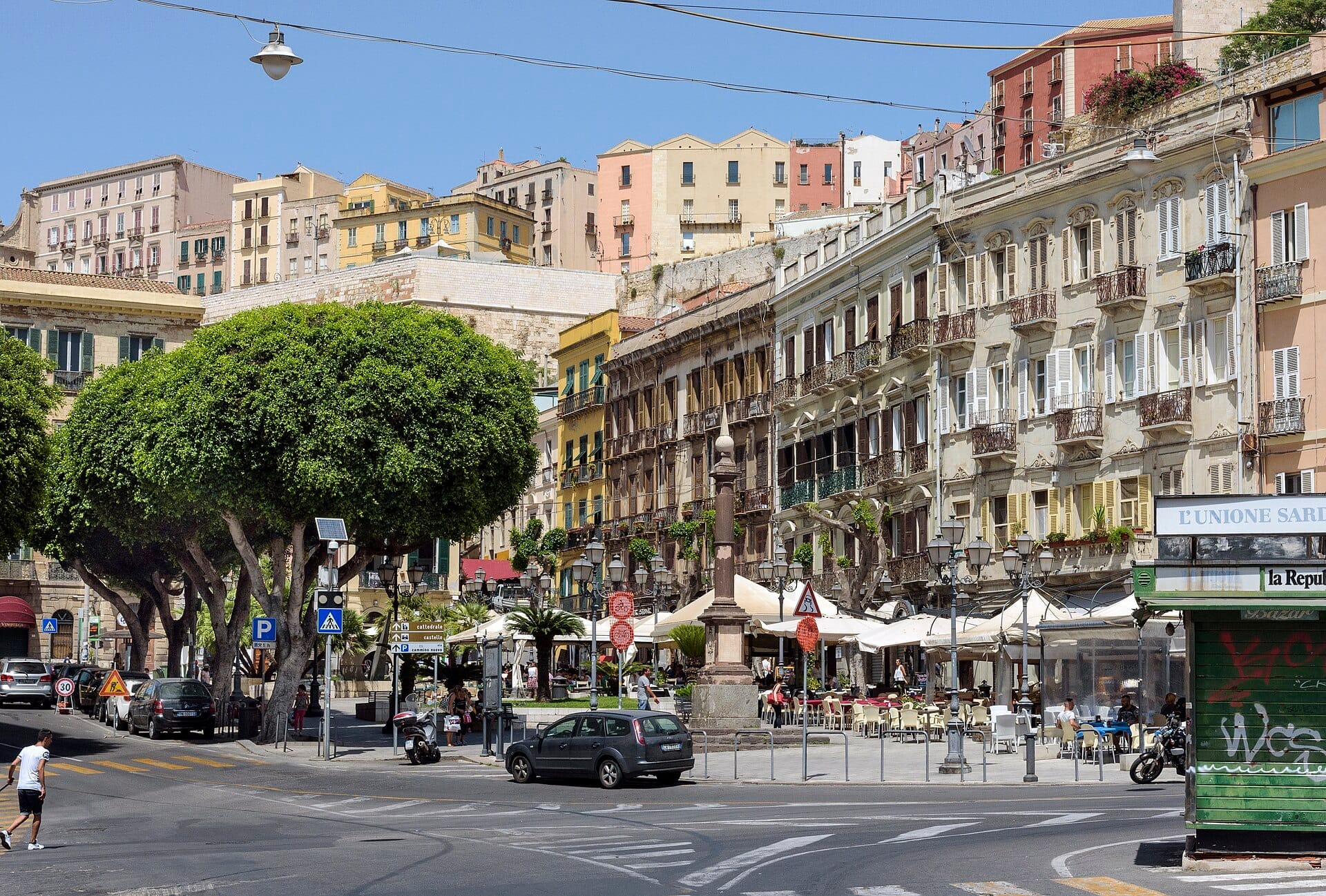
Piazza Yenne is a compact, flat urban square positioned at the geographic and social center of Cagliari's historic core. It marks the upper end of Largo Carlo Felice, the city's grand processional boulevard, and sits at the top of Largo Carlo Felice where Corso Vittorio Emanuele II meets Via Manno and other streets — meaning almost every foot journey through central Cagliari passes through or alongside it.
The square is anchored by a statue of King Carlo Felice, which carries a specific historical weight beyond mere decoration: it marks the symbolic starting point of the SS131, the trunk road that runs the length of Sardinia from Cagliari north to Sassari. Standing in front of that statue, you're at the traditional starting point of the island's main artery.
The square is often described as the point where Cagliari's four historic districts converge, which makes it the most useful single landmark for orientation. The Castello district rises steeply to the northeast, the Marina neighborhood stretches toward the port, Stampace extends to the west, and Villanova lies beyond. If you're spending more than a day in Cagliari, you will pass through Piazza Yenne repeatedly.
💡 Local tip
Piazza Yenne is the most reliable meeting point in central Cagliari. If you're joining a walking tour, coordinating with other travelers, or simply need a landmark to return to, this square works better than any other in the city center.
History Behind the Name
The square was originally known as Piazza San Carlo. It was later renamed to honor the Marquis Ettore Veuillet d'Yenne, a Savoyard viceroy who played a direct role in the square's development during the period of Piedmontese rule over Sardinia. The renaming reflects the complex layering of political administrations that shaped Cagliari's urban fabric — Spanish, Savoyard, and eventually unified Italian — each leaving architectural and toponymic traces across the city.
The statue of Carlo Felice, King of Sardinia from 1821 to 1831, was placed here as a statement of Savoyard authority. Carlo Felice was the monarch under whom the SS131 road was commissioned and began construction, which explains why the road bears his name and why the statue was positioned at its symbolic starting point. The king is depicted pointing in the direction of Sassari, a detail that rewards a second glance.
Tickets & tours
Hand-picked options from our booking partner. Prices are indicative; availability and final rates are confirmed when you complete your booking.
Gulf of Cagliari kayak tour
From 72 €Instant confirmationFree cancellationCagliari Sunset Boat Tour With Prosecco, Focaccia and Swimming
From 75 €Instant confirmationFree cancellationSmall Group Tour to Su Nuraxi Unesco Site From Cagliari
From 90 €Instant confirmationFree cancellationCagliari Small Group Tour by Minibus
From 85 €Instant confirmationFree cancellation
The Experience at Different Times of Day
Early morning, roughly 7 to 9am, Piazza Yenne belongs to locals. Bar counters inside the surrounding cafes fill with workers ordering a quick espresso standing up, the Italian way. The square itself is quiet, the light is low and warm, and the stone underfoot is cool. This is the version of the square you won't see in any promotional photograph, and it's arguably the most honest.
By mid-morning the square shifts into tourist mode. Walking tour groups gather near the Carlo Felice statue, guided by someone holding an umbrella or a small flag. Visitors photograph the statue and the view down Largo Carlo Felice toward the port. The cafe terraces start filling up. The noise level rises noticeably as Via Manno, a largely pedestrianized shopping street, fills with foot traffic.
The late afternoon and early evening slot, from around 5pm to 8pm, produces the square at its most lively. This is the passeggiata hour. Cagliari residents stroll along Corso Vittorio Emanuele II and through the square in the Italian tradition of the evening walk. Couples occupy the terrace seats. Teenagers cluster near the statue. The light at this hour, especially in spring and autumn, catches the ochre and pale stone of the surrounding buildings at a flattering angle.
ℹ️ Good to know
In peak summer (July and August), midday at Piazza Yenne is uncomfortably hot. Temperatures in Cagliari can exceed 32°C, the square has limited shade, and most locals avoid it between noon and 4pm. Plan accordingly: visit in the morning or evening during summer months.
What You'll See: Architecture and Layout
The square itself is modest in scale — more of a widened intersection than a grand piazza in the Roman or Florentine mold. What gives it presence is its position: the long perspective down Largo Carlo Felice draws the eye toward the port, and the climb toward Castello is visible immediately to the northeast. The surrounding buildings are in good condition, predominantly late 18th and early 19th century in style, with shuttered windows and wrought-iron balconies typical of Cagliari's historic center.
Via Manno, which opens off the square, is worth walking for a few hundred meters. It is one of Cagliari's main pedestrian shopping streets, lined with independent boutiques, chain stores, and more cafe terraces. It connects Piazza Yenne to Piazza Costituzione, where the Bastione di Saint Remy's monumental staircase provides access up into the Castello district.
For context on the broader walk from here, the Bastione di Saint Remy is roughly a 5-minute walk from Piazza Yenne and offers the most dramatic elevated view over the city and harbor. It is one of the logical next stops after pausing here.
Using Piazza Yenne as a Walking Tour Base
Most visitors do not spend long in Piazza Yenne itself. Its real value is as a starting point and recurring reference. From here, three distinct walks are immediately accessible: up into Castello, along the Marina waterfront toward the port, or westward into Stampace and toward the archaeological museum.
If you are planning a structured day, one efficient route starts at Piazza Yenne in the morning, climbs through Castello to see the cathedral and city walls, descends via the Bastione di Saint Remy for the panoramic views, and then walks south through the Marina to reach the Museo Archeologico Nazionale in the Cittadella dei Musei. This loop covers the essential historic center in a half-day without backtracking.
For context on what to prioritize across Cagliari, the day trips from Cagliari guide is useful for understanding how the city fits into a wider itinerary across Sardinia.
💡 Local tip
The bar terraces immediately surrounding Piazza Yenne are more expensive than spots a block or two away. If you want a coffee at a fair local price, step into any of the bars on Via Manno or Corso Vittorio Emanuele II and order at the counter rather than sitting outside.
Practical Details for Your Visit
Piazza Yenne is a public square with no admission fee and no opening hours. It is accessible around the clock. The surface is paved and flat, making it generally accessible for strollers and wheelchairs, though specific step-free routes through the surrounding streets should be confirmed locally, as some of the connecting historic lanes involve kerbs and uneven surfaces.
There is no on-site parking at the square; Cagliari's historic center has restricted traffic zones. Visitors arriving by car should use peripheral parking areas and approach on foot or by CTM city bus. The square is within comfortable walking distance of the main port ferry terminal and the Marina neighborhood, making it easy to reach from most central accommodations.
Photography works well at several points in the day. The view down Largo Carlo Felice toward the port with the morning light coming from the east is clean and graphic. The Carlo Felice statue photographs best in late afternoon when the low sun catches the bronze. In high summer, the midday glare from pale paving stones makes exposure difficult and the scene aesthetically flat.
Is It Worth Your Time?
Piazza Yenne is not a destination in itself. There is no single spectacle to see, no museum to enter, no paid experience. Travelers who arrive expecting a grand square on the scale of, say, Piazza Navona in Rome will find it underwhelming. The space is compact and the architecture, while pleasant, is not exceptional.
What it offers instead is something harder to find in tourist-heavy cities: a genuine, functioning piece of urban life. The mix of locals going about their day and visitors passing through creates an atmosphere that feels unrehearsed. For anyone spending time in Cagliari, Piazza Yenne is simply where the city happens, and that is enough to make it worth at least passing through deliberately rather than by accident.
Visitors who want to understand Cagliari more deeply should read about things to do in Sardinia to place the city within the broader island context, particularly if Cagliari is only one stop on a longer trip.
Insider Tips
- The Carlo Felice statue's pointing gesture is not just decorative. The king is pointing northwest toward Sassari, the direction the SS131 road travels. It is a useful real-world compass bearing if you are orienting yourself in the city.
- Bar terraces directly on the square charge a sitting surcharge. Walk 50 meters down Via Manno and you will pay significantly less for the same espresso — and you can still watch the square from a side table.
- The passeggiata hour (roughly 6 to 8pm) is the most social time at Piazza Yenne, but it is also when Via Manno gets congested. If you want to walk that street without weaving through crowds, go in the morning.
- Walking tour guides frequently use the Carlo Felice statue as a meeting point because it is the most identifiable object in the square. If you are not joining a tour, be aware that clusters of people near the statue are likely waiting for a guide rather than looking at the monument.
- In winter, Piazza Yenne gets cold and damp in the evenings. The cafe interiors are far more pleasant than the terraces from November through February, and you will find them occupied almost exclusively by locals.
Who Is Piazza Yenne (Cagliari) For?
- First-time visitors to Cagliari who need a central landmark for orientation
- Travelers who enjoy urban people-watching over a coffee at the passeggiata hour
- Walking tour participants, as almost every historic center tour starts or passes through here
- Anyone connecting the Marina, Castello, and Stampace districts on foot in a single day
- Photographers looking for the classic perspective down Largo Carlo Felice toward the port
Nearby Attractions
Other things to see while in Cagliari:
- Anfiteatro Romano di Cagliari
The Roman Amphitheatre of Cagliari is the most significant Roman monument in Sardinia, partially carved into the limestone hillside of Colle di Buoncammino. With a capacity estimated at 10,000 spectators, it dates to the late 1st or early 2nd century AD. Ongoing restoration limits what you can explore, but the scale of the structure and its setting repay the modest entrance fee.
- Bastione di Saint Remy
Standing at the southern edge of the Castello district, the Bastione di Saint Remy is a monumental Belle Époque terrace that offers some of the most commanding views in Cagliari. Free to enter and, as a public terrace, generally accessible at all hours, it rewards visitors who time their ascent right — especially at dusk, when the city lights begin to compete with the last colour in the sky.
- Castello District
Perched about 100 metres above sea level on a fortified limestone hill, the Quartiere Castello is the oldest and most historically layered part of Sardinia's capital. Enclosed by 13th-century Pisan walls, it holds the city's cathedral, major museums, and some of the best rooftop views in the Mediterranean. Entry is free, and the streets can be walked at any hour.
- Cattedrale di Santa Maria (Cagliari)
Rising above the Castello quarter on Piazza Palazzo, the Cattedrale di Santa Maria e Santa Cecilia is Cagliari's most important religious monument. First documented in the mid‑13th century and remodelled across several centuries, it layers Pisan Romanesque, Gothic, Baroque, and Neo-Romanesque styles into a single compelling structure. Entry is free, and the interior rewards anyone willing to look closely.