Palacio Lapido: Montevideo's Art Deco Landmark on 18 de Julio
Completed in 1933 and declared a National Historic Monument, Palacio Lapido is one of the most distinctive buildings on Montevideo's main avenue. Its curved balconies, expressive tower, and layered history make it a rewarding stop for anyone walking through the city center — no ticket required.
Quick Facts
- Location
- Av. 18 de Julio 948–950, esq. Río Branco, Centro, Montevideo
- Getting There
- Multiple urban bus lines stop on Av. 18 de Julio; roughly a 10-minute walk from Plaza Independencia
- Time Needed
- 15–30 minutes for the exterior and ground-floor gallery; longer if combined with a guided architecture tour
- Cost
- Free to view exterior and enter ground-floor commercial gallery when shops are open
- Best for
- Architecture enthusiasts, urban photographers, visitors doing a Centro walking route
What Is Palacio Lapido?
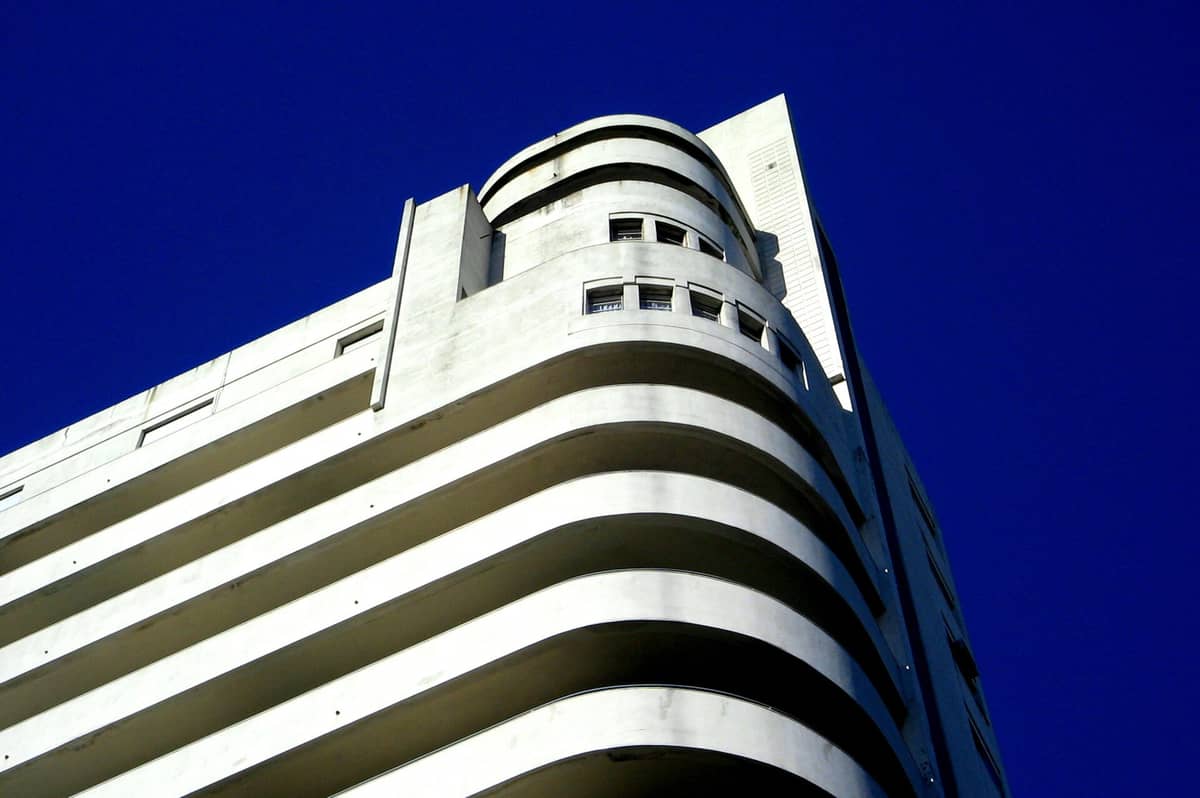
Palacio Lapido — also known as Edificio Lapido or, historically, Palacio de la Tribuna Popular — stands at the corner of Avenida 18 de Julio and Río Branco in Montevideo's Centro neighborhood. Designed by architects Juan María Aubriot and Ricardo Valabrega and completed in 1933, it belongs to a remarkable generation of buildings that reshaped Montevideo's skyline during a decade of confident modernism. Uruguay declared it a Monumento Histórico Nacional (National Historic Monument), recognition that places it among the country's formally protected architectural heritage.
The building was conceived as a genuine mixed-use tower for its era: the ground floor and lower levels housed commercial premises and the editorial offices of the newspaper La Tribuna Popular, while upper floors contained apartments, offices, and an auditorium. That layered program is still visible today in the building's current use as a mix of shops, apartments, and offices — a working building, not a museum piece.
ℹ️ Good to know
Palacio Lapido is not a museum with fixed opening hours. The exterior can be observed at any time of day. The ground-floor commercial gallery is accessible when its shops are open, typically during standard business hours on weekdays and Saturdays. There is no admission fee.
The Architecture: Art Deco with an Expressive Edge
What sets Palacio Lapido apart from its neighbors on 18 de Julio is its façade treatment. The design sits at the intersection of early modernism and Art Deco expressionism: the building's mass is broken by a series of curved balconies that wrap the corners in horizontal bands, softening what could have been a severe vertical tower. The surface modeling is deliberate and dense — there are no empty stretches of blank wall. Light at different times of day catches the relief differently, making it worth pausing at more than one hour if you have the time.
The tower volume rises above the base with a clear vertical emphasis, then terminates in a sculpted crown that reads well from a distance. In the morning, when the sun hits the 18 de Julio façade directly, the horizontal balcony bands cast sharp shadows that amplify the building's three-dimensional quality. By late afternoon, the light shifts to warmer tones and the curved corners become more prominent. Photographers working in black and white will find the contrast particularly rewarding in mid-morning light.
Aubriot and Valabrega were working during what Uruguayan architectural historians describe as the Década del 30, a period when Montevideo produced a concentration of modern buildings that still define the Centro streetscape. Palacio Lapido is one of the most formally ambitious of these, and it rewards close reading. For context on the broader architectural fabric of the city, the Montevideo architecture guide covers the key buildings and styles across different eras.
Tickets & tours
Live prices and dates from our booking partner. If you book, we may earn a commission at no extra cost to you.
Guided Tour with Wine Tasting Experience at Bouza Winery
From 68 €Instant confirmationFree cancellationAirport to Hotel or Hotel to Airport Transfer in Montevideo
From 47 €Instant confirmationFree cancellationTasting and Lunch at Bodega Pizzorno in Montevideo
From 115 €Instant confirmationFree cancellationPunta del Este full-day guided tour from Montevideo
From 47 €Instant confirmationFree cancellation
Visiting the Exterior: What to Expect on the Ground
The corner of 18 de Julio and Río Branco is one of the busier intersections in the Centro. During weekday mornings and early afternoons, the pavement fills with office workers, students, and shoppers moving along the avenue. The building itself is not set back from the street — it rises directly from the sidewalk, which means the base is always in motion with pedestrian traffic. If you want a clear photograph of the full tower without people, early weekend mornings offer the quietest window.
Standing across the avenue gives the best full-building view, but the sidewalk directly below the façade is where the decorative detail becomes legible. The texture of the lower floors, the rhythm of the balcony railings, and the quality of the original stonework are all visible at close range. Look up at the corner curve — the way the balconies follow the building's bend is the most technically interesting element of the design.
💡 Local tip
Cross to the opposite side of Av. 18 de Julio to photograph the full tower. From the sidewalk directly below, you only see the lower floors. A position roughly 30–40 meters east or west along the avenue gives the best unobstructed angle for the full height.
The Ground-Floor Gallery and Interior Access
The ground-floor commercial gallery is a covered passage that connects the street-level shops running through the base of the building. Entering it gives a sense of the original ground-floor program: the ceiling height, the proportions of the arcade, and the decorative details of the interior structure are all consistent with the building's 1930s character. Individual shops come and go over time, so the specific tenants will vary depending on when you visit.
Access to the upper floors — apartments, offices, or any former auditorium spaces — is not available to general visitors. Palacio Lapido functions as a private residential and commercial building. Occasional guided architecture tours organized by local cultural associations may include interior access; these are announced through Montevideo's municipal tourism channels and local cultural organizations rather than through the building itself. If interior access matters to you, it is worth checking with tour operators before your visit rather than arriving and expecting to be admitted.
Visitors with mobility limitations should note that no official accessibility statement for the building's visitor areas has been published. The exterior is entirely street-level and poses no particular access challenges, but anyone requiring step-free or adapted access to the gallery should confirm the current situation directly with shops inside. For broader navigation advice around Centro, the guide to getting around Montevideo includes useful context on public transport and pedestrian routes in the area.
Palacio Lapido in Context: The 18 de Julio Walking Route
The building sits at a natural midpoint along the 18 de Julio corridor between Plaza Independencia to the west and Parque Batlle to the east. Walking this avenue with architectural attention reveals how many significant buildings from the 1920s and 1930s survive in varying states of repair. Palacio Lapido is among the best-maintained of these, which makes the contrast with some of its neighbors instructive as much as the building itself.
If you are combining Palacio Lapido with a broader Centro or Ciudad Vieja itinerary, the Ciudad Vieja walking tour is a logical companion route that covers the historic district immediately to the west. The two areas connect at Plaza Independencia, making it straightforward to move between them in a single morning.
Other significant architecture stops within easy walking distance include Palacio Salvo on Plaza Independencia — the building that arguably defined Montevideo's early skyscraper ambition — and the Palacio Piria in Ciudad Vieja. Together, these buildings form a coherent picture of the architectural ambitions that shaped the city center across roughly three decades.
Honest Assessment: Is It Worth Your Time?
Palacio Lapido is not an attraction you spend an afternoon at. It is a building you look at carefully for fifteen minutes, photograph, and carry with you as a reference point for understanding what Centro was supposed to be in the 1930s. The payoff is real but proportionate — this is a stop on a route, not a destination in itself.
Visitors who find architectural detail unrewarding, or who are working through a tight schedule focused on museums and experiences rather than streetscapes, can reasonably skip it. The building cannot be entered beyond the ground-floor shops, and there is no interpretive signage, guided audio, or visitor infrastructure of any kind. What it offers is purely visual and contextual.
For anyone with a genuine interest in early 20th-century South American modernism, or for urban photographers looking for textured façades and strong formal geometry, it is one of the better stops in this part of the city. The combination of Art Deco ornament, expressionist massing, and a still-functioning mixed-use program is rare in buildings of this age.
⚠️ What to skip
Weather affects the experience more than you might expect. On overcast days, the façade's relief detail flattens significantly and the building reads as more monolithic than it actually is. A clear morning with direct sun is when Palacio Lapido looks its best.
Insider Tips
- Weekend mornings before 10:00 are the quietest time on this stretch of 18 de Julio. If you want to photograph the building without pedestrian traffic crowding the foreground, Saturday morning is your best option.
- The curved corner at Río Branco is the most photographed angle, but the lateral façade along Río Branco itself — looking up from close range — shows the balcony stacking more clearly and is less commonly seen in images of the building.
- Local architecture tours organized through Montevideo's municipal tourism office and cultural associations occasionally include interior access to Palacio Lapido. These tours are announced through Montevideo's official tourism channels and are not bookable through the building directly.
- If you are visiting several of Centro's 1930s buildings in one route, do Palacio Lapido before Palacio Salvo rather than after — the scale difference becomes more interesting in that direction, moving from the textured mid-rise to the larger tower on the plaza.
- The ground-floor gallery can feel humid and dim on overcast days. The building's interior character is much better appreciated on visits when the gallery has natural light filtering through the entrance from the avenue.
Who Is Palacio Lapido For?
- Architecture enthusiasts with an interest in Art Deco and early 20th-century South American modernism
- Urban photographers seeking strong geometric façades and textural detail
- Travelers doing a structured Centro walking route who want to understand the avenue's architectural history
- History-minded visitors curious about Montevideo's press history and the building's original role as home to La Tribuna Popular newspaper
- Anyone with limited time who wants a free, no-commitment stop that rewards close observation
Nearby Attractions
Other things to see while in Centro:
- Auditorio Nacional del SODRE
The Auditorio Nacional Adela Reta is Uruguay's most important performing arts venue, a 25,000-square-metre complex in central Montevideo that reopened in 2009 after decades of reconstruction. Home to the SODRE symphony orchestra, ballet, and opera, it draws serious music lovers and curious visitors alike.
- Cementerio Central
Inaugurated in 1835, the Central Cemetery of Montevideo is one of South America's most architecturally rich burial grounds. Free to enter and loaded with marble mausoleums, neo-Gothic chapels, and the graves of presidents and artists, it rewards those willing to look slowly.
- Estadio Centenario
Built for the 1930 FIFA World Cup and declared a Monument of World Football, Estadio Centenario is one of the most historically significant sports venues in the Americas. The on-site Uruguayan Football Museum makes it worth visiting even on non-match days.
- Mirador de la Intendencia
The Mirador Panorámico de la Intendencia de Montevideo sits on the 22nd floor of the city's main municipal building, offering unobstructed 360-degree views across the capital, the Río de la Plata, and the surrounding neighbourhoods. Entry is completely free, but you need to book a slot in advance. Here is everything you need to plan a visit.
Planning a trip? Discover personalized activities with the Nomado app.