Palacio Piria: Montevideo's Most Dramatic Courthouse
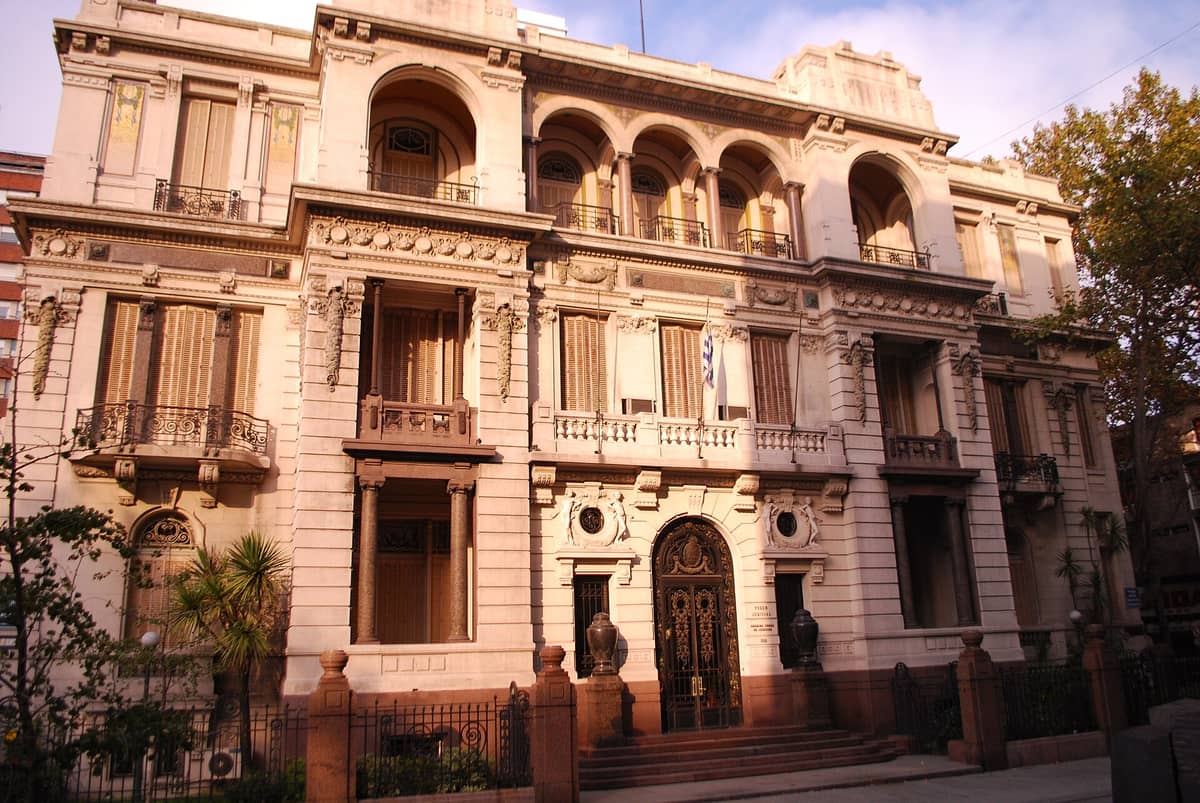
Built in 1917 for real estate magnate Francisco Piria, Palacio Piria is a commanding example of eclectic French-influenced architecture in the heart of Montevideo's Centro. Today it serves as the seat of Uruguay's Supreme Court of Justice, making it an active government building rather than a conventional tourist attraction. Its ornate facade on Plaza Cagancha is one of the most photographed streetscapes downtown.
Quick Facts
- Location
- Pasaje de los Derechos Humanos 1310, Centro, Montevideo
- Getting There
- Multiple bus lines along Avenida 18 de Julio; a short walk from Plaza Independencia
- Time Needed
- 15–30 minutes for the exterior; longer if interior access is granted
- Cost
- Free to view from outside; interior access is unconfirmed and subject to judicial authority conditions
- Best for
- Architecture enthusiasts, history buffs, and urban walkers doing a Centro circuit
- Official website
- http://www.poderjudicial.gub.uy/palacio-piria.html
What Palacio Piria Actually Is
Palacio Piria is not a palace in the royal sense and not a museum you book tickets for in advance. It is a working courthouse, specifically the headquarters of Uruguay's Supreme Court of Justice, housed in one of Montevideo's most architecturally striking early 20th-century buildings. Understanding this distinction upfront saves a lot of confusion on the ground.
The building was commissioned by Francisco Piria, one of the most influential entrepreneurs in Uruguay's late 19th and early 20th century. Piria made his fortune in real estate and tourism development, founding the coastal resort town of Piriápolis and leaving his name on several landmarks. His Montevideo residence, with construction begun in 1916 and completed in 1917 from a design by French architect Camille Gardelle, was intended as an urban statement: a grand private palace on a prominent downtown square.
The building sits on Plaza Cagancha, also known as Plaza Libertad, one of the city's main civic squares in the Centro neighborhood. Its position on the square means the facade is visible from across the plaza, and the surrounding streetscape gives it room to breathe in a way that many of Montevideo's older buildings, wedged into narrow colonial blocks, simply don't get.
⚠️ What to skip
Interior access is not guaranteed for general visitors. The building operates as an active judicial institution with security controls. Do not assume you can walk in freely. Contact the Poder Judicial (www.poderjudicial.gub.uy) in advance to ask about guided or public visits.
The Architecture: What to Look For on the Facade
The exterior of Palacio Piria is the main event for most visitors, and it rewards careful looking. Gardelle's design draws on the eclectic tradition that dominated elite South American civic and residential architecture in the early 1900s: French Second Empire influences combined with Italianate decorative detailing, all scaled up to make an impression from across a public square.
The facade is particularly notable for its symmetry and vertical emphasis. The roofline features mansard-style elements that gesture toward Parisian architecture, while the window surrounds, pilasters, and sculptural ornaments at key intervals give the surface texture and rhythm. It reads as confident and composed rather than excessive, which places it in a different register from the theatrical Palacio Salvo a few blocks away on Plaza Independencia.
If you are making a broader study of Montevideo's layered urban architecture, Palacio Piria belongs on the same itinerary as the Palacio Salvo and the Palacio Lapido. Together, these three buildings chart the stylistic ambitions of Montevideo's early 20th-century construction boom. The Montevideo architecture guide covers these connections in detail.
Photography works best in the morning when light falls on the main facade from the east. By midday the square gets direct overhead sun, which flattens the sculptural detail. Late afternoon can produce interesting shadows across the ornamental elements if you position yourself from the western side of Plaza Cagancha.
Tickets & tours
Live prices and dates from our booking partner. If you book, we may earn a commission at no extra cost to you.
Guided Tour with Wine Tasting Experience at Bouza Winery
From 68 €Instant confirmationFree cancellationAirport to Hotel or Hotel to Airport Transfer in Montevideo
From 47 €Instant confirmationFree cancellationTasting and Lunch at Bodega Pizzorno in Montevideo
From 115 €Instant confirmationFree cancellationPunta del Este full-day guided tour from Montevideo
From 47 €Instant confirmationFree cancellation
Francisco Piria: The Man Behind the Building
Francisco Piria's story is inseparable from the building's character. He was a Uruguayan entrepreneur of Italian descent who built a commercial empire across real estate speculation, port commerce, and resort development. He founded Piriápolis on the Atlantic coast as a planned resort town and developed large tracts of Montevideo's urban land. By the time he commissioned this palace in 1916, he was one of the most recognizable figures in Uruguayan business life.
The choice of a French architect and a design that signals Parisian influence was deliberate. At the turn of the 20th century, elite Latin American clients regularly looked to France as the prestige reference point for architecture, fashion, and culture. Building in this idiom was a statement of cosmopolitan standing. That Piria chose a prominent square in the commercial downtown rather than a quieter residential street also says something about his desire for visibility.
The building passed into state hands after Piria's death and eventually became the seat of the Supreme Court, a use that has continued to the present day. That transition from private palace to the republic's highest judicial institution gives Palacio Piria an interesting symbolic weight that most architecture guides underplay.
Visiting the Exterior: The Plaza Cagancha Context
Plaza Cagancha itself is worth spending time on. It is a working downtown square: office workers eat lunch on the benches, vendors operate along the edges, and the surrounding streets carry dense pedestrian and bus traffic along Avenida 18 de Julio. It is not a manicured heritage precinct. It feels lived-in and busy, which makes the formal grandeur of Palacio Piria's facade all the more striking by contrast.
On weekday mornings the square is active early, with commuters passing through from around 8am. By 10am the rhythm settles into mid-morning commercial activity. Weekend mornings are noticeably quieter, which can be pleasant if you want to photograph the building without crowded foregrounds, though some service activity around the judicial building may still occur even on Saturdays.
The walk from Plaza Independencia to Plaza Cagancha along Avenida 18 de Julio takes around ten minutes on foot and passes through the core of Montevideo's Centro district. This stretch is dense with commercial activity and additional architecture worth noting, from early modernist office buildings to Art Deco shopfronts.
💡 Local tip
The best unobstructed view of the full facade is from the northwestern corner of Plaza Cagancha, where you get the building at a slight angle that shows both the main elevation and the roofline profile. Bring a wider lens if you are shooting with a camera; the building's height and the square's width make standard primes feel cramped.
Interior Access: What Is and Is Not Known
No official public visiting schedule or ticketed entry system is published for Palacio Piria. The building operates under the administration of the Poder Judicial, Uruguay's judicial branch, and access is subject to the security and operational protocols of an active government institution. Some visitors have reported being able to enter the main hall during working hours on a casual basis, but this is not a reliable or consistent policy.
For anyone seriously interested in seeing the interior, the most practical approach is to contact the Poder Judicial directly through their official website before arriving in Montevideo. Institutional or guided visits may be possible with advance arrangement, particularly for architectural or educational groups. Attempting to walk in without prior contact is likely to result in being stopped at security.
If interior access is not possible during your visit, this is not a significant loss in terms of the building's main appeal. The architecture makes its strongest argument from the outside, and the surrounding urban context is the actual experience most visitors take away.
How It Fits Into a Centro Walking Circuit
Palacio Piria works best as part of a broader afternoon in the Centro neighborhood rather than as a standalone destination. A practical circuit combines it with the Palacio Salvo and Plaza Independencia, then continues along 18 de Julio toward Plaza Cagancha and returns via the side streets parallel to the main avenue, which tend to have quieter commercial activity and older building stock worth looking at.
If you are combining Centro with a visit to Ciudad Vieja, the Ciudad Vieja walking tour connects naturally to this area, as the two neighborhoods share a border just west of Plaza Independencia. The full walk from Ciudad Vieja's waterfront end to Plaza Cagancha is around 30 to 40 minutes at a comfortable pace, with stops.
Weather matters for this kind of urban walking. Montevideo's Centro offers almost no shade on the main avenues in summer, and midday temperatures between December and February regularly reach 28°C or above. Plan architecture walks for the morning or late afternoon in summer. In winter (June to August), temperatures are mild enough for comfortable walking throughout the day, though brief rain is possible in any month.
Who Should and Should Not Make the Trip
Palacio Piria is genuinely rewarding for anyone with a serious interest in early 20th-century South American architecture, in the history of Uruguayan urban development, or in the story of Francisco Piria as a figure who shaped the country's landscape. The building is also worth seeing for photographers working on a visual survey of Montevideo's Centro streetscape.
Travelers looking for an interactive experience, a museum narrative, or something to occupy children will find little here. There is no exhibition, no visitor orientation, and no guarantee of interior access. If your time in Montevideo is limited to one or two days, Palacio Piria is probably not the highest priority unless architecture is a primary interest. The facade can be seen as part of a walking route without dedicating specific time to it.
Insider Tips
- The building's reflection appears in the glass storefronts on the southern side of Plaza Cagancha on clear mornings, giving an alternative compositional angle for photography without requiring you to cross to the building itself.
- Weekday mornings around 9am to 10am tend to see a small flow of people entering and leaving the judicial offices. Observing this rhythm gives a real sense of the building as a functioning institution rather than a heritage set piece.
- If you want to understand Piria's broader ambitions as a developer, research his other project, Piriápolis, before visiting. Seeing the palace in the context of his coastal resort town makes both places more intelligible.
- The side elevations of the building, visible from the streets flanking Plaza Cagancha, show different aspects of the facade composition and are often less photographed. They are worth a quick look if you are circling the square.
- Avenida 18 de Julio between Plaza Independencia and Plaza Cagancha has several architectural details on upper floors that most pedestrians miss entirely. Walk it slowly with your eyes above shop-front level.
Who Is Palacio Piria For?
- Architecture enthusiasts studying early 20th-century eclectic and French-influenced design in South America
- Urban walkers doing a comprehensive circuit of Montevideo's Centro district
- Photographers building a visual record of Montevideo's historic streetscapes
- Travelers with an interest in Francisco Piria and Uruguay's history of real estate and resort development
- History and law researchers interested in the physical seat of Uruguay's Supreme Court
Nearby Attractions
Other things to see while in Centro:
- Auditorio Nacional del SODRE
The Auditorio Nacional Adela Reta is Uruguay's most important performing arts venue, a 25,000-square-metre complex in central Montevideo that reopened in 2009 after decades of reconstruction. Home to the SODRE symphony orchestra, ballet, and opera, it draws serious music lovers and curious visitors alike.
- Cementerio Central
Inaugurated in 1835, the Central Cemetery of Montevideo is one of South America's most architecturally rich burial grounds. Free to enter and loaded with marble mausoleums, neo-Gothic chapels, and the graves of presidents and artists, it rewards those willing to look slowly.
- Estadio Centenario
Built for the 1930 FIFA World Cup and declared a Monument of World Football, Estadio Centenario is one of the most historically significant sports venues in the Americas. The on-site Uruguayan Football Museum makes it worth visiting even on non-match days.
- Mirador de la Intendencia
The Mirador Panorámico de la Intendencia de Montevideo sits on the 22nd floor of the city's main municipal building, offering unobstructed 360-degree views across the capital, the Río de la Plata, and the surrounding neighbourhoods. Entry is completely free, but you need to book a slot in advance. Here is everything you need to plan a visit.
Planning a trip? Discover personalized activities with the Nomado app.